

NTx Files IPO Prospectus Following $60M+ in Funding to Advance Cell-Free Platforms for mRNA and Protein Synthesis

Nature's Toolbox
Innovative Therapy Developer
On November 16, 2023, Nature’s Toolbox (hereinafter referred to as “NTx”), a life sciences and bioinformatics company, announced that it had secured $47.5 million in Series B financing led by RA Capital Management. Anzu Partners, the lead investor in its Series A round, and long-term investor Blue Stone Venture Partners also participated in this funding round. The proceeds will continue to support the development of NTx’s cell-free biosynthesis platforms, NTxpress and NTxscribe, advancing technologies for protein and mRNA synthesis.
To date, NTx has completed three rounds of financing, totaling over $60 million. In addition to the $47.5 million raised in this Series B round, this includes a $339,000 grant from the New Mexico Economic Development Department’s Job Training Incentive Program (JTIP) and $13 million from Anzu Partners’ Series A financing.
Alex Koglin, the founder of NTx, graduated from Goethe University Frankfurt and completed his postdoctoral research at Harvard Medical School. He specializes in bioinformatic analysis of natural product biosynthetic clusters. During his tenure as an Oppenheimer Fellow at Los Alamos National Laboratory (LANL), he developed two compounds with potential for tuberculosis (TB) vaccine development.
In 2015, Dr. Koglin took an entrepreneurial leave from LANL and co-founded Nature's Toolbox with Dr. Michael Humbert, aiming to develop and commercialize tuberculosis treatments based on the two antibiotic compounds he created during his tenure at Los Alamos.
Dr. Michael Humbert also earned his Ph.D. from Goethe University Frankfurt and worked alongside Dr. Koglin at Los Alamos National Laboratory. He primarily focused on vaccine design and antibody development, creating diagnostic antibodies for blood tests. Their unique insights and strong professional synergy led them to join forces and establish NTx, laying the foundation for NTx’s future cell-free (CF) biosynthesis platform by developing compounds that mimic the initial collaborative mechanisms of enzymes within cells.
Subsequently, with the outbreak of the COVID-19 pandemic, it was discovered that essential enzymatic compounds could be utilized within this system to develop mRNA vaccines, shifting the fight against COVID-19 into the epidemic phase and laying the foundation for the future commercial development of NTx vaccines.


(Image source: NTX official website)
Biosynthesis is the process of synthesizing substances essential for the growth and proliferation of living organisms, including the biosynthesis of proteins, nucleic acids, and nucleotides. There are two types of systems: intracellular expression systems and cell-free synthesis systems. The advantage of cell-free (CF) biosynthesis lies in its independence from refrigeration and complex cold-chain logistics, enabling more efficient on-demand protein production and accelerating vaccine development.
Compared with cell-based expression, cell-free (CF) biosynthetic systems are characterized by flexibility, high efficiency, and environmental friendliness. They require a smaller facility footprint, eliminate the need for dedicated infrastructure for each strain, can be scaled up throughout the commercialization process, and reduce production costs.
NTx also took some detours—initially employing traditional cell-free biosynthesis production technology. This technique involves removing active cellular components, such as long-chain DNA, and freeze-drying the remaining material. The dried material is then rehydrated with water, nucleic acids are added to program the molecular machinery, thereby enabling the synthesis of unlimited quantities of target proteins.
However, the challenges are also evident: it requires large-scale production and entails extremely high technical costs. Issues include limited stability of biological enzymes, reduced ATP regeneration (leading to energy loss and short operational durations), diminished efficiency due to residual metabolic activities (such as nucleotide and amino acid cycling), protein artifacts caused by the presence of cellular nucleases and proteases, and codon usage dependency.
Since then, NTx has begun seeking a more cost-effective technology—"in vitro synthetic biology.",Specifically, a cell-free synthesis process in which recombinases with greater stability are used to replace cell extracts.
Leveraging in vitro synthetic biology, NTx developed a recombinant continuous-flow method, which served as the “precursor” to the NTxpress technology platform. With the emergence of large-scale epidemics, the team quickly recognized the importance of its system and complemented the first platform with a second one, NTxscribe, which utilizes transcription (the first step in protein translation) to produce mRNA-based products.
Compared with extract-based cell-free expression, the platform increases final product concentration (>7 g/L), improves NTP conversion efficiency, and enhances DNA template utilization with reduced T7 polymerase usage. It also enables the synthesis of poly(A) tails longer than 150 nt, eliminating the need for Oligo-dT affinity chromatography.achieving up to 85% mRNA integrity.Even saRNA with a genome length greater than 11 kb can undergo transcription with high integrity.
NTx has pioneered a fully reconstituted, continuous-flow, cell-free transcription system using hollow-fiber bioreactors, enabling capping and tailing modifications to be completed in a continuous flow. This approach reduces material loss and production time between processing steps. Furthermore, all enzymes designed for the platform are equipped with affinity tags, allowing for continuous capture and washing throughout all processing stages.
Today, the company is leveraging itsCell-free (CF) BiologySynthesisThe NTxpress and NTxscribe platforms synthesize biopharmaceuticals in an environmentally friendly and sustainable manner, scaling up the application of small-molecule drugs to the commercial production of therapeutic agents.
·NTxpress: Currently the only fully recombinant cell-free expression platform, it is an isothermal, stable, and robust in vitro transcription and translation system that can be used to synthesize proteins while minimizing unnecessary cellular metabolism.
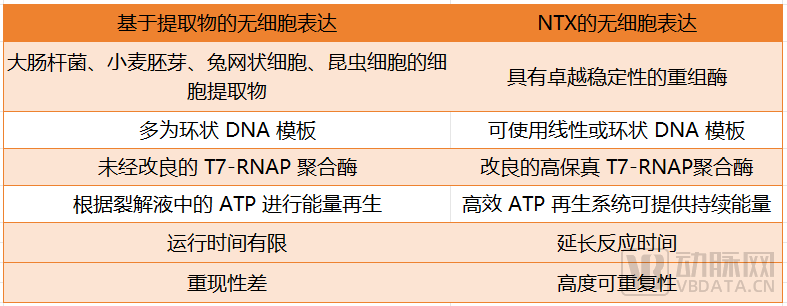
Comparison Table of Extract-Based Cell-Free Expression and NTx Cell-Free Expression (Compiled Based on the Official NTx Website)
· NTxscribe: A cell-free, truly continuous-flow synthesis platform for the production of conventional and self-amplifying mRNA, designed to provide a low-cost, high-speed, vertically integrated production system that is both environmentally friendly and safe.
NTxscribe employs modular technology, offering high flexibility and scalability to meet the rapidly changing demands of GMP manufacturing. NTx’s highly adaptable platform technology enables the rapid synthesis and production of diverse drug candidates, thereby accelerating the introduction of a broad range of biologics into the development pipeline and shortening development cycles.
Furthermore, compared with traditional biologic manufacturing systems, the platform requires simpler equipment and facilities, enabling scalable production with lower capital expenditure. The disposable kit is assembled using standard single-use components, ensuring a stable supply chain and achieving fully controlled, vertically integrated supply.
The main components of NTxscribe include:
1. Unique Bioreactor Design
2. A complete set of enzymes for mRNA sequence production, 5' capping, and poly(A) tailing
3. Specially designed glove box to maintain sterility in the work area
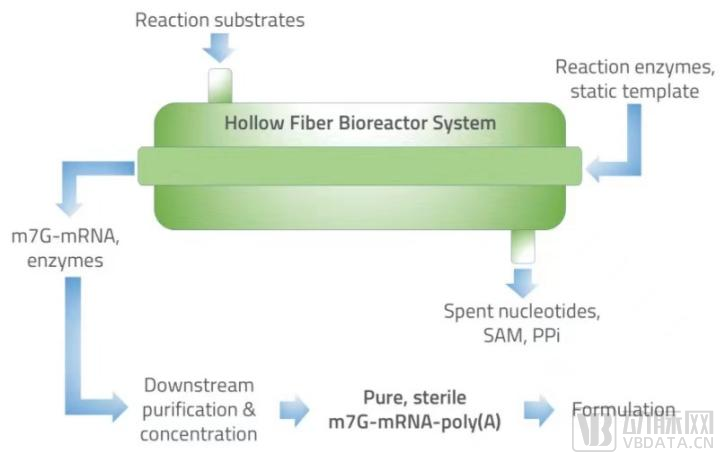
Proprietary Bioreactor Flowchart (Image Source: NTx Official Website)
A 5-mL bioreactor can synthesize 25 g of the target compound within 40 minutes, and 400 mg within 12 hours.
All enzymes used in the NTxscribe platform, including m7G-capping (Cap0) enzyme, Cap1-generating enzyme, and poly(A) polymerase, are engineered with affinity tags to enable continuous capture and washing throughout all processing steps. This approach minimizes material handling between production steps, reducing molecular damage and ensuring integrity. The supply of key NTx enzymatic components is stable, and the purification process enhances yield while reducing reliance on third-party suppliers, thereby meeting diverse needs from research and development to commercial-scale production.
NTx was named one of the best startups in New Mexico in 2022 by the Tech Forum. That same year, NTx received a grant from the Bill & Melinda Gates Foundation to develop new manufacturing methods aimed at reducing costs and improving access to mRNA vaccines and therapies in low- and middle-income countries, establishing collaborations with multiple enterprises, government agencies, and hospitals.

New Mexico Invests $5 Million from Economic Development Fund in NTx. Alicia Keyes, Secretary of the New Mexico Department of Economic Development, stated that NTx is projected to generate $1.3 billion in economic impact over the next decade, adding, “This company will not only transform New Mexico but also have a global impact in the health sector.”
Although cell-free biosynthesis was established decades ago, researchers have primarily used cell-free systems for biochemical reactions in laboratory settings, failing to extend their application to areas such as diagnostic sensor development and vaccine biomanufacturing. Leveraging its scalable platform, NTx addresses evolving global demands, enabling researchers to innovate more rapidly, expedite support for clinical trials, streamline and enhance production processes, and ultimately drive the development of global supply chains.
By leveraging proprietary enzymes and bioreactor systems, RNA (including mRNA, saRNA, etc.) can be synthesized with significantly reduced time and costs compared to traditional bioprocessing methods, thereby lowering purification expenses. According to the latest research report from QYResearch, the global market size for core enzymes used in mRNA vaccines is projected to reach $2,063 million by 2029, with a compound annual growth rate (CAGR) of -2.5% in the coming years. Protein-based therapies for combating cancer and autoimmune diseases have previously faced the same manufacturing challenges as vaccines; thus, the potential of this technology may extend beyond vaccine production.