

Parabilis Medicines (formerly FogPharma) Files IPO Prospectus: Pioneering Helicon Peptide Platform Targets 'Undruggable' Oncology Pathways with Lead Candidate FOG-001 in Clinical Trials

Parabilis Medicines
Developer of New Anti-Cancer Drugs

GV
Google's Investment Fund

Casdin Capital
Life Sciences and Healthcare Investment Firm

VenBio Partners
VenBio primarily provides financial support to promising companies at various stages of development.
Invus
Equity Investment Firms

ARCH Venture Partners
Venture Capital Firms
In November 2022, FogPharma announced the completion of a $178 million (approximately RMB 1.27 billion) Series D financing round. The proceeds will be used to advance and accelerate its pipeline of Helicon peptides, which are alpha-helical peptides, in order to develop a series of potential first-in-class candidate drugs targeting “undruggable” targets. Investors in this round included GV (Google Ventures), Casdin Capital, VenBio Partners, Invus, ARCH Venture Partners, and other renowned investment institutions.
In March 2023, Dr. Mathai Mammen, former head of global research and development at Johnson & Johnson, announced that he would join FogPharma. In addition to this high-profile appointment, FogPharma’s original founder, Professor Greg Verdine of Harvard University, is also a leading figure in the pharmaceutical industry. Notably, Dr. Mammen once served as a teaching assistant for Professor Verdine, and the two have known each other for over two decades.
In June 2023, FogPharma announced that the first patient had been dosed in its Phase I/II clinical trial of FOG-001, its first-in-class anticancer Helicon peptide drug, for patients with advanced solid tumors. FOG-001 is the first and only direct β-catenin inhibitor targeting TCF in its class, potentially benefiting a significant population of cancer patients.
FogPharma has achieved comprehensive development in funding, talent acquisition, and clinical industrialization within just one year. What are the differentiated advantages of this pharmaceutical company focused on the innovative peptide drug sector? How is the industry currently developing in this field? The following article will provide detailed answers.
The founder is a tenured professor at Harvard University,
Founded more than 10 companies consecutively
FogPharma was founded in 2015 by Dr. Gregory Verdine, a Harvard University scientist, entrepreneur, and investor, and focuses on developing Helicon peptides, a class of super-stable alpha-helical peptide therapeutics.
Dr. Verdine can be described as a legendary “genius.” He became a professor at Harvard University at the age of 29 and, by 35, had become the first tenured professor in Harvard’s Department of Chemistry.
During his nearly 30-year independent academic career at Harvard University and Harvard Medical School, he elucidated the molecular mechanisms of epigenetic DNA methylation, as well as the pathways for monitoring and eradicating certain genotoxic forms of DNA damage within the genome.
In addition, Dr. Verdine has developed innovative therapeutic modalities; FogPharma’s core technology, Helicon peptides, originated from the Verdine Laboratory at Harvard University, which he leads.
Based on decades of accumulated experience in the field of scientific research translation,VerdinePh.D.Founded or co-founded multiple successful biotechnology companies, including Enanta Pharmaceuticals (NASDAQ: ENTA), Gloucester Pharmaceuticals (acquired by Celgene), Tokai Pharmaceuticals (NASDAQ: TKAI), Wave Life Sciences (NASDAQ: WVE), Eleven Biotherapeutics (NASDAQ: EBIO), Warp Drive Bio, Aileron Therapeutics, Variagenics, LifeMine Therapeutics, and the protagonist of today’s story, FogPharma.
To date, several of these companies’ drugs have successfully received FDA approval, such as Viekirax for the treatment of hepatitis C and Istodax for the treatment of blood cancer.
In addition to helping incubate numerous companies in the pharmaceutical sector, Dr. Verdine also has extensive experience in the venture capital industry.
He has served as a Venture Partner at Apple Tree Partners, Third Rock Ventures, and WuXi Healthcare Ventures, and as a Special Advisor to Texas Pacific Group. Dr. Verdine is also the Co-founder and Founding President of the nonprofit organizations Gloucester Marine Genomics Institute and Gloucester Biotechnology Academy.
In fact, although Dr. Verdine has made significant contributions to the pharmaceutical field, he initially majored in English Language and Literature as an undergraduate. Later, guided by his personal interests, Dr. Verdine switched from the humanities to science, transferring to the Department of Chemistry. It was through this transition that he met his future close friend and collaborator, Li Ge, founder of WuXi AppTec.
FogPharma’s seed funding came from a group of prominent Chinese and foreign “star investors,” including Ge Li and his wife, Sean Tong of Boyu Capital, and Jeff Leerink, founder of the venture capital firm Leerink.
In addition to the angel investors, who are long-time close friends of Dr. Verdine, Dr. Mathai Mammen, FogPharma’s newly appointed CEO, President, and Chairman, is also a long-time friend of Dr. Verdine.
Previously, Dr. Mammen served as Global Vice President at Johnson & Johnson. During his tenure, he helped the company execute more than 40 acquisitions and licensing deals, over 350 strategic collaborations, and led his team to secure global approvals for eight new medicines, including Tremfya, Darzalex Faspro, Balversa, Carvykti, Rybrevant, Ponvory, Spravato, and Tecvayli.
Such a heavyweight figure chose to join FogPharma, which is still in its startup phase, perhaps partly due to the long-standing friendship between Dr. Verdine and Dr. Mammen. According to Endpoints News, Professor Verdine taught science courses at Harvard University in the 1990s, when Dr. Mammen served as his teaching assistant. The two maintained contact over the ensuing years and ultimately reunited at FogPharma.
Today, in addition to some of the key executives from the aforementioned companies, FogPharma boasts a multidisciplinary team with extensive experience in scientific research and industry. By leveraging the convergence of oncology, drug discovery and platform biology, proteomics, biochemistry, biology, big data, and other life science disciplines, along with technological innovation, the company has delivered a series of innovations in peptide therapeutics.
GV, Blue Pool Capital, and Tonghe Yucheng Have Made Consecutive Moves,
Peptide Drug Market to Exceed 100 Billion Yuan
An outstanding team will naturally attract favorable attention from capital.According to public records, since its inception, FogPharma has completed three rounds of market-based financing in addition to its seed funding, with a cumulative total exceeding $350 million.
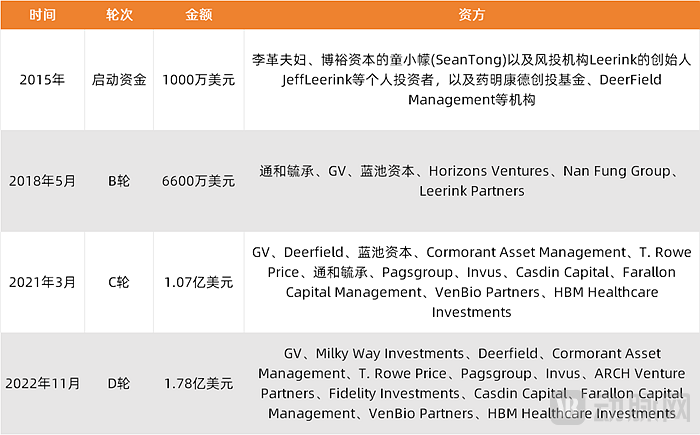
FogPharma’s Financing History, Compiled from Public Sources
As can be seen from the table data, FogPharma’s financing characteristics differ from those of most companies, with the majority of its shareholders opting for continued investment. Institutions such as Tonghe Yucheng, Blue Pool Capital, Deerfield, Cormorant Asset Management, T. Rowe Price, Pagsgroup, Invus, Casdin Capital, Farallon Capital Management, VenBio Partners, and HBM Healthcare Investments have all chosen to reinvest in the company.Google Ventures (GV) has further increased its investment in FogPharma for three consecutive rounds.
Why do these star investors remain bullish on FogPharma? What is the market potential of its focused therapeutic area? And what are FogPharma’s key differentiating advantages?
FogPharma is focusing on the vast market for peptide therapeutics. According to data from Tianfeng Securities, natural peptides have been continuously expanded since 2000, particularly driven by venom-derived peptidomics and novel chemical modification methods, which have facilitated the discovery of new peptide drugs. The emergence of emerging technologies—such as multifunctional peptides, constrained peptides, conjugated peptides, oral peptides, long-acting formulations, and delivery systems—has significantly propelled the flourishing development of the peptide drug sector, ushering in a period of explosive industry growth.
According to Frost & Sullivan data, the global market size for peptide drugs increased from $56.8 billion in 2016 to $62.8 billion in 2020, representing a compound annual growth rate (CAGR) of 2.6%. The global market for peptide drugs is projected to grow at a CAGR of 8.5% from 2020 to 2030, reaching $141.8 billion by 2030.
As of January 2023, approximately 180 peptide drugs have been marketed globally. Internationally, peptide drugs are primarily distributed across seven major therapeutic areas, including rare diseases, oncology, diabetes, gastrointestinal disorders, immunology, and cardiovascular diseases. Well-known blockbuster peptide drugs for diabetes, such as liraglutide, semaglutide, dulaglutide, and tirzepatide, generated over $20 billion in sales for their originator products in 2022.
With the iterative advancement of peptide structural modifications and chemical engineering techniques—including backbone modification, fatty acid conjugation, PEGylation, and protein fusion—coupled with the development of novel targets, expansion into new indications, and formulation optimization, the peptide drug market possesses substantial potential for growth.
FogPharma has drawn inspiration from nature, recognizing that alpha-helices in proteins are critical for mediating interactions with other proteins and can also confer unique properties, such as the ability to penetrate cell membranes.
Based on this, FogPharma has developed proprietary ultra-stabilized alpha-helical peptide drugs (Helicon peptides), with its core technology derived from a novel platform developed by Professor Verdine at Harvard University—Cell-Penetrating Miniproteins (CPMP).
CPMPs can be viewed as a hybrid of small-molecule drugs and biologics, combining the potent target-binding affinity of biologics with the cell-penetrating capability of small molecules. Their core principle involves embedding amide groups within the folded structure of an α-helical conformation, thereby masking the polarity of the peptide backbone and enhancing its hydrophobicity (i.e., lipophilicity). This modification helps them evade detection by the cell membrane while facilitating transmembrane passage. The α-helix can display a diverse array of side chains along an extended interface, enabling it to bind to “undruggable” target proteins that are inaccessible to many small-molecule drugs. This functional domain resembles antibody derivatives but is sufficiently small to penetrate cells.
In addition to enhancing cellular penetration, this novel technology enables Helicon peptide drugs to evade rapid renal clearance, thereby achieving prolonged plasma and tissue residence times and improved therapeutic efficacy. Furthermore, Helicon peptide drugs prevent recognition by proteases and MHC proteins required for immune identification, thus enhancing stability and reducing immunogenicity.
Helicon peptide drugs combine the cell permeability and oral bioavailability of traditional small-molecule drugs with the high specificity and broad target accessibility of monoclonal antibody therapies, holding promise for targeting “undruggable” sites and revolutionizing new drug discovery and development.
FogPharma’s technology is designed not only to discover novel peptide therapeutics targeting previously undruggable pathways, but also to enable faster and more scalable drug discovery compared to traditional pharmaceutical R&D processes.
FogPharma’s multiplexed tandem discovery engine integrates cutting-edge technologies, including directed evolution, proprietary α-helix conformational super-stabilization chemistry, highly multiplexed drug optimization technologies, analytical and predictive data science (including machine learning and deep learning), and structure-based drug discovery.
By leveraging these tandem discovery engines, FogPharma’s scientists are able to design, synthesize, and evaluate thousands of new Helicons weekly in biochemical and cell-based assays, rapidly developing peptide drug candidates against previously undruggable targets within months.
Currently, FogPharma’s most advanced pipeline candidate is FOG-001. On June 5 this year, the Phase I/II clinical trial of FOG-001 in patients with advanced solid tumors completed dosing of the first subject.
FOG-001 is the first peptide drug developed based on the Helicon technology platform that targets the Wnt/β-catenin signaling pathway. Aberrant dysregulation of the Wnt/β-catenin signaling pathway occurs in more than 20% of cancer patients. Biochemical and cellular studies have demonstrated that FOG-001 can effectively, precisely, and selectively disrupt the interaction between β-catenin and the transcription factor TCF, thereby abolishing oncogenic signaling driven by Wnt pathway mutations. Preclinical studies indicate that FOG-001 inhibits tumor growth in a β-catenin-dependent manner, leading to tumor regression.
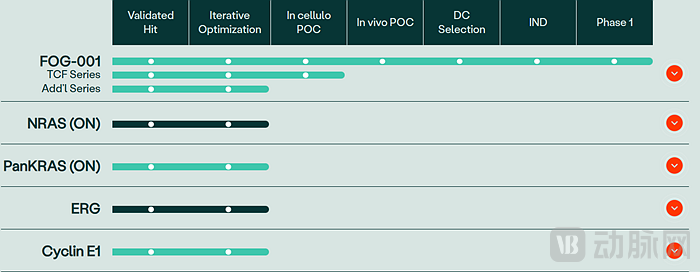
Product Pipeline Under Development, Source: FogPharma Official Website
In addition to FOG-001, FogPharma has four other drug candidates in development, each targeting validated cancer targets such as NRAS (ON), Pan-KRAS (ON), ERG, and Cyclin E1. These compounds are currently undergoing iterative optimization.
In addition to outstanding overseas peptide-focused innovative pharmaceutical companies such as FogPharma, multinational giants including Novo Nordisk, Novartis, AstraZeneca (AZ), Eli Lilly, Takeda, Amgen, and Teva are also strategically prioritizing the peptide therapeutics sector.
In recent years, the research and development of polypeptide drugs in China has also been advancing rapidly, with polypeptides and peptide-drug conjugates being listed as key areas for development in the National 14th Five-Year Plan for the Pharmaceutical Industry.
Frontier Biotechnologies, PegBio, TPI, LinkCare Biosciences, MicuRx Pharmaceuticals, Innovent Biologics, Hangzhou Sino-Reach, BrightGene Bio-medical Technology, Daor Biopharmaceuticals, Pulead Pharmaceutical, Renhui Biotech, Hengrui Medicine, Beta Pharma, Hansoh Pharmaceutical, China Peptides Co., Ltd., Sinopep-Allsino, Hybio Pharmaceutical, Huadong Medicine, MedKey, Shuangcheng Pharmaceutical, and over a hundred other companies have all established a presence in the peptide drug sector.
Since the first successful extraction of insulin in 1921 and the subsequent improvement of symptoms in a diabetic patient following insulin injection in 1922, peptide drugs have embarked on a century of remarkable achievements. In recent years, the surge in popularity of semaglutide has swept across the globe. It is anticipated that further surprises will emerge from this Pandora’s box of peptide-based therapeutics.