

Blue Sail Surgical Launches RenoVue®/RenoPort®: World’s First Single-Use Intracorporeal Closed-System Endoscopic Lens Cleaner
Since Dr. Mouret of France successfully performed the first laparoscopic cholecystectomy in 1987, laparoscopic surgery has gained widespread recognition in the medical community for its advantages, including minimal invasiveness, clear visualization, and fewer postoperative complications, becoming a core component of minimally invasive surgical procedures. Today, as the concept of minimally invasive surgery becomes deeply entrenched and laparoscopic technologies continue to innovate, the application of this technique has gradually expanded to fields such as hepatobiliary, gastrointestinal, cardiac, thoracic, obstetrics and gynecology, and urology. In many respects, laparoscopic surgery has even become the gold standard, replacing traditional open surgery.
However, as the industry continues to optimize laparoscopic surgical standards and innovate laparoscopic equipment and instruments, a critical issue in laparoscopic surgery cannot be overlooked—Lens Fogging or Contamination from Tissue Fluids。
During laparoscopic surgery, surgeons lose tactile feedback, making the need for clear visualization even more critical. Although minimally invasive surgical techniques have gradually matured, the use of energy devices such as ultrasonic scalpels and electrocautery still generates smoke during procedures. Additionally, manipulating tissues and blood vessels may cause splattering of tissue fluid or blood, leading to contamination of the surgical lens. Furthermore, residual tissue fluid on the trocar’s sealing membrane can cause secondary soiling of the lens, while the temperature difference between the lens and the body cavity may result in fogging upon insertion into the abdominal cavity. These issues impair the clarity of the surgical field, thereby increasing the difficulty and risk of the procedure.
Although endoscopic lenses are generally equipped with anti-fog measures, and clinical practice has identified solutions such as wiping the lens with povidone-iodine, soaking it in hot water contained in a sterilized insulated cup, and applying sterile anti-fog oil, the anti-fog coating gradually deteriorates after repeated cleaning and disinfection over prolonged use, leading to fogging once the lens is inserted into the abdominal cavity.
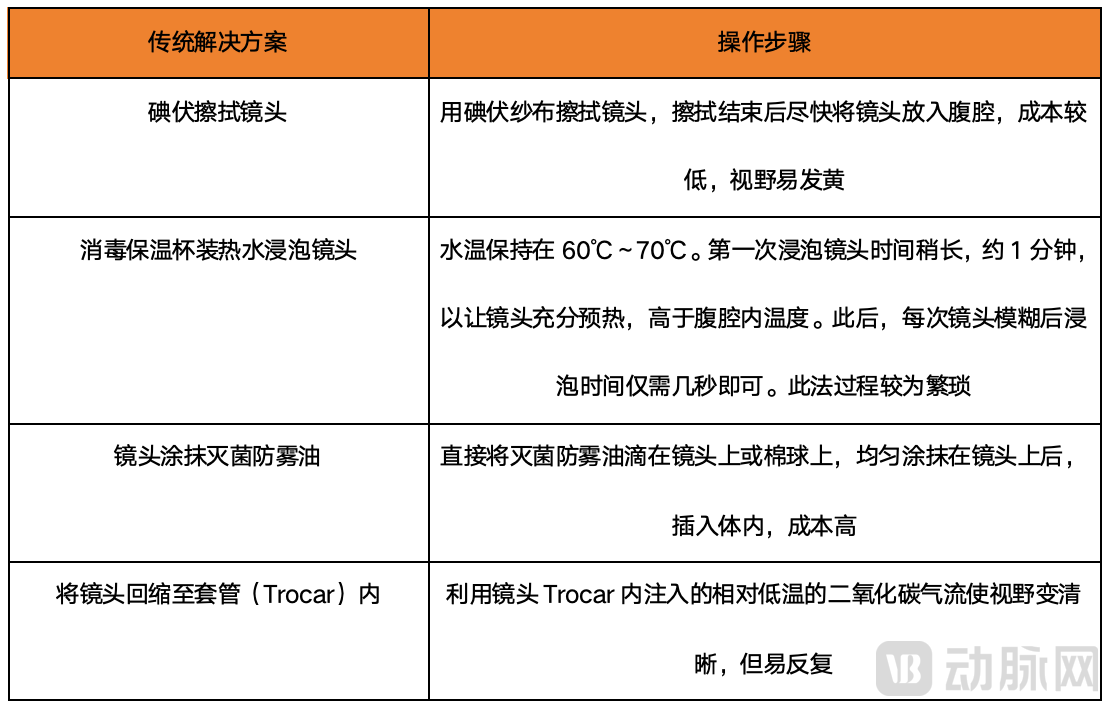
Traditional Methods for Resolving Fogging
Source: "Endoscopic Lens Fogging and Contamination"
Furthermore, interrupting the procedure to clean the lens during surgery disrupts surgical continuity, prolongs both anesthesia and operative times, and thereby adversely affects surgical outcomes and patient prognosis. Therefore, implementing effective measures to minimize lens contamination and other influencing factors is of great significance for improving surgical quality and patient prognosis.
VCBeat noted that in February 2022, Blue Sail Surgical independently developed and designedThe World’s First RenoVue®/RenoPort® Disposable Endoscopic Closed-Loop Lens Cleaner(hereinafter referred to as the RenoVue®/RenoPort® products) and obtained approval through the Innovative Pathway. In May 2023, the product completed its pre-market clinical trials, achieving efficient cleaning and anti-fog coating functions without altering existing surgical workflows. This addresses the pain point of surgeons having to interrupt procedures to remove the endoscope from the body cavity for cleaning and wiping, thereby facilitating efficient lens cleaning and enabling continuous surgery by physicians.
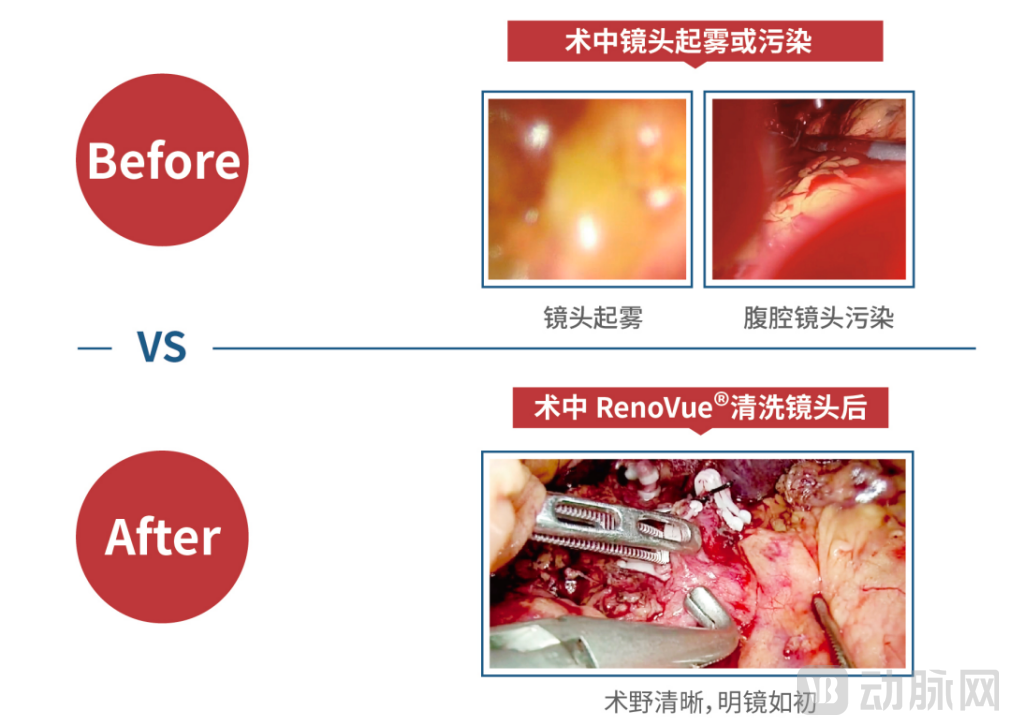
Without altering surgeons’ existing operative habits, addressing the pain point of manual extracorporeal lens cleaning is no easy task. For product developers, launching a product line requires overcoming challenges such as integrating the cleaning channel with the minimally invasive working channel, incorporating cleaning fluid pathways within the confined space of the trocar to achieve efficient cleaning and anti-fogging performance, and implementing automated valve controls.
The Blue Sail Surgical team conducted thousands of gas-liquid mixing tests to determine the optimal gas-to-liquid ratio for generating high-pressure jetting gas-elastic flows, performed tens of thousands of tests to achieve stable and efficient cleaning performance, and carried out thousands of tests to verify the realization of an optimal flow channel and sealed coating structure. After iterative optimization across multiple technical versions, the RenoVue®/RenoPort® products were ultimately developed. Pre-market clinical trial data indicate that the RenoVue®/RenoPort® products have the shortestEndoscope cleaning is completed in just 2.4 seconds, reducing the average lens cleaning time by 24 seconds compared to traditional manual wiping methods, thereby effectively shortening surgical duration.

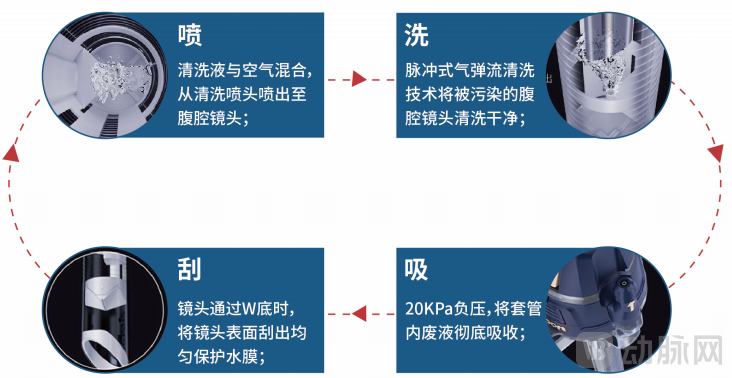
RenoVue®/RenoPort®Disposable Endoscopic Closed-Loop Lens Cleaner
Specifically, this product retains the original trocar structure while incorporating an inflow port and a negative pressure port, thereby integrating cleaning and channel-establishment tubing into a single system. The pre-configured povidone-iodine cleaning solution within the device is connected to the fluid collection port via a gas-liquid cleaning line. Under the synergistic effect of appropriate negative pressure, the gas and liquid phases are mixed to form a "pulsatile gas-elastic flow." When the lens becomes contaminated and is retracted into the cleaning sheath, the cleaning nozzle automatically opens. At this point, the high-pressure pulsed gas-elastic flow rapidly cleans the lens, achieving efficient in-situ cleaning in just 3 seconds.
Upon completion of cleaning, the lens utilizes a special "W-base" structure to wipe water from its surface, forming a uniform water film that prevents "temperature-differential fogging." Meanwhile, the W-base ensures a sealed cleaning chamber to prevent leakage and avoid secondary contamination.
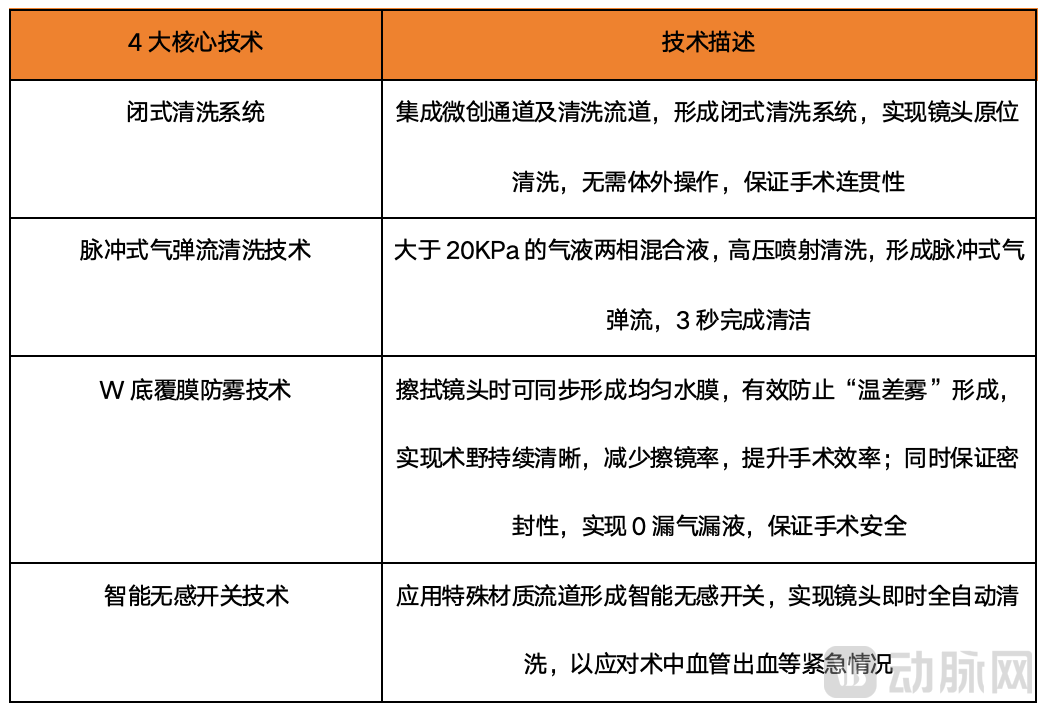
RenoVue®/RenoPort®Four Core Technologies of the Disposable Endoscopic Closed-Loop Lens Cleaner
It is worth noting that this product integrates a minimally invasive access channel, is compatible with various types of endoscopes, and is suitable for laparoscopic and endoscopic surgeries across all surgical specialties, including the stomach, intestines, hepatobiliary and pancreatic systems, esophagus, kidneys, bladder, uterus, and adnexa. It can be used for both endoscopic examination and intraoperative procedures, and is expected to see broader clinical adoption in the future.
In May this year, the RenoVue®/RenoPort® products completed enrollment of the final surgical case in their pre-market clinical trials. During the clinical trials, the RenoVue®/RenoPort® products were utilized in multiple complex minimally invasive procedures, demonstrating superior cleaning efficacy compared to traditional manual lens wiping methods.
Pre-market clinical trial data for the RenoVue®/RenoPort® products demonstrate that, compared with conventional lens cleaning methods (soaking in warm povidone-iodine saline followed by gauze wiping), the use of RenoVue®/RenoPort® products reduced the overall surgical time by an average of 20 minutes and decreased the time required for a single lens cleaning by an average of 24 seconds. The maximum duration of coating protection reached 30 minutes, while the minimum effective cleaning time was only 2.4 seconds. Furthermore, the products achieved zero fluid leakage, zero air leakage, and zero secondary contamination, effectively addressing the pain points associated with traditional manual lens cleaning, improving the efficiency of minimally invasive surgery, and validating the safety and efficacy of the RenoVue®/RenoPort® products in clinical applications.
RenoVue®/RenoPort® is not only the world’s first single-use endoscopic closed-loop lens cleaner, but also a testament to Blue Sail Surgical’s continued dedication to the field of minimally invasive surgery.
It is reported that this product underwent tens of thousands of tests and experiments, multiple rounds of iterative optimization, and overcame numerous technical challenges from project initiation to final launch. As a rising star in the field of minimally invasive surgery, Blue Sail Surgical leverages the platform of Blue Sail Medical and began achieving results in its second year of establishment. Currently, Blue Sail Surgical’s product portfolio basically covers traditional surgical solutions, including access products, stapler series (manual/electric, open/laparoscopic), energy-based device series (ultrasonic scalpels, monopolar/bipolar devices, etc.), and vessel sealing products.
In addition to Blue Sail Surgical’s existing technological expertise and its dedication to R&D, these achievements have also been driven by the support provided by the Blue Sail Medical platform.
Since its inception, Blue Sail Medical has consistently advanced its globalization strategy, establishing over 70 subsidiaries and branches across more than 20 countries and regions worldwide. It has grown into a multinational medical device platform enterprise with China at its core and a global outreach, building a comprehensive global system encompassing R&D, clinical trials, regulatory registration, manufacturing, and sales. Furthermore, Blue Sail Medical has established multiple R&D centers globally, employing nearly 800 R&D professionals, and has invested approximately RMB 2 billion in innovative research and development over the past five years. Currently, the company holds more than 600 patents worldwide, with several innovative products already approved for market entry in various global regions. It is precisely this strategic foundation that has enabled Blue Sail Medical to transform from a glove manufacturer into a global medical platform enterprise, accelerating the growth of its business divisions.
In the future, leveraging Blue Sail Medical’s resources, Blue Sail Surgical will strategically focus on developing innovative surgical devices characterized by high R&D barriers, lengthy clinical registration cycles, and cutting-edge global technology. This initiative aims to provide patients worldwide with solutions that are more minimally invasive or non-invasive, more precise, associated with fewer complications, and conducive to better prognoses.