

Cionic Files for IPO: Revolutionizing Mobility with AI-Powered Bionic Wearables

Cionic
Wearable Solutions Provider

L Catterton
Equity Investment Firms

THVC
Healthcare Investors

Enable Ventures
Venture Capital Firms
In 2010, tech innovator Jeremiah Robison’s daughter was diagnosed with cerebral palsy, which severely affected her motor skills and ability to walk. Over the following eight years, her mobility continued to deteriorate without any effective solutions available, leaving him deeply frustrated.
“As a technologist, I had the opportunity to put into practice the innovations we were seeing in the field of autonomy and apply them to the human body, providing her with medical devices superior to canes, walkers, and wheelchairs.” This was how Jeremiah Robison came up with the idea of developing a mobility-assist device for his daughter.
“Disability Impacts All of Us” points out that 12.1% of American adults have mobility disabilities, experiencing severe difficulties in walking or climbing stairs. These mobility impairments are seriously compromising patients’ physical safety and emotional well-being, and may lead to many other complications. As the population ages, this issue will become increasingly severe.
To help his daughter and other individuals with mobility impairments, Jeremiah Robison founded Cionic in 2018, focusing on providing bionic clothing to people who have difficulty moving due to multiple sclerosis, stroke, cerebral palsy, and other neurological conditions, thereby helping them move and walk more independently. Over the course of four years, Jeremiah Robison and his team transformed the Cionic wearable neural sleeve from a studio concept into an FDA-approved product.
For many patients with mobility impairments, the standard treatment involves the use of ankle-foot orthoses (AFOs), which are rigid plastic braces designed to stabilize the foot. Other assistive devices include walkers, canes, and wheelchairs. While these aids help prevent falls and provide a certain degree of mobility, they do not address the underlying neurological, strength, and coordination deficits. Moreover, some of these devices are cumbersome and ineffective in scenarios such as climbing stairs, while also visibly revealing the patient’s mobility impairment, thereby exposing them to intrusive questions and social stigma.
Another therapeutic approach involves the use of exoskeleton devices. These devices are relatively bulky and are operated via remote control, external electrodes, or surgically implanted brain-computer interfaces. Their adoption is constrained by factors such as limited battery capacity and restricted range of motion, while the persistently high cost of some devices has further hindered their widespread adoption.
If the exoskeleton’s design is an inspired recreation of the human skeletal system, then Cionic draws its inspiration from the body’s own muscles and neural signals.
Even when muscles are strong and the body is free from conditions requiring therapeutic intervention, correctly recruiting muscles during complex movements can pose a significant challenge for certain populations. For millions of individuals who experience difficulty walking due to stroke, multiple sclerosis, and other neurological disorders, the primary issue lies not in leg injuries, but in the brain’s inability to effectively communicate with the limbs and activate muscles in the correct sequence during complex motor tasks.
“Therefore, our technical goal is not to replace the skeletal system like a prosthesis, but rather to replace the neural signals in the brain responsible for controlling gait and complex movements.” This approach enables the creation of a more stable motor system, preventing falls and reducing mobility impairments in patients. Cionic’s technology coordinates neural firing in damaged muscles and provides a more natural pattern of movement than rigid braces or conventional durable medical equipment.
Rather than attaching a robot to a person’s body to move it for them, Cionic connects artificial intelligence (AI) to the body, enabling the AI to interpret the user’s intended movements and activate the body’s own muscles to execute those actions. Cionic embeds this technology into “clothing,” making it as easy to wear as pants or socks.
During the R&D process, Cionic collaborated with world-renowned industrial designer Yves Behar and his multidisciplinary agency, fuseproject. They integrated the main wiring that powers the electrodes into soft fabrics, creating a design that is easy to wear. To achieve this, Cionic conducted tests and validations using more than 50 prototype devices in various scenarios and configurations.
The most distinctive feature of the Cionic wearable neural sleeve is its design, which resembles athletic gear rather than a medical device, and it comes in various colors, looking much like ordinary sportswear. “When people have mobility impairments, they often feel as though they need to be cared for. We want patients to live equal, independent lives, just like anyone else,” said Jeremiah Robison, founder of Cionic.
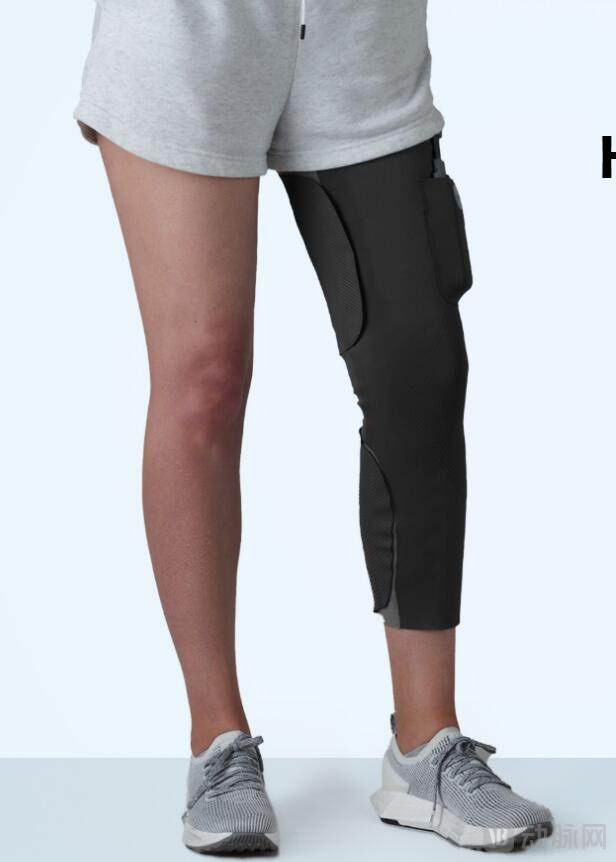
Cionic’s wearable neural sleeve looks very similar to ordinary athletic pants. Image source: Cionic official website
Cionic stated that its wearable neural sleeve has reduced the number of trial participants experiencing moderate to severe pain by 60%, and those with moderate to severe anxiety or depression by 75%. Many users also reported improved mobility.
Cionic Wearable Neural Sleeve is lightweight, durable, and can be worn anywhere. The device improves an individual’s gait by electrically stimulating the muscles of the affected leg, thereby facilitating muscle re-education, preventing or delaying disuse atrophy, and promoting local blood flow.
Cionic’s wearable neural sleeve is a bionic garment that combines the diagnostic capabilities of a gait laboratory with the therapeutic power of functional electrical stimulation (FES).
This device can be wrapped around a person’s thigh and calf. Concealed within its breathable fabric is a system of sensors and electrodes that communicate with an artificial intelligence-powered application. The sensors monitor the patient’s movement in real time, assessing muscle contractions and limb position. The application then analyzes this data to predict the intention to take a step within one-tenth of a second before the foot leaves the ground. It subsequently directs the electrodes to activate leg muscles in the correct sequence of the gait cycle, thereby supporting natural human movement.
Cionic’s wearable neural sleeve features a proprietary read-write neural interface that measures and analyzes muscle twitches and limb position in real time, providing detailed analysis of each movement to accurately reflect muscle activity, strength, and limb trajectory and posture. Furthermore, the system offers flexible context awareness, capable of identifying whether the patient is sitting, standing, or walking, and delivers timely stimulation based on the environment and the user’s status.
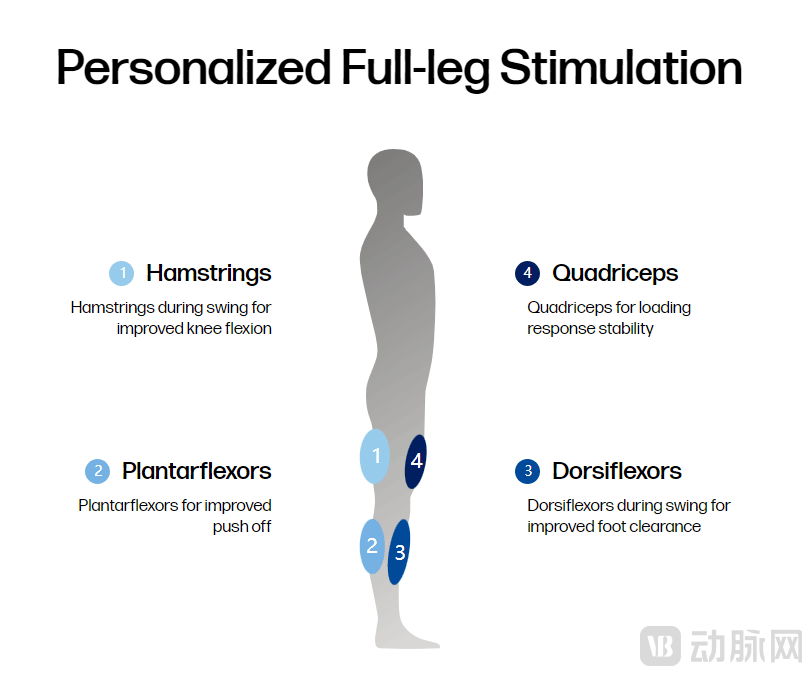
Cionic Wearable Neural Sleeve Enables Personalized Full-Leg Stimulation (Image source: Cionic official website)
A major innovation of this system is its software-controlled current, which enables patients to precisely modulate subtle movements of the musculoskeletal system (or body). Traditional stimulation systems require manual electrode placement, meaning that each new functional movement may necessitate repositioning the electrodes. The Cionic wearable neural sleeve eliminates this limitation.
The Cionic app is compatible with iOS and Android systems, allowing users to control and manage the settings and functions of the Neural Sleeve via smartphones or tablets. Leveraging this software, the Cionic wearable Neural Sleeve enables personalized care. EMG and kinematics reports facilitate real-time monitoring of patients’ movement progress, track long-term outcomes, and enable data sharing with their healthcare teams. Additionally, the app supports customized treatment by providing exercise regimens and educational resources.
Notably, the device also features an adaptive algorithm that automatically adjusts parameters such as stimulation frequency, duration, waveform, and sequence based on input data and feedback results. This continuously optimizes stimulation patterns, achieving “every step smarter than the last.”
Furthermore, the Cionic wearable neural sleeve features a comfortable and intuitive design that is easy to don and doff, minimizing user discomfort and pressure during wear. Its built-in battery provides up to 8 hours of operation, meeting the demands of daily activities and offering all-day assistance.
Cionic’s multicenter clinical trial evaluated the efficacy of the Cionic wearable neural sleeve in assisting patients with foot drop. Participants wore the neural sleeve on their more affected leg. By adjusting the stimulation frequency, pulse width, and amplitude, the ankle dorsiflexor muscles were activated, and users underwent consecutive walking tests with and without gait-assist stimulation. The primary endpoint of the study was to increase ankle dorsiflexion to improve foot clearance. In paired consecutive tests, 94% of participants demonstrated a positive improvement in ankle dorsiflexion at heel strike.
However, ankle dorsiflexion is only part of the mobility impairment issue. Many individuals with foot drop also exhibit excessive ankle inversion, which can lead to landing on the lateral side of the foot, thereby increasing the risk of ankle injuries and falls. Cionic’s software manipulates the stimulation array to enable the nerve cuff to balance increased dorsiflexion with reduced inversion. Eighty-eight percent of participants showed positive improvement in ankle inversion during the swing phase.
After aggregating the improvements of all participants on these two metrics, Cionic’s gait assistance trial showed an average composite improvement of 9° across all participants.
On March 8, 2022, Cionic announced that the Cionic Wearable Neural Sleeve had been cleared by the FDA as a Class II medical device. This milestone will accelerate Cionic’s commercialization efforts.
On October 18, 2023, Cionic announced that it had secured a $12 million extension to its Series A financing round. The round was led by L Catterton, with participation from Transformational Healthcare and Enable Ventures. According to data disclosed on Crunchbase’s official website, the total amount raised in this round has exceeded $20 million (approximately RMB 143 million).
Currently, purchasing this device requires a physician’s prescription, and it is not covered by insurance. However, Cionic has stated that it will support customers in seeking reimbursement from their insurance providers. Although the device is currently available only to individuals aged 22 and older, Cionic is planning pediatric trials with the aim of ultimately helping children like Jeremiah Robison’s daughter overcome mobility impairments.