

F-Prime Capital-Backed Radiopharmaceutical Biotech ARTBIO Files for IPO with Novel Pb212-Based Alpha Therapy Platform

F-Prime Capital
Healthcare Venture Capital Firms

Third Rock Ventures
Venture Capital Firms

Omega Funds
Venture Capital Firm

ARTBIO
Radiopharmaceuticals Developer
On December 7, radiopharmaceutical company ARTBIO announced the completion of an oversubscribed Series A financing round exceeding $90 million. The round was co-led by Third Rock Ventures and an undisclosed healthcare fund, with significant follow-on investments from seed investors F-Prime Capital and Omega Funds.
This funding round will help solidify the company’s proprietary Pb-212 isolation technology, AlphaDirectT™, and its distributed manufacturing network, advance its lead program AB001 for the treatment of prostate cancer, and further expand the company’s product pipeline.
Six months ago, ARTBIO had just completed a $23 million seed funding round. With $113 million raised in six months and repeated bets from existing shareholders, what makes this radiopharmaceutical biotech company so special?
ARTBIO was founded in 2021 by Roy Larsen, Øyvind Bruland, Radforsk, and F-Prime Capital with the aim of creating highly targeted cancer therapies by pairing the optimal alpha-emitting radioisotope Pb-212 with ligands for proven tumor-specific targets.
ARTBIO was founded in Norway, a country with nearly a century of research in radiation therapy, emerging from actinium modification research conducted at the University of Oslo and The Norwegian Radium Hospital. Scientific founders Roy Larsen and Øyvind Bruland invented Xofigo®, the world’s first alpha-particle-emitting radiopharmaceutical for targeted therapy, which was later acquired by Bayer through Algeta. In 2021, Roy Larsen and Øyvind Bruland co-founded ARTBIO together with the global venture capital firm F-Prime Capital and Radforsk.
F-Prime Capital is a global venture capital firm affiliated with Fidelity Investments, which has $3.9 trillion in assets under management. Over the past 50 years since its founding, it has supported groundbreaking companies such as Atari, MCI, Ironwood, Alibaba, and Medbanks.
In early 2022, Emanuele Ostuni, former head of Novartis Oncology’s Cell and Gene Therapy division in Europe, joined ARTBIO as Chief Executive Officer, with additional funding support from F-Prime Capital and Omega Funds. However, ARTBIO remained in stealth mode until June 2023, when it announced the completion of a $23 million seed financing round.
According to data from VCBeat, the therapeutic radiopharmaceutical industry currently focuses most heavily on beta-emitting radionuclides, represented by Lutetium-177 [177Lu], but attention is shifting from beta emitters to alpha emitters. Compared with beta particles, alpha particles have greater mass, higher potency, and a shorter range. Targeted alpha therapy can exert significant cytotoxic effects within a limited area around the target, delivering lower harmful radiation doses to other healthy tissues and organs, thereby achieving more potent therapeutic efficacy with minimal impact on normal tissues.
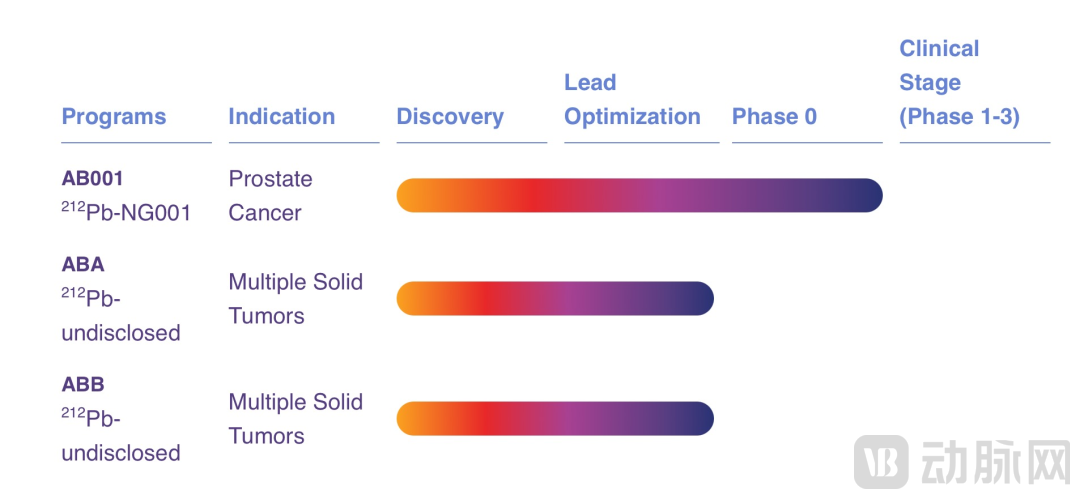
ARTBIO’s three currently disclosed drug pipelines are all Alpha Radiotherapy (ART) agents targeting the alpha-emitting radioisotope Pb-212. Among them, AB001, which has been publicly announced, is scheduled to enter clinical trials next year; it targets PSMA (Prostate-Specific Membrane Antigen) and is indicated for prostate cancer. The other two undisclosed projects are intended for the treatment of solid tumors.
ARTBIO’s official website states that alpha particles induce double-strand DNA breaks in cancer cells, thereby minimizing penetration into healthy tissues while causing greater damage to tumor tissue. Beta-emitting radiopharmaceuticals, by contrast, sacrifice speed and efficiency but offer advantages in centralized manufacturing and distribution. To meet the manufacturing demands of alpha-emitting therapies, ARTBIO has developed AlphaDirect™, a proprietary containment technology enabling flexible production of Pb-212.
Medical isotopes are the foundational raw materials for the research, development, and production of radiopharmaceuticals. For midstream biotech companies, the high dependency of radiopharmaceuticals on medical isotopes grants upstream suppliers greater bargaining power. Consequently, many midstream radiopharmaceutical R&D enterprises have begun to engage in upstream medical isotope production, thereby strengthening the radiopharmaceutical supply chain at its source. In other words, securing upstream supply enables a faster transition of medical isotopes from the laboratory to industrialized, large-scale production.
Furthermore, the short shelf life of radiopharmaceuticals, resulting from the decay of radioisotope activity over specific timeframes, makes timely delivery and patient administration a significant challenge. Supply chain stability issues, including source isotope production and nuclear pharmacy operations (also known as end-to-end distributed networks), will substantially impact the market adoption and clinical application of therapeutic radiopharmaceuticals.
Perhaps benefiting from the experience of its scientific founders, ARTBIO, a biotech company established less than three years ago, unveiled its comprehensive radiopharmaceutical ecosystem built on four strategic pillars during its debut in June.
α-Emitter with Ideal Clinical Characteristics—²¹²Pb
Pb-212 has a short half-life and is well-matched to the characteristics of the small-molecule vectors used by ARTBIO, enabling rapid delivery of most of its energy to tumors to achieve therapeutic efficacy. Its carrier molecules exhibit high stability, which may have a potentially positive impact on safety and effectiveness. Additionally, it can be imaged via SPECT (Single Photon Emission Computed Tomography)/CT, allowing for precise clinical efficacy assessment.
Differentiated ART Pipeline
Combining the ART targets and drug molecules most likely to benefit patients, we can unlock the potential of ART and improve therapeutic outcomes.
Proprietary PB212 Isolation Technology—AlphaDirect™
Unlike the stringent manufacturing of alpha isotopes in large, centralized facilities such as nuclear reactors or high-energy cyclotrons, AlphaDirect™ patented technology offers unique advantages as the first system capable of effectively separating Pb-212. AlphaDirect™ is a benchtop system that can be operated in various product assembly facilities; it features a simple process requiring no separation steps, achieving purity levels exceeding 99.9%. By utilizing widely available raw materials from the nuclear industry, it simplifies the supply chain, reduces uncertainties, and lowers manufacturing costs.
Distributed Manufacturing Ecosystem for Rapid Delivery of ART Drugs
Leveraging the flexible infrastructure of AlphaDirect™, end-to-end distributed manufacturing aligns with the short half-life of targeted Pb-212 therapeutics, mitigating the drawbacks of centralized production; a strategic partner network is established to reliably, rapidly, and flexibly deliver medications to as many patients as possible.
Concurrent with the completion of its Series A financing, ARTBIO appointed Philippe Dasse as Chief Technology Officer and Daniel Rossetto as Senior Vice President and Head of Supply Chain and External Manufacturing. They will lead the development and expansion of ARTBIO’s unique distributed manufacturing network to support the company’s clinical pipeline.
As Chief Technology Officer, Philippe will lead the development of ARTBIO’s proprietary AlphaDirec™ technology and the establishment of the company’s distributed manufacturing network. Previously, Philippe served as Head of Technical Operations for Radioligand Therapy at Novartis Oncology and was the first employee of Advanced Accelerator Applications in 2002. The company was acquired by Novartis in 2018.
As Senior Vice President and Head of Supply Chain and External Manufacturing, Daniel will lead efforts to strengthen the company’s supply chain logistics and manufacturing partnerships to ensure seamless distribution of ART’s products. With a focus on pharmaceutical manufacturing, Daniel most recently served as Global Head of Supply Chain for Novartis’ Advanced Accelerator Applications. In this role, he managed a diverse team and expanded high-speed, agile internal and external supply networks to deliver clinical and commercial radioligand therapy (RLT) portfolios for patients with prostate cancer, including PLUVICTO®.
Furthermore, Founding CRO Emanuele Ostuni previously served as the former Head of Cell and Gene Therapy for Novartis Oncology in Europe, where he was responsible for all commercialization activities related to Kymriah in the region. The CSO formerly held the position of Vice President of Integrated Science at Celgene/BMS, as well as various scientific management roles at Pfizer. The Vice President of Clinical Development previously served as the Senior Head of Clinical Development for Bayer’s targeted alpha therapy platform, overseeing the early clinical development of multiple Th-227 and Ac-225 isotope-based radiopharmaceuticals.
By combining robust proprietary technological innovations with a strong management team, ARTBIO offers an alternative solution to challenges in the radiopharmaceutical supply chain—starting from the production end and building a more flexible and accessible ecological network through distributed manufacturing. VCBeat New Medicine will continue to monitor whether this approach proves viable.