

Single-Cell Biotech Pioneer Stars Biotech Secures Nearly RMB 100 Million Series A Funding to Advance Raman-Activated Cell Sorting Technology

eCyte
Life Science Instrument Developer
Recently, eCyte, Inc. (hereinafter referred to as “eCyte”) announced the completion of its nearly RMB 100 million Series A financing round, led by Hengxu Capital, with participation from Beiyang Haitang Fund. Yi Pie Capital served as the exclusive financial advisor. The proceeds from this round will support eCyte’s expansion of its industrial layout, accelerate the development of its “Ramanome” industrial projects and microfluidics technology, strengthen brand building, and open up international markets.
Founded in 2014, eCyte leverages the cutting-edge technical support of the Qingdao Institute of Bioenergy and Bioprocess Technology, Chinese Academy of Sciences (hereinafter referred to as “QIBEBT, CAS”) in the field of single-cell research. The company has pioneered the original concept of the “Ramanome,” independently developed core components, algorithms, scenario-specific databases, and intelligent software, and created domestically produced high-precision life science instruments along with配套 microfluidic chip consumables. In doing so, it has established a technological platform for “metabolic function-targeted live single-cell analysis and sorting.”
Dr. Xu Jian, Co-founder of eCyte, received his bachelor’s degree in Biotechnology from Peking University, and earned his Master’s degree in Computer Science and Ph.D. in Biochemistry from Washington University in St. Louis. He currently serves as Director of the Bioenergy Research Division, Director of the Single-Cell Center, and Director of the Shandong Provincial Key Laboratory of Energy Biological Genetic Resources at the Qingdao Institute of Bioenergy and Bioprocess Technology, Chinese Academy of Sciences. He is also a member of the Shandong Provincial Committee of the Chinese People’s Political Consultative Conference. Dr. Xu has long been engaged in research on single-cell Raman imaging, sorting, sequencing, and cultivation, with applications in microbiome detection and microalgal synthetic biology. He has been supported by the National Science Fund for Distinguished Young Scholars, the National Special Support Program for High-Level Talents, and the China Youth Science and Technology Award.
Another co-founder, Researcher Ma Bo, holds a Ph.D. in Analytical Chemistry from the Dalian Institute of Chemical Physics, Chinese Academy of Sciences. He has conducted scientific research at the University of California and Rice University in the United States. Currently, he serves as Deputy Director of the Single-Cell Center at the Qingdao Institute of Bioenergy and Bioprocess Technology, Chinese Academy of Sciences. With over a decade of R&D experience in single-cell technologies and instrumentation, he has long been engaged in research on key microfluidic technologies and devices.
“The Raman Group” concept, first proposed by this team, is a broadly applicable, non-invasive, single-cell metabolic phenome with high spatiotemporal resolution, designed to address the core bottleneck in detecting and utilizing live single-cell metabolic functions within living systems.: (1) label-free, non-destructive, and rapid identification; (2) real-time, panoramic characterization; (3) high-throughput, high-precision sorting, etc.
Researcher Xu Jian explained to VCBeat, “A Ramanome (meta-Ramanome) can be understood as a collection of N single-cell Raman spectra from a cell population (community). Each single-cell Raman spectrum characterizes M metabolic phenotypes of the cell in that state, and each Ramanome serves as a ‘group portrait of single-cell metabolic functions’ for that state.”
Ramanomics quantitatively translates the molecular spectra of intracellular metabolites into key metabolic functions—such as substrate metabolism, product synthesis, drug susceptibility/stress resistance, environmental stress responses, networks of compound interconversion, and intercellular metabolic interactions—as well as cell type information. It offers advantages including being closest to functional assessment, non-invasive, label-free, rapid, low-cost, broadly applicable, and compatible with downstream single-cell sequencing (or culture) or single-cell mass spectrometry. Therefore, Ramanomics complements single-cell genomics, transcriptomics, proteomics, and metabolomics, jointly establishing a comprehensive single-cell multi-omics methodological framework that spans from the metabolic phenome to the genome.
Furthermore, by integrating the “screen-then-culture” sorting strategy, this approach has overcome the theoretical limitations of the traditional “culture-then-screen” paradigm, significantly enhancing the efficiency of mining and cultivating target functional cells. It provides new tools for bioprospecting and synthetic biology applications, such as the identification and sorting of probiotics based on “in situ” metabolic functions directly from human or environmental samples without prior cultivation, as well as the breeding of industrial microbial strains.
Leveraging pDEP-RACS, a Raman-activated cell sorting technology based on dielectrophoretic single-cell capture and release, the eCyte biotechnology team has successfully developed FlowRACS, the first high-throughput flow Raman cell sorter. This achievement was approved as part of the 2022 National Key Research and Development Program under the category “Basic Scientific Research Conditions and Development of Major Scientific Instruments and Equipment.”This is the first and only flow Raman sorting instrument on the domestic and international markets.
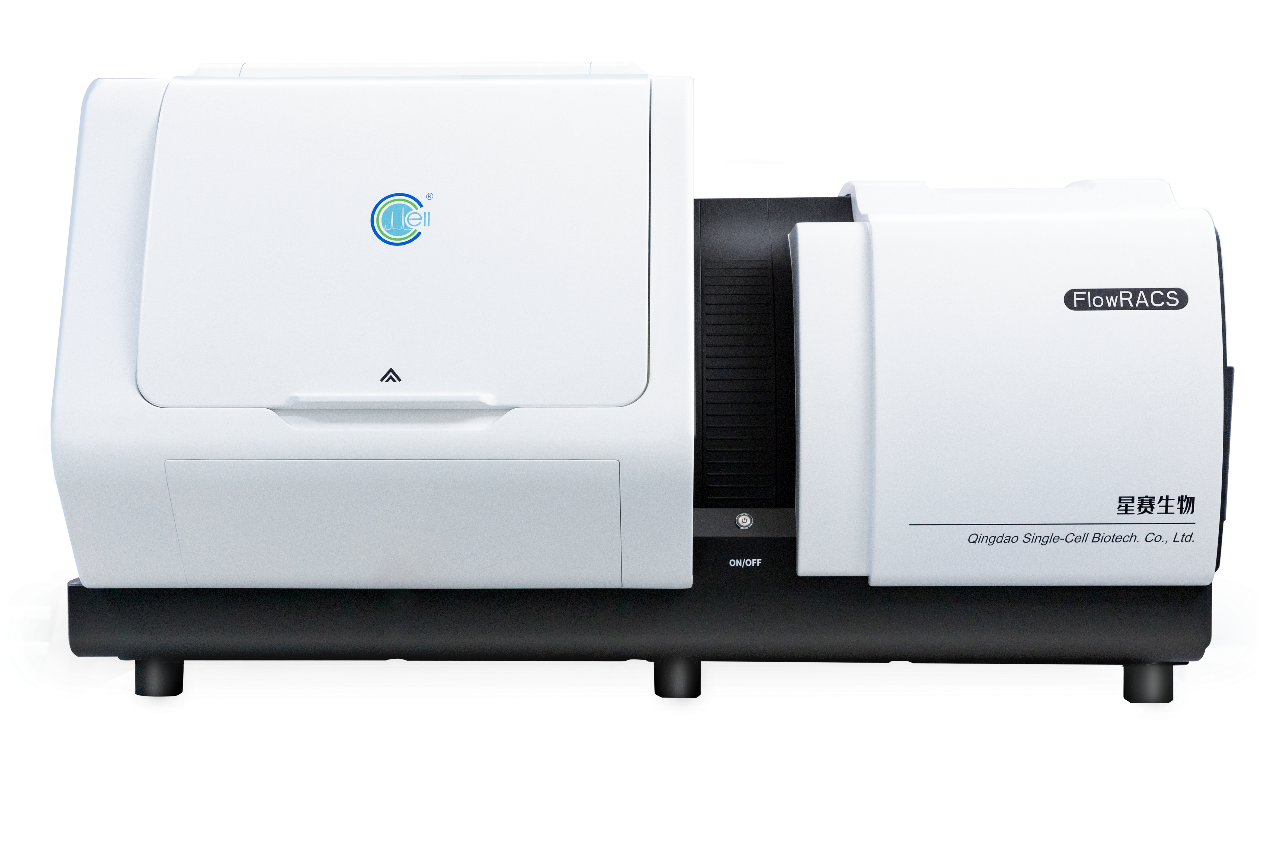
FlowRACS is characterized by high throughput, making it suitable for sample detection in complex scenarios. It enables label-free cell analysis and allows for the detection of cellular functions through spectral detection and analysis.Currently, the FlowRACS system achieves a sorting throughput of nearly 2,000 cells per minute. Post-sorting, cells maintain high viability and extensive genome coverage. The label-free, non-destructive Raman detection principle, combined with the “screen-first, culture-later” sorting strategy, enables efficient mining of industrial microbial resources, thereby greatly meeting downstream application demands.
eCyte has established three major technology platforms: microfluidics, instrumentation, and biological applications. Based on diverse application scenarios, the company has developed a series of algorithmic models and scenario-specific databases, leveraging machine learning to guide metabolism-based functional targeted sorting, thereby achieving full-process visualization, automation, and intelligence.
eCyte has independently developed a series of single-cell analysis instruments (the Raman-omics instrument series), including the high-throughput flow Raman cell sorter FlowRACS, the single-cell Raman optical tweezers sorter RACS-Seq, the single-cell microdroplet sorter EasySort, and the clinical single-cell Raman antimicrobial susceptibility rapid tester CAST-R, as well as various reagent kits and microfluidic sorting chips for microbiome analysis, single-cell whole-genome/trace nucleic acid amplification, and single-cell culture/sorting.
In terms of exploring application scenarios,In the industrial sector,eCyte provides solutions for microbial metabolic process detection and cell sorting, targeting sectors including baijiu brewing, food, preservatives, probiotics, and fermentation., has established partnerships with large industrial clients such as Moutai and Procter & Gamble,Its Raman spectroscopy instrument series has been applied to product development and quality control in industrial sectors such as baijiu brewing and personal care. Furthermore, leveraging its proprietary single-cell quality inspection technology for probiotics, eCyte has participated in the formulation of group standards for probiotic viable cell counting and vitality assessment, and is collaborating with institutions such as the National Institute of Metrology, China to promote new standards for rapid quality testing of next-generation cellular products.
In the field of synthetic biology,eCyte provides an integrated solution for single-cell phenotypic identification and sorting. Supported by the National Key R&D Program for Synthetic Biology Equipment, eCyte has established collaborations with institutions such as the Shenzhen Institute of Advanced Technology and CABIO Biotech, dedicated to improving the efficiency of industrial microbial resource screening.In the field of microbiological testing,eCyte provides next-generation solutions for rapid microbial detection. In collaboration with the Chinese Center for Disease Control and Prevention (China CDC) and Qingdao Customs, it has established new strategies for the rapid detection, early warning, and source tracing of pathogenic bacteria. To date, eCyte has drafted two national standards in the field of rapid microbial detection.In the field of scientific instruments,eCyte’s instruments have been deployed in major cities across China, recently completed installation at the University of Hong Kong, and have also entered the European market.
Dr. Ma Bo, Chairman of eCyteeCyte stated that its mission is to establish a “functional ID” system for every cell on Earth, thereby enabling real-time, in-depth detection and exploration of biological resources inherent in nature and the human body. The company expressed gratitude to investors for their recognition and support of this mission, as well as to the entire eCyte team for their dedication and hard work. Over the next five years, eCyte will concentrate its efforts on developing systematic solutions, functional application scenarios, and fully automated industrial instruments. It will focus on key sectors including biomanufacturing, synthetic biology, microbiome detection, biopharmaceuticals, and cell therapy, promoting advanced standards and achieving comprehensive advancement from scientific research to industrial applications.
Lu Yongtao, Chairman of Hengxu CapitalIt was stated that, leveraging 12 years of accumulated expertise in scientific research, technology, and interdisciplinary talent, eCyte has successfully developed a single-cell metabolic functional detection and sorting platform based on Raman spectroscopy, and proposed the developmental direction of the “Ramanome.” By integrating with single-cell multi-omics data, this approach has significantly enhanced the value of current single-cell multi-omics datasets, filling a gap in the high-end laboratory instrument market both domestically and internationally. We look forward to eCyte’s long-term empowerment of the high-end laboratory instrument sector and its shared growth with the single-cell industry ecosystem.
Liu Xiaolei, Investment Director of Beiyang Haitang FundeCyte has achieved a series of source innovations spanning detection principles, key components, and instrumentation. Its single-cell Raman-omics products are widely applicable in the fields of single-cell analysis, microbial detection, and synthetic biology, providing enhanced tools for scientific research, healthcare, and industrial sectors. We also look forward to eCyte translating its advanced Raman-omics technology into tangible productivity, bringing further breakthroughs in the field of industrial microbiology.
About Hengxu Capital
Hengxu Capital, established in 2019, is a private equity investment institution under SAIC Motor Financial Holdings Management Co., Ltd. (“SAIC Financial Holdings”), the financial platform of Shanghai Automotive Industry Corporation (SAIC Motor). Leveraging the overall industrial advantages of SAIC Motor and the efficient collaborative empowerment of SAIC Financial Holdings, its equity investment segment is dedicated to strategically laying out emerging industries in green mobility, the mobility ecosystem, and the health ecosystem. Its alternative investment segment focuses primarily on investment opportunities in the photovoltaic and energy storage sectors, contributing to the development of SAIC Motor’s innovative industrial chain and the enhancement of its mobility ecosystem.
Hengxu Capital’s cumulative assets under management have exceeded RMB 37 billion. Its investors include industry leaders, financial institutions, government entities, and market-oriented institutions. The core team possesses extensive industry resources and rich experience in project and fund management, having led investments in dozens of high-quality enterprises such as CATL, Horizon Robotics, Jiehydrogen Technology, Tongxingbao, QingTao Energy, ChipON Microelectronics, Yihua Pharmaceutical, and Shuaike Pet Care, supporting their growth into leading players in their respective niche markets.
About Beiyang Haitang Fund
Beiyang Haitang Fund is a purely market-oriented venture capital fund focused on the commercialization of university scientific and technological achievements and high-growth technology projects. It was jointly established by prominent alumni entrepreneurs, including Liu Yi, President of the Tianjin University Tianjin Alumni Association and Chairman of Andon Health Co., Ltd., with the mission of building a “Stanford + Silicon Valley” model for Tianjin University and fostering an entrepreneurial ecosystem for its alumni. Since its establishment over three years ago, the fund has invested in more than 30 startup projects, primarily founded by Tianjin University alumni, leveraging nearly RMB 2 billion in co-investments. The first and second phases of the Haitang Fund have managed sizes of RMB 100 million and RMB 540 million, respectively. Sub-funds such as Haitang Tuanbo, Haitang Tiankai, and Haitang Golden Seed have gradually commenced operations, bringing the total assets under management to over RMB 1 billion.