

Volcano Engine's Progress in Bringing Life Sciences to the Cloud: An Interview with Zhang Xin
“The intervention of artificial intelligence has brought unprecedented opportunities to bioinformatics research, not only enhancing our understanding of life sciences but also opening up new possibilities in fields such as disease treatment and gene editing,” stated Zhang Zemin, a newly elected academician of the Chinese Academy of Sciences, National Distinguished Professor, Changjiang Scholar, and Director of the Beijing International Center for Genetic and Genomic Medicine (BIOPIC) at Peking University, during the 2023 Volcano Engine AI for Science Closed-Door Seminar.
AI for Science (AI4S) is undoubtedly enjoying widespread enthusiasm across all fronts.
Both domestically and internationally, the entire industry is “abuzz” with the structural transformation opportunities brought about by AI. In China, initiatives such as the “AI Paradigm for Major Scientific Research” have been deployed to foster innovative research in key fields including earth sciences and biomedical sciences. Globally, competition among industry leaders is intensifying, with IT giants like Microsoft and NVIDIA, as well as pharmaceutical giants like Sanofi, significantly increasing their investments in AI for Science (AI4S). Furthermore, the Organisation for Economic Co-operation and Development (OECD) has released policy recommendations on AI in Science targeted at policymakers worldwide.
However, to unlock the full potential of AI for Science (AI4S) and truly realize AI-accelerated molecular simulations, AI-based protein structure prediction, and AI-enabled drug and material design in fields such as life sciences, there is still a long and arduous road ahead, even with the current foundation of computational power.
Industry practitioners have undoubtedly recognized this issue as well.
To unlock the value of AI for Science (AI4S), Volcano Engine also unveiled its Research Intelligent Computing Cloud Solution at the conference, providing research institutions and professionals with full-scenario products and solutions spanning from IaaS to PaaS and SaaS.
How is Volcano Engine helping accelerate scientific research toward AI for Science (AI4S) and enabling life science institutions to move to the cloud? VCBeat took this opportunity to interviewZhang Xin, Vice President of Volcano Engine.
In 2021, Volcano Engine made its brand debut. As the cloud service platform under ByteDance, Volcano Engine aims to open up the growth methodologies, technical capabilities, and application tools accumulated during ByteDance’s rapid development to external enterprises, serving as an industry “engine” to drive customer business growth.
Volcano Engine Vice President Zhang Xin
Amid the structural transformation opportunities brought by AI, Volcano Engine is, in Zhang Xin’s words, “a new generation of infrastructure and supporting technical middle platforms built for intelligent new applications.”
Against this backdrop, in 2022, Volcano Engine launched a series of cloud-based product solutions, including general-purpose solutions for enterprise cloud migration and intelligent marketing, as well as cloud-driven growth solutions spanning multiple industries such as finance, automotive, and healthcare. Also in 2022, Volcano Engine significantly increased its investment in the “healthcare” sector, particularly in life sciences and related fields.
The reasons for its focus on the life sciences sector are obvious.
On one hand, the life sciences sector holds immense potential for substantial growth.Currently, the sequencing of the complete human genome has been accomplished, but the paradigm shift brought about by sequencing technologies is only just beginning. With the advent of the omics era and the “big bang” of life science data, the limitations of traditional research methods have become apparent. Artificial intelligence (AI) will undoubtedly play an increasingly important role in areas such as elucidating biological mechanisms, disease screening, diagnosis, and treatment. In terms of investment in the biopharmaceutical sector, according to the “2022 Global Healthcare Industry Capital Report” published by VCBeat and Eggshell Research Institute, biopharmaceuticals led other sub-sectors with 1,094 financing deals and a cumulative total of approximately USD 34.61 billion. Consequently, the cloud services market closely associated with this sector undoubtedly presents significant opportunities.
On the other hand, “A workman must first sharpen his tools if he is to do his job well.”Volcano Engine had already established a solid foundation for delivering mature solutions before offering universal solutions to the life sciences sector. This advantage stems from its long-term exploration in the field of life sciences. Internally, research papers from ByteDance’s AI Lab have been frequently accepted by top academic conferences, covering high-profile areas such as protein structure prediction models and quantum chemistry. Externally, Volcano Engine has maintained long-term collaborations with prestigious scientific research institutions, including the Guangzhou Laboratory. These factors have jointly laid a strong foundation for its competitive edge.
At a time when AI is bringing about opportunities for structural transformation, Volcano Engine’s decision to engage in this field and increase its investment in life sciences is undoubtedly a move that aligns with the trend.
“On the one hand, in the era of big data in life sciences, researchers are confronted with the complexity and diversity arising from multimodal, high-dimensional, and cross-scale data; on the other hand, they face numerous challenges, including standardization issues associated with the paradigm shift from experiment-driven to data-driven research,” mentioned Zhang Xin.
These issues are particularly pronounced in the fields of bioinformatics and pharmaceuticals.
From the perspective of gene sequencing in the field of bioinformatics, after undergoing sample preparation and sequencing on the instrument, high-throughput gene sequencing generates massive amounts of genomic sequence data. This involves the storage, computation, and transmission of vast datasets, imposing stringent requirements on the underlying infrastructure. Furthermore, faced with such an enormous volume of data, enterprises also encounter challenges in efficiently processing data and enabling its analysis and sharing.
If traditional IDC data centers are adopted for construction, enterprise IT infrastructure may face issues such as fixed resource scale, long construction cycles, and high operational and maintenance costs for hardware resources, which will hinder the company's development during its rapid expansion phase. Meanwhile, for systems gradually built based on their own business development and workflows, enterprises often face not only high R&D investment but also challenges in compatibility with external standards.
The challenges facing the pharmaceutical sector are “anything but few.”Due to the significant challenges in elucidating target-disease relationships, the high complexity of target druggability, and the difficulties in developing drug molecules, the success rate of drug research and development (R&D) remains extremely low. Relying solely on traditional experimental approaches for drug discovery is no longer viable. Consequently, a large number of enterprises are exploring AI- and big data-driven drug R&D models that integrate mechanistic understanding with data-driven insights, thereby reducing the time and economic costs associated with extensive experimentation.
Clearly, the bioinformatics and pharmaceutical sectors do not merely require a standalone computing power solution; rather, they need a comprehensive solution that better meets foundational computational demands and accelerates scientific discovery.
Volcano Engine targets the aforementioned pain points,At the conference, a scientific research intelligent computing cloud solution was released. Targeting broad AI scenarios such as bioinformatics, healthcare, artificial intelligence, materials science, molecular simulation, and EDA, it has built an AI4S full-scenario product and solution encompassing a three-tier architecture: infrastructure layer, platform layer, and scientific research application layer.Its goal is to accelerate the unlocking of new discoveries by experts in basic science fields, including life sciences.
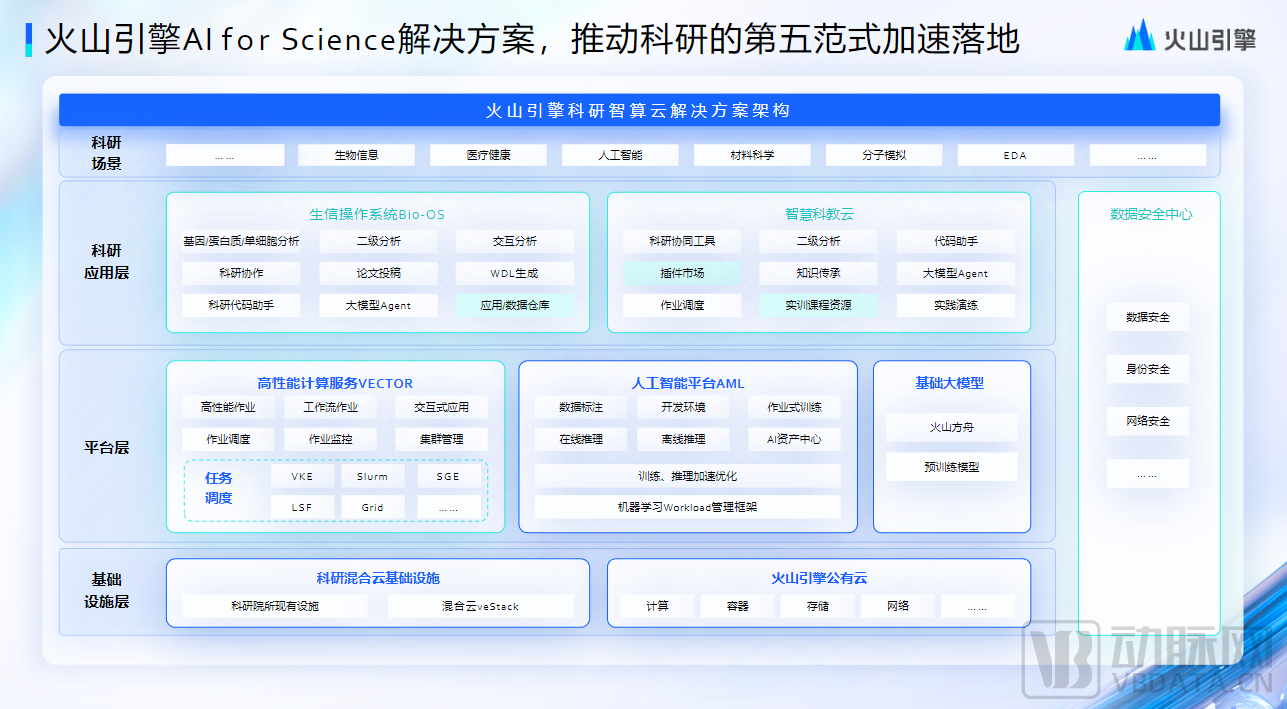
Volcano Engine Scientific Research and Intelligent Computing Cloud Solution Architecture Diagram
From an infrastructure perspectiveCurrently, some institutions adopt hybrid cloud strategies for security reasons, while others opt for full-scale migration to the cloud. Volcano Engine can provide computing, containerization, storage, networking, and other infrastructure services for scientific research via its public cloud offerings. Additionally, through its hybrid cloud solution, veStack, Volcano Engine can integrate with existing facilities at research institutions to jointly build a robust hybrid cloud infrastructure.
From a platform perspectiveTaking AI-driven drug discovery as an example, DeepModeling has completed the training of Uni-RNA, a novel context-aware deep learning model, leveraging Volcano Engine’s Huoshan Ark large model service platform and pre-trained large models. Pre-trained on the largest RNA sequence dataset to date at an unprecedented scale, this model is poised to deliver innovative solutions for numerous critical areas, including mRNA vaccine design, RNA structure prediction, antisense oligonucleotide (ASO) development, small interfering RNA (siRNA) therapeutic innovation, targeted RNA small-molecule development, and aptamer research and development.
From an application perspectiveThe quality of the operating system is crucial to the smooth progress of scientific research. To address this, Volcano Engine has developed Bio-OS, a biomedical big data operating system that integrates automated workflow orchestration and Workspace capabilities. Taking the bioinformatics field as an example, with the support of Volcano Engine’s Bio-OS system, MoleculeMind has built and launched China’s first fully functional AI platform for protein design and optimization.
Across the industry, the performance growth of cloud service platforms in the life sciences sector follows a discernible trajectory.
On one hand, life sciences companies are accelerating their migration to the cloud. Whether in gene sequencing or AI-driven drug discovery, the massive demands for data storage, computing, and transmission, along with the need for elastic support for business growth and control over IT operational costs, are driving the accelerated adoption of cloud solutions in the life sciences sector.
On the other hand, driven by needs such as business stability, controllability, and resource complementarity, enterprises have increasingly adopted multi-cloud deployment strategies, which has further expanded the cloud market.
Volcano Engine has also achieved notable progress in the gradually expanding cloud services market for the life sciences sector. Since 2022, Volcano Engine has partnered with dozens of leading universities and institutions in the life sciences field, with both the willingness to collaborate and the number of partnerships continuing to grow. With the launch of its Research Intelligent Computing Cloud solution, Volcano Engine is not only further empowering the life sciences sector to unlock new discoveries but is also poised to drive further growth in its cloud services business.
For Volcano Engine, in addition to the overall positive market trend, a particularly crucial factor is that it has avoided homogeneous competition among vendors in computing power, instead providing differentiated services oriented toward applications and scenarios. In short, Volcano Engine has identified its “three key strategies” that fully leverage its competitive advantages.
First, Volcano Engine has continued to build its advantages by leveraging an open-source and open-strategy approach.Taking Bio-OS, a biomedical big data operating system designed for the bioinformatics field, as an example, Volcano Engine offers not only commercial solutions but also an open-source version of Bio-OS. Based on this, it has built a community that continuously improves Bio-OS capabilities and accumulates more tools and data by hosting open-source competitions. The inaugural Bio-OS Open Source Competition attracted 187 teams from 45 universities, 16 research institutions, 8 enterprises, and individual participants worldwide. As a novel foundational platform for biomedical information analysis, Bio-OS leverages open-source collaboration to drive joint development and application, which undoubtedly holds significant importance for its future growth.
Second, Volcano Engine fully meets customer needs through its end-to-end solutions.“Compared to hardware infrastructure such as computing power, users (enterprises) are undoubtedly more concerned with the experience of the upper-level operational interface and the direct incremental value.” On one hand, Volcano Engine has sidestepped the homogenized and hyper-competitive “computing power” race; on the other hand, targeting the entire life sciences sector, it provides full-stack solutions spanning from infrastructure to platforms to applications, covering academia, research, and industry. While fully meeting B-end demands, this approach further drives the rapid development of both enterprises and the platform through the data flywheel effect.
Third, Volcano Engine delivers a more intelligent service experience based on the large model service platform “Volcano Ark.”Unlike many other cloud providers that merely offer computing power and basic infrastructure, the Volcano Ark platform is committed to reducing inference costs and collaborating with customers on the co-development and deployment of key applications, thereby accelerating the adoption of large models and high-performance computing across various industries. For instance, in the field of bioinformatics, leveraging the Bio-OS operating system and AI large models, it enables enterprises to perform tasks such as scientific knowledge retrieval, in-depth paper analysis, data analysis agents, and manuscript writing assistance, facilitating more efficient and precise academic research, knowledge discovery, and scientific decision-making.
It is worth noting that the content production capabilities and multi-user collaboration features, honed through products serving hundreds of millions of users and daily active users (DAU), are also contributing to the development of Volcano Engine. These capabilities drive Volcano Engine, with its internet DNA, to deliver ultimate product experiences, such as leveraging the advantages of content creation and multi-user collaboration in scientific research to meet the needs of educational and research institutions.
As cloud service platforms such as Volcano Engine continue to leverage their platform value in the era of profound AI transformation, empowering the life sciences sector to reduce costs and increase efficiency, accelerate research, and drive commercial innovation, we believe that an era of explosive innovation in life sciences may be upon us.