

Editas Medicine Reports Positive Clinical Data for EDIT-301 (reni-cel) in SCD and TDT at ASH 2023

Editas Medicine
Genomic Drug Development and Manufacturing
On December 12, at the 65th American Society of Hematology (ASH) Annual Meeting, genome editing company Editas Medicine (hereinafter referred to as “Editas”) presented the latest safety and efficacy data for its CRISPR gene-editing therapy, EDIT-301, from two clinical trials: the RUBY trial for severe sickle cell disease (SCD) and the EdiTHAL trial for transfusion-dependent β-thalassemia (TDT).
Study data show that EDIT-301 (now known as renizgamglogene autogedtemcel [reni-cel]) was well tolerated in both the RUBY trial (n=11) and the EdiTHAL trial (n=6), and all patients across the two trials (n=17) continued to exhibit a safety profile consistent with busulfan-based myeloablative conditioning and autologous hematopoietic stem cell transplantation. Following reni-cel infusion, all treated patients with more than 2 months of follow-up demonstrated successful neutrophil engraftment within 1 month and successful platelet engraftment within 1.6 months. To date, no serious adverse events (SAEs) related to reni-cel treatment have been reported in either trial.
Editas Medicine was founded in 2013 as a genome editing company co-established by five world-class leaders in the field of gene editing. Among its founders is Chinese-American biologist Feng Zhang, along with 2020 Nobel Laureate Jennifer Doudna and other renowned gene editing scientists George Church, Keith Joung, and David Liu. The company went public on the NASDAQ on February 3, 2016, becoming the first initial public offering (IPO) in the global CRISPR gene editing sector.
Editas Medicine primarily leverages two distinct CRISPR nucleases—Cas9 and Cpf1 (also known as Cas12a)—to develop targeted, durable gene-editing therapeutics aimed at improving the lives of patients with serious diseases. To date, Editas is the only company with a patented combination of CRISPR Cas9 and Cas12a technologies.
Cas9 is a programmable protein that can specifically locate, bind to, and edit the DNA of target genes. It pairs with guide RNA molecules to recognize and initiate double-strand breaks in the target DNA sequence, followed by repair processes that enable changes to the DNA sequence. Cas9 has accelerated biomedical research worldwide and made possible the development of gene-editing drugs and cell therapies that were previously unattainable.
Cas12a is a novel CRISPR gene-editing tool developed by Feng Zhang’s team in 2015. Cas12a is a CRISPR protein similar to Cas9, but it exhibits significant molecular differences in its mechanisms of DNA targeting and editing. Cas12a can also perform staggered DNA cleavage, thereby enhancing the efficiency and accuracy of certain forms of gene repair. These distinctions make Cas12a an excellent complementary tool that expands the scope of CRISPR gene-editing applications.
Furthermore, to address the relatively low editing efficiency of Cas12a in living cells, Editas has developed a novel gene-editing proprietary technology called SLEEK. SLEEK utilizes Editas’s proprietary engineered AsCas12a nuclease to enable highly efficient multi-gene knock-in in induced pluripotent stem cells (iPSCs), T cells, and NK cells. It achieves knock-in of functional genes at specific genomic loci with nearly 100% efficiency, ensuring robust transgene expression while significantly reducing off-target risks.
Building on this foundation, Editas has established a gene editing platform based on CRISPR-Cas9/Cas12a technology patents, primarily focused on the research and development of in vivo gene editing therapeutics and ex vivo gene-edited cell therapies.
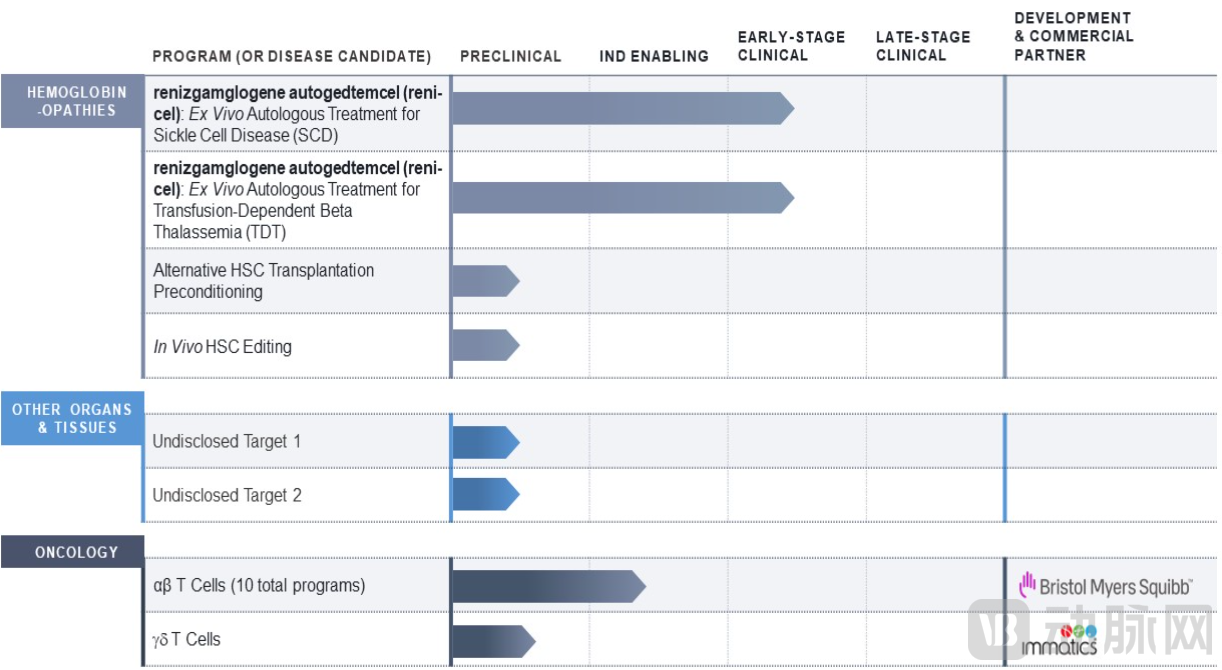 Editas Medicine's Pipeline in Development
Source: Editas Medicine website
reni-cel is Editas Medicine’s ex vivo gene-edited cell therapy program for the treatment of sickle cell disease (SCD) and transfusion-dependent beta-thalassemia (TDT). It utilizes Cas12a protein for gene editing, marking Editas Medicine’s first drug candidate to employ the Cas12a enzyme.
reni-cel consists of patient-derived CD34+ hematopoietic stem and progenitor cells edited with AsCas12a nuclease at the promoters of the γ-globin genes (HBG1 and HBG2). Studies have shown that reni-cel can reactivate γ-globin expression, thereby promoting fetal hemoglobin production and ultimately improving erythroid maturation in patients. This may provide a one-time, durable therapeutic effect for patients with severe sickle cell disease (SCD) and transfusion-dependent β-thalassemia (TDT).
reni-cel is currently being evaluated in two clinical trials: RUBY and EdiTHAL.
The RUBY trial is a single-arm, open-label, multicenter Phase 1/2 clinical study designed to evaluate the safety and efficacy of reni-cel in patients with severe sickle cell disease (SCD). Results showed that no patient experienced vaso-occlusive events (VOEs) following treatment with reni-cel (n=11). Treatment with reni-cel led to increases in total hemoglobin and fetal hemoglobin levels.
Furthermore, all patients with a follow-up of ≥5 months maintained normal hemoglobin levels and fetal hemoglobin levels >40% (n=6; follow-up range: 5–18 months). All treated patients with more than 1 month of follow-up exhibited similar trajectories of increase in total hemoglobin and fetal hemoglobin (n=10).
The EdiTHAL trial is a single-arm, open-label, multicenter Phase 1/2 study designed to evaluate the safety and efficacy of reni-cel in patients with transfusion-dependent thalassemia (TDT). Data showed that total hemoglobin levels increased in all patients following treatment with reni-cel, exceeding the transfusion-independence threshold of 9 g/dL (n=6). In patients with follow-up durations exceeding one month (n=5), both total hemoglobin and fetal hemoglobin levels increased, with total hemoglobin rising above the transfusion-independence threshold of 9 g/dL.
Although Editas was the first company to go public in the global CRISPR gene-editing sector, it has not gained a first-mover advantage in product development. Compared with other industry players such as Vertex Pharmaceuticals, CRISPR Therapeutics, and bluebird bio, Editas’s clinical progress has been notably slower.
On December 8, the FDA simultaneously approved Casgevy (exa-cel), a CRISPR/Cas9 gene-editing therapy co-developed by Vertex and CRISPR Therapeutics, and Lyfgenia (lovo-cel), a cell and gene therapy developed by bluebird bio.
Casgevy has been approved for the treatment of patients aged 12 years and older with sickle cell disease (SCD) who experience recurrent vaso-occlusive crises (VOC), priced at $2.2 million. Lyfgenia has been approved for the treatment of patients aged 12 years and older with SCD and a history of vaso-occlusive events (VOE), priced at $3.1 million. The simultaneous launch of these two products has ushered in the era of gene therapy.
In addition, Editas faces numerous competitors, one of which is Intellia Therapeutics (hereinafter referred to as “Intellia”), another member of the “big three” in gene editing with significant historical ties.
Intellia was founded by Jennifer Doudna, who had previously co-founded Editas Medicine. Due to disagreements with Feng Zhang over a patent dispute, Jennifer Doudna left the company and established Intellia in 2014. The company successfully completed its initial public offering (IPO) on the NASDAQ in 2016.
Intellia is dedicated to rapidly translating CRISPR/Cas9-based drug candidates into clinical applications, developing novel engineered cell therapies for various cancers and autoimmune diseases. Leveraging its CRISPR/Cas9 genome editing platform, Intellia focuses on the research and development of both in vivo and ex vivo gene editing therapeutics.
Currently, Intellia has multiple pipelines under development, with the most advanced being NTLA-2001, which is being developed for the treatment of transthyretin amyloidosis (ATTR).
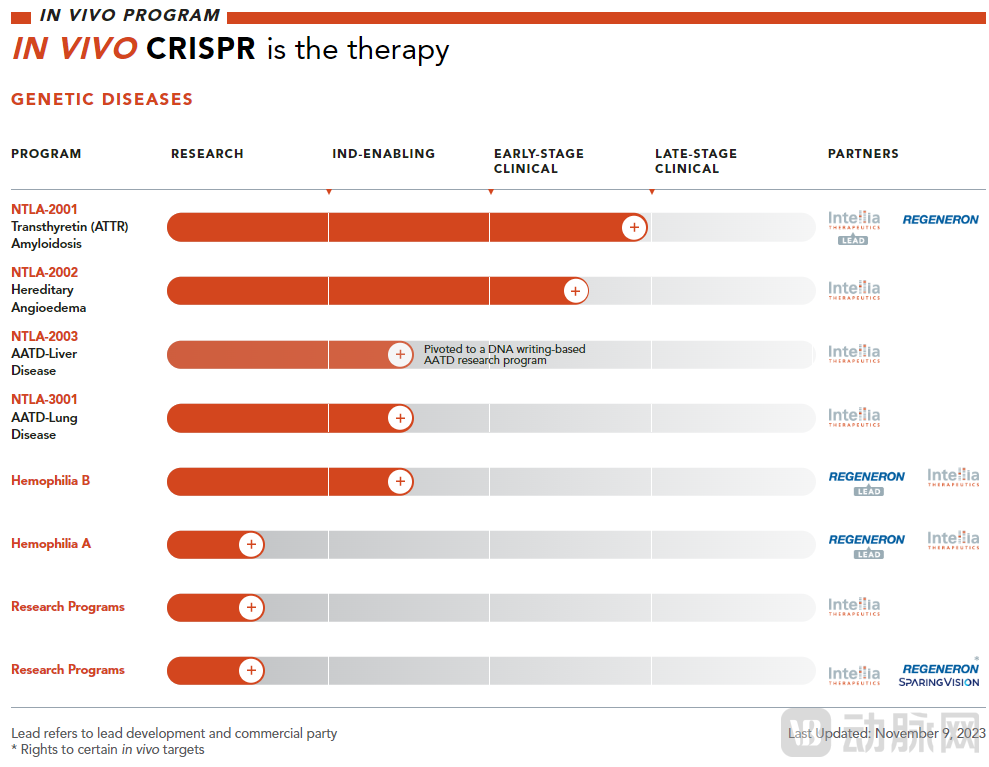
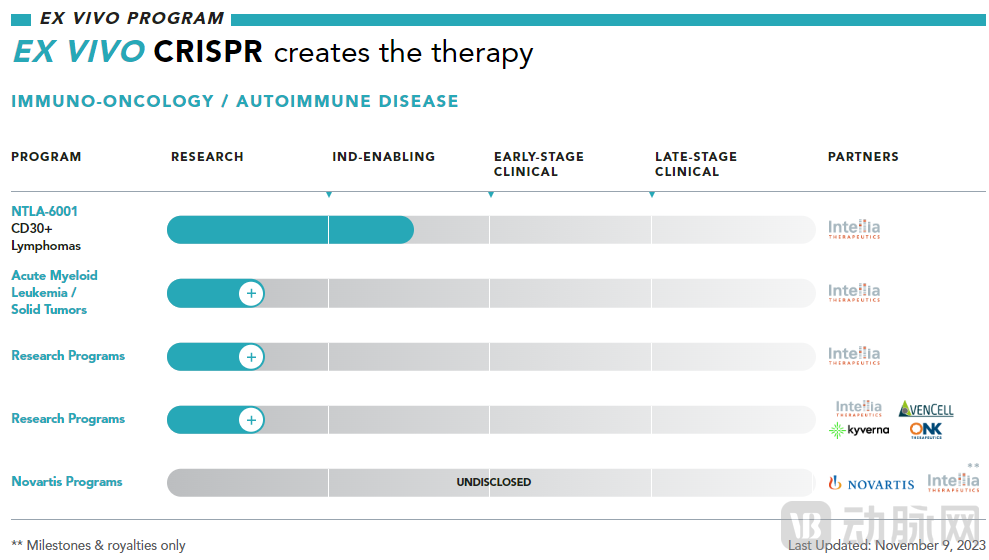
Intellia's Pipeline in Development
Image source: Intellia’s official website
In addition to Jennifer Doudna, Editas’ Chief Medical Officer Gerald Cox proposed a job change in August 2018, and CEO Katrine Bosley announced her resignation at the end of March 2019. The successive departures of key personnel have placed Editas in the spotlight, subjecting it to public scrutiny.
Challenges Have Once Again Found Editas.
In January this year, Editas adjusted its product and personnel portfolio to extend its cash runway into 2025 and focus on research in hemoglobinopathies and in vivo gene editing therapies. First, the company streamlined three R&D pipelines, discontinuing internal investment in its inherited retinal disease (IRD) program and its multiplex-edited induced pluripotent stem cell (iPSC)-derived natural killer (iNK) cell program. Editas will seek partners to continue developing the iNK franchise. Additionally, the company reduced its workforce by approximately 20% and reorganized its research operations into two divisions. In line with the shift in product portfolio priorities, Dr. Mark S. Shearman, Chief Scientific Officer of Editas, also announced his resignation and departure from the company.
Yet with challenges come opportunities. Judging by the efficacy, pricing, and other aspects of currently approved and marketed gene-editing drugs, they are far from perfect.
Taking bluebird bio as an example, although Lyfgenia is its third gene therapy approved by the FDA, its price is $900,000 higher than that of Casgevy, which essentially stifles its commercialization potential. Furthermore, Lyfgenia carries an FDA black box warning: clinical trial data indicated that several subjects developed blood cancers while receiving the therapy, necessitating lifelong monitoring. Consequently, the approval of Lyfgenia did not elicit “cheers” for bluebird bio; instead, its stock price plummeted by 40%.
Vertex/CRISPR’s Casgevy (exa-cel) is developed based on the CRISPR/Cas9 gene-editing system. The most significant concern surrounding CRISPR technology is off-target effects, and minimizing the safety risks associated with such effects remains a key challenge.
Furthermore, based on data from the two global clinical trials of Casgevy for SCD and TDT—CLIMB-111 and CLIMB-121—previously released by Vertex/CRISPR, 29 out of 31 treated patients (93.5%) achieved freedom from vaso-occlusive crises (VOCs) for 12 consecutive months, with a maximum hemoglobin increase exceeding 4 g/dL. Compared with the clinical data disclosed by Editas Medicine, this level of hemoglobin elevation reported by Vertex/CRISPR is lower than the 9 g/dL observed in Editas’s trials.
Therefore, Editas can bridge the gap in terms of clinical efficacy, R&D costs, and technology. Building on its proprietary CRISPR-Cas9 and Cas12a patented technologies, the company continues to discover new gene-editing technologies, thereby innovating and optimizing the safety and efficacy of therapies under development. This approach may ultimately enable it to secure a true foothold in the gene-editing therapy market.