

Sichuan-Based Baili Tianheng Submits Hong Kong IPO Filing Following $8.4B Deal for China's First Bispecific ADC
OrbiMed
Developer of Novel Antibody Drugs
On December 12, Baili Tianheng hit the 20% daily price limit. Since its listing in January, Baili Tianheng’s share price has risen from RMB 32.05 to RMB 131.11, while its market capitalization has surged from RMB 12.852 billion to RMB 52.58 billion.
The sharp surge may be attributed to the announcement on the 11th that SystImmune, a subsidiary of Baili Tianheng Pharmaceutical, and Bristol-Myers Squibb (BMS) reached an exclusive license and collaboration agreement for BL-B01D1. BL-B01D1 is a potential first-in-class HER3/EGFR bispecific antibody-drug conjugate (ADC) independently developed by SystImmune.
Under the cooperation agreement, both parties will collaborate to advance the development and commercialization of BL-B01D1 in the United States.SystImmune will, through its affiliates, be exclusively responsible for the development, commercialization, and manufacturing of BL-B01D1 in mainland China, as well as for manufacturing a portion of the drug supply for regions outside mainland China. BMS will be exclusively responsible for the development and commercialization of BL-B01D1 in all other regions worldwide.
Upon the effectiveness of the cooperation agreement, BMS will pay SystImmune an upfront payment of $800 million and near-term contingent payments of up to $500 million. Upon achievement of development, regulatory, and commercial milestones, SystImmune will be eligible for additional payments of up to $7.1 billion, bringing the potential total transaction value to up to $8.4 billion.
In terms of collaboration, SystImmune and BMS will share the global development costs for BL-B01D1, as well as profits and losses in the U.S. market. BMS will receive royalties from net sales in mainland China. Outside the United States and mainland China, SystImmune will receive tiered royalties from net sales.
As the first company to list on the STAR Market this year, Baili Tianheng Pharmaceutical has seen multiple share price increases within the year, marking the first time a domestically produced bispecific antibody ADC drug has entered the global market.
On January 6, the first day of trading, Baili Tianheng opened at RMB 28.75 per share and rose more than 40% during the session. By the close of trading that day, Baili Tianheng’s shares had gained 29.76%, closing at RMB 32.05 per share, with a total market capitalization of RMB 12.852 billion.
Public records indicate that in 1996, Baili Pharmaceutical, the predecessor of Baili Tianheng, established a manufacturing facility in Wenjiang. Baili Tianheng is a biopharmaceutical company focused on the global frontier of biomedical innovation and dedicated to addressing unmet clinical needs. The company possesses comprehensive R&D capabilities across small-molecule chemotherapeutics, large-molecule biologics, and antibody-drug conjugates (ADCs). Leveraging its integrated advantages spanning intermediates, active pharmaceutical ingredients (APIs), and finished formulations, Baili Tianheng has established end-to-end commercial operational capabilities covering the entire product lifecycle from “R&D to production to marketing.”
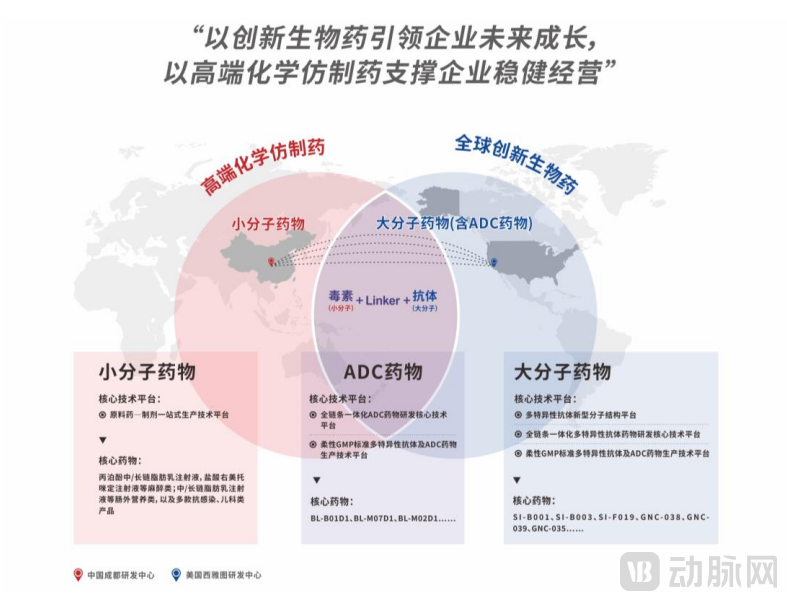
Multi-sector Layout (Source: Baili Tianheng Prospectus)
Baili Tianheng owns two new drug R&D centers—Systimmune (US) and Baili-Bio (China)—one antibody and ADC drug manufacturing enterprise, one chemical intermediate manufacturing enterprise, one active pharmaceutical ingredient (API) manufacturing enterprise, two chemical drug formulation manufacturing enterprises, and two marketing companies.
Among the many pharmaceutical companies undergoing transformation by betting on innovative drugs, Baili Tianheng has made significant investments, using its “chemical drug formulations and traditional Chinese medicine preparations segment” to continuously generate revenue, thereby supporting the R&D and related production base layout of its “innovative biologics business segment.”The prospectus shows that from 2019 to 2021, the company's operating revenue was RMB 1.207 billion, RMB 1.013 billion, and RMB 797 million, respectively; in the first half of 2022, it was RMB 305 million, showing a year-on-year decline. The corresponding net profit attributable to shareholders of the parent company was RMB 7.7309 million, RMB 37.9016 million, -RMB 99.9913 million, and -RMB 138 million, respectively, with the net profit attributable to shareholders of the parent company after deducting non-recurring gains and losses remaining negative.
The breakout point for these high-potential stocks occurred in May of this year.
At the 2023 ASCO Annual Meeting, Professor Zhang Li from Sun Yat-sen University Cancer Center presented the initial first-in-human Phase I clinical study data for BL-B01D1. The study primarily enrolled 195 patients with locally advanced or metastatic solid tumors who had failed standard therapies, including those with epidermal growth factor receptor (EGFR) mutation-positive and EGFR wild-type non-small cell lung cancer (NSCLC), head and neck cancers, and nasopharyngeal carcinoma. Notably, more than 50% of the patients had received three or more prior lines of therapy.
Trial data show that,Among 34 NSCLC patients with EGFR mutations, the objective response rate (ORR) was 61.8% and the disease control rate (DCR) was 91.2%; among 42 NSCLC patients with wild-type EGFR, the ORR was 40.5% and the DCR was 95.2%.Notably, all enrolled patients with EGFR-mutant NSCLC had previously received EGFR-TKI therapy (third-generation EGFR-TKIs are the mainstay of NSCLC treatment, but resistance mechanisms have limited therapeutic options for a subset of patients, creating an urgent need for novel agents); 88% of patients had received third-generation EGFR-TKIs, and 68% had undergone platinum-based chemotherapy.
In addition to NSCLC, among 7 patients with small cell lung cancer (SCLC), the ORR was 14.3% and the DCR was 85.7%; among 24 patients with nasopharyngeal carcinoma (NPC), the ORR was 45.8% and the DCR was 100%; and among 13 patients with head and neck squamous cell carcinoma (HNSCC), the ORR was 7.7% and the DCR was 76.9%.
In terms of safety, the most common grade ≥3 treatment-related adverse events (TRAEs) associated with BL-B01D1 were primarily hematologic, including leukopenia, neutropenia, anemia, and thrombocytopenia. No treatment discontinuations or deaths due to TRAEs occurred, demonstrating a manageable safety profile.
On July 3, Baili Tianheng Pharmaceutical announced that its Investigational New Drug (IND) application for BL-B01D1 had been approved by the U.S. Food and Drug Administration (FDA), with the approved indication being non-small cell lung cancer (NSCLC).As of this announcement, five Phase Ia/Ib clinical studies of BL-B01D1 monotherapy have been conducted in China, covering 16 types of tumors. In patients with heavily pretreated non-small cell lung cancer (NSCLC) and nasopharyngeal carcinoma, the drug has demonstrated breakthrough efficacy sufficient to advance to pivotal registration trials. In China, applications for pre-IND meetings have been submitted for three two-arm Phase III registration trials and two single-arm pivotal registration trials of BL-B01D1 monotherapy. Furthermore, IND approvals have been obtained for Phase II clinical trials evaluating BL-B01D1 in combination with SI-B003, with chemotherapy agents, and with osimertinib (a third-generation EGFR-TKI), and these combination therapy Phase II studies are currently underway. On July 4, shares of Baili Tianheng hit the daily upper limit in afternoon trading.
In October, Baili Tianheng presented Phase I study data on BL-B01D1 for the treatment of NSCLC at the 2023 ESMO Congress. Among 88 NSCLC patients evaluable for efficacy,The median progression-free survival (PFS) for patients with EGFR mutations and those with wild-type EGFR was 6.9 months and 5.2 months, respectively.
Since RemeGen’s disitamab vedotin successfully went global in August 2021, the wave of overseas expansion for antibody-drug conjugate (ADC) drugs has entered its third year, with total transaction values exceeding $25 billion. The current deal for BL-B01D1 not only marks the first successful overseas launch of a bispecific ADC but also sets a new record for licensing-out transactions involving a single Chinese-made ADC drug. This development underscores that the differentiation and diversification of ADC therapies have moved beyond the exploratory phase and are progressively entering a stage of maturity.
As a bispecific antibody-drug conjugate (ADC), the macromolecular component of BL-B01D1 is the bispecific antibody SI-B001, a recombinant humanized bispecific antibody independently developed by Baili Tianheng. It can simultaneously target and bind to the EGFR and HER3 receptors on tumor cells, thereby blocking tumorigenesis and progression, and enabling precise targeting for BL-B01D1.
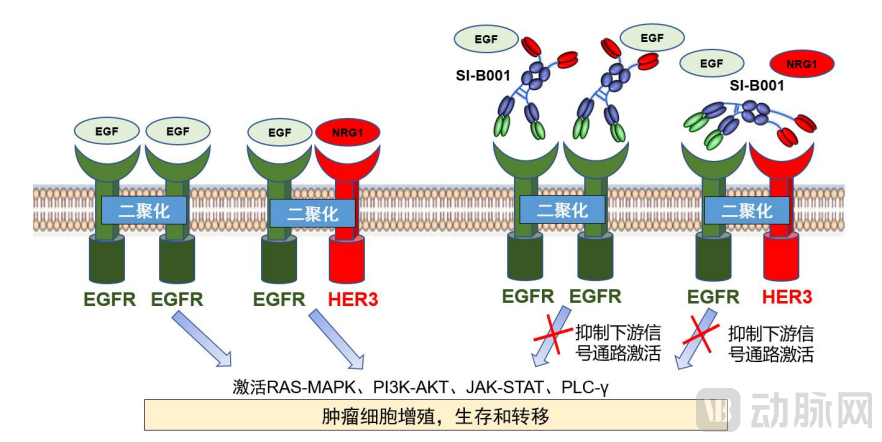
Mechanism of Action of SI-B001 (Source: Baili Tianheng Prospectus)
SI-B001 blocks the binding of EGFR and HER3 to their respective ligands, thereby further inhibiting the pharmacological activity of EGFR and HER3 and their downstream pathways, achieving the goal of suppressing and killing tumor cells. Meanwhile, due to its unique structural features, SI-B001 does not directly bind to HER3, thus avoiding inhibition of targets essential for maintaining normal physiological functions and resulting in low drug toxicity and side effects. In vitro and in vivo pharmacodynamic studies have demonstrated that SI-B001 has the potential to overcome HER3-mediated resistance following EGFR-targeted therapy, delivering superior efficacy compared to the combination of EGFR monoclonal antibodies and HER3 monoclonal antibodies.
The small-molecule toxin component of BL-B01D1 is ED04, a camptothecin analog independently developed by Baili Tianheng. It exerts direct cytotoxic effects on tumor cells by disrupting DNA structure. ED04 prevents the rejoining of broken DNA strands, thereby inhibiting DNA replication and RNA synthesis, which ultimately suppresses tumor growth.
Payload Fragment Section: BL-B01D1 is BaiLi TianHeng’s proprietary Ac linker, offering improved stability
Qualitative stabilization effectively prevents the detachment of drug molecules, ensuring the stability of the toxin during systemic circulation. Meanwhile, BL-B01D1, formed by conjugating the Ac linker with the antibody, exhibits enhanced hydrophilicity and reduced aggregation, thereby demonstrating improved safety and antitumor activity in vivo.
Comprehensive innovation across the three key elements of antibody-drug conjugates (ADCs) may explain why Bristol Myers Squibb (BMS) offered a substantial premium. According to China Securities Network, industry experts view this move as an indication that BMS will also pursue a development strategy combining PD-1 inhibitors with ADCs.
In April this year, Merck & Co. and Seagen/Astellas announced that the FDA had granted accelerated approval to Keytruda in combination with Padcev as a first-line treatment for patients with locally advanced or metastatic urothelial carcinoma who are ineligible for cisplatin-based chemotherapy. This marks the first approved combination therapy involving a PD-1 antibody and an antibody-drug conjugate (ADC) for this indication.
Analyses suggest that Merck & Co.’s comprehensive strategy to position PD-1 inhibitors in combination with antibody-drug conjugates (ADCs) is driven by the impending expiration of key patents for Keytruda; the approval of such combination therapies could extend Keytruda’s product lifecycle and help maintain its market leadership.Since 2022, Merck & Co. has secured overseas rights for the research, development, manufacturing, and commercialization of nine ADC drugs from Kelun-Biotech, with total milestone payments nearing $11.8 billion. In addition, Merck has entered into successive collaborations with VelosBio, Seattle Genetics, Gilead Sciences, and AstraZeneca, acquiring rights to multiple ADC candidates through pipeline acquisitions or clinical trial partnerships.
Key patents for Keytruda are set to expire in 2028, whereas those for Opdivo will expire in 2026. With time running out, BMS has adopted an “alternative” strategy of acquiring ADC assets.
In April this year, BMS reached an agreement with Tubulis to acquire its proprietary P5 conjugated ADC technology platform, with milestone payments exceeding $1 billion and a certain percentage of sales royalties. BMS will be fully responsible for the development, manufacturing, and commercialization of ADC candidate products generated from this technology platform. Subsequently, BMS announced that it would develop a drug named“Antibody-Conjugated Molecular Glue”a novel drug primarily intended to enhance the efficacy and safety of treatments for hematologic and solid tumors.
On November 7, BMS made another move, acquiring a product from Orum Therapeutics with an upfront payment of $100 million and a total transaction value of approximately $180 million.Potential First-in-Class ADC Drug ORM-6151. ORM-6151 is constructed using the dual-precision targeted protein degradation (TPD2) approach via a proprietary GSPT1 technology platform.Targeted Protein Degraders, which selectively degrades target proteins within cancer cells via E3 ubiquitin ligases. Upon conjugation with an antibody, it precisely targets cancer cells and disrupts the GSPT1 protein to achieve tumor-killing effects.
With the acquisition of the bispecific ADC drug BL-B01D1, BMS has made a significant bet on the cutting-edge ADC sector, which is characterized by both high risks and high opportunities.Whether the next move will be to double down on PD-1 + ADC or to become the next “Daiichi Sankyo,” we shall wait and see.