

Vertex Surges 13% on Breakthrough Non-Opioid Pain Drug VX-548, Joins $100B+ Market Cap Club

Vertex
Breakthrough Small Molecule Drug Developer
On December 13 (U.S. time), the share price of Vertex Pharmaceuticals (hereinafter referred to as “Vertex”) surged by 13% in a single day, pushing its market capitalization above $100 billion and adding another member to the elite club of pharmaceutical companies valued at over $100 billion.
The surge in Vertex’s market capitalization is primarily attributed to the favorable clinical data obtained for its chronic pain drug, VX-548.
Analgesics have long been a hotly contested sector, characterized by broad demand, substantial market potential, and significant government attention. Well-known opioid analgesics have exposed numerous issues, thereby drawing greater focus to the development of non-opioid analgesic targets. The positive results from VX-548 have ushered in a ray of hope for novel analgesics.
Pain management has long been a highly competitive sector. According to Mordor Intelligence’s 2023 market research report, the global pain management market was valued at an estimated $75.4 billion in 2023 and is projected to reach $90 billion by 2028.
Pain is defined as the sensation arising from actual or potential tissue damage, often accompanied by unpleasant emotional or physical symptoms. It serves as a protective mechanism for the body and is one of the most common clinical symptoms. There is a broad clinical demand for analgesia.
On the other hand, despite the availability of various medications and therapeutic approaches for pain management, many patients still do not achieve adequate pain relief. Consequently, there is an urgent patient demand for more effective and safer pain treatment methods, indicating significant market potential; in particular, innovative therapies and novel drugs have substantial opportunities to capture market share. Meanwhile, government attention to chronic pain and the misuse of analgesic medications has further heightened the prominence of this sector.
The analgesics referred to herein specifically denote agents that exert targeted effects on pain transmission pathways within the central nervous system (CNS), thereby alleviating pain. In other words, such drugs must act on specific targets within the CNS, as opposed to agents that “directly address or mitigate the underlying causes of pain,” or those exemplified by anesthetics that “non-selectively and comprehensively suppress CNS activity.”
Opioids are the mainstream analgesics for moderate to severe pain. Their core mechanism of action involves binding to opioid receptors, thereby reducing the transmission and perception of pain signals and exerting analgesic effects on both the central and peripheral nervous systems. Commonly targeted receptors include the μ (mu), κ (kappa), δ (delta), and nociceptin/orphanin FQ peptide (NOP) receptors, which represent the most frequently utilized analgesic targets in the clinical management of moderate to severe pain.
On the other hand, opioid receptors are not limited to the pain transmission pathways in the human body; they are also present in other regions of the central nervous system. Consequently, the use of opioid drugs activates opioid receptors in these additional areas, leading to side effects such as constipation, respiratory depression, and addiction. Due to their addictive potential, opioids are subject to strict regulatory control, leaving the clinical needs of the large population of patients with neuropathic pain, acute pain, and chronic pain unmet. Furthermore, tolerance to opioid drugs poses a significant challenge, necessitating dose escalation with long-term use.
A 2022 report by the U.S. Congress Joint Economic Committee indicated that opioid misuse cost the United States nearly $1.5 trillion, accounting for approximately 7% of the nation’s gross domestic product (GDP) that year. The Lancet previously predicted that, with the rise in co-use of xylazine and opioids, approximately 1.22 million Americans would die from opioid overdoses cumulatively between 2020 and 2029 unless new measures were implemented.
Although opioids provide excellent analgesic efficacy, the numerous issues they have raised have created a strong clinical demand for novel analgesics that are non-addictive, highly specific, associated with fewer side effects, and longer-acting. Attracted by the substantial market potential, many pharmaceutical companies are actively developing next-generation analgesic products.
Nav1.8 Inhibitor VX-548 Meets Primary Endpoint, Pivotal Trials to Commence Soon.
Studies have found that pain signal transmission depends on voltage-gated sodium channels (Nav) on the cell membrane. Inhibiting abnormal sodium channel activity and developing Nav inhibitors can help treat and alleviate pain. The Nav family has nine subtypes. Except for Nav1.8 and Nav1.9, which are only distributed in peripheral neurons, other subtypes are widely distributed in sympathetic neurons, cardiomyocytes, skeletal muscle, and the central nervous system. Inhibition of these subtypes can lead to some side effects.
Precisely because they do not engage in central nervous system-related activities, they do not pose addiction risks similar to those of opioids, nor do they affect motor function. Consequently, current research primarily focuses on the Nav1.8 and Nav1.9 sodium channel proteins.
On December 13 (U.S. time), Vertex announced positive results from its Phase 2 dose-ranging study of VX-548, a selective NaV1.8 inhibitor, in patients with painful diabetic peripheral neuropathy (DPN).
The primary endpoint of this study was the change from baseline in the mean daily pain intensity over 12 weeks, as assessed by the Numerical Pain Rating Scale (NPRS), a standard pain assessment tool, in patients with diabetic peripheral neuropathy (DPN) treated with VX-548. In the clinical trial, patients were randomized into four treatment groups: VX-548 at doses of 69 mg (high dose), 46 mg (medium dose), or 23 mg (low dose) once daily, and a pregabalin reference group at 100 mg three times daily (TID), for a duration of 12 weeks.
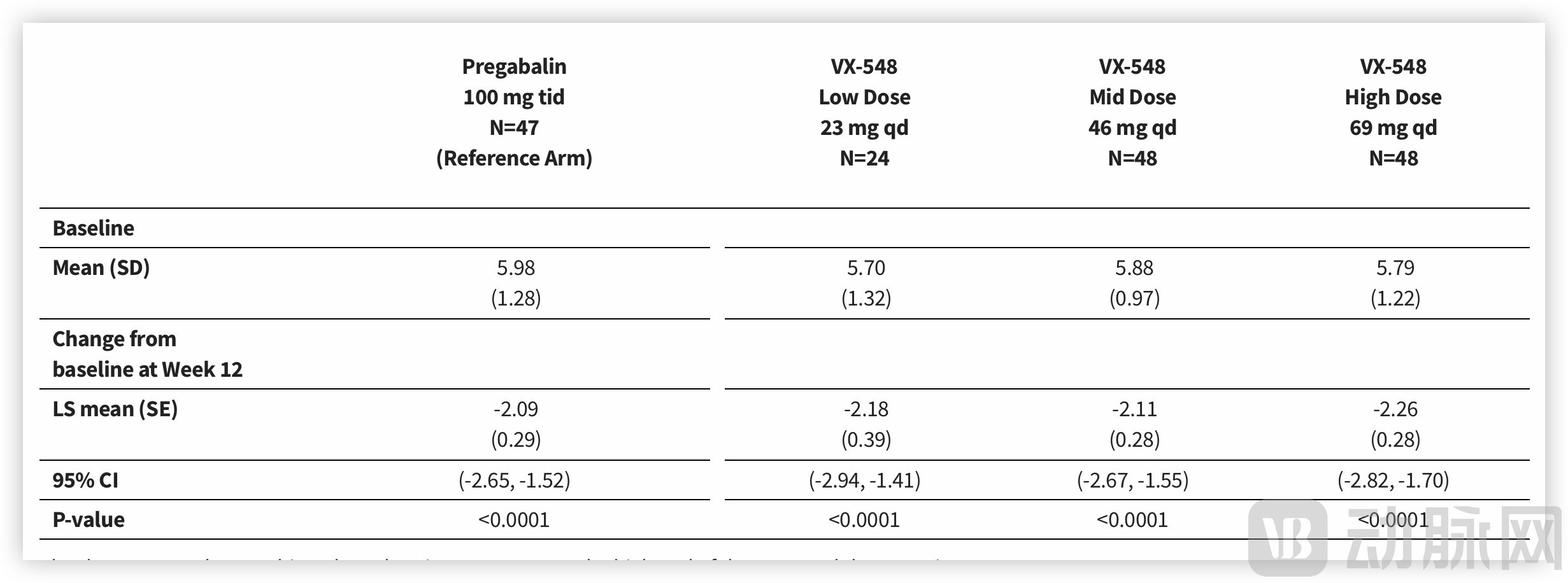
VX-548 Clinical Trial Data, Image Source: Corporate Website
Data show that starting from the first week of treatment, mean pain scores relative to baseline decreased continuously in all VX-548 dose groups, with sustained pain reduction through Week 5 and maintained analgesic efficacy throughout the treatment period. Furthermore, all VX-548 treatment groups demonstrated statistically and clinically significant reductions in pain compared to baseline. At Week 12, the mean changes in NPRS were -2.26, -2.11, and -2.18 for the high-, medium-, and low-dose groups, respectively. Meanwhile, the mean change in NPRS from baseline in the active control group (pregabalin) was -2.09 at Week 12.
Analyses of secondary and other endpoints also supported the primary endpoint results of this trial. In the responder analysis, more than 30% of patients treated with VX-548 across all dose groups achieved a greater than 50% reduction in NPRS scores compared with baseline. More than 20% of patients in the medium- and high-dose groups achieved a greater than 70% reduction in their weekly average NPRS from baseline at Week 12. In the pregabalin reference group, 22% of patients achieved a greater than 50% reduction in weekly average NPRS from baseline at Week 12, and 10% achieved a greater than 70% reduction.
VX-548 was generally well tolerated during the 12-week treatment period. Most adverse events were mild or moderate in severity, and no serious adverse events related to VX-548 occurred. The incidence of treatment-related adverse events was 14.5% among patients receiving VX-548, compared with 27.8% among those receiving pregabalin.
Vertex Plans to Advance VX-548 into Pivotal Trials Following Discussions with Regulatory Authorities
Currently, Vertex has initiated a second Phase 2 clinical trial of VX-548 for peripheral neuropathic pain, which will evaluate the efficacy of VX-548 in patients with lumbosacral radiculopathy (LSR), a condition characterized by pain resulting from damage or injury to the nerve roots in the lumbar region. Furthermore, results from the Phase 3 clinical trial of VX-548 for the treatment of acute pain are scheduled to be released in the first quarter of 2024.
Currently, opioids remain the most effective analgesics; however, their side effects, such as addiction potential, have led to stringent clinical restrictions, resulting in a significant unmet clinical need. If VX-548 can demonstrate a pathway to fill this gap, it will undoubtedly greatly boost confidence in the development of novel analgesic drugs.
This August, VX-548 was featured in the New England Journal of Medicine, demonstrating high selectivity (30,000-fold) for Nav1.8.
Professor Rao Yi gave this high praise: “These results indicate that basic research into the molecular mechanisms of pain is beginning to show clinical promise. This promise is the fruit of over a century of successive efforts by physicists, physiologists, geneticists, pharmacologists, and clinicians. If this path can be sustained, it will not only enable the development of specific chemical drugs but also open up possibilities for other therapeutic approaches, including gene editing.”
The reason for such a high evaluation lies in the fact that, over the past few decades of research into non-opioid analgesics, the critical bottleneck of safety has remained difficult to overcome, with selectivity being the key determinant of safety.
Taking ion channels, the mainstream targets in analgesic drug development, as an example, why have numerous ion channels involved in the generation and transmission of pain signals failed to become druggable targets? The core issue lies in the existence of multiple subtypes for each ion channel. These subtypes exhibit distinct distributions and functions, yet share extremely high structural similarity, making it exceedingly difficult to develop antagonists that specifically target a particular subtype.
For many years, research has confirmed that blocking the generation of action potentials in the peripheral nervous system to inhibit pain signal transmission and achieve analgesia is a viable technical approach. The critical roles of Nav1.7, Nav1.8, and Nav1.9 in pain signal transmission have also been elucidated; however, no drug developed based on this mechanism has yet become available.
VX-548 demonstrates up to 30,000-fold subtype selectivity for Nav1.8 and exerts selective inhibitory effects, exhibiting a favorable safety profile. It provides superior analgesic efficacy while avoiding adverse effects such as addiction. This bolsters confidence in the future development of highly selective analgesics based on ion channels and dispels the setbacks previously encountered by VX-150 and Pfizer’s PF-04531083, which both stalled at Phase II clinical trials.
Currently, several other novel analgesic drugs have been launched on the market, all placing significant emphasis on safety. For instance, ziconotide, an N-type calcium channel blocker developed by Elan Corporation in Ireland, is also known as intrathecal ziconotide due to its route of administration. It is an atypical analgesic used for the relief of severe and chronic pain. Derived from conotoxin peptides found in the cone snail, ziconotide exerts its analgesic effect by binding to N-type calcium channels, thereby inhibiting the release of pro-nociceptive neurochemicals—such as glutamate, calcitonin gene-related peptide (CGRP), and substance P—in the brain and spinal cord.
In September this year, Novartis’ imported erenumab injection, marketed under the brand name Aimovig, was officially approved for launch in China. It is the first fully human monoclonal antibody approved domestically that targets the calcitonin gene-related peptide (CGRP) receptor, indicated for the prevention of migraine in adults. During spontaneous migraine attacks, cerebral vasoconstriction occurs, and CGRP is released from trigeminal nerve fibers surrounding intracranial blood vessels. It then binds to CGRP receptors, triggering meningeal inflammation, which manifests as severe pain. Erenumab prevents migraine by blocking the binding of CGRP to its receptor, thereby inhibiting pain transmission.
Internationally, R&D interest in CGRP is high, with Novartis, Merck & Co., Eli Lilly, and Pfizer all having established pipelines. In China, only Junshi Biosciences’ JS010 has entered Phase I clinical trials.
For clinical practice, there has long been a need for highly effective analgesics without addictive potential. Breakthroughs in new targets such as Nav1.8 may help us open this long-sealed door.
According to data from Zhiyan Consulting, the market size of anesthetic and analgesic drugs in China has grown from RMB 19.75 billion in 2016 to RMB 30.34 billion in 2022. Anesthetics and analgesics are the two most important segments, collectively accounting for more than 80% of the entire market.
Faced with such a competitive landscape, domestic pharmaceutical companies will clearly not let this opportunity slip by.
In early December, Haisco Pharmaceutical announced that the Investigational New Drug (IND) application for its independently developed neuropathic pain treatment, HSK36357, had been accepted. Previously, the company’s new drug for neuralgia, HSK16149 capsules, had also seen its application for a new indication accepted for marketing approval. HSK16149 is a novel analgesic targeting voltage-gated calcium channels, indicated for diabetic peripheral neuropathic pain (DPNP) and postherpetic neuralgia.
At the American Diabetes Association (ADA) Scientific Sessions held this June, Haisco Pharmaceutical presented a multicenter clinical study evaluating the efficacy and safety of HSK16149 in Chinese patients with diabetic peripheral neuropathic pain (DPNP), reporting positive results. The drug is poised to become the first therapy approved for DPNP in China.
In addition to novel analgesics, the improvement of opioids is also a direction for innovation. HSK-21542, developed by Haisco Pharmaceutical, is a peripherally selective κ-opioid receptor agonist. Due to its peripheral action without central nervous system penetration or crossing of the blood-brain barrier, it carries a lower risk of addiction and avoids central side effects, resulting in a very low incidence of adverse reactions such as vomiting and constipation.
Numerous Chinese companies are also investing in the development of Nav1.8 inhibitors.
For instance, HRS-4800 from Hengrui Medicine has initiated a Phase II clinical trial for postoperative analgesia following impacted tooth extraction; JMKX000623 from Shanghai Jiyu received clinical trial approval in March 2022, and in May of the same year, Shanghai Jiyu, a subsidiary of Jemincare, partnered with ORION, granting ORION the rights to develop, manufacture, and commercialize the drug outside Greater China, with an upfront payment exceeding RMB 100 million; HBW-004285 from Haibowei Pharmaceutical also received clinical trial approval in China this April.
Guangzhou Fermion Tech signed an agreement with Joincare Pharmaceutical this November, granting the listed company Joincare exclusive rights in Greater China for its independently developed novel analgesic, FZ008-145. FZ008-145 is a highly selective second-generation Nav1.8 inhibitor that has currently obtained clinical data from five proof-of-concept (POC) studies. In October this year, an Investigational New Drug (IND) application for FZ008-145 was submitted to the Center for Drug Evaluation (CDE). Other candidates, including those from Minghui Pharmaceuticals and Pengji Kaifeng, are also in the preclinical stage.
Furthermore, monoclonal antibodies targeting nerve growth factor (NGF) inhibitors represent another strategic area of development.
Studies have found that injection of nerve growth factor (NGF) induces non-inflammatory, persistent thermal and mechanical hyperalgesia, while elevated NGF levels are observed in the nervous system across various animal models of neuropathic pain. Therefore, monoclonal anti-NGF antibodies have been developed to exert analgesic effects by selectively targeting, binding to, and inhibiting NGF.
Previously, Pfizer’s Tanezumab, Johnson & Johnson’s Fulranumab, and Regeneron’s Fasinumab were successively discontinued due to safety concerns; however, some domestic pharmaceutical companies have not given up.
Dashi Pharmaceutical’s DS002 is the first domestic monoclonal antibody drug targeting nerve growth factor (NGF), with Phase I clinical trial results demonstrating a favorable safety profile. SMR7694 from Unimed Pharmaceuticals received approval for clinical trials in China in March 2021 for the treatment of osteoarthritis pain. TNM009 from TopAlliance Biosciences was approved for clinical trials this April for the management of cancer pain (including bone metastasis-related cancer pain) and has shown promising analgesic efficacy and safety in preclinical in vivo studies.
Currently, opioid analgesics remain the mainstay for managing moderate to severe pain globally; however, these agents are commonly associated with safety and tolerability issues, prompting both clinical practitioners and the market to anticipate the introduction of novel therapeutics. In the first quarter of 2024, results from three Phase III clinical trials of VX548 for acute pain are scheduled to be released. Should these trials yield favorable outcomes, the analgesic market may undergo a significant transformation.
References:
https://news.vrtx.com/news-releases/news-release-details/vertex-announces-positive-results-phase-2-study-vx-548-treatment
https://news.vrtx.com/news-releases/news-release-details/vertex-announces-publication-vx-548-positive-phase-2-proof
https://mp.weixin.qq.com/s/jOR90PvSVN4UhlhRV7OzIg