

Zhuji Qingyan Biotech: Pioneering Innovative Polymer Payload Material for Non-Invasive Macromolecular Drug Delivery
The Prescriptions for Fifty-Two Diseases, compiled around the Warring States period, contains a note stating, “apply Cirsium to the center of the vertex,” which means that after being bitten by a venomous snake, fresh Cirsium can be crushed and applied as a compress to the center of the wound for treatment. This represents the earliest recorded use of topical application technology in China. After hundreds of years of development, Wu Shiji, known as the “Master of External Therapies” during the Qing Dynasty, systematically organized and theoretically explored the concept of treating internal diseases through external methods based on his clinical experience. His work, Liyue Pianwen, systematically elucidates an external therapy theory centered on medicinal patching, integrating acupuncture, medicated wines, and herbal formulations into a unified approach.
Nevertheless, for a considerable period, there remained a degree of skepticism toward transdermal drug delivery. It was not until the late 20th century, with the emergence of extensive theoretical and practical research on transdermal systems, that people gradually began to understand this technology.
As the third major drug delivery system after oral and injectable routes, transdermal drug delivery systems (TDDS) exert systemic therapeutic effects by entering the human bloodstream through the skin. This approach avoids drug degradation in the gastrointestinal tract and offers advantages such as reduced fluctuations in plasma drug concentration, decreased toxic and side effects, convenient administration, and improved patient compliance.
Represented by hydrogel patches, hot-melt adhesive patches, and solvent-based adhesive patches, the new generation of transdermal formulations offers rapid onset of action, minimal odor, low allergenic potential, non-stick properties, and enhanced convenience and safety, presenting numerous advantages over traditional dosage forms. According to statistics from the China Transdermal Technology Alliance, a total of 58 Chinese pharmaceutical companies and research institutions had transdermal patch products accepted for review or completed clinical trial registration and filing over the past three years (2021–2023). A total of 29 product varieties were accepted, including 11 traditional Chinese medicine (TCM) products and 18 chemical drug products, among which 9 were new drugs.
In this field,VCBeat has recently turned its attention to Electret Qingyan Biotechnology (Shenzhen) Co., Ltd. (hereinafter referred to as “Electret Qingyan”), a company that has successfully developed “polymer-loaded materials” enabling the non-invasive delivery of macromolecules.Zhuji Qingyan was founded in 2021, dedicated to applying polymer carrier materials to medical transdermal drug delivery and electric field physical therapy, with a focus on the development of high-end medical aesthetic masks, traditional Chinese medicine dressings, and transdermal drug delivery patches. Currently, the company holds three core patents.
From Semiconductors to Biopharma: Always Ready for Your Entrepreneurial Dreams
“Entrepreneurship is a path I must take.”“At the start of the interview, Zhang Qingyang, founder of Zhuji Qingyan, remarked. Yet we all know this is by no means an easy path: it is not a 50–50 coin toss, but rather entails significant risk and challenge, with odds akin to ‘nine deaths for every one survival.’”
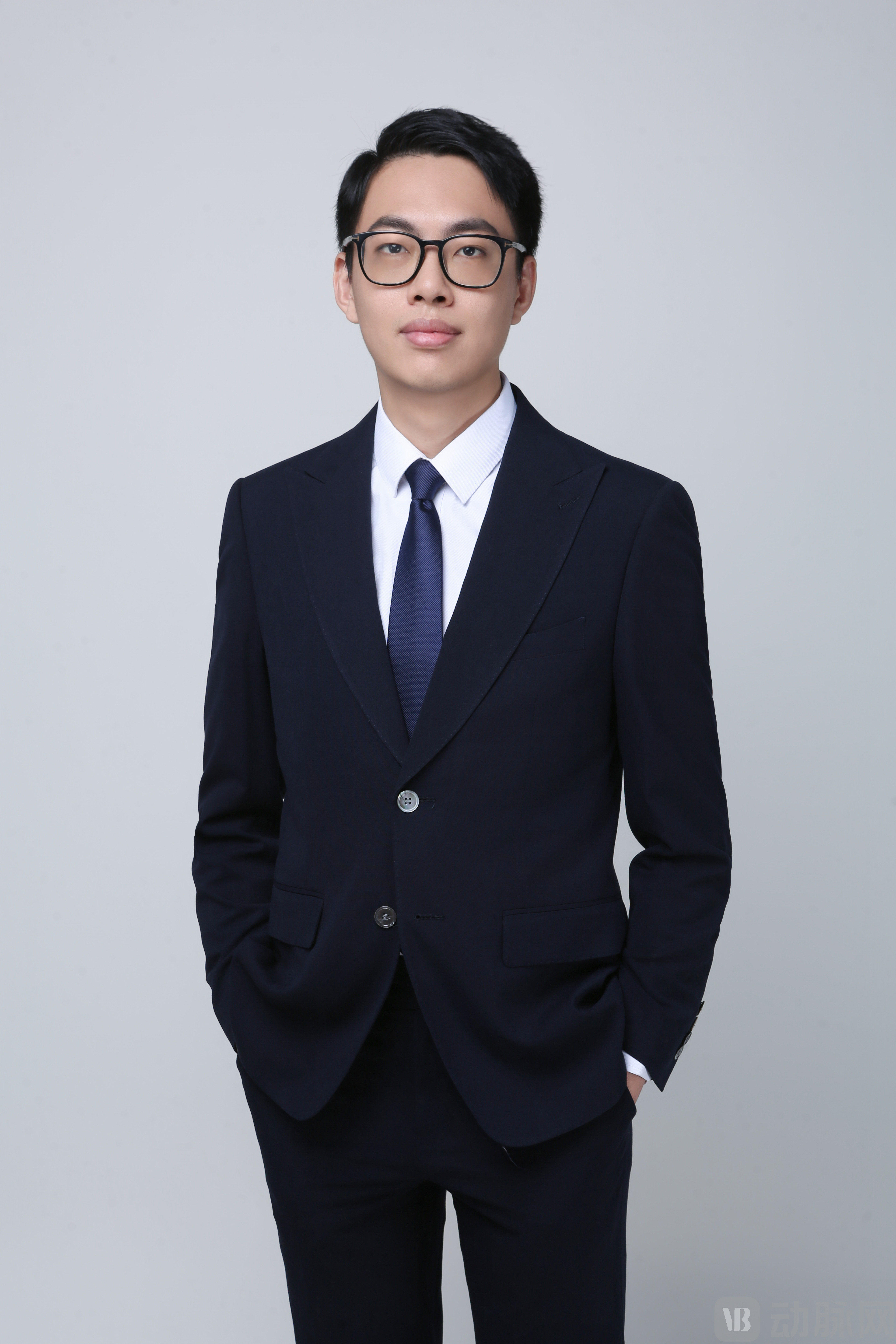
Zhang Qingyang, Founder of Zhuji Qingyan
Yet Zhang Qingyang has achieved success starting from scratch. At the age of 25, driven by his passion for electronic music and dissatisfaction with its prevailing culture, he began teaching himself all aspects of electronic music production. Two years later, he formed a pioneering electronic music duo with a like-minded musician, signed with Sony Music, and released multiple successful electronic music works. Their following across various self-media platforms in China exceeded 300,000 fans, while their streams on digital music platforms surpassed 6 billion plays.
Prior to this, Zhang Qingyang had never been exposed to music theory. “I didn’t approach it ‘purely’ as just a hobby; my ultimate goal for learning was commercialization. Therefore, while systematically studying music, I also minored in music business management. During our early startup phase, I was responsible for the team’s agency operations, including content distribution and traffic promotion across omni-media platforms.”
Creating electronic music, much like entrepreneurship, is a pursuit far removed from Zhang Qingyang’s “main profession.” As a Ph.D. in Materials Engineering from Johns Hopkins University, Zhang has long been immersed in the world of semiconductors. Having studied under Professor Howard Katz, a luminary in flexible electronics, and Professor James West, a member of the U.S. National Academy of Inventors, Zhang returned to China to join TCL CSOT Optoelectronics Technology Co., Ltd. as a Senior Engineer for New Technology Development. Meanwhile, recognized as an overseas high-level talent in Shenzhen, he also serves as a Distinguished Researcher at Hunan University’s Greater Bay Area Institute.
In late 2020, by chance, Zhang Qingyang joined the Shenzhen Jiyin Institute for Bioconversion, where he helped incubate multiple startup ventures. It was there that he met Dr. Lu Ruitao, a Doctor of Clinical Medicine from Guangzhou Medical University, and developed a strong interest in the field of “transdermal drug delivery,” ultimately resolving to co-found a startup together.
Polymer-Based Delivery System: Enables Macromolecule Administration Without Active Devices
Since 2016, with the advancement of innovative drugs, transdermal drug delivery has reached a turning point, marked by the frequent introduction of favorable policies. In December 2020, the Center for Drug Evaluation (CDE) of the National Medical Products Administration (NMPA) issued the Technical Guidelines for Pharmaceutical Studies of Generic Transdermal Patches (Trial). For the first time, these guidelines specified requirements for the specifications, package inserts, and technical standards for generic transdermal patches in China, thereby facilitating the research and development of transdermal patches, improving the quality and efficacy of generic drugs, enhancing drug supply assurance, and better meeting clinical medication needs and public health safety requirements.
Exogenous substances, such as drugs, must undergo transdermal absorption to enter the body. There are three primary pathways for penetration into the body: first, intercellular permeation through the stratum corneum without directly crossing the cells; second, intracellular permeation through the stratum corneum by directly traversing the cells; and finally, permeation via skin appendages, such as sweat glands and hair follicles. Since these skin appendages constitute a relatively small proportion of the total skin area, this represents the third major route of drug administration.
The stratum corneum, located at the outermost layer of the skin, exhibits the strongest barrier effect and is described as the skin’s natural barrier. The “brick-and-mortar” structure, composed of corneocytes and intercellular lipids, constitutes the primary obstacle to transdermal drug absorption. Currently, common methods for enhancing transdermal permeation include three categories: chemical, biological, and physical approaches.
To date, although chemical and biological methods have made certain progress, no chemical approach has yet fully met the ideal criteria for penetration enhancers. The most common physical method is subcutaneous injection, which delivers drugs by disrupting the skin barrier. Non-invasive physical methods primarily rely on energy-driven active devices, including iontophoresis, sonophoresis, microneedles, and electroporation.
“However, these common physical transdermal drug delivery methods are either invasive or require external energy-driven active devices. ‘From any perspective, non-invasive methods that do not require active devices would be more ideal for patients or users,’ said Zhang Qingyang.”
Based on this, Electret Qingyan has successfully developed"Polymer Load-Bearing Materials"—By utilizing electric field traction to enhance the permeability of the stratum corneum, reversible nanoscale “channels” for substance transport are created within this layer. These channels enable large-molecule exogenous substances to penetrate through the stratum corneum and granular layer to reach the dermis, while the directional electric field force further drives highly charged exogenous substances deeper into the skin.
According to Zhang Qingyang, the technology has currently completed animal experiments on mice and pig skin. “The results from over a year of animal studies have validated the technical principle of the polymer-loaded material, demonstrating its ability to deliver macromolecules while possessing both antibacterial and reparative capabilities.”
“The external electrostatic field generated by a load-bearing membrane composed of 4M membranes can promote transdermal drug absorption, inhibit scar formation, regulate the electrical potential states of biological tissues and biomacromolecules, induce cell polarization, facilitate the proliferation and differentiation of neutrophils, macrophages, and lymphocytes, initiate the regulation of wound healing, and promote the restoration of skin barrier function,” added Zhang Qingyang.
This application translation of electric field therapy and the original load dressing technology enable Zhudian Qingyan to apply this technology in the development of various products such as medical beauty masks, traditional Chinese medicine dressings, and transdermal drug delivery patches.
From Medical Aesthetics to Drug Delivery, Achieving Full-Scale Mass Production
Currently, Electret Qingyan has identified three major application scenarios for its charged dressing technology: medical aesthetics, skin repair, and drug delivery.
“Polymer-based carrier materials, with their non-invasive nature and ability to deliver macromolecules, align perfectly with the needs of medical aesthetics, particularly for the transdermal delivery of high-molecular-weight hyaluronic acid, collagen, and other active ingredients,” said Zhang Qingyang. According to animal experimental data from Zhuji Qingyan, non-invasive delivery via polymer-based carrier materials enables hyaluronic acid molecules with a molecular weight exceeding 50,000 Da to penetrate into the deep epidermis and superficial dermis, increasing skin retention of high-molecular-weight hyaluronic acid by nearly threefold.
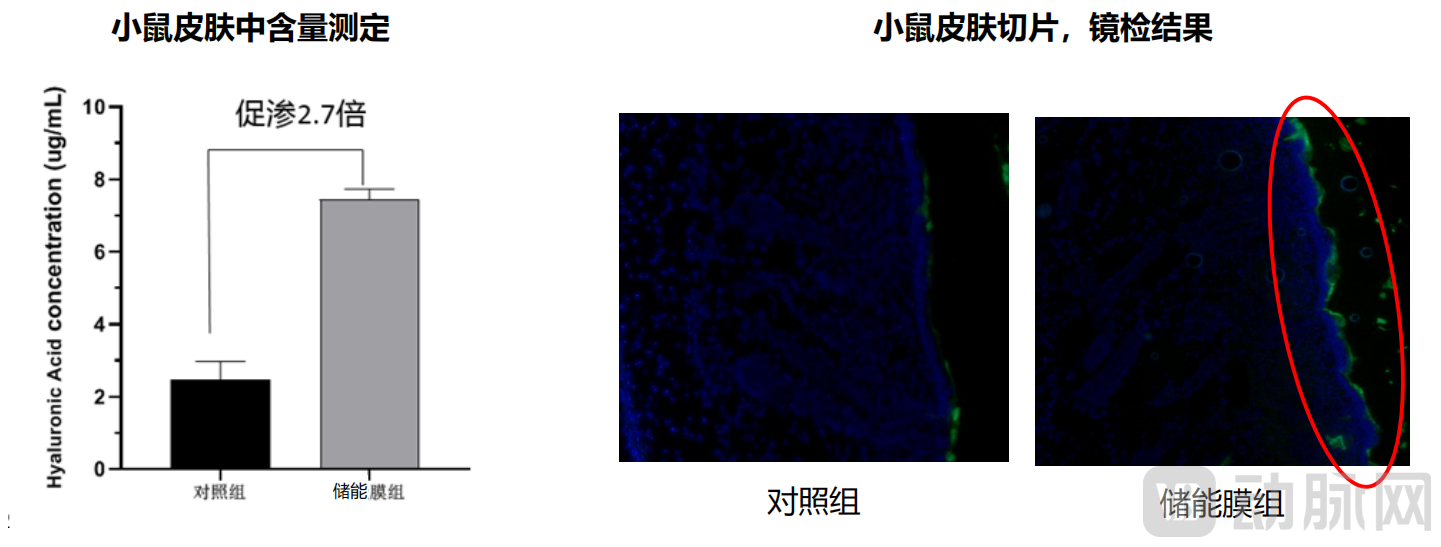
Animal Study on Ultra-Effective Payload Membrane Permeation of Hyaluronic Acid Molecules with Molecular Weight >50,000
“Secondly, the repair function provided by this polymer carrier material also enables us to focus on skin repair, such as for postpartum stretch marks or diabetic foot.” Animal control experiments with Jingdian Qingyan showed that its fibroblast and macrophage migration increased twofold.
Furthermore, polymer-based carrier materials may also open up new possibilities for drug delivery. Can they be applied to small-molecule drugs and anti-inflammatory analgesics? Can they enhance the efficiency of delivering a broader range of therapeutics? Zhang Qingyang also acknowledged that, from both scientific research and industry perspectives, significant challenges remain to be addressed, requiring concerted efforts across the sector.
Currently, relying on the Shenzhen R&D Center (Jiyin Research Institute), Jidian Qingyan has secured three patents and completed the verification of the core self-developed production process for its 4M energy-storage membrane, achieving full-scale mass production of the material. “Next, we will focus on breakthroughs in material upgrades and functional expansion, continuing to exert efforts in the three fields of medical aesthetics and personal care, traditional Chinese medicine patches, and repair dressings,” said Zhang Qingyang. Notably, Jidian Qingyan is simultaneously developing an active energy-based medical aesthetic device.