

Xi'an's Biopharma Industry Races Toward Its First RMB 100 Billion Milestone

Giant Biogene
Skin Care Product R&D Developer
Amid the economic downturn, investments in tech-driven healthcare have yet to reach their payoff period, while the risks in the biotech sector have become excessively intense. In such times, if investment firms do not adopt a passive stance to mitigate risk, one of the best strategies is to pivot toward upstream basic research, betting on the future value unleashed by transformative core technologies.
Unlike in the past, scientific and technological translation has shown a trend of spilling over from Beijing, Shanghai, Guangzhou, and Shenzhen in recent years. Among them, many capitals have targeted Chengdu and Xi'an in the western region, where a number of emerging tech-medical companies are being incubated.
Compared to Chengdu, Xi’an boasts a deeper industrial foundation, yet its economic growth has been slower. Nevertheless, by integrating and revitalizing its accumulated resources, Xi’an still has the potential to vie for the title of the leading city in medical innovation in Western China.
In recent years, many Xi’an-based enterprises focusing on the upstream segment of their respective industries have completed initial public offerings (IPOs). In the medical sector, Kangtuo Medical, which specializes in high-end Class III implantable medical devices, has ranked first in its niche market with its PEEK material cranial repair plates. Meanwhile, Giant Biogene, a leader in recombinant collagen, has broken into the top three in market share within the broader functional skincare sector, closing in on multinational giant L’Oréal.
Xi’an’s medical industry is clearly more powerful than this. Over the next five years, where will the boundaries of the city’s capabilities lie?
For numerous venture capital firms, Xi’an’s appeal can be simply broken down into three parts: first, its cluster of universities; second, its cluster of hospitals; and third, its pharmaceutical and medical industry cluster.
University clusters are the primary driving force behind this frenzied investment boom. For some investors, startups backed by renowned professors inherently possess technological “substance,” further endorsed by scientific achievements and ample funding, thereby significantly reducing learning and due diligence costs.
Moreover, the scientific research projects here are mostly at the forefront of basic research. If these achievements can be translated into practical applications, their potential ceiling is often higher than that of projects incubated within the market.
Therefore, although it may not rival the top-tier universities in Beijing and Shanghai, Xi’an—home to prestigious institutions such as Xi’an Jiaotong University, Northwestern Polytechnical University, Xidian University, Northwest University, and the Xi’an Institute of Optics and Precision Mechanics (XIOPM) of the Chinese Academy of Sciences—nonetheless holds its own as a major academic hub within China.
Xi’an Jiaotong University, in particular, excels at engaging with venture capital firms. From 2021 to the present, professors at the university have founded more than 150 technology-based enterprises in Shaanxi Province, many of which are high-tech projects in cutting-edge fields such as brain-computer interfaces, chemiluminescence, lasers, and novel molecules.
ZhenTai Intelligence, a leading domestic brain-computer interface (BCI) enterprise, was incubated here. The company has secured multiple rounds of financing and developed four BCI-based rehabilitation products, providing enhanced rehabilitative therapy services for patients with stroke, spinal cord injury, Alzheimer’s disease, and psychiatric or psychological disorders.
Huabang Neutron, a pioneer in domestic Boron Neutron Capture Therapy (BNCT), has successfully developed the latest generation of BNCT products for the treatment of malignant tumors. This technology involves injecting a non-toxic and harmless boron-containing drug, followed by irradiation with neutron beams that cause minimal damage to the human body, thereby initiating a "nuclear reaction" within tumor cells to precisely destroy cancer cells. In August this year, the company completed an angel financing round exceeding RMB 100 million.
At the core of these numerous achievements lies “people,” but not just “people.”
From 2019 to 2022, China’s patent filings ranked first globally for three consecutive years; however, the rate of commercialization of scientific research remains below 10%, with less than 5% achieving industrialization. In contrast, developed countries in Europe and the United States boast commercialization rates of approximately 40%. This gap highlights our need for a more supportive environment and a more robust system.
Therefore, to create an ideal environment for the commercialization of scientific research, Xi’an Jiaotong University has taken direct action to promote this process. For instance, it has established a dedicated team of 57 technology brokers who work on two fronts: on one hand, they connect university scientific and technological resources with the market, identify achievements with commercialization potential and promising market prospects, and facilitate collaborations between researchers, relevant enterprises, and sales channels to drive commercialization; on the other hand, they gain deep insights into market demands and industrial development trends, ensuring precise alignment between research outcomes and market needs.
Under multiple initiatives, the system established by Xi’an Jiaotong University to support industry chain research, investment promotion, and the commercialization of scientific and technological achievements has gradually taken shape. By breaking down the boundaries between innovation and industry, more than 100 achievements have benefited from this approach.
Unlike Xi’an Jiaotong University, Northwest University emphasizes a “context-specific” approach in the commercialization of scientific research. In 2019, the university launched explorations into customized technology transfer solutions, creating a series of new “technology transfer plus” models.
To attract enterprises to invest in early-stage and seed-stage ventures, the university has adopted a technology transfer model featuring “licensing + phased incubation + assignment.” For instance, in the project titled “Anti-fouling Filtration Membranes and Separation/Purification of Oily Wastewater,” the research team collaborated with an enterprise to establish a new company, with the university licensing the technology for RMB 12 million. The enterprise provided the conversion funds in phases, and the team allocated the majority of these funds to further pilot testing and industrial scale-up. At a designated stage, the university assigned the intellectual property rights to the enterprise at no cost, thereby dispersing the enterprise’s risk.
For R&D-intensive projects such as “early-stage breast cancer diagnostic reagents,” Northwest University completed a technology transfer valued at 9.3 million yuan through a model combining “rights assignment + cash payment.” After the research team paid cost compensation to the university based on the agreed transfer amount, the university assigned ownership rights to the team, allowing them to independently commercialize the technology. This approach aims to mitigate corporate operational risks associated with high upfront R&D investments.
Judging by today’s achievements, Northwestern University’s performance is equally remarkable. Fan Daidi, founder of Giant Biogene, serves as the Dean of the Institute of Biomedicine at Northwestern University. The company’s flagship product, “recombinant collagen,” was commercialized from her scientific research achievements two decades ago, and it has now emerged as a leader in the collagen sector.
Another typical case comes from the Xi’an Institute of Optics and Precision Mechanics (XIOPM), the pioneer of the “Xiguang Model.” As the research institution in Xi’an with the fastest pace in translating scientific achievements into commercial applications, XIOPM has incubated more than 400 companies, forming three frontier technology clusters: photonic manufacturing, photonic information, and biophotonics.
From the perspective of the Xi’an Institute of Optics and Precision Mechanics (XIOPM), the traditional model of technology transfer typically involves developing achievements first and then seeking applications. The inherent mission of research institutes predisposes them to prioritize scientific research while neglecting commercialization. This has led to a disconnect between scientific research and industry, resulting in scenarios where heavily funded research projects ultimately address only niche market applications.
To address this entrenched problem, the Xi’an Institute of Optics and Precision Mechanics has proposed the concept of “tearing down walls and operating as an open institute.” On one hand, it encourages research achievements to “go out”; on the other, it invites more talented individuals to “come in.”
“Going global” entails not only the opening up of high-quality scientific and technological resources, such as research achievements, instruments and equipment, and experimental environments, but also the full unleashing of research outcomes. It encourages these achievements to “go global,” effectively integrating technological results that might otherwise remain shelved within the “walls” with the market. Conversely, “bringing in” involves introducing excellent external resources, relocating enterprises into research institutes, and leveraging their strengths based on the platform of the Xi’an Institute of Optics and Precision Mechanics (XIOPM).
Furthermore, "de-administratization" plays a crucial role in the process of transforming research achievements into enterprises. The Xi’an Institute of Optics and Precision Mechanics has consistently adhered to the incubation philosophy of “taking equity stakes without holding controlling interests, and incubating enterprises without directly operating them,” thereby unleashing maximum vitality by encouraging the development of mixed-ownership enterprises.
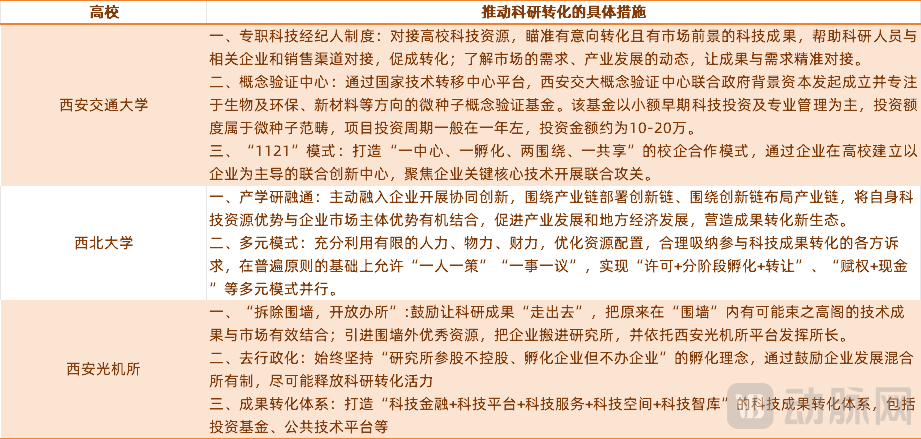 Policies Promoting the Commercialization of Scientific Research at Three Typical Universities in Xi'an
Overall, universities and their established research commercialization systems have effectively eliminated information asymmetry between enterprises and investors by standardizing the research commercialization process. The accumulation of scientific research achievements within universities also serves as an endorsement for frontier technology projects, enabling them to be marketed at premium prices.
This is a win-win-win transaction. As universities and investors create value, local governments also benefit from the aggregation of resources.
In the early 1930s, the domestic processing and manufacturing of Western medicines in Northwest China remained virtually nonexistent. Although Xi’an had a few Western-style pharmacies, most of the drugs sold were imported and prohibitively expensive. Following the Mukden Incident on September 18, 1931, imports of foreign goods declined sharply or even ceased entirely, further widening the gap between public demand for medications and supply, which became an urgent priority at the time.
Over the past nearly 90 years, Xi’an has not only developed a substantial traditional Chinese medicine (TCM) R&D and active pharmaceutical ingredient (API) industry, bringing together listed pharmaceutical companies such as Panlong Pharmaceutical and Jinhua Pharmaceutical, but also established Xi’an Janssen through a joint venture with foreign investment. This has built what is regarded as the “Whampoa Military Academy of the pharmaceutical industry,” marking the formal integration of China’s pharmaceutical sector with Western modern concepts.
These achievements have collectively established Xi’an’s current third cluster—the medical industry cluster.
As of the end of 2022, Xi'an High-Tech Industries Development Zone was home to 4,120 biopharmaceutical-related enterprises. Among them, two were among the Top 100 Industrial Enterprises, 26 held GMP certification, and nine were publicly listed. The output value of the biopharmaceutical sector exceeded RMB 20 billion, with the total industrial scale surpassing RMB 70 billion, ranking among the leading national high-tech zones in central and western China.
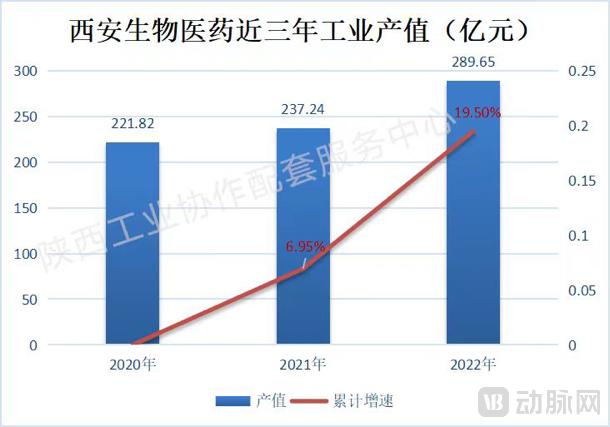
Xi'an Biopharmaceuticals: Industrial Output Value Over the Past Three Years
(Unit: 100 million yuan; Data source: Xi'an Biopharmaceutical Industry Chain Directory (2023 Edition))
From an overall layout perspective, Xi’an has basically formed an industrial development pattern with the High-Tech Zone, Economic and Technological Development Zone, Aerospace Base, and Xixian New Area as its main regions; with chemical drugs, biological drugs, traditional Chinese medicine patent drugs, and medical devices as its foundation; and with cutting-edge technologies such as regenerative medicine, gene sequencing, and peptides and proteins as its leading drivers.
Among these, Xi’an High-Tech Industries Development Zone is the development area with the largest number of innovative biopharmaceutical enterprises and the most comprehensive innovation services. In 2019, it accounted for 42% of the output value with only 31% of the enterprises, showing a further trend of aggregation that may change the industrial pattern of Xi’an’s biopharmaceutical industry, which is currently dominated by traditional Chinese medicine.
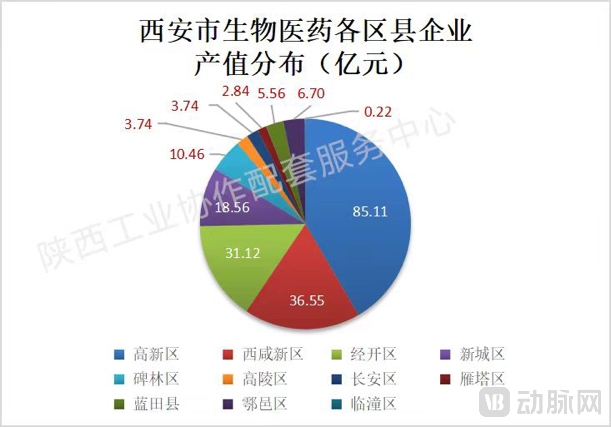
2019 Distribution of Output Value of Biopharmaceutical Enterprises by Districts and Counties in Xi'an
(Unit: RMB 100 million; Data source: Xi'an Biopharmaceutical Industry Chain Directory (2023 Edition))
Furthermore, Xi’an’s pharmaceutical industry cluster maintains a complementary relationship with its hospital cluster.
On the one hand, among the total of 81 tertiary hospitals in Shaanxi Province as of the end of 2022, Xi’an accounted for 55, with the industrial advantage reinforcing the concentration of medical resources in Shaanxi. On the other hand, Xijing Hospital of Air Force Medical University and the First Affiliated Hospital of Xi’an Jiaotong University demonstrated outstanding performance in the number of projects funded by the National Natural Science Foundation of China, securing 82 and 67 grants respectively, ranking second and third among hospitals in western China, only behind West China Hospital of Sichuan University.
The presence of high-quality hospitals has attracted clinical trials for major new drugs across China, providing sustained and robust support for the development of Xi’an’s pharmaceutical industry.
In addition to its long-accumulated advantages, Xi’an is also accelerating the development of its biopharmaceutical industry through policy measures.
In recent years, Xi’an has introduced multiple policy initiatives, including the *Action Plan for the Development of Biomedical Industry Clusters in Xi’an*, to encourage leading domestic medical enterprises to establish manufacturing facilities in the city. Additionally, the Xi’an Innovation Fund, with a scale of RMB 10 billion, has been established to attract more social capital and financial institution investment into hard-tech industries, including the biomedical sector, through market-oriented operations, thereby accelerating the development of the biomedical industry.
Numerous measures have yielded immediate results for Xi’an’s biopharmaceutical industry. In 2023, a total of 438 companies were selected into Shaanxi Province’s “reserve force” for listed enterprises, including 43 from the medical sector. This has fostered a networked biopharmaceutical industry with Xi’an at its core and surrounding urban areas as supporting nodes, leveraging provincial resources to break through in the life sciences sector.
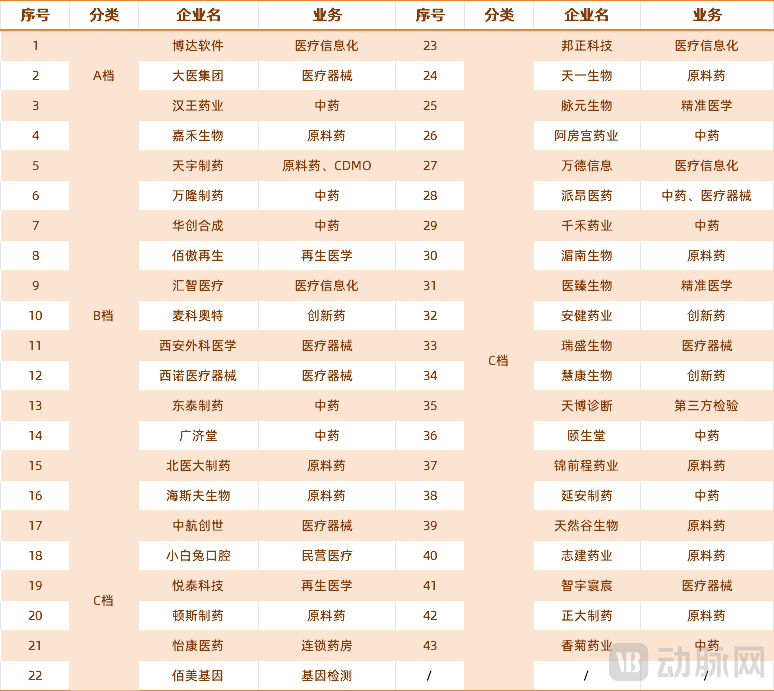
List of Biopharmaceutical Companies in Shaanxi Province Identified as “IPO Pipeline” Candidates in 2023
However, it should also be noted that despite the advantages of multiple clusters and support from various local policies, Xi’an’s biopharmaceutical industry still has some shortcomings.
First, the majority of biopharmaceutical enterprises in Xi’an are small and medium-sized enterprises (SMEs) with limited financing channels. Apart from shareholder investments, these companies rely heavily on bank loans, with minimal involvement from private equity capital. This has led to a disproportionate allocation of funds toward sales activities at the expense of research and development (R&D), resulting in few breakthrough innovative products and weak competitiveness. Many firms merely produce low-level, repetitive products, struggling to survive.
Second, although the province boasts a large biotechnology research workforce, its innovative capabilities and technical strength remain insufficient. Issues persist, such as an abundance of traditional drugs versus a scarcity of innovative ones, and a prevalence of generic drugs versus a lack of proprietary drugs with independent intellectual property rights. A closer look at the pipeline of companies preparing for IPOs reveals that traditional Chinese medicine (TCM) and TCM active pharmaceutical ingredients (APIs) account for a significant share, indicating that the development of innovative drugs is still in its infancy.
While the current influx of substantial capital may gradually address these issues, a cycle of boom and bust will still unfold over time.
After all, large-scale financing provides companies with opportunities for growth but also introduces noise. Many tech firms whose technologies or capabilities fall short of standards may survive longer due to capital support or endorsement, thereby imposing greater competitive pressure on truly outstanding enterprises.
If such enterprises can survive three years of operation, they typically have established robust technological barriers and identified genuine market demand, ultimately becoming the backbone supporting the development of Xi’an’s biopharmaceutical industry.
Therefore, once the tide recedes, Xi’an’s biotechnology industry may usher in a prolonged period of prosperity.