

AWAK Technologies Files IPO Prospectus: Pioneering Portable Dialysis with Over $500M Raised and Dual FDA Breakthrough Designations

AWAK Technologies
Medical Device Developer
According to the “2019 Global Health Estimates” report released by the World Health Organization in 2020, kidney diseases have ranked among the top ten causes of death worldwide. The disease burden attributable to chronic kidney disease is rising rapidly, with its disability and mortality rates increasing more than those of any other chronic disease.
However, many patients with kidney disease only become aware of their condition in its later stages. The severe progression of the disease forces them to devote substantial time and energy to dialysis treatment. Throughout this prolonged care process, it is difficult for physicians to closely monitor patients’ disease progression and treatment adherence at all times. Due to these multifactorial challenges, the dialysis journey for patients with chronic kidney disease is fraught with difficulties.
Currently, both peritoneal dialysis (PD) and hemodialysis (HD) require the consumption of large volumes of dialysate. Furthermore, existing dialysis machines are relatively bulky; common PD machines typically weigh 15–20 kg, while common HD machines generally weigh 50–80 kg, which significantly restricts patients' mobility and scheduling flexibility.
Generally, peritoneal dialysis (PD) patients are “tethered” to the dialysis machine for 10–12 hours during each treatment session. Hemodialysis (HD) patients must visit a dialysis center three times per week, with each session lasting four to five hours. This not only increases the financial burden and impairs patients’ quality of life, but also adversely affects their mental health. The prolonged “deep tethering” to dialysis centers and machines may lead to emotional issues such as anxiety and depression.
For decades, the field of renal dialysis has seen little innovation, while kidney failure rates have been rising globally, creating an urgent need for breakthrough innovations in care. In the vision of experts and patients with kidney disease, next-generation dialysis machines will not only save lives but also bring convenience and dignity to millions of patients with end-stage renal disease (ESRD).
AWAK Technologies is turning this vision into reality.
As a game-changer in the field of renal dialysis, AWAK Technologies, an innovative medical device company from Singapore, has developed a comprehensive, context-aware, and digital renal dialysis care solution. AWAK’s relentless innovation in adsorbent-based regeneration technology, remote patient monitoring, and artificial intelligence has facilitated personalized, home-based, and long-term kidney care, benefiting millions of patients.
In the field of renal dialysis, AWAK’s most significant innovation lies in the development of sorbent-based dialysate regeneration technology. This technology enables the recovery and reuse of dialysate within the device, thereby reducing dialysate consumption and waste discharge. As a core technological foundation, it underpins the development of its portable dialysis devices and establishes a unique advantage for subsequent product development.
The core of AWAK’s adsorption technology lies in its ability to filter uremic toxins from spent dialysate and regenerate it into fresh dialysate in real time. During each recirculation cycle, the integrated infusion system readjusts calcium and magnesium concentrations to the required levels and adds glucose to compensate for the patient’s dilution and absorption. This feature eliminates the dialysis machine’s dependence on large volumes of dialysate, a continuous water supply, and expensive water treatment facilities.
Traditional hemodialysis systems consume approximately 120 liters of ultrapure water to prepare dialysate during a single session. The AWAK adsorption device eliminates the need for a reverse osmosis (RO) water system, requiring less than 6 liters of tap water to regenerate used dialysate and reconstitute it into fresh dialysate. Starting with only 2 liters of dialysate per treatment, the system can regenerate up to 14–18 liters of fresh dialysate. During a single hemodialysis session, AWAK has successfully reduced the required dialysate volume from 120 liters to 4 liters per treatment.
Meanwhile, using less dialysate will significantly reduce the energy consumption required for heating it. Compared with existing sorbent cartridges, AWAK’s novel sorbent formulation also reduces flow resistance, which serves as another energy-saving feature and makes future battery-powered dialysis machines feasible.
Notably, AWAK’s unique sorbent device can be engineered in various shapes and sizes to accommodate different dialysis modalities and dialysis machines. It features a 30% reduction in size compared to current sorbent cartridges. In vitro experiments have demonstrated that the AWAK sorbent cartridge maintains stable sodium levels, thereby achieving neutral sodium balance and acid–base equilibrium. This indicates that the AWAK sorbent effectively removes waste products and toxins from the blood while preserving normal physiological conditions.
Currently, AWAK’s dialysate regeneration technology has been incorporated into the company’s AWAK PD dialysis device, a portable automated peritoneal dialysis machine.
The greatest advantage of AWAK PD is that it frees dialysis patients from constraints of time and location, enabling them to undergo dialysis in any setting, thereby improving their quality of life and convenience.
The AWAK PD dialysis device is compact and shaped like a crossbody shoulder bag, making it highly portable. It features wearable, mobile, and bedside usability, allowing patients to undergo dialysis anytime and anywhere by simply wearing it.

AWAK PD resembles a crossbody shoulder bag. Image source: AWAK official website
The AWAK PD dialysis machine requires only 1–2 liters of dialysate per day. Its pH-neutral dialysate exhibits high biocompatibility, thereby reducing irritation and damage to the human body and lowering the risk of infection and complications.
Furthermore, AWAK provides patients with a digital solution called “nefrO”. This mobile application, connected to a multi-parameter health monitor, enables patients to easily record and track their health data, offering intuitive visualizations of their health status. nefrO simplifies and automates the logging of daily data such as treatments, medications, diet, vital signs, and notes, while using reminders and alerts to encourage patient adherence to care routines.
The mobile application in nefrO controls the AWAK PD dialysis device and establishes a digital connection with the clinician-facing portal, enabling healthcare providers to remotely manage patient treatment, monitor their health status, and intervene appropriately when necessary to avoid unnecessary hospitalizations. This further ensures that the care process is comprehensive and effective, achieving intelligent and personalized dialysis therapy. Additionally, through the app, patients can share their care updates with family and friends.
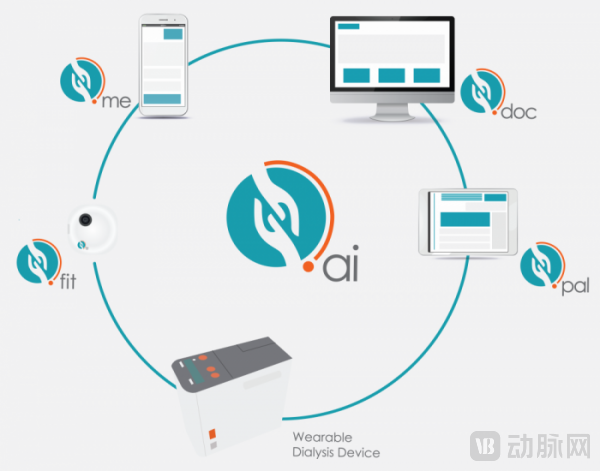
nefrO Digital Solution | Image source: AWAK official website
The “O” in nefrO symbolizes wholeness and completeness—meeting the needs of all patients with chronic kidney disease through a comprehensive, fully integrated application portal solution. “Through nefrO, we aim to create a complete circle of care and instill the idea that patients with chronic renal failure are not alone,” AWAK stated on its official website.
In October 2018, AWAK PD successfully completed its first-in-human safety trial at Singapore General Hospital. The trial results demonstrated that AWAK PD could effectively clear accumulated toxins from the body, and no serious adverse events occurred among patients undergoing dialysis with AWAK PD during the trial. On January 8, 2019, AWAK announced that the U.S. Food and Drug Administration (FDA) had granted AWAK PD the “Breakthrough Device” designation.
On September 13, 2023, AWAK announced the completion of its $20 million Series B financing round. This was not only the largest funding event in Singapore’s medtech sector in 2023 but also one of the largest in Southeast Asia this year. The round was co-led by two venture capital firms, Lion X Ventures and Vickers Venture Partners. Other major investors included Advanced MedTech, Eckuity Capital, and an investment firm managing billions of dollars in assets within the healthcare sector. According to data disclosed on Crunchbase, the company’s total fundraising has reached $77.2 million (approximately RMB 554 million) after four rounds of financing.
The newly raised funds will be used to complete the ongoing pivotal pre-clinical human trials of AWAK with Singapore General Hospital and to make necessary improvements to the ultra-portable dialysis device in preparation for the final pivotal trials expected to begin in the United States in 2025. AWAK will also drive the development of new products, promote ancillary products for home dialysis, and integrate digital solutions to improve home care for patients with chronic kidney disease.
On November 27, 2023, AWAK announced that its Kidney Disease Progression Prediction (KDPP) artificial intelligence model for the care of patients with chronic kidney disease (CKD) had received Breakthrough Device Designation from the U.S. Food and Drug Administration (FDA). The KDPP model helps assess the risk of kidney disease progression and the risk of initiating renal replacement therapy (dialysis or transplantation) within 1, 2, and 5 years.
As early as September 2021, AWAK and Ever Fortune.AI (EFAI) established a strategic partnership to jointly develop this groundbreaking artificial intelligence solution, which aims to revolutionize the diagnosis, treatment, and management of kidney diseases by leveraging medical big data and AI.
Suresha Venkataraya, CEO of AWAK Technologies, stated that the FDA’s Breakthrough Device Designation will accelerate AWAK’s product validation process. AWAK is committed to advancing this predictive artificial intelligence model into clinical practice.
To address the unmet needs in kidney disease management in other regions, AWAK has also entered into a research collaboration with Singapore General Hospital (SGH) to jointly develop new artificial intelligence models and evaluate existing KDPP models using the hospital’s de-identified CKD patient database.
The company is also engaged in in-depth discussions with its U.S. partners regarding its innovative products to adapt to and integrate into the U.S. market. AWAK’s products are currently in the clinical trial phase and have not yet been launched for commercial sale.