

Shanghai Launches National Platforms for Intelligent Triage of Rare Diseases and Lifecycle-based Multimorbidity Management
On December 15, the 5th Healthy China Sinan Summit was held in Shanghai, where multiple key projects in the field of digital medicine were signed. Among them, the Shanghai Digital Medicine Innovation Center signed a cooperation agreement with WeDoctor to jointly establish a National Intelligent Triage Center for Complex and Rare Diseases. Additionally, Ruijin Hospital, Shanghai Jiao Tong University School of Medicine (hereinafter referred to as “Shanghai Ruijin Hospital”) signed an agreement with WeDoctor to co-establish a Lifecycle Integrated Management Center for Six Major Chronic Diseases. The launch and construction of these two centers will significantly promote the development of China’s triage and referral system for complex and rare diseases, as well as the comprehensive prevention and control of major chronic diseases.
The Shanghai Digital Medicine Innovation Center, Shanghai Ruijin Hospital, and WeDoctor will leverage their respective strengths to establish an Intelligent Triage Center for Complex Diseases and a Lifecycle Management Center for the Co-management of Six Major Diseases. Together, they will explore the application of digitalization and intelligence in the diagnosis and treatment of complex diseases and the coordinated management of multiple chronic conditions. By capitalizing on Shanghai’s advantages as a hub for think tanks, technological innovation, and high-quality medical resources in the field of digital medicine, they will promote integrated innovation across healthcare, research, and industry, thereby better serving patients with complex diseases and the “six major diseases” in Shanghai and across China.
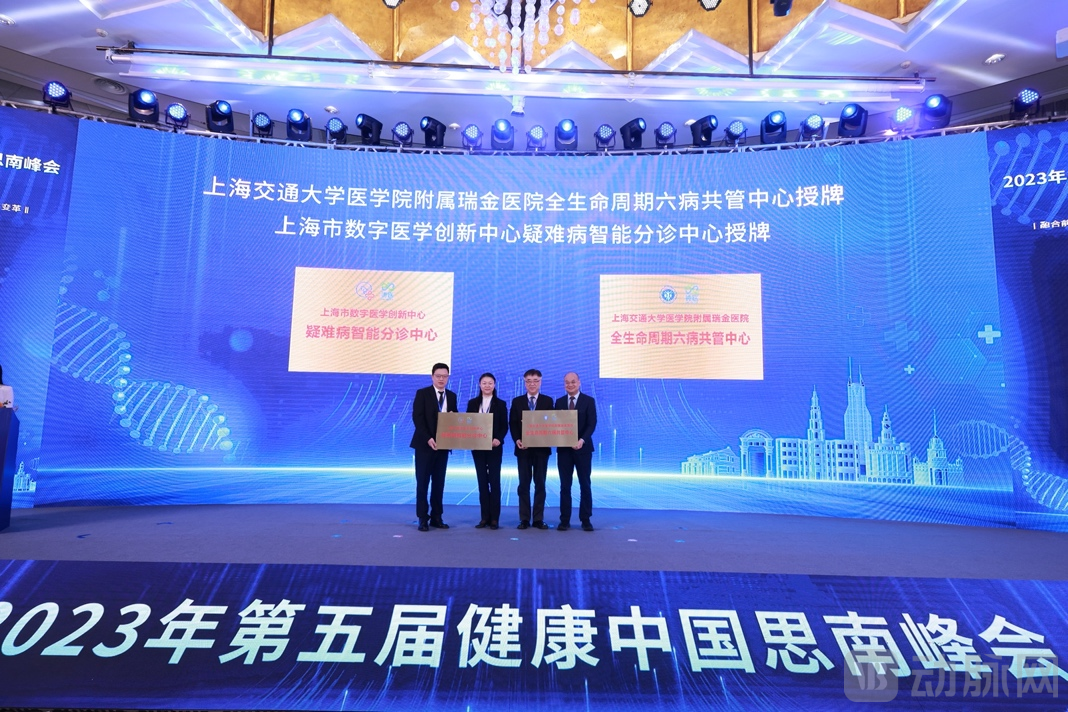
Figure | Plaque Awarding Ceremony for the Intelligent Triage Center for Complex Diseases and the Six-Disease Co-Management Center for Full Life Cycle Care
At the conference, Chen Zhu, an academician of the Chinese Academy of Sciences and President of the Red Cross Society of China, delivered a special report on strengthening the prevention and control management of chronic diseases. He pointed out that chronic diseases are complex, multifactorial conditions that require a systems approach to understanding, prevention, and early intervention. Furthermore, chronic diseases often present as multimorbidity, which has become a significant threat to the survival and health of the Chinese population. Leveraging technologies such as the Internet, big data, and 5G, it is essential to establish personal health profiles and implement precision health management, thereby achieving comprehensive chronic disease management that covers the entire population, all aspects of health, and the full life cycle.
Addressing the challenges of chronic disease management, the Center for Integrated Management of Six Major Conditions across the Full Life Cycle will conduct research on digital comprehensive prevention and control systems, establish integrated management frameworks, and develop medication guidelines for four major categories of chronic diseases—cancer, cardiovascular and cerebrovascular diseases, respiratory diseases, and metabolic disorders—as well as reproductive medicine and geriatrics (collectively referred to as the “Six Conditions”). Leveraging data from medical care and health management indicators, and combining the commonalities of multi-morbidity with personalized management requirements, the Center will build an intelligent digital platform for prevention, control, and full-life-cycle management of multiple co-existing conditions. It will formulate comprehensive, scientifically grounded joint treatment and management plans and health programs for patients, thereby maximizing improvements in patient health outcomes, enhancing individualized health management effectiveness, and avoiding unnecessary medical expenditures.
The Intelligent Triage Center for Complex and Refractory Diseases will provide precise triage and referral services, along with seamless continuous management, for patients with complex and refractory diseases across China. Leveraging WeDoctor’s comprehensive digital healthcare platform and the resources of Shanghai’s tertiary Grade A hospitals connected through the Shanghai Digital Medicine Innovation Center, the center will rapidly screen and accurately match patients with the most appropriate medical resources. Upon completion, the center will effectively address the current challenges faced by patients with complex and refractory diseases, including difficulties in diagnosis and treatment, as well as high costs. Its intelligent triage system can quickly match patients with relevant specialists. Once referral criteria are met, patients can be referred upward via a green channel to major hospitals capable of treating their specific conditions. After their condition stabilizes, they can be referred back to local facilities while continuing to receive guidance from experts at the major hospitals.
The establishment of the aforementioned triage center relies on the high-quality resources of the Shanghai Digital Medicine Innovation Center and the support of WeDoctor’s digital platform capabilities. It is understood that the Shanghai Digital Medicine Innovation Center, approved by the Shanghai Municipal People’s Government, benchmarks against international best practices and is committed to building an open platform that connects medical institutions at all levels in Shanghai, thereby promoting the digital transformation of healthcare in China. The center’s director and chief scientist is Ning Guang, an academician of the Chinese Academy of Engineering and president of Shanghai Ruijin Hospital.
Furthermore, the three parties will jointly establish a Demonstration Center for Frontier Medical Technology Applications, introducing advanced technologies, innovative pharmaceuticals and medical devices, and digital therapeutics to fully meet the treatment needs of various diseases as well as the requirements for real-world clinical data research. Meanwhile, Shanghai Ruijin Hospital will collaborate with WeDoctor on the training of health management professionals. Serving as a practical training base for WeDoctor’s Hainan Health Management College, Shanghai Ruijin Hospital will provide mentoring, training, and internship opportunities for outstanding students, thereby cultivating urgently needed talent such as health managers.
Following the tripartite collaboration, the joint research team will be based at the Shanghai Guangci-Sinan National Translational Medicine Innovation Industrial Park, adjacent to the Shanghai Digital Medical Innovation Center and Shanghai Ruijin Hospital. This co-location aims to enhance the efficiency of daily scientific research cooperation and leverage the park’s resources to provide comprehensive industrial and technological support for the development of the dual centers. It is reported that the industrial park is structured around “clinical translation + professional services + non-public high-end healthcare,” focusing on five major sectors: biopharmaceuticals, medical devices, digital health, medical services, and non-public high-end healthcare. With medical translation as its core element, the park accelerates the docking, incubation, translation, and industrialization of scientific and technological achievements—such as innovative drugs and medical devices—with translational medicine centers.
At the summit, Academician Ning Guang stated, “Shanghai Ruijin Hospital adheres to the institutional philosophy of ‘Extensive Benevolence and Pursuit of Excellence,’ and is committed to becoming a global source of new medical technologies, a national demonstration site for full-lifecycle health management, and a training hub for healthcare professionals and practitioners.” The Full-Lifecycle Health Management Center established under Shanghai Ruijin Hospital integrates the hospital’s strengths in clinical research and innovative translation. Through the strategic partnership between Shanghai Ruijin Hospital and the digital healthcare service platform Weiyi, this collaboration will further support the high-quality development of full-lifecycle health management and disease prevention in China.
“At the Intelligent Triage Center for Complex Diseases and the Full-Lifecycle Co-Management Center for Six Chronic Conditions, WeDoctor will collaborate closely with the Shanghai Digital Medicine Innovation Center and Shanghai Ruijin Hospital. Leveraging the resource-linking capabilities of its digital platform and advanced technologies such as artificial intelligence, WeDoctor will focus on building precise triage and referral capabilities, as well as the capacity to manage comorbidities through coordinated care,” said Qiu Kai, Senior Vice President of WeDoctor. He added that WeDoctor will rapidly implement the services of both centers by harnessing its digital and intelligent capabilities.