

Editas Medicine Secures $100 Million from Vertex for CRISPR-Cas9 Patent License Following Global Launch of First Gene-Editing Drug Casgevy
CRISPR Therapeutics
Gene Editing Drug Developer
On December 8, 2023, the FDA approved the first CRISPR gene-editing therapy, Casgevy, for marketing to treat patients aged 12 years and older with sickle cell disease (SCD) accompanied by recurrent vaso-occlusive crises. The therapy was initially launched by CRISPR Therapeutics in 2018 and has since been advanced in collaboration with Vertex Pharmaceuticals.
Over the past decade, CRISPR gene-editing technology has spawned countless gene-editing companies, attracted billions of dollars in investment, and enabled scientists to win the Nobel Prize, culminating this year in the global approval of the first CRISPR-based gene therapy, Casgevy (exa-cel). The approval of Casgevy has once again brought renewed attention to the patents surrounding CRISPR-Cas9.
A few days later,Vertex Pharmaceuticals Announces $100 Million Payment to Editas Medicine, the Gene-Editing Therapy Developer Founded by Feng Zhang, plus potential licensing fees, to obtain a non-exclusive license for its CRISPR-Cas9 gene-editing technology, for use in ex vivo gene-edited therapies targeting the BCL11A gene for sickle cell disease and beta-thalassemia, including Casgevy.
It is reported that Editas will receive a $50 million upfront payment from Vertex, with eligibility for an additional $50 million in contingent payments; however, the parties did not disclose the conditions triggering this $50 million contingent payment. Furthermore, Editas has the opportunity to earn annual patent royalties of $10–40 million until the patent expires in 2034.
The approval journey of Casgevy is a story about scientific discovery, boldBetting and Holding Firmly to the Green MountainsStoryAlnylam Pharmaceuticals, a pioneer in the field of RNAi therapeutics, took 16 years to translate an academic discovery into the first RNAi drug.In contrast, Casgevy’s initial approval came 11 years after the scientific discovery and 10 years after the founding of CRISPR Therapeutics.
2012-2015: Major Players Enter the Arena, Igniting a Frenzied Technological Race
In 1987, Professor Yoshizumi Ishino from Japan first discovered the presence of CRISPR sequences in Escherichia coli. During the same period, Francisco Mojica from the Mediterranean region also identified CRISPR in a species of archaea and firmly believed that CRISPR might serve certain specialized functions. However, at that time, researchers were unclear about the specific functions of CRISPR.
In August 2012, Emmanuelle Charpentier, Jennifer A. Doudna, and Michael Hauer, as co-corresponding authors, published a research paper titled “A Programmable Dual-RNA–Guided DNA Endonuclease in Adaptive Bacterial Immunity” online in Science, announcing the emergence of CRISPR-Cas gene-editing technology, which has sparked a revolutionary wave in the fields of life sciences and medicine. The history of CRISPR gene editing thus began.
The final sentence of this paper hints at an impending scientific revolution: an ancient bacterial defense system can be repurposed to provide “considerable potential for gene targeting and genome editing applications.”
Within less than a year after CRISPR was proven to have gene-editing capabilities, scientists, investors, and entrepreneurs began formulating business plans, establishing new gene-editing companies, and initiating efforts to apply this technology to the treatment of genetic diseases. In the subsequent years, its applications were expanded to multiple therapeutic areas, including cancer, HIV/AIDS, chronic pain, and Lyme disease.
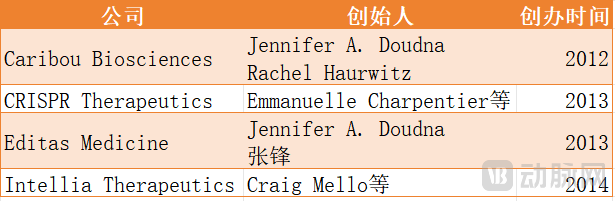 Selected Gene Editing Companies | Graphic by VCBeat
To date, Caribou Biosciences, CRISPR Therapeutics, Editas Medicine, and Intellia Therapeutics have all successfully completed their initial public offerings on the Nasdaq.
In 2014, CRISPR Therapeutics completed a $25 million Series A financing round, with Versant Ventures as the investor. “Founding a gene-editing company is quite complex, involving novel technology, experts, investors, and a complicated intellectual property landscape. Therefore, we initially approached only two venture capital firms: Versant Ventures and Atlas Ventures,” said Shaun Foy, co-founder of CRISPR THERAPEUTICS.
Later, due to divergent visions for the company between the two venture capital firms, Versant Ventures won the bidding war with a higher investment amount. Subsequently, Atlas Venture joined forces with Novartis to co-invest $15 million in founding another gene-editing company, Intellia Therapeutics.
“By the end of 2014, ten investors had flocked in. At that time, I truly believed CRISPR should be a company encompassing all technologies, patent portfolios, and scientists. However, it became evident that everyone was caught up in the CRISPR technology frenzy, causing all companies to focus solely on this one area. In retrospect, perhaps having multiple companies collaborate would better serve patients; it is hard to imagine how a single company could efficiently handle every aspect of the process,” said Shaun Foy.
2014–2016: Intense Competition and Determination of the Technical Route
Thousands of human diseases are caused by genetic mutations. In theory, CRISPR, known as “God’s scalpel,” can address nearly all of them.
Editas Medicine is the first publicly listed CRISPR gene-editing company in the field of gene editing. It has a total of nine pipelines under development, including in vivo gene-editing therapies, ex vivo gene therapies, and cell therapy projects. Among these, the gene-editing therapies are advancing more rapidly, with all candidates having entered clinical trial stages; meanwhile, the cell therapy projects targeting cancer are progressing slightly slower and remain in the preclinical research stage.
Editas Medicine’s EDIT-301 is an investigational cell therapy,For the treatment of SCD and TDTEDIT-301 consists of patient-derived CD34+ hematopoietic stem and progenitor cells,These cells were edited at the promoters of the γ-globin genes (HBG1 and HBG2) using highly specific and efficient engineered AsCas12a nucleases.. Red blood cells derived from EDIT-301-edited CD34+ cells exhibit sustained increases in fetal hemoglobin production, which may provide a one-time, durable therapeutic effect for patients with severe sickle cell disease (SCD) and transfusion-dependent beta-thalassemia (TDT).
Not long ago, Editas Medicine presented the latest trial results for EDIT-301 at the ASH Annual Meeting. The results showed that no vaso-occlusive events (VOEs) occurred in any patients in the RUBY trial. In the EdiTHAL trial, total hemoglobin levels increased early and robustly in all patients, exceeding the transfusion-independence threshold of 9 g/dL (n=6).
Intellia has also developed proprietary, revolutionary products for ex vivo and in vivo gene therapies.Intellia's Lead Pipeline: NTLA-2001, the World's First In Vivo CRISPR Gene Editing Therapy, utilizing an LNP hepatic delivery system carrying sgRNA targeting the human TTR gene and mRNA sequences encoding an optimized Streptococcus pyogenes Cas9 protein. This October,NTLA-2001 has been approved by the FDA to conduct pivotal Phase III clinical trials,Treatment of transthyretin amyloidosis (ATTR).
For early-stage biotech companies, selecting indications requires consideration of multiple factors. “Initially, to mitigate technical risk, we focused on ex vivo and gene knockout strategies, seeking the intersection between diseases with high unmet medical needs and those where editing a small number of cells could yield significant therapeutic impact. The two primary approaches we prioritized were knocking out CCR5 for HIV and knocking out BCL11A. We even held preliminary discussions with Gilead Sciences regarding the CCR5 knockout concept,” said Shaun Foy.
“Later, we engaged a consulting firm and received approximately 20 proposals for different indications. However, we ultimately did not select any of them,” said Rodger Novak, Co-Founder and CEO of CRISPR Therapeutics.
CRISPR Therapeutics ultimately selected sickle cell disease (SCD) and transfusion-dependent beta-thalassemia (TDT) as its indications. Before CRISPR technology was proven to have gene-editing capabilities, Stuart Orkin discovered the BCL11A gene, providing a technical pathway for the treatment of these two diseases.
At that time, there was only one paper on CRISPR technology.Science “Endorsement,”Precise targeting of gene editing sites is the greatest challenge“To this end, we have conducted numerous large-scale trials to explore different possibilities and optimize for various characteristics. We also need to consider a range of issues: Which guidelines should be used? Should synthetic guidelines be developed? Is transcription required? Do nucleotides need to be added? How should it be delivered into cells?” said Bill Lundberg, Chief Scientific Officer at CRISPR Therapeutics.
In advancing the research of exa-cel, CRISPR Therapeutics is fully confident that CRISPR technology can treat SCD and TDT, provided that the engineering approach is thoroughly investigated.
2015-2019: CRISPR’s “Out-of-Control Moment”
In 2014, the United States Patent and Trademark Office awarded the first patent related to CRISPR/Cas9 technology to Feng Zhang’s team at MIT, sparking significant controversy. Emmanuelle Charpentier and Jennifer A. Doudna contended that they had discovered CRISPR-Cas9 earlier and filed their patent applications prior to Zhang’s team, arguing that the latter’s success in animal cells was merely an extension of their work.
In the following years, a fierce patent battle erupted over who invented the technology between Emmanuelle Charpentier and Jennifer A. Doudna of the University of California, Berkeley, and Feng Zhang’s team at MIT and the Broad Institute of MIT and Harvard. The patent dispute divided into two camps: CRISPR Therapeutics and Intellia allied with Berkeley, while Editas allied with the Broad Institute.
In August 2012, the team led by Emmanuelle Charpentier and Jennifer A. Doudna published a paper demonstrating that CRISPR-Cas9 could cleave DNA. In January 2013, the teams of Feng Zhang and George Church at Harvard University simultaneously published research papers showing that the improved CRISPR-Cas9 gene-editing technology functioned in mouse and human cells. The application of CRISPR-Cas9 gene-editing technology to mammals by the team led by Emmanuelle Charpentier and Jennifer A. Doudna was published a few weeks later.
In 2013, Feng Zhang and Jennifer A. Doudna, among others, co-founded the gene-editing company Editas Medicine; as patent disputes arose and negotiations broke down, another legendary gene-editing company, Intellia Therapeutics, was born.
In 2022, the years-long patent dispute over gene-editing technology finally received a ruling from the U.S. Patent and Trademark Office (USPTO), with the Broad Institute’sFeng Zhang TeamStill PossessingIn eukaryotic cellsRegarding patents for CRISPR/Cas9 technology, Emmanuelle Charpentier and Jennifer A. Doudna have lost patent priority in the most critical areas of application.
Patents are just one of the issues; the ethical and moral concerns surrounding gene editing also pose a major challenge for companies following their initial public offering (IPO).
In 2017, concerns about bioterrorism stemming from CRISPR gene editing began to emerge. In *A Crack in Creation: Gene Editing and the Unthinkable Power to Control Evolution*, co-authored by Jennifer Doudna and Samuel H. Sternberg, Doudna expressed concern over the resurgence of eugenics: “Perhaps we should limit gene editing to ‘somatic’ cells—altering genes in affected tissues that cannot be passed on to the next generation? Or should we pursue ‘germline’ editing, modifying early embryos in ways that can be inherited by offspring? Although this inevitably evokes the dark era of eugenics, it is in fact the only way to repair most ‘disease-causing genes.’ But if we do proceed down this path, should we restrict ourselves to repairing genes such as those causing sickle cell anemia, which clearly harm offspring? Or should we also alter genes that may predispose individuals to disease—for example, genes associated with high cholesterol and heart disease?”
In 2018, He Jiankui, an associate professor at Southern University of Science and Technology, and his team announced to the public that twin girls with gene-edited HIV immunity had been born a few weeks earlier. This announcement triggered a massive public outcry.
Regarding the ethical issues of gene editing, as early as 1999, the European Convention on Human Rights and Biomedicine explicitly prohibited heritable human genetic modifications. This remains the most authoritative international document in the field of human genetic technology to date.
2016–2021: Joining Hands to Go Further
Investors are not the only ones recognizing the value of CRISPR; large pharmaceutical companies have also begun to enter the field. Bayer, Vertex, Regeneron Pharmaceuticals, and Novartis are representative multinational corporations (MNCs) with the most extensive layouts in gene editing.
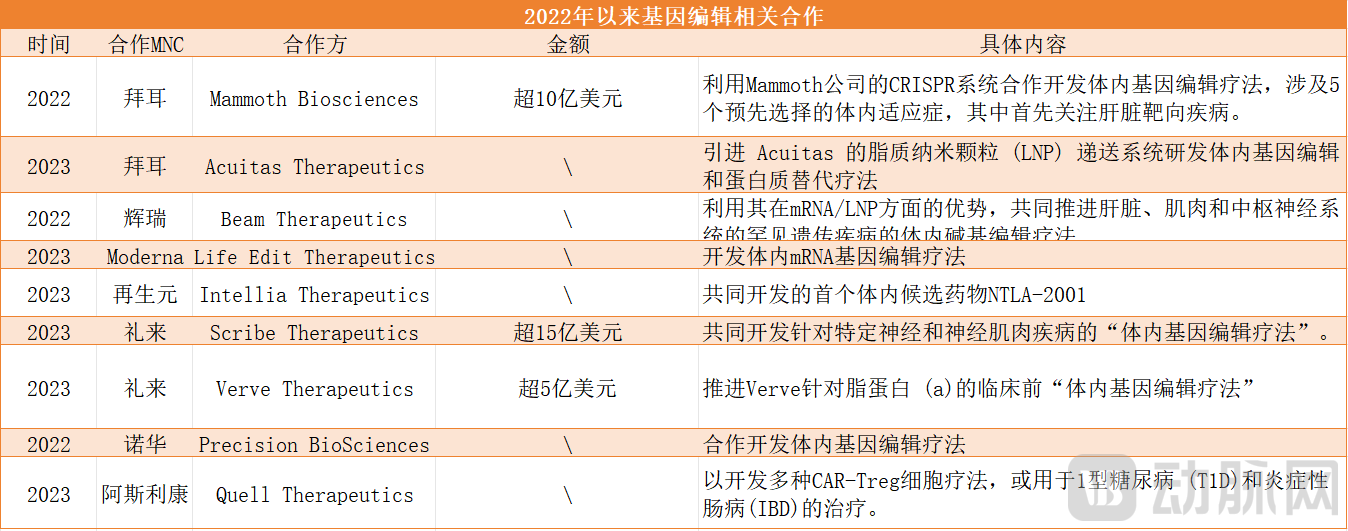 Incomplete Statistics on Gene Editing-Related Collaborations Since 2022
The collaboration between CRISPR Therapeutics and Vertex began in 2015. In that year, Vertex partnered with CRISPR Therapeutics to jointly develop gene therapies for hemoglobinopathies. Two years later, Vertex and CRISPR Therapeutics announced the joint development of CTX001 (exa-cel).
In April 2021, Vertex announced updated terms of its collaboration with CRISPR Therapeutics regarding the investigational therapy CTX001 (exa-cel). Under the amended agreement, Vertex will lead the global development, manufacturing, and commercialization of exa-cel.CRISPR will receive a $900 million upfront payment and may be eligible for $200 million in milestone payments upon the first regulatory approval of exa-cel.
2019–2023: More Trial Results and More Beneficiaries
In 2019, CRISPR Therapeutics and Vertex treated the first patient with β-thalassemia using Casgevy. Shortly thereafter, they treated the first patient with sickle cell disease.
“We were on edge when we administered the first dose to the initial patient, trying to determine how high their fetal hemoglobin levels would rise and whether Casgevy would translate into clinical benefit,” said Haydar Frangoul, a hematologist at the Sarah Cannon Research Institute. Fortunately, the outcome was favorable, with the first treated patient showing significant improvement.
After four years of testing, the benefits of Casgevy are evident. This therapy can eliminate the pain crises frequently experienced by patients with sickle cell disease and may also enable individuals with severe beta-thalassemia to no longer require regular blood transfusions.
In November 2023, exa-cel received conditional marketing authorization from the UK Medicines and Healthcare products Regulatory Agency (MHRA), becoming the world’s first approved CRISPR gene-editing therapy. In December, the FDA approved Casgevy (exa-cel) for the treatment of patients aged 12 years and older with sickle cell disease (SCD) suffering from recurrent vaso-occlusive crises (VOC). A decision on the indication for transfusion-dependent beta-thalassemia (TDT) is expected next year.
Following approvals in the UK and by the FDA, Casgevy (exa-cel) is now seeking approval in Europe. On December 15, European regulators issued a positive opinion on the drug, with a final decision expected no later than February of next year. Similarly to the UK, the potential marketing authorization for Casgevy in Europe will be “conditional,” requiring Vertex and CRISPR Therapeutics to submit results from ongoing pivotal trials and long-term follow-up data by August 2026 to assess long-term efficacy and safety.
Upon FDA approval, Casgevy (exa-cel), bearing the title of “the first CRISPR gene-editing drug,” stepped into the spotlight.