

Riding the Surge of Industry-Academia Collaboration: East China University of Science and Technology Has Quietly 'Landed'
In the spring of 1965, a group of pioneers traveled from bustling Shanghai to the remote and desolate Huangling area of Dengguan in Yantan, solely to accomplish a mysterious mission—Project 652. Years later, the public finally learned that Project 652 was not intended for building rockets and artillery, nor for conducting any secret experiments, but rather forEast China Institute of Chemical Technology (now East China University of Science and Technology) Established a Branch Campus in Southwest China。
Why does establishing a branch campus require such extensive mobilization? East China Institute of Chemical Technology, founded after the birth of New China,The First University of Chemical Engineering, has been undertaking cutting-edge scientific research tasks since its establishment and serves as an important "talent reservoir for the chemical industry." In an era of rapid national development, human resources are the primary resource; therefore, the inland relocation of certain classified programs at East China Institute of Chemical Technology became a key national priority.
In 1993, East China Institute of Chemical Technology was finally renamed after undergoing several rounds of mergers and reorganizations.East China University of Science and Technology(hereinafter referred to as “ECUST”). As is well known, it is a research-intensive university with particular strengths in engineering; however, beyond its inclusion in the “211” and “985” national initiatives, it also excels in translating scientific research achievements into practical applications.
I. From Strengths in Chemical Engineering to Comprehensive Development
In our daily lives, the chemical industry is indispensable, ranging from large-scale energy development such as petroleum and electricity to the processing and production of fertilizers, soaps, and various consumer goods. The importance of research and development (R&D) in chemical engineering is self-evident; therefore, establishing a university dedicated to cultivating R&D talent in this field naturally requires every possible effort.
In 1952, under policy guidance, Jiaotong University, Aurora University, Datong University, Soochow University, and Jiangnan UniversityThe chemical engineering departments of five renowned universities were merged, giving rise to Huali. Later, to enrich its faculty, the Ministry of Education furtherFudan University, Tongji University, St. John's University, Hujiang University, East China Normal Universityand eight universities, includingEast China Military and Political CommitteeMany faculty members were also transferred to East China University of Science and Technology (ECUST) from across the country. For a time, ECUST brought together a group of renowned chemical engineering scientists in China, with its first president beingProfessor Zhang Jiangshu, the founder of physical chemistry and colloid chemistry in China.
As of December 2023, East China University of Science and Technology has welcomed 14 academicians to its lecterns, along with more than ten field experts who have participated in national-level research programs such as the “973” and “863” Programs. The number of Distinguished Young Scholars and outstanding teachers is too numerous to count.
Supported by a robust faculty, East China University of Science and Technology has cultivated numerous outstanding talents, including Academicians Wang Jiming, Zhou Jun, and Tian He. Some serve in academic institutions and engage in scientific research, while others have pursued careers in business or government, advancing China’s scientific and technological development from diverse perspectives and through varied approaches.
With the progress of the times, the need for interdisciplinary integration has become increasingly evident. Amid this overarching trend, East China University of Science and Technology has diversified its academic offerings, continuing to leverage its strengths in chemical engineering and other dominant disciplines while incorporating a wide range of subjects such as clinical medicine and agricultural sciences.
These subjectsMost target the pain points in national development.. For instance, the Department of Integrated Circuit Materials, established in 2021, was designed to address the bottlenecks of low localization rates for key integrated circuit materials in China, supply chain dependencies, and a shortage of high-level talent. ECUST is leveraging its platform strengths to fill the talent gap in China’s integrated circuit sector.
In just a few years, the overall strength and academic level of East China University of Science and Technology (ECUST) have shown a significant upward trend. In the ESI rankings released in May 2020, ECUST’s “Environment/Ecology” discipline successfully entered the top 1% globally, becoming the eighth discipline at the university to achieve this milestone. Meanwhile, its traditional strong disciplines, such as Chemistry and Engineering, have continued to maintain their positions within the top 1‰ worldwide.
With a professional background characterized by strong application-oriented features, East China University of Science and Technology has demonstrated unique acumen in technology transfer. In 2015, when the trend of technology transfer had just begun to sweep through Chinese universities, it had already completedTwo Technology Transfer Projects Valued at Over 10 Million Yuan Each: Collaborated with a publicly listed company to commercialize avian vaccines; partnered with Shanxi Jincheng Anthracite Mining Group to commercialize industrial equipment.
To this day, East China University of Science and Technology remains on the list of Chinese universities ranked by the contract value of scientific and technological achievement transfers.
II. Commercialization Policies: Tightening on One Front, Generous on Another
For universities to advance the commercialization of research outcomes, the importance of policy cannot be overstated. The technology transfer policies at East China University of Science and Technology also reflect a “STEM-male” pragmatism.
1Cancel Patent Application Rewards
In June 2021, the State Council issued a policy requiring all localities toCompletely Eliminate Subsidies and Rewards for Patent and Trademark Applications, and East China University of Science and Technology had already experimented with similar policies around 2015.
At that time, to encourage researchers to engage in innovative activities, universities typically offered monetary rewards ranging from hundreds to thousands of yuan to faculty members who filed patent applications. For these researchers, this constituted a considerable sum of income. From the university’s perspective, an increase in the number of patents not only reflected its strong capabilities and qualifications but also served as proof of its educational quality.
Huali’s tough new policy directly disrupted this balance, and the results were immediately evident.
Following the cancellation of patent incentives, some applicants abandoned filings for patents with insufficient innovation, compelling East China University of Science and Technology to shift its patent strategy from pursuing quantity to enhancing quality. As original innovative capacity forms the foundation for translating scientific achievements into practical applications, the “streamlining” of patents has optimized both the quantity and quality of commercially viable projects, thereby steadily improving the level of technology transfer.
2Generous Incentive Policies
For researchers, the sudden loss of a source of income inevitably creates a sense of imbalance. To stimulate their innovative drive, East China University of Science and Technology has simultaneously abolished its previous reward system while introducing a new incentive policy:Once professors’ patents are commercialized, up to 50% of the proceeds can be distributed as remuneration in accordance with the maximum incentive standards for intellectual property set by Shanghai Municipality, while the university allocates an additional 40% as a development fund for the professor’s team, to be managed at the professor’s discretion.
Under the policy, professors at East China University of Science and Technology must incorporate market-oriented considerations into their project design from the outset if they wish to receive rewards for patent applications, thereby inadvertently enhancing the market feasibility of translating scientific research outcomes. Furthermore, the policy stipulates that patents must be commercialized within industry to qualify for rewards, which indirectly encourages researchers to proactively seek out industrialization partners.
Returning to the present, East China University of Science and Technology (ECUST) has continued its tradition of emphasizing rewards. The "Administrative Measures for the Transformation of Scientific and Technological Achievements (Trial)" issued in 2019 stipulates that for net income derived from the transfer or licensing of scientific and technological achievements, the distribution and reward principles are as follows: 10% to the university, 5% to the college, and 70% to the individuals who completed the achievements and those who made significant contributions to their transformation.15% Team Development Fund for Achievement Contributors。
It is worth noting that while traditional universities typically adopt a 70/30 revenue-sharing model, East China University of Science and Technology (ECUST) has reduced the university’s share by earmarking 15% as a team development fund. Since this fund can only be used for team development, it compels researchers to continue their scientific work to access the reward, thereby indirectly encouraging the sustainable development of research projects.This also serves as an incentive for the entire value chain of intellectual property creation, management, protection, and utilization.
These policies reveal that while East China University of Science and Technology offers substantial incentives, it has also established numerous restrictions, all aimed at facilitating the marketization of scientific research projects.
3“Three-Tier Assessment” Required Prior to Conversion
To achieve the translation of scientific research outcomes, it is always necessary to cross the “valley of death” between research and the market; this is not something that can be accomplished simply by “professors’ good intentions.” To improve conversion efficiency, East China University of Science and Technology has specially established“Three-Level Assessment”, to enhance the risk resilience of the professor program.
First,The R&D team conducts an independent assessment of the application value of the technology proposed for patent application.. The R&D team is required to submit an assessment and appraisal report to the institution to demonstrate that market research has been conducted. Through this process, the team’s understanding of the market can be effectively enhanced, thereby enabling the elimination of components unsuitable for commercialization during the research and development phase.
Afterward,The project must also undergo evaluation by specialized agencies commissioned by the school.As of 2022, East China University of Science and Technology has signed cooperation agreements with 11 patent agencies as well as national-level specialized technology transfer institutions. These external institutions are primarily responsible for evaluating the innovativeness and novelty of projects, and for forecasting project prospects from a professional, market-oriented perspective.
Finally,The University’s Technology Transfer Center will also conduct evaluation and review of the project.. After evaluating the project, external agencies will submit an approval report to the university, and the university’s Technology Transfer Center needs to conduct further evaluation based on the report.
In addition to evaluation, the university’s Technology Transfer Center has a more critical mission: assisting project teams in optimizing and refining their initiatives. When external organizations provide feedback, the expert panel under the Technology Transfer Center offers revision recommendations to the project teams and supports them in making adjustments to meet market-oriented standards as closely as possible. As of 2022, the university had helped refine more than 50 projects to achieve better commercialization outcomes.
III. Transformation Platform: Unified Coordination by One Party, with Each Fulfilling Its Own Responsibilities
Policy initiatives have positioned East China University of Science and Technology at the forefront of Chinese universities in translating research achievements into practical applications. In 2001, ECUST establishedChina's First Batch of National Technology Transfer Centers, and was included in the list again in 2021List of the First Batch of Pilot Programs for Establishing Professionalized National Technology Transfer Offices at Universities. The construction of its technology transfer platform has also become a benchmark for many universities to emulate and learn from.
Unlike many other universities, East China University of Science and Technology does not rely on a single department to coordinate its technology transfer efforts. It established in 2012Academy of Scientific and Technological Development, it has established the Institute for Frontier Interdisciplinary Sciences, the Institute of Industrial Technology, and a series of sub-centers including the National Technology Transfer Center and the International Technology Transfer Center. This approach ensures that research and development functions remain closely integrated with market-oriented operations, thereby further enhancing the university’s tripartite innovation capacity in disciplines, talent, and scientific research.
In various fields, East China University of Science and Technology has also established specialized service platforms. Taking the one that just made its debut at the China International Industry Fair as an example,Synthetic Biology Technology Transfer PlatformAs an example, the platform primarily serves the East China University of Science and Technology Qingdao Innovation Research Institute, a joint initiative established by East China University of Science and Technology and the Qingdao Municipal People's Government, designed to facilitate the commercialization of synthetic biology products.
As is well known, the greatest challenge in the synthetic biology industry lies in mass production. To address this bottleneck, synthetic biology technology transfer platforms have developed a full-chain suite of technical services, including fermentation process development, product separation and purification, pilot-scale validation, and engineering design. Compared with traditional centralized commercialization models, this “point-to-point” service model better clarifies discipline-specific translation challenges, thereby precisely improving the success rate of technology transfer.
IV. School-Enterprise Cooperation Embedded in the “DNA”
In December 1995, the State Education Commission and China Petrochemical Corporation signed an agreement to jointly establish and manage East China University of Science and Technology (ECUST). Whether due to historical heritage, ECUST has now demonstrated unique characteristics in the process of translating research achievements into practical applications.School-Enterprise CooperationColor.
1Innovative “Two-Way Model”
In traditional university-enterprise collaborations, the two parties typically “each fulfill their respective roles”: universities provide scientific and technological expertise to enterprises, which are responsible for development and commercialization; enterprises feed market demands back to universities, which then conduct research aimed at addressing key pain points.
This approach indeed ensures that each research project is fully utilized, thereby improving translation efficiency. However, East China University of Science and Technology (ECUST) believes that valuable scientific achievements worthy of academic recognition can also originate from the corporate sector; therefore, in university-industry collaborations,ECUST places greater emphasis on the concept of “sharing”。
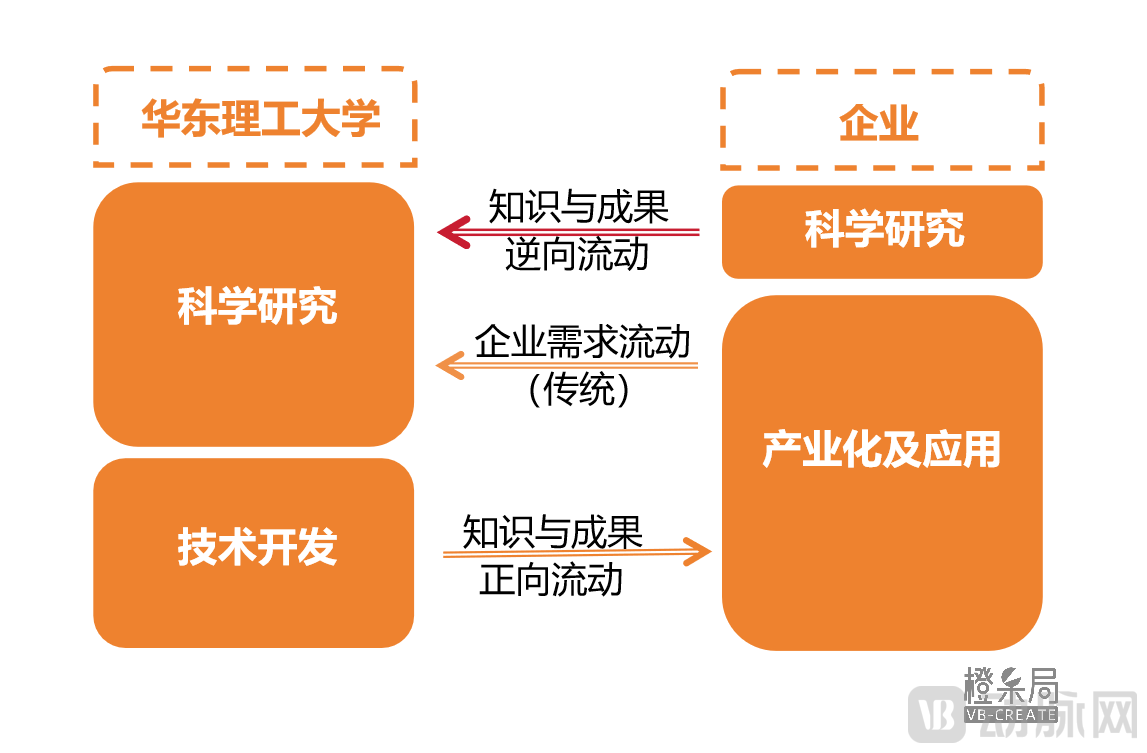
East China University of Science and Technology's "Two-Way Model" for University-Enterprise Cooperation
ECUST has adhered to the traditional model, whereby universities conduct research and development to generate scientific and technological achievements, which are then transformed through enterprise-led technology development and engineering applications. At the same time, it has also pioneered"Reverse Absorption"pioneered the integration of corporate scientific and technological achievements and innovative ideas into universities, combining them with university technical expertise for subsequent development.
Today’s enterprises have long moved beyond the “contract manufacturing” model, with many shifting their focus from “in-house production” to “independent R&D-driven production.” Consequently, most technology companies harbor robust internal research and development teams, and in some cases, their founders come from scientific research backgrounds.
However, research and development require substantial funding and platform capabilities, making it genuinely difficult for enterprises to go it alone. In this context, East China University of Science and Technology can leverage its advanced technologies accumulated over many years, along with its “national-level” strength, to take on corporate innovation projects and jointly complete the development. This approach not only provides access to first-hand market information but also enhances the university’s technology transfer capabilities, achieving a win-win outcome.
In 2017, East China University of Science and Technology partnered with the listed company Xintai Technology to jointly establish“ECUST-Xintai Joint Research Center for Rare Earth Functional Materials”. As a high-tech enterprise focused on the development and utilization of rare earth elements, Xintai Technology has accumulated substantial expertise in rare earth research. During their collaboration, East China University of Science and Technology provided innovative solutions for device and material R&D, while also gaining numerous inspirations for research projects.
In addition, ECUST also collaborates withShenneng Energy, Xilong Scientific, Jiangsu Chuanglianand other enterprises to establish joint research centers.
2Research Outreach Across Jiangsu, Zhejiang, Shanghai, and Anhui
Although East China University of Science and Technology (ECUST) is located in Shanghai, its influence has long transcended geographical boundaries. At a time when major cities are flocking to Shanghai to establish “research enclaves,” ECUST has begun to export its capabilities in the opposite direction, forming a “"Shanghai for R&D and manufacturing, Zhejiang for engineering design, Jiangsu for demonstration operations, Anhui for production implementation"new model.
The most representative case is the commercialization of the SE gasification technology. In 2016, the SE gasification technology, jointly owned by Sinopec and East China University of Science and Technology (ECUST), was awarded the Special Prize of the Shanghai Technology Invention Award. This technology enables the efficient and clean utilization of low-quality coal, making significant contributions to China’s energy security. Subsequently, leveraging the platform strength of the Sinopec Group, ECUST coordinated scientific research capabilities, talent advantages, and industrial resources across Jiangsu, Zhejiang, Shanghai, and Anhui provinces, ultimately achieving industrial implementation of the technology and reversing the previous situation where “Huainan coal” could not be utilized on an industrial scale.
This initiative has opened new channels for technology transfer at East China University of Science and Technology (ECUST), enabling enterprises collaborating with ECUST on technological partnerships to extend beyond Shanghai. Through exchanges and collaborations with enterprises across various regions, ECUST’s research capabilities and technology transfer proficiency have been significantly enhanced.
V. ECUST’s Unconventional Path to Technology Transfer
At the recently concluded JEC Composites Show in Paris, Huachang made its debut with new products, showcasing the emerging strength of China’s chemical industry to the world. As the “flagship enterprise” born from the industry–academia collaboration between Huachang and East China University of Science and Technology (ECUST), Huachang has grown from a small factory located next to the No. 1 canteen at the northeast corner of the ECUST campus into an internationally renowned brand—a transformation made possible by the scientific research support provided by ECUST professors.
In addition to Huachang, many other well-known enterprises, such as HGLaser and Shanghai Electric, have development trajectories that are inextricably linked to the scientific research conducted at East China University of Science and Technology. There are various models for the commercialization of scientific and technological achievements.Some prefer entrepreneurship, while others are willing to entrust their technology to more suitable platforms; Huali deeply understands this dynamic.
The market serves as both a litmus test and a star-making arena. It is precisely because ECUST alumni have always harbored passion and perseverance that scientific achievements imbued with the “ECUST DNA” have found their way into every corner of our daily lives. In the future, they will continue to shine and make significant contributions.