

BayOmics CEO Xu Hao: The Next Decade Belongs to Proteomics
In recent years, with the rapid global advancement of life science technologies such as mass spectrometry, the era of industrial applications in proteomics has arrived. Significant progress has been made in fields including tissue microenvironment analysis, drug target discovery, and research on complex diseases, continuously updating our understanding of the complexity of life.
One of the key forces driving the continuous advancement of practices in both research and industrial sectors lies in the emergence of suppliers offering innovations and application solutions across various omics technologies.Shenzhen Beipuaobiotech Co., Ltd. (hereinafter referred to as “Beipuaobiotech”) is a technology-based small and medium-sized enterprise holding multiple patented technologies. With proteomics sample pre-treatment products as its entry point, the company drives innovative development in life sciences and biopharmaceutical R&D through its clinical functional proteomics technology platform.
Since its founding in January 2022, Beipuao Bio has completed a Pre-A financing round worth tens of millions of yuan. In just two years, how has Beipuao Bio built a comprehensive solution for proteomics? And how has it expanded its market and established deep collaborations? Recently, VCBeat held an exclusive interview with Dr. Xu Hao, CEO of Beipuao Bio, to hear about his journey and the company’s rise.

Dr. Xu Hao, CEO of Beipuao Bio: Holds a Ph.D. from the Second Military Medical University of China. Previously held positions at Bio-Rad, BD, and Danaher, and served as General Manager for Waters-TA in the Asia-Pacific region prior to joining Beipuao Bio. Possesses extensive experience in the biopharmaceutical industry and rich managerial expertise.
The foundational technology underlying Beipuao Bio was derived from the SISPROT fully integrated sample preparation technology developed by Professor Tian Ruijun’s team at Southern University of Science and Technology (hereinafter referred to as “SISPROT”).Dr. Wei-Na Gao, formerly a Research Assistant Professor at Southern University of Science and Technology (SUSTech), leads BeipuBio’s core R&D team, which has accumulated extensive technical expertise in the development and application of proteomics methodologies. In 2016, the team pioneered the SISPROT technology. This technology has been granted invention patents in both China and the United States, with full independent intellectual property rights, laying a solid foundation for BeipuBio’s continuous innovation.
Dr. Xu Hao stated, “The advantage of the SISPROT technology lies in integrating all proteomic sample preparation steps into a miniaturized solid-phase extraction column, which not only reduces sample loss during transfer steps but also significantly shortens the total operation time. Compared with traditional methods, SISPROT can reduce sample preparation time by 90% and lower the required sample amount to 10% of the conventional requirement.”
Leveraging this technology, Beipuao Bio has developed and launched a commercial product—the SISPROT Fully Integrated Proteomics Sample Preparation Kit. The SISPROT kit is suitable for the analysis of ultra-trace clinical samples, enabling the stable detection of over 6,000 proteins from an initial sample amount of 100 ng through a one-stop sample preparation workflow.
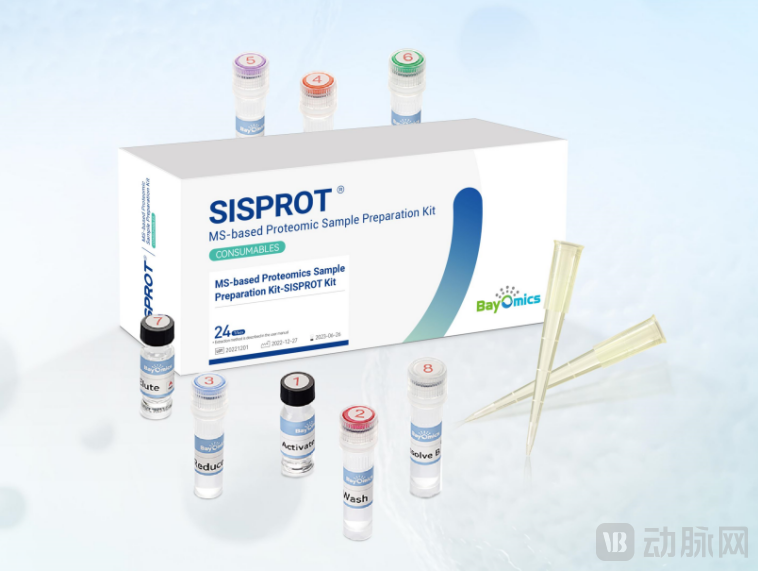
SISPROT Proteomics Sample Preparation Kit
Furthermore, based on its AutoProteome automated sample preparation technology, Beipu Bio has developed a high-throughput, fully automated sample preparation workstation with independent intellectual property rights. This system can be used in conjunction with the SISPROT kit to complete all steps of proteomic sample preparation, enabling the processing of 96 samples within 3 hours. It significantly enhances experimental efficiency while ensuring result uniformity, thereby meeting the practical analytical demands of large-scale clinical cohorts.
SISPROT technology represents a significant technological breakthrough at the foundational level of Beipuao Bio. The SISPROT proteomics sample preparation kit enablesUltra-Micro Proteomics Analysishas become possible. Equipped with an automated sample pre-processing workstation, it can achieve more than a 10-fold increase in experimental efficiency.
Dr. Xu Hao stated, “The SISPROT technological innovation provides a superior solution to the core challenges of sample preparation in mass spectrometry analysis. By offering complementary advantages to mass spectrometry techniques with higher sensitivity and broader applicability, it has promoted the widespread application of proteomics in both scientific research and clinical settings.”
While developing the SISPROT kit and the automated sample pre-processing workstation, Beipuao Biotech has also extended its product chain to scientific research services. Leveraging the extensive experience accumulated by its technical team over many years, Beipuao Biotech has launched service offerings including spatially resolved proteomics, single-cell/cell-type-specific proteomics, and functional proteomics, thereby lowering the barrier for users to enter the field of cutting-edge proteomics.
Leveraging years of deep expertise in the field of spatially resolved proteomics, Beipuao Bio has developed robust multi-platform integration capabilities. The company offers spatially resolved proteomics services or turnkey solutions that encompass visualized single-cell identification, automated laser microdissection, high-recovery sample collection, sample preparation, and data analysis.
Beipu Bio’s spatially resolved proteomics platform enables multiplex immunofluorescence staining to label specific cell types or regions of interest on the same tissue section, followed by precise microdissection of these labeled areas for deep mass spectrometry analysis, thereby obtaining authentic in situ protein expression data at a resolution of 0.1 mm2Fluorescence-stained FFPE sections enable deep detection of over 7,000 proteins. Furthermore, when integrated with single-cell or cell-type-specific proteomics data, this approach allows for the prediction of spatial distributions across different cell types.
Dr. Xu Hao believes that Beipu Bio positions itself asUpstream Platform Supplier for Proteomics, not merely as a hardware or software vendor or service provider, but by building platforms and offering comprehensive proteomics solutions, thereby positioning itself in the market to deliver deep-tier services that remain largely untapped by others.
Reagents, instruments, and services are integrated in a three-pronged approach, leveraging strong partnerships to establish a platform-based supply and sales system that enables effective bundling and combined sales, thereby building a broad-spectrum supply chain.Furthermore, by collaborating with CRO clients and starting with foundational services such as sample collection and omics services, Beipuao Bio helps them establish a mature and comprehensive service system, gradually evolving into a close, high-quality partnership integrating “hardware + software.” By transforming clients into suppliers with independent third-party service capabilities, Beipuao BioIt has established an independent third-party service model with extended service capabilities, while also building a sustainable, in-depth, and long-term mechanism for deep collaboration.
Within Beipu Bio’s service portfolio, clinical functional proteomics solutions enable pharmaceutical companies and research institutions to discover innovative biomarkers and drug targets derived from clinical samples, thereby delivering deep omics services that extend into upstream industrial discovery and application. The aim of clinical functional proteomics is to investigate how protein networks contribute to dysfunction, facilitating applications in drug development, target protein identification, clinical efficacy evaluation, and biomarker discovery.
Since 2014, the founding team of Beipuao Bio has been researching proteomics technical solutions that are more closely aligned with clinical practice—specifically, clinical functional proteomics solutions. This year, they were invited to systematically elaborate on this next-generation functional proteomics strategy in *Molecular & Cellular Proteomics*, a core journal in the international field of proteomics. Based on this approach, the founding team collaborated with the Salk Institute in the United States and published their research findings in *Nature* in April 2019. They identified Leukemia Inhibitory Factor (LIF) as a key mediator of signaling between pancreatic cancer cells and stellate cells, and systematically validated its feasibility as a therapeutic target and biomarker for pancreatic cancer. Currently, AstraZeneca has advanced the first neutralizing antibody targeting LIF, used in combination with anti-PD-L1 therapy, into Phase II clinical trials. These achievements fully demonstrate the pivotal role of clinical functional proteomics in drug target discovery and pharmaceutical development.
As can be seen from the LIF case,By employing clinical functional proteomics strategies, researchers can rapidly pinpoint the most functionally potent proteins, thereby significantly reducing trial-and-error costs and accelerating progression to the clinical stage.This strategy stems from Beipuao Biotech’s early foundational experience and the accumulation of unique advantages, building comprehensive expertise across the entire workflow—from omics data mining to drug target discovery and development.
Dr. Xu Hao believes that, “The core technological barriers in the field of proteomics are currently being gradually overcome. Breakthroughs in new scientific discoveries are highly dependent on innovations in detection instruments and technical platforms, while advancements in detection technology also drive and accelerate progress in proteomics, and even the development of life sciences as a whole. The next decade will be a period of rapid growth for proteomics.”
It is foreseeable that the leapfrog development of mass spectrometry platforms will bring new opportunities to the entire proteomics application market. Meanwhile, technological advancements and product iterations will pave the way for proteomics to enter downstream industrial applications.