

Angiochem Files IPO Prospectus for First-in-China PDC Candidate Targeting Brain Tumors with Blood-Brain Barrier Penetration

AngioChem
Biotechnology Research Merchant
To date, Angiochem Inc. has completed five rounds of financing, totaling $21.3 million. The most recent investors are the Government of Quebec and the Business Development Bank of Canada (BDC). BDC Venture Capital, VIMAC Milestone Medical Fund, and MMV Capital Partners participated in the previous three rounds of financing, respectively.
Angiochem, founded in 2003 and headquartered in Montreal, is a clinical-stage biotechnology company dedicated to developing novel peptide-drug conjugates (PDCs) and antibody-drug conjugates (ADCs) capable of crossing the blood-brain barrier (hereinafter referred to as “BBB”).includingCo-developed with Shengnuoji Pharmaceutical Co., Ltd.SNG1005 (also known as ANG1005) is currently undergoing Phase III clinical trials and is poised to become China’s first peptide-drug conjugate (PDC) capable of specifically delivering paclitaxel to the brain.
John Huss, Executive Chairman of Angiochem, has over 25 years of experience in the pharmaceutical industry. He spent 20 years working in the pharmaceutical divisions of Merck & Co., Roche, and Sanofi, and served as Chief Executive Officer, President, and Director of Theratechnologies. Currently, he is the Founder, President, and Chief Executive Officer of H&P Labs, as well as Vice President, Executive Committee Member, and Director of BioQuebec.
Dr. Martin Godbout, a member of the Board of Directors, holds a Bachelor’s degree in Biochemistry and a Ph.D. in Physiology and Molecular Endocrinology from Université Laval, and has achieved numerous accomplishments and honors in the biopharmaceutical healthcare sector.
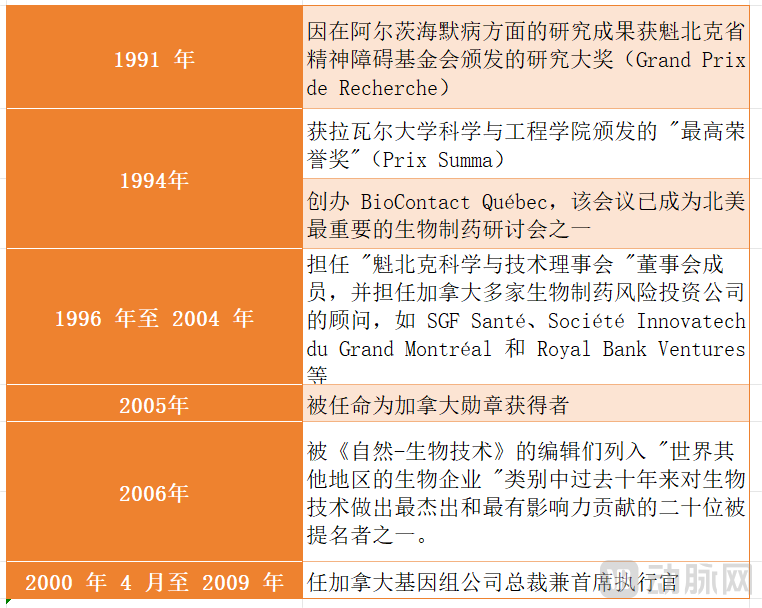
Table of Honors (Key Achievements) of Martin Godbout (Data Source: Angiochem Official Website)
The blood-brain barrier (BBB) is highly selective, permitting only certain metabolically essential molecules (such as glucose, insulin, and growth hormone) and lipid-soluble small molecules to enter the brain, thereby posing a significant constraint on the development of effective therapeutics for diseases of the brain and central nervous system.
Therapeutic agents can be delivered to the brain using pharmacological or physiological approaches. The traditional pharmacological approach involves modifying known active molecules to meet the criteria required for blood-brain barrier (BBB) penetration, such as size, charge, and lipophilicity. However, this may reduce drug efficacy and even lead to unwanted toxicity.
In contrast, physiological methods can leverage the brain’s own active transport systems to cross the blood-brain barrier in the same manner as other molecules such as growth hormone or insulin. BBB entry into the brain does not reduce drug activity, ensuring therapeutic efficacy.
Lipoprotein Receptor-Related Protein 1 (hereinafter referred to as “LRP-1”) is a critical receptor involved in the transport of essential substances, such as insulin and growth hormone, into the brain. It is one of the largest, most abundantly expressed, and most versatile receptors on the blood-brain barrier (BBB). LRP-1 can bind to a wide variety of drug molecules, facilitating the entry of both small and large molecular therapeutics (with more than 40 known natural ligands) into the brain. Furthermore, due to its rapid transcytosis and recycling time (approximately 30 seconds), LRP-1 is difficult to saturate, ensuring that the receptor is not permanently occupied and can continue to perform its physiological functions.
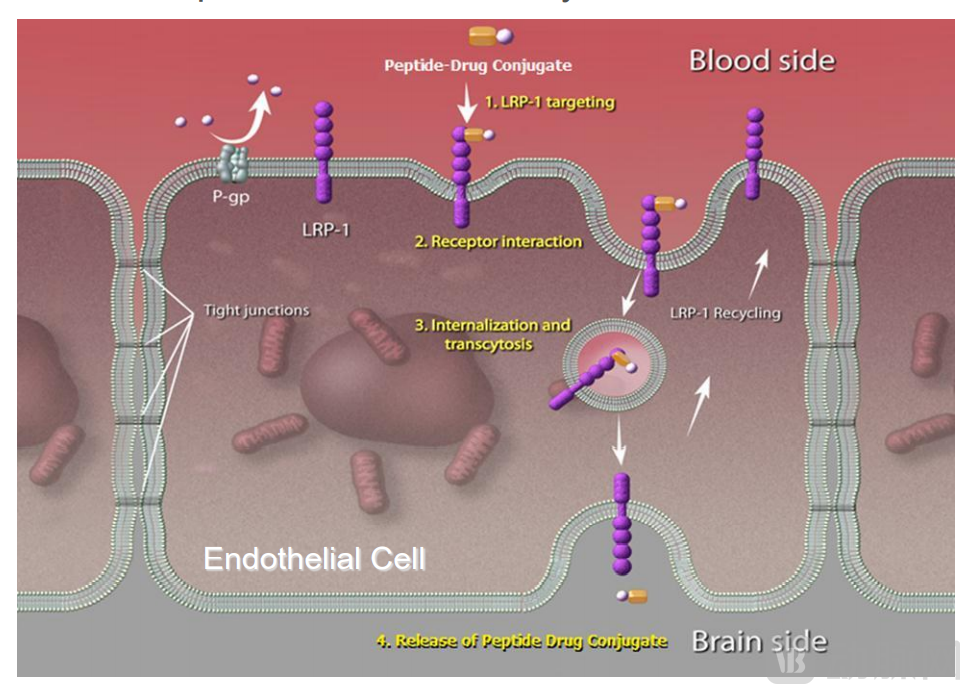
Crossing the BBB: Diagram of Receptor-Mediated Transcytosis Mechanism (Image Source: AngioChem Official Website)
Angiochem has developed aOver 100 TypesA proprietary library of peptide structures, with amino acid counts ranging from 8 to 34. Innovative drugs are based on these proprietary amino acid sequences (known as Angiopeps), which bind to the LRP-1 receptor, penetrate the blood-brain barrier (BBB), and reach the site of pathology.Capable of Penetration BBB can also maintain its own activity and efficacy。
According to the World Health Statistics 2023, non-communicable diseases accounted for 74% of global deaths in 2019, with cardiovascular diseases alone causing 17.9 million deaths. Chronic conditions such as cancer, diabetes, and autoimmune diseases are difficult to treat with conventional therapies due to challenges in targeting specific cells or tissues. Peptide–Drug Conjugates (PDCs) offer a more targeted therapeutic approach.
Steven L. Gonias, M.D., of the University of California, San Diego, stated, “The properties of LRP-1 make this receptor an excellent target for drug development. Leveraging LRP-1 to facilitate drug delivery across the blood-brain barrier into the brain offers new hope for the treatment of neurological disorders, cancer, diabetes, and pain.”

Steven L. Gonias (Image source: AngioChem official website)
By leveraging the characteristics of LRP-1 for drug development, Angiochem currently has four drug candidates in its pipeline, with the most advanced one having reached Phase III clinical trials.
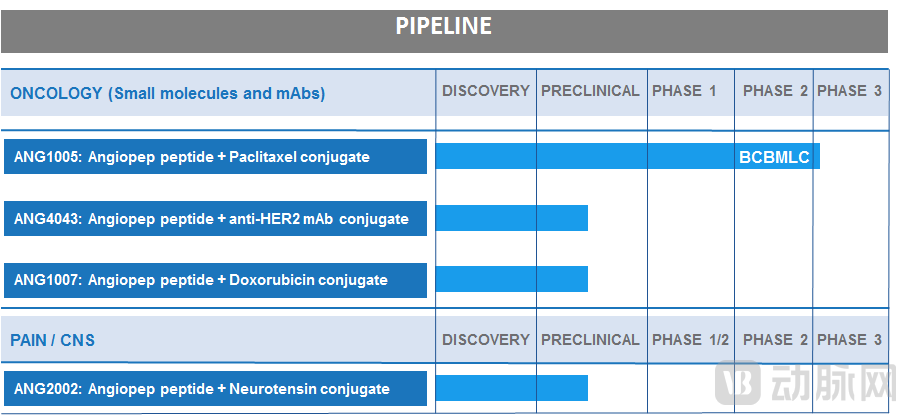
Product Pipeline (Source: Angiochem Official Website)
The following section introduces several core pipelines:
·ANG1005
ANG1005It is an innovative paclitaxel derivative that targets tumors, specifically the Angiopep-2-paclitaxel conjugate. It is the first drug to utilize the AngioChem technology platform to cross the blood-brain barrier (BBB) and enter cancer cells. By linking a peptide that recognizes the LRP-1 receptor with paclitaxel, it facilitates drug delivery into the brain and tumor cells.
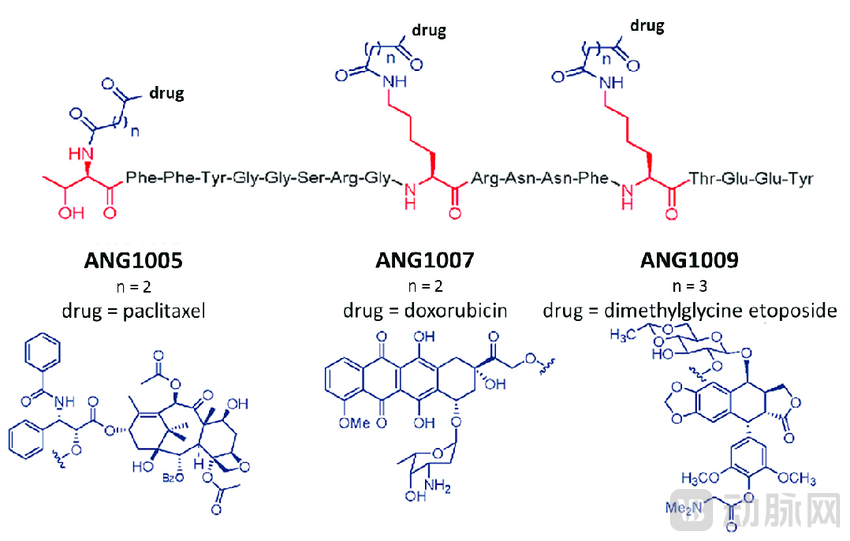
Chemical Structure Diagram (Image source: AngioChem official website)
ANG1005 has been studied in more than 200 patients with primary or secondary brain tumors. Two Phase I clinical trials (NCT00539344 and NCT00539383) have been conducted to determine the maximum tolerated dose (MTD) and to obtain data on safety, tolerability, and preliminary efficacy; these trials enrolled patients with malignant glioma and patients with advanced solid tumors and brain metastases, respectively.
Furthermore, a Phase IIPhase I clinical trial (NCT01480583). To further confirm its clinical anticancer activity in patients with recurrent high-grade glioma (NCT01967810) and in patients with recurrent brain metastases from breast cancer (NCT02048059), two additional Phase II trials were conducted.
In 2018, Angiochem announced that it had obtained Special Protocol Assessment (SPA) agreement from the FDA on the design and statistical analysis plan for the Phase III clinical trial of ANG1005.
·ANG4043
According to data from the AngioChem official website, the global market size for monoclonal antibodies reached $48 billion in 2010. The top 10 monoclonal antibody (hereinafter referred to as “mAbs”) therapies accounted for the majority of sales, including Roche’s Avastin®, Rituxan®, and Herceptin®, as well asAbbVie'sHumira® and other products.
Monoclonal antibodies (mAbs) can specifically bind to target cells or proteins, offering certain advantages in the treatment of various neurological disorders. However, the blood-brain barrier (BBB) limits the ability of mAbs to reach therapeutic concentrations in the brain, thereby compromising their therapeutic potential. Studies have demonstrated that receptor-mediated transcytosis can enable mAbs to achieve the required concentrations in the brain parenchyma.
Angiochem leverages Angiopep-2, an active targeting peptide with high affinity for low-density lipoprotein receptor-related protein-1 (LRP-1), to cross the blood-brain barrier via receptor-mediated transcytosis, while maintaining affinity for target receptors and preserving normal in vivo function. As a proof of concept, Angiochem developed an anti-HER2 (human epidermal growth factor receptor 2) brain-penetrating peptide–antibody conjugate capable of entering the brain at therapeutic concentrations, namelyANG4043。
20%-30% of primary invasive breast cancers exhibit HER2 gene overexpression. HER2 overexpression is not only associated with tumor initiation and progression but also serves as a critical biomarker for clinical treatment monitoring and prognosis. Herceptin® (trastuzumab) is a monoclonal antibody (mAb) targeting the HER2 receptor, which has significantly improved survival outcomes in HER2-positive patients.
However, due to the limited ability of trastuzumab to penetrate the blood-brain barrier (BBB), the central nervous system (CNS) may serve as a site for breast cancer metastasis in HER2-positive patients. ANG4043, which combines Angiopep-2 with a trastuzumab-like monoclonal antibody (mAb), can inhibit metastasis to the brain.
Antibody-drug conjugates (ADCs) consist of monoclonal antibodies (mAbs) or mAb fragments stably linked to biologically active cytotoxic drugs, thereby combining the target specificity of mAbs with the anticancer potency of cytotoxic agents. Angiopep molecules can be utilized to cross the blood-brain barrier via receptor-mediated transcytosis, targeting tumor markers to distinguish healthy tissue from diseased tissue and deliver cytotoxic agents to tumor cells.
Angiochem has successfully conjugated two anticancer drugs, docetaxel and maytansine, with anti-HER2 antibody-drug conjugates (ADCs). Compared to the unconjugated drugs, these ADCs exhibit stronger antiproliferative activity, enhanced blood-brain barrier penetration, and improved survival rates in preclinical studies.
·ANG2002
In recent years, the range of available analgesic medications has expanded. However, there remains a significant gap in treatments for chronic cancer pain, postoperative pain, and neuropathic pain. According to data from the AngioChem website, up to 70% of cancer patients are unable to take oral medications, 40–50% of cancer patients do not achieve adequate pain relief, and 75% of postoperative patients do not receive sufficient analgesia.
Opioid analgesics and nonsteroidal anti-inflammatory drugs (NSAIDs) can cause adverse reactions, such as constipation, respiratory depression, cognitive impairment, and gastrointestinal bleeding, while other analgesic therapeutic agents face the challenge of ineffective penetration across the blood-brain barrier (BBB).
ANG2002, a neurotensin derivative developed by AngioChem, is composed of the peptide Angiopep-2 conjugated with neurotensin. Its analgesic efficacy has been validated in preclinical models of acute pain, inflammatory pain, postoperative pain, cancer pain, and neuropathic pain.
· Novel Enzyme Replacement Therapy (ERT)
Lysosomal Storage Diseases (LSD) are caused by genetic mutations that result in deficiencies of specific acid hydrolases within lysosomes. This leads to the abnormal accumulation of corresponding biological macromolecules in lysosomes due to impaired degradation, thereby causing dysfunction in cells, tissues, and organs. According to data from the AngioChem website, approximately 1 in every 7,000 newborns is affected by LSD. Although there is currently no cure, intravenous administration of the deficient enzymes (Enzyme Replacement Therapy, hereinafter referred to as “ERT”) has been used to alleviate symptoms in certain LSD patients.
Hurler Syndrome is one of the most severe lysosomal storage diseases (LSDs), also known as mucopolysaccharidosis type I (MPS I). It is a genetic disorder that causes a deficiency in α-L-iduronidase (IDUA), the enzyme responsible for degrading glycosaminoglycans within lysosomes. In the absence of this enzyme, the degradation of its substrates is impaired, leading to their accumulation in the body. However, currently available enzyme replacement therapy (ERT) cannot cross the blood-brain barrier (BBB); therefore, ERT fails to address neurological symptoms such as cognitive decline and behavioral changes.
The half-life of lysosomal enzymes is very short, and without the protection of structural modifications, they may even fail to reach It is cleared before reaching the BBB. The enzyme derivative developed by Angiochem designs the Angiopep-2 enzyme conjugate into a structure that can both enter lysosomes and maintain its enzymatic activity. While enhancing its penetrability, it is also less susceptible to hepatic clearance.
2018,Xinogen, a subsidiary of Shengnuoji Medicine, has entered into a development and collaboration agreement with Angiochem,Secured exclusive rights for the development and commercialization of ANG1005 in the Greater China region. Angiochem Inc. will receive an upfront payment, milestone payments based on significant research achievements during the development process, and royalties from future product sales.
Currently, ANG1005 is undergoing Phase III clinical trials. It is the most advanced PDC project in China and has the potential to become the next approved and marketed PDC product.