

Pharma Investors Stepping into the Spotlight as BD Deal-Makers

Eccogene
Small Molecule Drug Developer
Legend Capital
Early-stage venture capital and growth-stage private equity investment institutions

OrbiMed
Healthcare Investment Institutions

Biokin
Pharmaceutical R&D Developer

DualityBio
Innovative Molecular Type Drug Developer
“This is what true post-investment management looks like,” remarked an investor. The global expansion of drug pipelines has undoubtedly been the hottest topic in the innovative pharmaceutical sector this year. What many have overlooked is that behind this trend, some investors have actively engaged themselves, playing an indispensable role by bridging connections and facilitating deals.
Over time, the randomness of overseas pipeline expansions has gradually given way to a certain inevitability driven by industrial dynamics. This trend appears to represent some of the deeper transformations underway in China’s innovative drug sector. According to incomplete statistics, nearly 50 license-out deals involving Chinese companies had been completed in 2023 as of press time. Since 2021, the frequent occurrence of such overseas licensing transactions has even begun to induce a sense of aesthetic fatigue among observers.
Six months ago, a seasoned industry practitioner wrote an article pointing out that, from the perspective of extending the time frame and expanding the sample size, these transactions should be viewed as positive news. He noted that while any given deal may have its own specific motivations, interest among overseas pharmaceutical companies in Chinese pharmaceutical assets is rising rapidly, “even if such companies have long been out of favor within their domestic industries and capital markets.” In this practitioner’s view, the quality of assets underlying outbound licensing deals by Chinese pharmaceutical companies is improving at a visibly rapid pace, to the extent that they can indeed be considered regular participants in the global pharmaceutical industry.
China’s innovative drug ecosystem is once again different from the past, and everyone involved may need to re-examine and redefine their roles.
If pipeline deals between pharmaceutical companies are considered commonplace in the eyes of industry peers, then the licensing transaction between Biokin and BMS at the end of 2023 was somewhat different.
On December 11, SystImmune, a subsidiary of Biokin, entered into an exclusive license and collaboration agreement with Bristol Myers Squibb (BMS) for the BL-B01D1 project. Upon effectiveness of the collaboration, BMS will pay SystImmune $800 million in upfront payments and up to $500 million in near-term contingent payments. Including potential future milestone payments, the total potential value of the transaction could reach up to $8.4 billion, setting a new record for the total value of out-licensing deals for Chinese innovative drugs.
The news immediately sparked intense industry attention. “This deal could become a landmark for BD professionals.” In this transaction, Biokin retained partial development and commercialization rights in the U.S. market to be advanced jointly with BMS. Many drew parallels to the classic deal between Johnson & Johnson and Legend Biotech.
In an investor mutual assistance group for small and medium-sized funds, an insider revealed that behind the transaction, an early investor in Biokin had devoted considerable effort, “having been in the U.S. recently to help the company negotiate this deal.” The final terms of the agreement also closely aligned with the founding team’s operational style.
In China, the development model for innovative drugs has undergone profound changes.Historically, new drug development has relied more heavily on the further advancement of in-licensed pipeline assets. During this period, the key competitive factors were clinical and commercialization capabilities, as well as the intrinsic quality of the in-licensed pipeline. The latter depended on business development (BD) capabilities. Consequently, during the earlier surge in innovative drug development, experienced medical officers and business development executives were in high demand and short supply, with annual compensation packages bidding up to millions of yuan.
To date, innovative pharmaceutical companies have increasingly recognized that innovation must be globally oriented, with the introduction and development of pipeline assets gradually transitioning toward independent R&D. Against this backdrop, Chinese innovative pharmaceutical companies are accelerating the pace of out-licensing their pipelines and technology platforms.
However, beyond the reversal of roles between the transacting parties, out-licensing and in-licensing of pipeline assets pose entirely different challenges to a company’s comprehensive capabilities. Pipeline asset transactions are characteristic of a buyer’s market, where the primary task of the buyer’s business development (BD) team is to screen a wide range of projects and select the best among them. In contrast, the seller’s BD responsibilities are far more complex and fragmented, often requiring coordinated efforts from the BD team, R&D team, and senior management to close the deal and even drive subsequent co-development initiatives.
Notably, in several other major overseas licensing deals for key pipelines in 2023, the active involvement of investors was also evident.
“Before moving into investment, my primary work experience was in pharmaceutical companies. Many of the previous investment opportunities I identified were first discovered within my professional network,” an investor told VCBeat. In his view, providing portfolio companies with necessary support and resources has always been part of his job. This year, two star projects he helped incubate successfully licensed their investigational pipelines to multinational pharmaceutical firms, with total contract values setting new records in their respective subsectors.
“If both parties share the same goal of developing high-quality novel drugs, collaboration in pipeline licensing transactions is only natural.” In his view, once R&D reaches a certain stage, it is standard practice to either secure independent financing for further development or pursue pipeline licensing and collaborative development. Therefore, providing appropriate support during the pipeline licensing process is a logical and natural step.
“Investors play an active supportive role before and after BD transactions, but the core driving force still relies on the Biotech company’s own capabilities and decision-making,” said Yang Shujun, Investment Director at Legend Capital. “Two years ago, we observed the trend of innovative drug companies going global and their need for out-licensing. We actively bridged domestic and international industrial resources, organized relevant BD forums and events, and coordinated experts in finance, law, and BD transactions to share BD-related experience.”
Furthermore, he emphasized that successful business development (BD) deals still require companies to possess differentiated products and robust preclinical or clinical data, with investors merely playing a supportive role. After all, in an increasingly mature and transparent pipeline transaction market, establishing connections through social circles is only the first step; ultimately, success hinges on the quality of the product and its data.
From an investment perspective, investments in domestically developed innovative drugs were previously anchored primarily to the domestic market, with a focus on the development team’s ability to rapidly follow suit. As new drug R&D enters deeper, more complex stages, there is a growing recognition that only by possessing global innovation capabilities can companies secure a long-term foothold in the rapidly evolving pharmaceutical market. Consequently, the logic underlying venture capital investment in innovative drugs has shifted.
Certainly, some institutions have proactively established new global footprints—a move carrying greater risk than follow-on innovation, and equally so for early-stage investors. Today, the bold are reaping the fruits of victory.
VCBeat conducted a brief review of representative cross-border pipeline transactions over the past two years and found that professional investment institutions were prominently involved behind these deals. Moreover, investors who proactively provide business development (BD) support to their portfolio companies mostly come from these same institutions. “Over the past two years, many of our portfolio companies have also achieved outstanding pipeline licensing deals. However, the underlying reason is more attributable to the innovative drug companies themselves reaching a certain stage of development. Enterprises with global innovation capabilities will naturally enter the global market,” Yuan Kejia, Managing Director at V-Capital, told VCBeat.
Since 2021, dozens of domestic innovative pharmaceutical companies have completed more than one hundred cross-border pipeline transactions. In this analysis, we selected representative deals characterized by either substantial total contract values (ranging from hundreds of millions to tens of billions of US dollars), involvement of multinational pharmaceutical giants as counterparties, or leadership status within specific therapeutic segments. Our examination reveals two major clustering characteristics among the investment institutions behind these representative transactions.
First, the clustering effect among leading institutions is significant; firms including Lilly Asia Ventures, Hillhouse Capital, Legend Capital, OrbiMed, and China Health Capital have been involved in more than half of the representative transactions through their portfolio companies.“In fact, we closely monitor the global business development (BD) activities of companies, facilitate connections for our portfolio companies, and even organize industry salons to foster knowledge exchange,” Yuan Kejia pointed out. “However, based on results to date, the primary drivers of successful transactions are the companies’ own outstanding products and teams.”
Second, some investment institutions that took equity stakes in the early stages provided multiple rounds of additional support during the company’s growth process.For instance, Huagai Capital continuously invested in Eccogene in 2020 and 2021; the latter secured the largest domestic pipeline licensing deal in the GLP-1 field with AstraZeneca (AZ) in November 2023. Similarly, Sherpa Capital participated in Series A and Series B+ financing rounds of Biocytogen in 2019 and 2023, respectively, while Loyal Valley Capital supported Elevation Bio during its Series A round in 2021 and Series B round in 2022. Both Biocytogen and Elevation Bio have demonstrated strong performance amid the surge in licensing deals for domestically developed ADC pipelines.
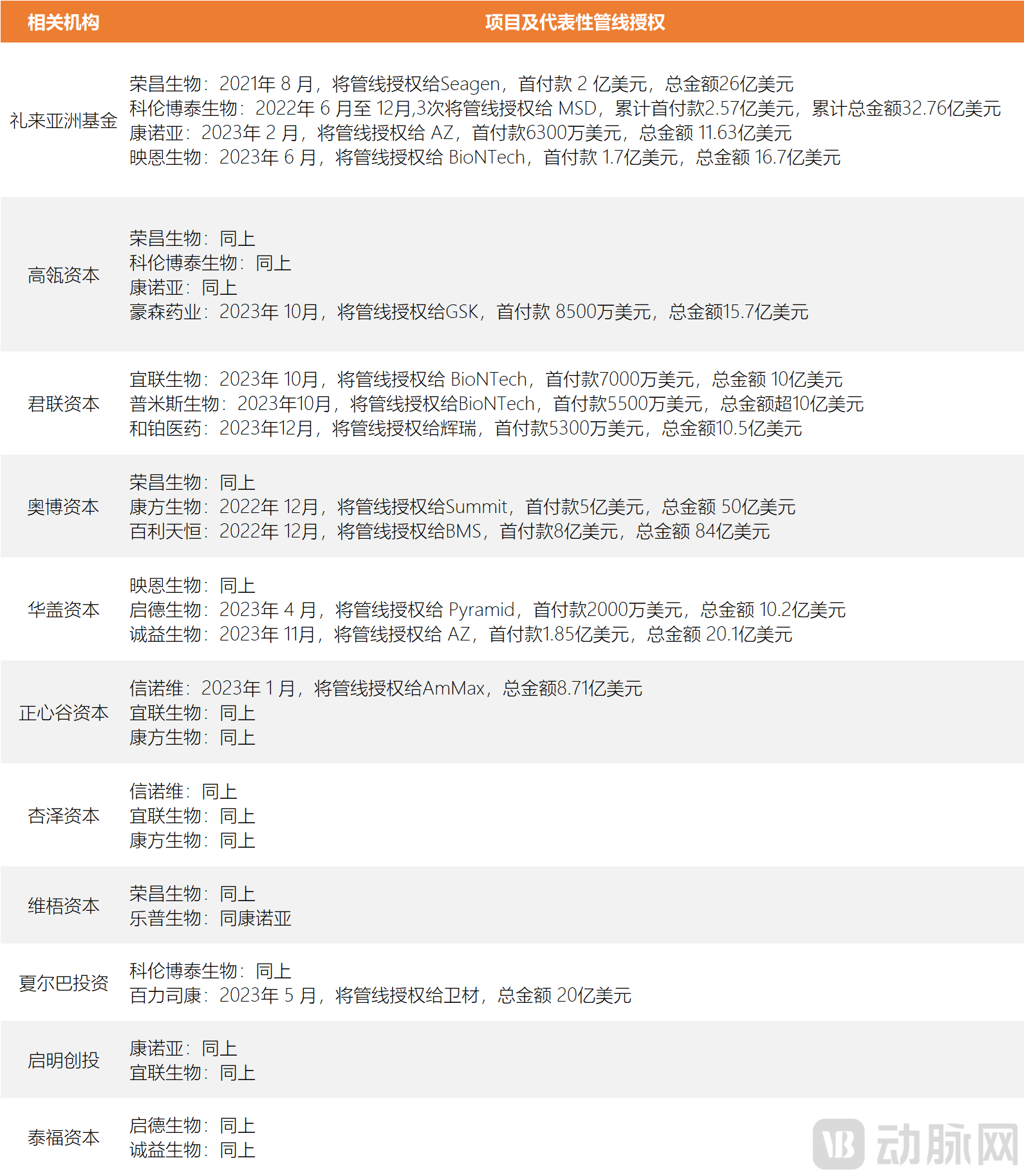
2021Age 2023 In [Year], Some Venture Capital Firms with Significant Portfolio Company Pipeline Licensing Activities Data Source: Arterial Orange Database
In a sense, while investors hustle to forge global business development connections for their portfolio companies, they also share in the dividends of these companies’ growth. Admittedly, this satisfaction may not be as exhilarating as that brought by an IPO, but it nevertheless serves as a key to unlocking future opportunities.
On the one hand, upfront payments without repayment obligations have alleviated cash flow pressures for many companies, enabling them to continuously advance their promising pipelines. On the other hand, the entry of multinational pharmaceutical companies has propelled innovative drug developers into global competition in new drug R&D. Bolstered by enhanced clinical and commercialization capabilities, the growth risks faced by these innovative enterprises have been mitigated to some extent, often leading to a re-anchoring of their overall valuations. Naturally, the more abundant cash flow has objectively provided foundational conditions for certain investment institutions preparing to exit.
Returning to the core of innovative drug development, the most critical factor for pharmaceutical innovation companies is to integrate with top-tier global R&D capabilities, thereby making the vision of developing new drugs with clinical value more attainable.
Nowadays, the continued tightening of capital markets has led an increasing number of new drug founders to focus on business development (BD).
When to initiate business development (BD) and how to execute it effectively have become unavoidable topics within the industry. Objectively speaking, BD in pharmaceutical companies is a rather traditional profession with well-established processes. In a sense, the growth history of multinational pharmaceutical companies is essentially a history of BD. In China, the evolution of BD mirrors the iterative development of the innovative drug ecosystem. However, BD is merely one component of new drug development and can only provide limited value toward the market launch of innovative drugs. If this is regarded as the sole objective, decision-making in development is inevitably prone to deviation.
An inescapable reality is that not every business development (BD) deal is aimed at accelerating the growth of innovative drugs. For most companies, BD serves to expand their R&D pipelines and rapidly establish a presence in emerging hotspots. However, when observed across a larger sample size, many enterprises also leverage BD to build patent barriers or secure advantages in clinical development timelines. From a commercial perspective, BD activities driven by different objectives all hold their own rationale.
Of course, the true motives behind business development (BD) activities remain opaque to outsiders. Even in some BD transactions where the initial intent was genuinely to expand the pipeline, unforeseen challenges during subsequent clinical development have led to outcomes that deviate from original expectations. The risks inherent in R&D and BD are unavoidable. This necessitates a thorough analysis based on clinical value and commercialization efficiency at the very inception of pipeline projects. As a strategic option within the commercialization process, BD must be advanced scientifically and effectively at every stage, from early-stage data preparation and core transaction negotiations to later-stage collaborative R&D.
First, it is essential to clearly understand the other party's needs.In most cases, pipeline collaborations are characterized by a strong buyer’s market, with sellers often tailoring their offerings to meet buyers’ preferences. On one hand, buyers with the financial capacity are few and far between. “Buyers are generally multinational pharmaceutical companies or large domestic pharma firms. When factors such as product type, therapeutic area, development stage, and market scope are taken into account, the number of pharmaceutical companies that could potentially become buyers is actually quite limited, necessitating substantial targeted efforts,” pointed out an investor. On the other hand, many innovative biopharmaceutical companies seek to monetize part of their asset value in stages through pipeline licensing, aiming to realize partial value of their products incrementally. The intensity of competition in this space is thus self-evident.
Even so, before establishing formal communication, innovative pharmaceutical companies must conduct thorough due diligence on each potential buyer. This includes gaining a clear understanding of the buyer’s product strategy, R&D centers, current pipeline assets, internal decision-making mechanisms, and significant prior licensing transactions, as well as their past successes and setbacks with specific products. On this basis, companies should assess the feasibility of advancing their own products through collaboration, rather than blindly following trends. As some investors have previously pointed out, “marrying into a wealthy family” may not be suitable for all innovative pharmaceutical companies.
Secondly, develop an objective and comprehensive understanding of your own products.Generally, the decision-making chain for overseas pharmaceutical companies is relatively straightforward, with the primary consideration being whether clinical needs can be met. Factors such as payment capacity, exit channels, and policy fluctuations are less frequently involved. A thorough understanding of one’s own product performance is a prerequisite for smoothly advancing licensing transactions and subsequent development.
Throughout this process, the BD team must maintain highly effective communication with R&D and management. For instance, ensuring that a product’s performance stands out among numerous competitors through meticulous and detailed presentation of materials and data is typically the result of repeated internal refinement. “However, internal team members must have an accurate understanding of the product’s strengths and weaknesses. When communicating with the R&D teams of potential buyers, they should not gloss over defects merely to facilitate the transaction,” pointed out an experienced BD practitioner.
Of course, whether a new drug can ultimately be developed depends on the smooth progress of subsequent co-development. In past pipeline licensing deals, some products have successfully launched and become blockbusters—for instance, Legend Biotech’s gene therapy pipeline licensed to Johnson & Johnson, which saw sales climb steadily after launch. However, far more candidates have been returned after a period of development. For innovative pharmaceutical companies engaging in out-licensing, maintaining a steady pace of innovation and treating business development (BD) as a milestone in asset development rather than the end goal is essential. Whether collaborating with multinational pharmaceutical companies for the domestic market or advancing independently after termination of cooperation, success undoubtedly hinges on iteratively strengthened technical capabilities.
New drug development has always been a collaborative effort requiring multi-party coordination. The surge in business development (BD) activities, driven by overseas licensing of antibody-drug conjugates (ADCs), signifies a stage of maturation in China’s innovative drug ecosystem. We hope to see more clinically urgent therapies developed now that the models and pathways have become clearer.
Reference Materials:
Kong Zhike: [Civic Wenxin] Labels Aside, Let the Data Speak: Starting with Biokin
Xianfeng Qiyun: We Spoke with 11 Pharmaceutical Experts About the Pitfalls and Lessons of Taking Innovative Drugs Global