

FOXO Technologies Files for IPO Amid Launch of VITHAR™, a Saliva-Based AI-Powered Aging Assessment Platform

FOXO Technologies
Modern Service Provider for the Life Insurance Industry
In November 2023, biotechnology company FOXO Technologies (FOXO) unveiled a direct-to-consumer (DTC) personalized health service product—the VITHAR™ AI Health Coach (VITHAR™)—during a webinar. This application, powered by epigenetic technologies and AI algorithms, analyzes an individual’s aging status and health condition through saliva samples, thereby providing tailored strategies for improving health outcomes.
FOXO was founded in 2016 and is headquartered in Minnesota, USA. The company primarily comprises two operating divisions: FOXO Labs and FOXO Life.
Among them, FOXO Labs serves as the R&D division, collaborating with biotechnology firms and AI enterprises to apply epigenetics and AI technologies to DNA methylation, with the aim of developing products that identify biomarkers associated with human health and aging. Building on this foundation, FOXO Life commercializes the company’s epigenetic biomarker technology, providing next-generation underwriting solutions and consumer engagement services to the global life insurance industry.
Jon R. Sabes is the Founder and CEO of FOXO Technologies, Inc., a seasoned “insurance expert” and investor with over 25 years of experience in life insurance, venture capital, and related fields.
Prior to founding FOXO, Jon R. Sabes established GWG Holdings, a life and health insurance company, in 2006 and served as its CEO. Under his leadership, GWG Holdings evolved from a startup into a publicly traded enterprise with $1.6 billion in assets and a market capitalization of $525 million. Additionally, he has served as CEO at several other companies, including the investment firms Longevity Partners, Opportunity Finance, and Freedom.
After founding FOXO, Jon R. Sabes assembled a technical team comprising experts in epigenetics and bioinformatics.
Chief Technology Officer Tyler Danielson is a seasoned technology leader with extensive experience in leveraging modern technologies to develop software for life insurance products. Prior to joining FOXO Technologies, he served as Chief Engineer and held other leadership roles at financial and insurance companies such as Cargill and Brightpeak Financial. Additionally, he has held positions including Senior Web Application Engineer, UI Architect, and Consultant at technology firms such as Brightpeak Financial, Assessment Systems, and Fishbowl Solutions.
Chief Scientific Officer Dr. Brian Chen is an epidemiology expert who holds a Ph.D. in Epidemiology from the University of California, Los Angeles (UCLA). Notably, he completed his postdoctoral research under the supervision of Dr. Steve Horvath, known as the “father of the methylation physiological age clock” and one of the leading international authorities in the field of anti-aging.
Dr. Brian Chen has published more than 50 peer-reviewed scientific articles in the fields of aging biology, genomics, biomarkers of chronic diseases, and gerontology, including work related to Dr. Horvath’s pioneering research on the “epigenetic clock.”
In addition, members of the FOXO Scientific Advisory Board include Dr. Peter Laird and Dr. Hui Shen, researchers at the Van Andel Institute in the United States, as well as Dr. Bret Barnes, a bioinformatics expert at the gene sequencing technology company Illumina.
The technical team and members of the Scientific Advisory Board have brought technical resources to FOXO, and the company has also garnered significant attention in the field of epigenetic biomarkers.
From 2019 to 2022, FOXO completed three rounds of financing, raising a total of $62.5 million. After completing its Series C financing, the company partnered with the special purpose acquisition company (SPAC) Delwinds Insurance Acquisition Corp. and successfully listed on the New York Stock Exchange through this merger in September 2022, achieving a post-merger valuation of $369 million.
Nevertheless, as the company’s prospects improved, FOXO removed founder and CEO Jon R. Sabes from his position in November 2022 and appointed Tyler Danielson as interim CEO. Despite this interim leadership change, FOXO achieved tangible results in its research on epigenetic biomarkers.
On December 1, 2023, FOXO Technologies announced that it expects to begin the commercial launch of VITHAR™ in early 2024.
After users subscribe to the VITHAR™ service and complete installation, they first use a proprietary kit to collect saliva samples and mail them in. Subsequently, FOXO conducts end-to-end DNA methylation testing and analysis of the saliva samples at its CLIA-certified high-throughput laboratory, generating a proprietary “Longevity Report.” This report includes information on the user’s aging level, health status, and recommendations for improving health.
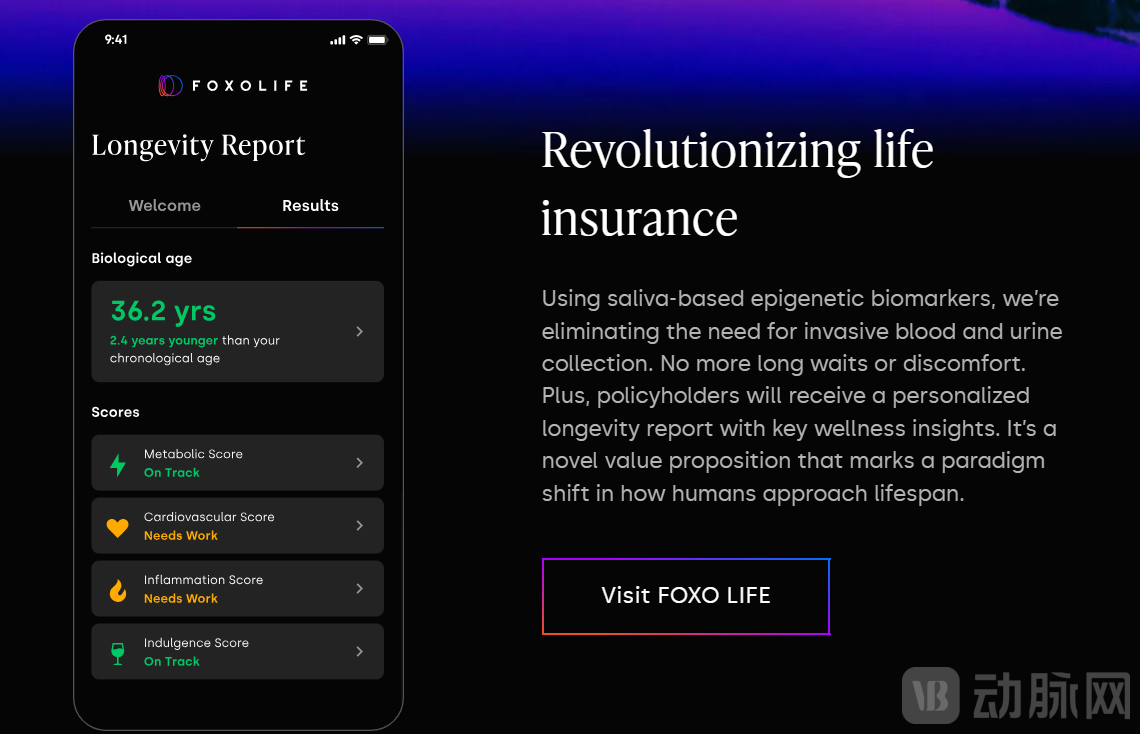 VITHAR™ Report Page Example
Image source: FOXO official website
In simple terms, VITHAR™ works by analyzing saliva samples to measure aging biomarkers such as DNA methylation levels, thereby determining biological age. This helps individuals assess their health status and disease mortality risk, and provides corresponding recommendations for improvement.
The key technologies underpinning VITHAR™ in delivering this suite of services are the epigenetic clock and AI platform.
Among them, the epigenetic clocks used by VITHAR™ are three epigenetic clocks developed by Dr. Steve Horvath’s laboratory, namely:
Mortality Predictor EEAA: The mortality predictor EEAA is an epigenetic clock that predicts lifespan by analyzing DNA methylation age. It was developed to predict all-cause mortality across 13 different cohorts, with a total sample size of 13,089 individuals, based on blood assessments.
DNAm PhenoAge: DNAm PhenoAge is a novel clock developed based on nine aging biomarkers, enabling more precise assessment and measurement of physiological age and mortality risk.
GrimAge: GrimAge is composed of 2,356 data points, including seven DNA methylation-based plasma protein markers and smoking pack-years, which have been proven to be associated with morbidity or mortality. GrimAge places greater emphasis on lifestyle and age-related conditions, thereby demonstrating superior accuracy compared to existing epigenetic clocks and offering better prediction of lifespan.
Currently, these three epigenetic clocks are exclusively licensed by FOXO for actuarial predictive modeling and underwriting. Building on this foundation, FOXO collaborates with multiple AI companies to create thousands of models through its partners’ technology platforms, aiming to identify epigenetic biomarkers that assess health status.
First, FOXO partnered with Illumina to build its own bioinformatics analysis platform using the latter’s developed and provided microarray technology, thereby enabling services that include epigenome-wide association studies (EWAS) and AI-driven development of epigenetic biomarkers.
This August, FOXO partnered with DataRobot, a leading enterprise in the field of AI. By leveraging DataRobot’s AI platform and drawing on quantitative data from over 860,000 DNA methylation probes corresponding to different loci in the human genome, FOXO identified new DNA methylation patterns for assessing human health and developed more than 110,000 predictive models to evaluate individual aging levels.
Building on this collaboration, FOXO is also responsible for developing technologies that support epigenetic science, including the Infinium Mouse Methylation Array, co-developed with leading technology experts, and the open-source bioinformatics software package MethylSuite. Meanwhile, FOXO collaborates with the biotechnology company GERO and the diagnostic technology company Neogen to jointly conduct research projects on epigenetic biomarkers.
Meanwhile, to validate the accuracy of VITHAR™, FOXO conducted a case study on the impact of smoking on identical twins. In theory, identical twins share the same genetic makeup; however, factors such as genetic mutations, environment, and lifestyle can lead to changes in their epigenetic DNA methylation markers. For instance, frequent consumption of high-sugar and high-fat foods may induce obesity, thereby triggering alterations in gene methylation markers associated with obesity-related diseases.
The study results indicate that VITHAR™ can identify smokers with accuracy consistent with cotinine testing (cotinine being the product of hepatic nicotine metabolism). Furthermore, FOXO’s smoking biomarkers can detect regular smokers who have ceased smoking for one week prior to testing, thereby preventing individuals from fraudulently claiming insurance benefits from insurers.
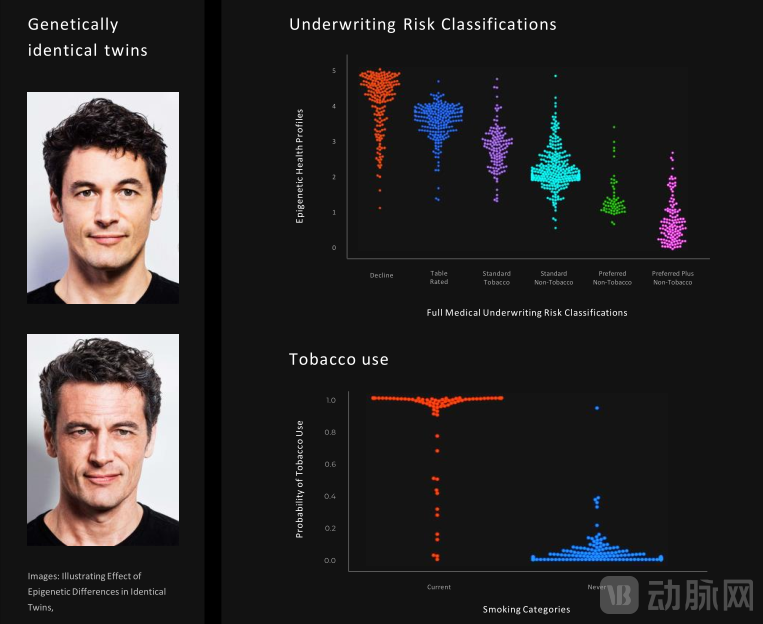 Differences Between Smokers and Non-Smokers in Monozygotic Twins
Image source: FOXO official website
Notably, VITHAR™’s services are built upon saliva-based analysis. Compared with samples such as blood and urine, saliva collection is non-invasive, simple, and rapid. Therefore, all other factors being equal, insurers do not need to outsource sample collection to third-party agents, thereby further enhancing the integrity of their insurance services.
On November 29, 2023, FOXO received a notice from the regulatory authority of the New York Stock Exchange indicating that the Company failed to meet the continued listing standards set forth in Section 1007 of the NYSE American Company Guide, as it did not timely file its Form 10-Q quarterly report for the third quarter of 2023 by the prescribed deadline. FOXO faces the risk of delisting.
However, the crisis of delisting this time seemed to have been foreshadowed.
First, revenue has declined consecutively. When FOXO Technologies went public in September 2022, its prospects appeared promising, with its stock price rising by 5% in the first month after listing and Q4 revenue reaching a peak of $418,000. However, this positive momentum was short-lived. Since Q4 2022, the company’s revenue has continued to fall, dropping to $12,000 in Q2 2023, and it has yet to achieve profitability since its IPO.
Secondly, there have been successive changes in leadership. Shortly after FOXO’s IPO, the company dismissed its original founder and CEO, Jon R. Sabes, and appointed Tyler Danielson, then Chief Technology Officer, as interim CEO. However, Danielson also announced his resignation this September. The board of directors subsequently appointed Mark Brian White as interim CEO. Upon taking office, Mark Brian White announced measures to support the company’s development and core product R&D by cutting costs and optimizing headcount.
As an early entrant in the aging biomarkers sector, FOXO was once highly regarded, but its development has seemingly fallen short of expectations.
This time, FOXO aims to reverse the crisis by launching VITHAR™. To this end, FOXO has engaged Atrio Insurance, a U.S. general insurance brokerage agency, to market its FOXO Longevity Report™ life insurance product, which includes VITHAR™ services.
In addition, FOXO has entered into a partnership with the technology company KR8 and obtained exclusive licensing rights to software developed by KR8, such as KR8 COACH, thereby collecting user health data and feedback from third-party social media platforms to further expand the marketing reach and methods of VITHAR™.
Life expectancy has risen from 66.8 to 73.3 years, but this increase does not necessarily translate into a longer healthspan, as the added years are not entirely free of disease; indeed, there has been a slight rise in the number of years lived with illness. Currently, “healthy aging” is a more sought-after goal than “immortality.”
According to data released by the World Health Organization, the proportion of the global population aged 60 and over will double between 2015 and 2050, rising from 12% to 22%. This indicates that there will be a substantial demand for interventions to delay aging and extend healthspan.
According to the "Research Report on the Development of the Global and Chinese Anti-Aging Industry and Consumer Demand (2022–2023)" released by iiMedia Research, the global anti-aging market size grew from $139.5 billion in 2015 to $216 billion in 2021. It is projected that the global anti-aging market will maintain a high growth rate, with its size expected to exceed $300 billion by 2025. In the field of anti-aging, aging biomarkers may become a prerequisite for understanding aging and developing targeted interventions against it.
Can FOXO leverage VITHAR™ to break through the competition and secure a foothold in the anti-aging market? Time will tell!