

BAYONE Scientific Pioneers AI-Driven Paradigm in Life Science Research Tools, Files IPO Prospectus

BAYONE
Scientific Instrument R&D Developer
Currently, brain disorders have become the largest healthcare burden on human society worldwide, affecting a vast patient population. Taking autism as an example, according toWHO data indicates that approximately 1 in 100 children has autism.
Unfortunately, progress in drug development for brain diseases remains sluggish. The annual growth rate in the number of innovative drugs approved for brain disorders lags far behind that for cardiovascular diseases, cancer, and other conditions. Take Leqembi, a new drug approved by the FDA this year, as an example: it is the first fully approved Alzheimer’s disease medication by the FDA in two decades. Prior to this, the failure rate for new Alzheimer’s drug development reached as high as 99.6%, with more than hundreds of clinical trials ending in failure, resulting in over $600 billion in R&D investments going down the drain.
This is due to the maturation of physiological testing technologies for blood, cells, tissues, and other biomarkers, which has made it easy to reproduce in humans the evaluation results of cardiovascular and oncology drugs obtained from animal studies. However, given the complexity of the brain and the structural and functional differences between animal and human brains, the mechanisms of many diseases cannot be directly assessed or diagnosed through these conventional and single-modal physiological tests.Evaluation and diagnosis of brain diseases require experiments using cross-species animal models, combined with comprehensive analytical assessment of multimodal data ranging from internal neurophysiology to external behavioral phenotypes.
To accelerate the development of diagnostic and therapeutic approaches for brain disorders and address the global burden of these conditions, researchers worldwide are making continuous efforts. China has long elevated “Brain Science and Brain-Inspired Research” to a national strategic priority.
Against this backdrop, BAYONE (Shenzhen Yiwan Life Technology Co., Ltd.; hereinafter referred to as “BAYONE”), a key enterprise incubated by the Shenzhen Brain Science and Technology Industry Innovation Center and a provider of upstream tools for the life sciences industry chain, has established two core business segments in the life sciences field: high-end scientific research instruments and software, and proprietary laboratory animal resources. The company has gained recognition from nearly 100 clients across China and has begun to expand its user base into overseas markets such as the United States and Germany.
In the drug development pipeline for brain disorders, behavioral assessments based on animal disease models account for a significant proportion of R&D investment.Therefore, accurate behavioral assessment of animal models is key to the development of drugs for brain disorders!For example, children with autism exhibit impairments in social interaction and communication, restricted interests, and repetitive, stereotyped behaviors. Corresponding behavioral characteristics are also observed in mice, dogs, and monkeys.
“Animal behavior research equipment has been in development for several decades. Many existing products employ video recording and digital image processing techniques tailored to single species, making it difficult to detect the autism-like behavioral states in animals mentioned above. Amidst the wave of the Fourth Industrial Revolution, cutting-edge technologies such as AI have brought new opportunities to neurobehavioral research. In response, BAYONE Life Sciences further developed BehaviorAtlas, building upon the technology published by the team from the Institute of Brain Science, Shenzhen Institutes of Advanced Technology, Chinese Academy of Sciences, in Nature Communications in 2021.” The 3D-AI Animal Behavior Analysis System series has established the AI + Neuroethology product line, BehaviorAtlas.®,” said Huang Kang, CTO of BAYONE, in an interview with VCBeat.
Specifically, as AI rapidly gains traction across various industries, what changes will it bring to the field of ethology? And how is BAYONE leveraging AI to deeply empower the industry?
First, efficiently and automatically process and analyze large-scale data.Ethological studies typically require extensive processing and analysis of animal information and video data. Traditional methods demand substantial investments in manpower, material resources, and funding. By leveraging AI technologies, researchers can automate the processing of behavioral characteristic data from animals in experiments, thereby enhancing the speed and efficiency of data analysis for scientific personnel.
BAYONE's data processing software, BehaviorAtlas®Taking Analyzer as an example, this software employs a language-like structural algorithm model of animal behavior as its core engine. It extracts body coordinates of multiple anatomical regions from multi-view videos for 3D reconstruction and processing, ultimately enabling the construction of animal behavioral atlases. This facilitates associative analyses between behavioral atlases and factors such as neurological function and disease subtypes.
Second, improve the precision and reliability of the research.To investigate the mechanisms of animal behavior and behavioral evolution, researchers must conduct timely and long-term observations and recordings of animal behavior; however, the results may be influenced by factors such as human error and individual variability. By leveraging AI technology and standardized machine language, the precision and reliability of data processing and analysis can be enhanced.
For example, BehaviorAtlas, developed by BAYONE®EyeTracking Mouse Mobile Eye-Tracking System: By leveraging the company’s adaptive fusion algorithm, this system automatically collects and processes data while mitigating the impact of noise—such as complex lighting conditions, wide-ranging ocular movements in animals, and increased blink frequency—on analytical results.
Finally, new behavioral patterns and mechanisms are identified.AI can also replace manual labor to extract deeper insights from massive amounts of data and videos, thereby helping researchers better understand animal behavior and the mechanisms underlying behavioral decision-making.
Taking as an example an article published this October in Molecular Psychiatry, a premier international journal in the field of psychiatric disorders under the Nature portfolio, BAYONE, in collaboration with Professor Zhang Yongqing’s team at the Institute of Genetics and Developmental Biology, Chinese Academy of Sciences; Professor Wei Pengfei’s team at the Shenzhen Institute of Advanced Technology, Chinese Academy of Sciences; and Professor Guo Kun’s team at the University of Lincoln, UK, successfully designed and applied a head-mounted real-time pupillometry system for dogs. This study demonstrated the validity and value of pupillometry in canines and provided an effective paradigm for investigating the potential neural mechanisms underlying autism spectrum disorder and other psychiatric conditions.
AI Brings New Transformations to the Study of Animal Behavior. To accelerate the understanding of animal behavior and promote in-depth research into animal cognition and behavioral patterns, BAYONE has developed BehaviorAtlas, an internationally leading platform based on its self-developed core AI algorithms—such as computer 3D vision and deep learning—as well as interdisciplinary technologies including neuroscience.®Neurobehavioral Product Series.
Currently, BehaviorAtlas®Three products have already been launched and are on the market, namely:3D-AI Animal Behavior Analysis System, EyeTracking Mouse Mobile Eye-Tracking System, and Small Animal Virtual Reality System.
3D-AI Animal Behavior Analysis System is China’s first markerless 3D animal pose capture and analysis system.This product system comprises a 3D data acquisition device, the BA-Analyzer data processing software, and the BA-Explorer data analysis software. It is applicable to various common paradigms within existing behavioral research systems, such as the open field test, novel object recognition, and innate fear assays.
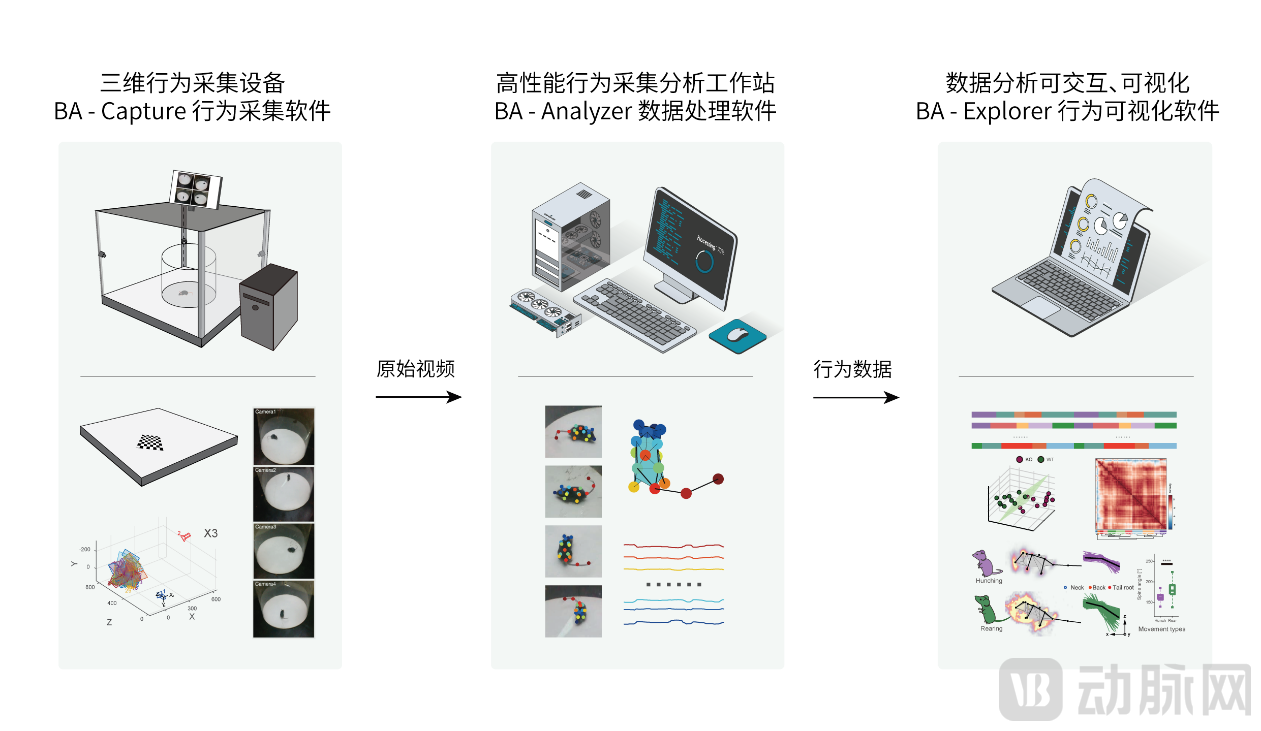
BehaviorAtlas®3D-AI Animal Behavior Analysis System
Three-dimensional data acquisition equipment can accurately identify multiple (more than 16 points) parts of an animal's body without any physical markers, track the three-dimensional skeletal sequence in all directions and without blind spots, obtain animal behavior parameters, and achieve millimeter-level accuracy in motion capture.The collected data can be processed and analyzed by BA-Analyzer and BA-Explorer, enabling the generation and export of more than 10 types of charts suitable for publication and presentation.
Furthermore, the 3D-AI animal behavior analysis system is compatible with conventional recording or modulation techniques—such as in vivo electrophysiological recording, in vivo fluorescent neural imaging, eye tracking, and optogenetic or chemogenetic stimulation—while acquiring behavioral data, ensuring temporal synchronization with behavioral measurements.
Eye-tracking is a key technology for understanding behavior and underlying thought processes, enabling precise characterization of cognitive processes and emotional states.BehaviorAtlas®EyeTracking Eye-Tracking System enables real-time data acquisition, analysis, export, and visual preview of pupillary responses in freely moving small animals.
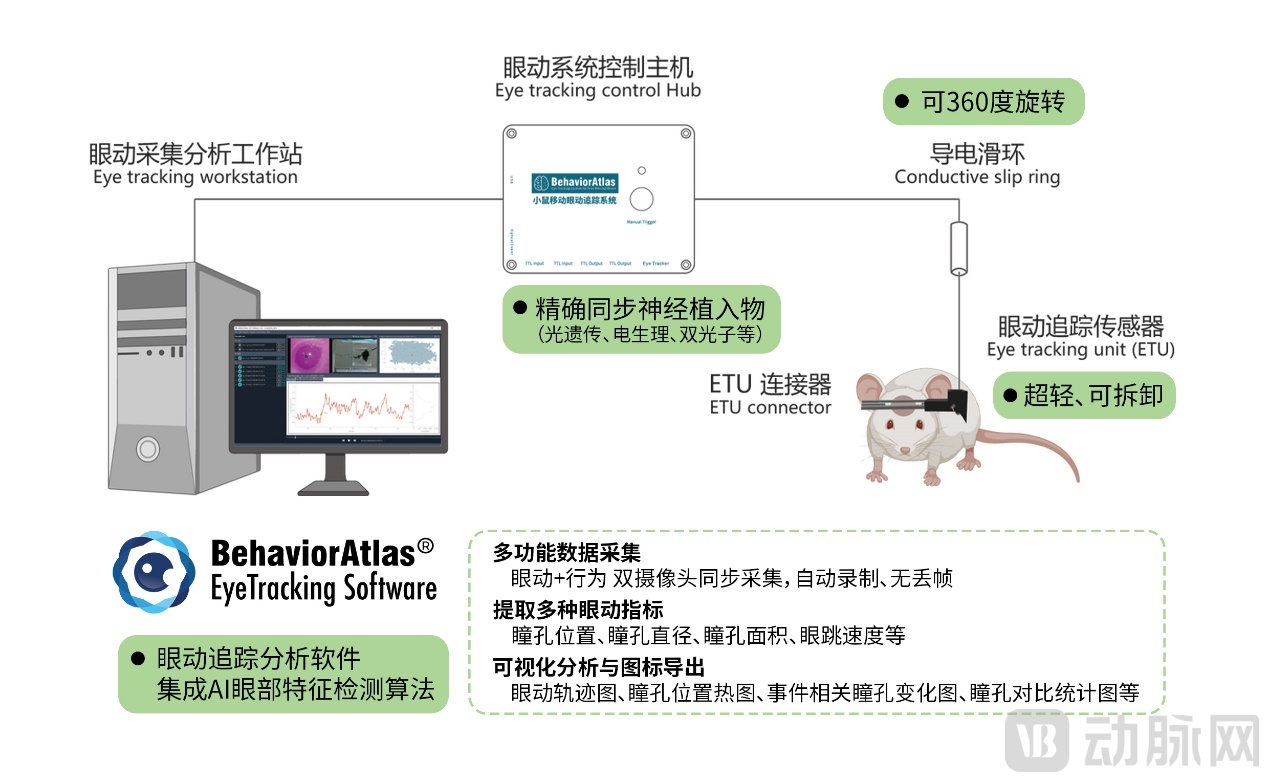
BehaviorAtlas® EyeTracking
The system consists of two components: hardware and software.The core hardware is an ultra-miniature eye-tracking sensor (ETU) that weighs only 1g and does not interfere with the free movement of animals when worn.Furthermore, the sensor is installed or removed via a custom 0.1 g connector implanted on the skull of small animals, enabling the reuse of core hardware and improving device switching efficiency during data acquisition.
In terms of software, the built-in AI pupil detection algorithm accurately identifies pupils under various lighting and contrast conditions, extracting multiple eye movement metrics such as pupil position, pupil diameter, pupil area, and saccadic velocity. This provides precise eye movement analysis for diverse neuroscience research studies and generates publication-ready visualizations, including gaze trajectory plots, pupil position heatmaps, event-related pupil change graphs, and pupil comparison statistical charts, thereby achieving fully automated end-to-end processing of eye movement data.
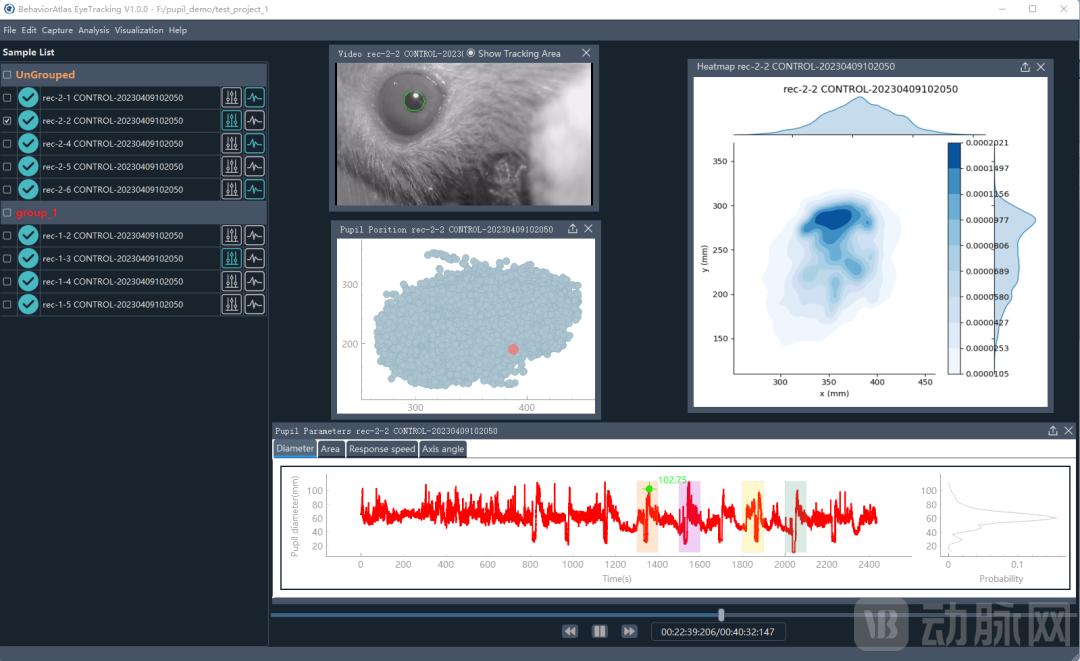
BehaviorAtlas®EyeTracking Eye-Tracking Visualization Interface
BAYONE'sSmall Animal Virtual Reality SystemIt integrates the features of both fixed and mobile eye-tracking. The system employs a 720° panoramic screen and an air-supported ball, enabling small animals to move within a virtual space. This setup provides a highly realistic interactive visual environment with quantitatively controllable variables, thereby shortening the training period for experimental animals.
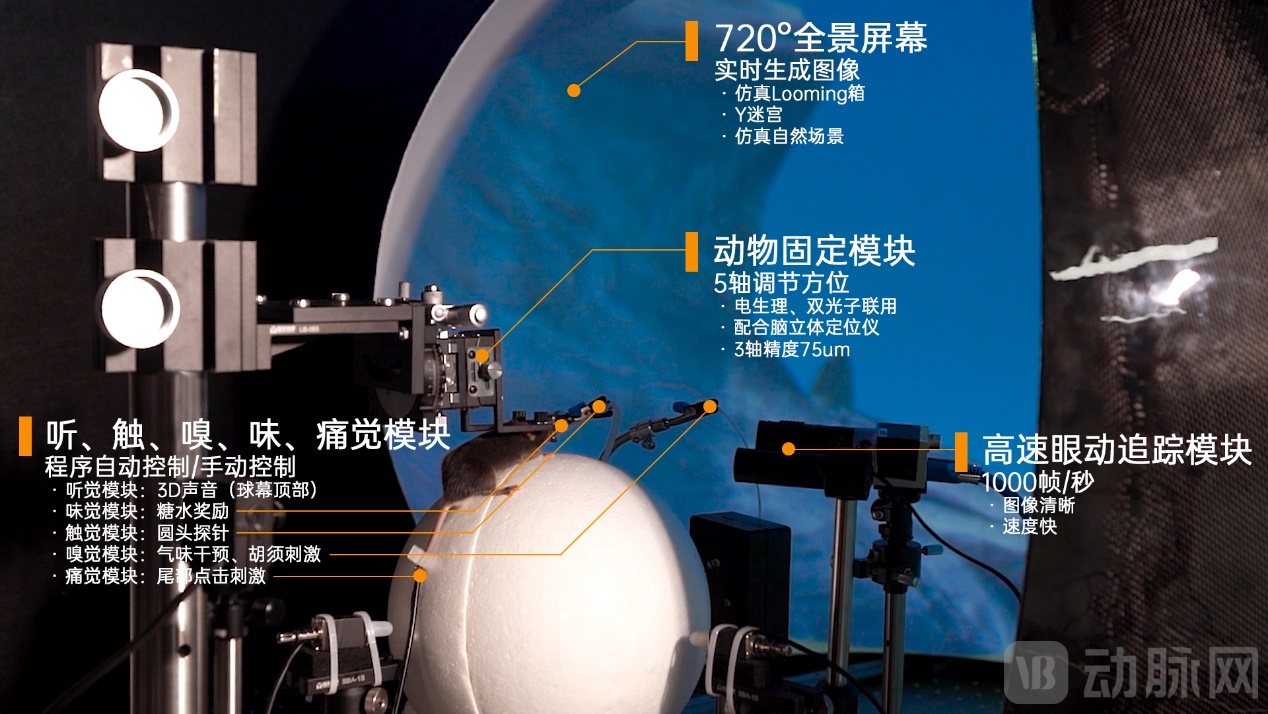
Small Animal Virtual Reality System
“These data acquisition terminals are not the end point of our smart solutions. BAYONE aims to actively participate in various research programs, establish long-term and stable connections with clients, and collect a larger volume and broader range of behavioral data for in-depth mining and analysis. Meanwhile, as data and research achievements accumulate, we seek to create a virtuous cycle in the field of scientific research equipment, ultimately leading industry standards,” Dr. Huang Kang told VCBeat.
According to research data from Guosheng Securities, China’s scientific instrument market reached approximately RMB 58 billion in 2022, reflecting robust demand. However, the domestic high-end scientific instrument market remains dominated by international giants from the United States, the United Kingdom, and Japan, resulting in a heavy reliance on imports. To reverse this situation, the Chinese government is promoting the substitution of imported products with domestically produced ones through national strategies, procurement policies, and interest-subsidized loans.
As a key innovative force in the field of intelligent scientific instruments for neurobehavioral studies, BAYONE has assembled an interdisciplinary team integrating information science and biological sciences, with members hailing from renowned academic institutions both in China and abroad.
On the occasion of its third anniversary, BAYONE was recognized as a National High-Tech Enterprise and approved for the Shenzhen Major Special Project titled “Research and Development and Application of an Intelligent Animal Behavior Analysis System for Brain Diseases,” further advancing the application of AI-based behavioral technologies in the field of drug development for brain disorders.
Looking to the future, Dr. Huang Kang stated at the end of the interview: “BAYONE is currently undergoing a new round of financing. In addition to accelerating the application of AI-driven software and hardware in neurobehavioral research across different diseases and species, thereby enriching product application scenarios and enhancing competitiveness, the company also aims to leverage self-training, evolving AI agents in the future. This will enable the discovery of scientific mechanisms and principles to no longer rely solely on the experience of a few top scientists, allowing AI to accelerate scientific experiments and drive scientific research, ultimately benefiting humanity.”
About the Shenzhen Brain Science and Technology Industry Innovation Center
Shenzhen Brain Science and Technology Industry Innovation Center (hereinafter referred to as the “Brain Innovation Center”) is a specialized incubation platform established with strong support from the Shenzhen Municipal Government and the Guangming District Government, with technical support and operational management provided by the Shenzhen-Hong Kong Institute of Brain Science. The Brain Innovation Center is committed to building China’s first “plug-and-play” specialized incubation and empowerment platform, striving to become a demonstration hub for brain science and technology industry innovation that serves China and has a global reach. Since commencing trial operations in October 2022, the Center has developed over 220,000 square meters of phased incubation and industrial space. It has attracted nearly 50 enterprises to its incubator and industrial park, with both the incubator and the China Merchants Group Brain and Brain-inspired Intelligence Industrial Park fully leased. The cumulative historical financing of resident enterprises exceeds RMB 1 billion, with valuations surpassing RMB 10 billion. The Center has facilitated additional financing of over RMB 200 million for resident enterprises and established China’s first venture capital fund in the field of brain science and brain-inspired intelligence entirely funded by social capital, with a scale of RMB 100 million, focusing on investing in high-quality early-stage projects at the Brain Innovation Center.