

FDA Updates Carvykti Label with Secondary Malignancy Warning Amid Ongoing CAR-T Safety Review
Legend Biotech
Tumor Cell Immunotherapy Developer
Recently, GenScript announced that its non-wholly owned subsidiary, Legend Biotech, has received U.S. FDA approval for a label update to CARVYKTI, incorporating additional efficacy and safety information from the long-term follow-up (with a median duration of 28 months) of the CARTITUDE-1 study.
In this labeling update, a statement has been added to the Boxed Warning section of the U.S. Prescribing Information indicating that secondary hematologic malignancies, including myelodysplastic syndrome and acute myeloid leukemia, have occurred in patients following treatment with ciltacabtagene autoleucel.
This label update is based on long-term follow-up data from a study of ciltacabtagene autoleucel. According to the announcement by GenScript, in the CARTITUDE-1 study, 10% (10/97) of patients were observed to develop myeloid neoplasms after receiving ciltacabtagene autoleucel treatment, including myelodysplastic syndrome (MDS), acute myeloid leukemia (AML), or AML secondary to MDS.
Notably, all gene therapy products containing integrating vectors, including CAR-T therapies, are labeled with a potential risk of developing secondary malignancies.
The First FDA-Approved Domestically Produced CAR-T Therapy
In the history of CAR-T cell therapy development in China, Legend Biotech is a name that cannot be overlooked.
CARVYKTI, known in Chinese as ciltacabtagene autoleucel, is the first China-developed CAR-T therapy approved by the FDA. In March 2022, this BCMA-targeting CAR-T therapy received approval for the treatment of patients with relapsed or refractory multiple myeloma (R/R MM) who had previously received four or more prior lines of therapy, including a proteasome inhibitor, an immunomodulatory agent, and an anti-CD38 monoclonal antibody.
In December 2022, the marketing application for CARVYKTI was accepted in China, with the indication being the treatment of patients with relapsed/refractory multiple myeloma. In January 2023, CARVYKTI was included in the priority review and approval program. On April 14, the Company entered into an agreement with Novartis, under which the latter would provide manufacturing services for its BCMA CAR-T therapy, Carvykti, for a term of three years. Previous media reports indicated that Legend Biotech/Janssen had suspended the launch of CARVYKTI in the UK due to supply shortages caused by complex manufacturing processes.
In terms of commercialization capabilities, ciltacabtagene autoleucel achieved total sales of $133.4 million (approximately RMB 920 million) in its first year on the market. According to GenScript’s semi-annual report, the net sales of ciltacabtagene autoleucel reached approximately $117 million by the end of the first half of this year.
Myelodysplastic syndromes (MDS) are a group of hematopoietic stem cell disorders characterized by ineffective hematopoiesis and refractory cytopenias. Clinical presentations vary significantly among patients, who can be broadly categorized into low-risk and high-risk groups. High-risk MDS is prone to transformation into acute myeloid leukemia (AML), and thus it is often regarded as a "pre-leukemic" condition. AML arises from the malignant proliferation of myeloid blasts in the bone marrow, peripheral blood, or extramedullary tissues, which impairs the production of normal blood cells. With numerous subtypes, AML is a highly aggressive hematologic malignancy.
As indicated in Genscript’s announcement, patients experienced relatively challenging hematologic complications following treatment with ciltacabtagene autoleucel, prompting the current label update to alert users and encourage risk assessment. Regarding the specific disease course, Genscript’s announcement reported that the median time to onset of myeloid neoplasms after ciltacabtagene autoleucel treatment was 485 days (range: 162–1,040 days). Among the 10 patients, nine died after developing myeloid neoplasms, and four cases occurred after the initiation of subsequent anti-myeloma therapy.
However, GenScript’s announcement also noted that the aforementioned 10 patients had received multiple prior lines of therapy, and some harbored genetic mutations even before receiving ciltacabtagene autoleucel treatment; to date, the potential mechanism linking ciltacabtagene autoleucel to the development of myeloid neoplasms remains undetermined.
The recent update to the label of Legend Biotech’s CARVYKTI has drawn significant attention, primarily because on November 28, the U.S. FDA announced on its official website that it had received case reports of malignancies associated with CAR-T therapy.
CARVYKTI is the first CAR-T product to have its label updated following this investigation, and more CAR-T cell products may subsequently add corresponding boxed warnings. This also signals a potential trend toward stricter FDA regulation of CAR-T therapies.
According to the announcement, the FDA has received reports of cases involving T-cell malignancies (including chimeric antigen receptor [CAR]-positive lymphoma) in applications for autologous CAR-T cell therapies targeting BCMA or CD19. These reports originated from clinical trials and/or post-marketing adverse event databases.
The FDA states that the potential risk of secondary malignancies is highlighted as a boxed warning in the prescribing information for BCMA- and CD19-targeted autologous T-cell immunotherapies approved in the United States. Post-approval, 15-year long-term follow-up studies are required to assess long-term safety and the risk of secondary malignancies following treatment. Patients receiving these therapies and participants in clinical trials should be monitored for new malignancies throughout their lifetime. In the event of a new malignancy, manufacturers should be notified, and sample collection and testing studies should be conducted.
Meanwhile, the FDA has publicly disclosed the specific names of the six currently approved therapies on its official website, including: Bristol Myers Squibb’s Abecma and Breyanzi; Carvykti, jointly developed by Legend Biotech and Johnson & Johnson; Novartis’ Kymriah; and Gilead’s Tecartus and Yescarta. All these therapies target either BCMA or CD19.
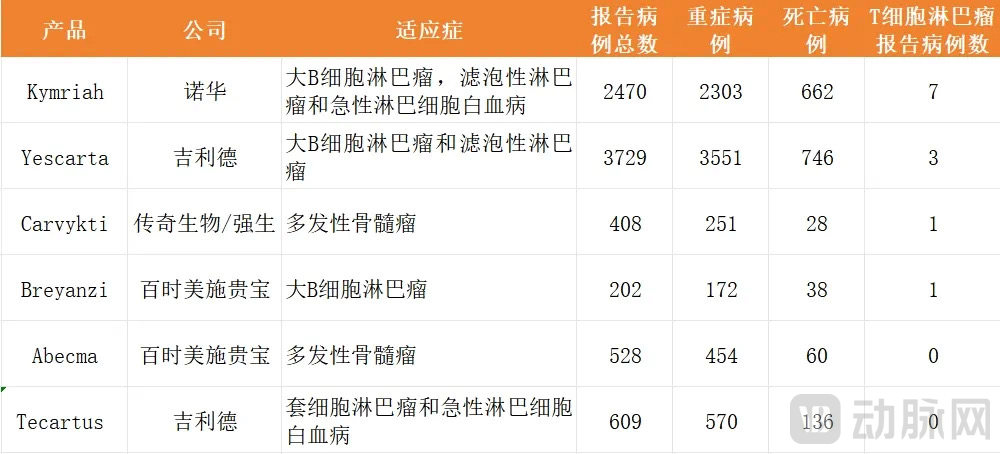
In response to the FDA’s investigation, these companies have also issued responses. Summarizing their viewpoints: while secondary tumors do occur in cancer treatment, a causal relationship has not been demonstrated.
Among them, Legend Biotech’s Carvykti is approved in the United States for the treatment of multiple myeloma. Legend Biotech has stated that there is a risk of secondary cancers regardless of whether CAR-T therapy is administered. Meanwhile, regarding the risk of secondary cancers, approximately 25,000 patients worldwide have received CAR-T products, with only 19 cases reported, indicating a relatively low incidence rate. Furthermore, from Legend Biotech’s own experience, there was indeed one prior case involving T-cell malignancy; however, a definitive causal relationship with the CAR-T product could not be established, as the patient, being in the last line of therapy, had also undergone chemotherapy and other treatments.
In fact, as a novel anti-tumor treatment regimen, CAR-T therapy has consistently drawn significant attention regarding its safety risks and the assessment of patient benefits. In addition to the carcinogenic risk mentioned earlier, clinical use also raises concerns about adverse events such as cytokine release syndrome (CRS) and neurotoxicity.
CAR-T therapy represents a new era in cancer treatment, and its remarkable efficacy in treating certain types of cancer cannot be overlooked. However, as research and application of this therapeutic approach deepen, its potential risks are gradually becoming apparent. Today, the possibility of secondary malignancies has further heightened concerns regarding the safety of this therapy.
However, as understanding of the long-term effects of CAR-T therapy deepens, the medical community is developing more effective monitoring and management strategies. For instance, the FDA mandates 15-year long-term follow-up observational safety studies to assess long-term safety post-treatment and the risk of secondary malignancies.