

China's First Blue Book on Continuous Glucose Monitoring: Characteristics of Data from 70,000 Chinese Individuals
In recent years, the value of continuous glucose monitoring (CGM) has become increasingly prominent. In the 2023 edition of the Standards of Medical Care in Diabetes issued by the American Diabetes Association (ADA),CGM has been incorporated for the first time into the patient-centered glycemic management decision-making cycle, holding a status equivalent to that of fingerstick blood glucose monitoring.
To explore the role and value of CGM in diabetes management, VCBeat will jointly release a report with Silicon Based Bionics in the near future, based on a survey of users of Silicon Based Motion CGM."Blue Book on the Characteristics of Continuous Glucose Monitoring Data from a Cohort of 70,000 Chinese Individuals," as the first blue book in the CGM field, with a focus on analyzing real-world, objective, and comprehensive glucose data across different types, genders, ages, regions, disease durations, and medication regimens. The aim is to present the analytical results of core metrics—Glucose Management Indicator (GMI), Time in Range (TIR), Time Above Range (TAR), Time Below Range (TBR), and Coefficient of Variation (CV)—for various patient populations, thereby leveraging Continuous Glucose Monitoring (CGM) data to gain insights into the current status of diabetes patients in China.Providing Insights for Endocrinologists, Patients with Diabetes, Non-Diabetic Individuals, and Developers of National Diabetes Management Guidelines in China: Leveraging CGM for Digital Management to Facilitate Precision Diagnosis and Treatment of Diabetes and Achieve Superior Glycemic Control。
The study population of the Blue Book comprised individuals who wore the Silicong Dynamic CGM device at any time during the full year of 2022 (January 1, 2022–December 31, 2022). The selected sample included only those wearing the device for the first time for ≥10 days. For users who wore multiple devices, baseline characteristics, treatment modalities, and metric data were derived from the first device used. A total of 71,566 individuals aged 18 years and older were included in the analysis, with 152,689 CGM reports collected. The numbers of patients with type 1 diabetes, type 2 diabetes, gestational diabetes, and non-diabetic individuals were 9,458, 45,893, 1,852, and 14,353, respectively. The study population was drawn from all 31 provinces, autonomous regions, and municipalities directly under the Central Government in mainland China, as well as the two Special Administrative Regions of Hong Kong and Macao.This Blue Book features a large sample size, extensive regional coverage, and comprehensive demographic diversity.。
Below are selected chart analyses excerpted from the Blue Book. Stay tuned for the full release!
Among individuals aged 35 and above, male wearers outnumber female wearers, with the highest number of male wearers found in the 45–59 age group.
From the overall age distribution of CGM users, only in the 18–25 and 26–34 age groups do females outnumber males; in all other age groups, the number of females is lower than that of males. Regarding the specific gender distribution across age groups, males aged 45–59 constitute the largest population, numbering three times that of females in the same age bracket.
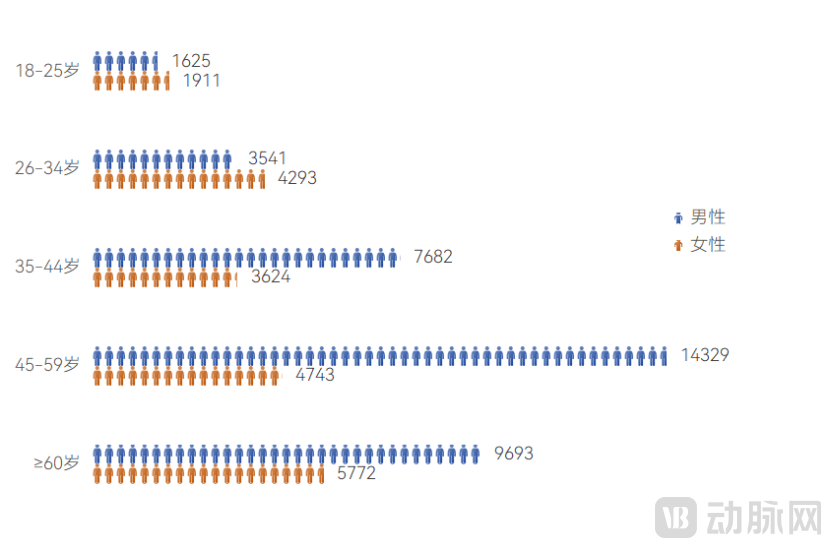
Distribution of Male and Female Patients with Diabetes Using CGM by Age Group in China
Patients with type 1 diabetes may have favorable mean blood glucose levels but exhibit significant glycemic variability, necessitating enhanced precision management.
Based on CGM data, the metrics for patients with type 1 diabetes are as follows: the GMI value is 6.79%, and the TIR value is 72.30%. In terms of absolute values, GMI, TIR, and TAR all fall within the reference ranges; however, GMI and TIR values are close to the reference limits, while TBR and CV values exceed the reference ranges, indicating poorer performance. Regarding target attainment rates, GMI has the highest rate at 69.57%, CV has the lowest at 32.07%, and TIR stands at 55.08%.
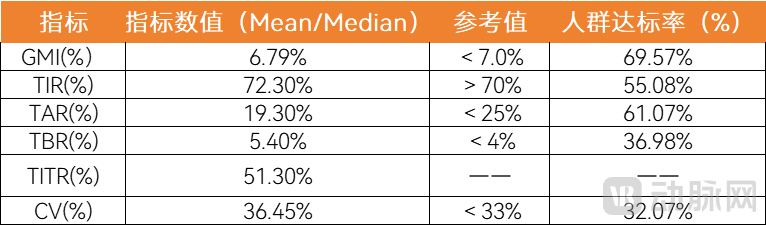
GMI: Glucose Management Indicator TIR: Time in Range TAR: Time Above Range TBR: Time Below Range TITR: Time in Tight Range CV: Coefficient of Variation
Analysis of Core Metrics for Type 1 Diabetes Patients Using CGM in China
Type 2 Diabetes Patients Using CGM Achieve Effective Glycemic Control: Strengthening the Application of CGM in Glycemic Management for This Population
Based on CGM data, the metrics for patients with type 2 diabetes are as follows: all metric values fall within the reference ranges, with a Time in Range (TIR) of 86.80%. In terms of target attainment rates, Time Below Range (TBR) has the highest rate at 89.21%, followed by TIR at 74.88% and Glucose Management Indicator (GMI) at 72.15%.
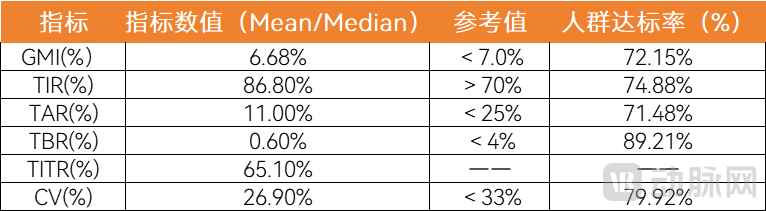
Analysis of Core Metrics in Chinese Patients with Type 2 Diabetes Using CGM
Gestational Diabetes Patients with Strong Glycemic Control Awareness Achieve Excellent Outcomes with CGM
Due to the unique characteristics of gestational diabetes mellitus (GDM), patients in this group demonstrate strong awareness of blood glucose management, although available intervention options are limited. Based on continuous glucose monitoring (CGM) data, GDM patients overall exhibit the most favorable metric values compared to those with type 1 and type 2 diabetes, with all indicators falling within reference ranges, thereby achieving safe and effective glycemic control through CGM. Specifically, the Glucose Management Indicator (GMI) was 5.85%, and the Time in Range (TIR) was 94.70%. In terms of target attainment rates, GDM patients outperformed those with type 1 and type 2 diabetes, with all metrics exceeding 90%. The highest target attainment rate was observed for GMI at 97.95%, followed by Time Below Range (TBR) at 97.89%.
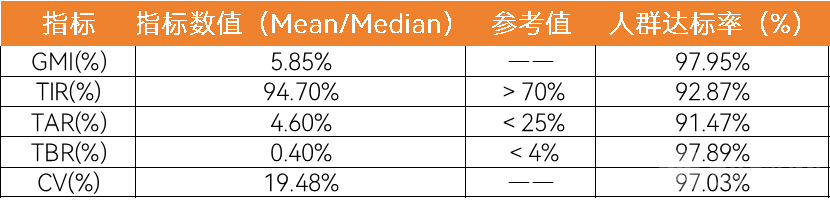
Analysis of Core Metrics in Chinese Patients with Gestational Diabetes Mellitus Using Continuous Glucose Monitoring
The sample size of non-diabetic individuals wearing CGM is substantial, with age and gender distributions similar to those of diabetic patients wearing CGM.
The number of non-diabetic individuals using continuous glucose monitors (CGMs) exceeds 14,000, representing a substantial sample size. The overall age distribution of CGM users is similar to that of diabetic CGM users. In terms of the specific gender distribution across age groups, females outnumber males only in the 26–34 age bracket; in all other age groups, the number of females is lower than that of males, with males aged 45–59 constituting the largest group.
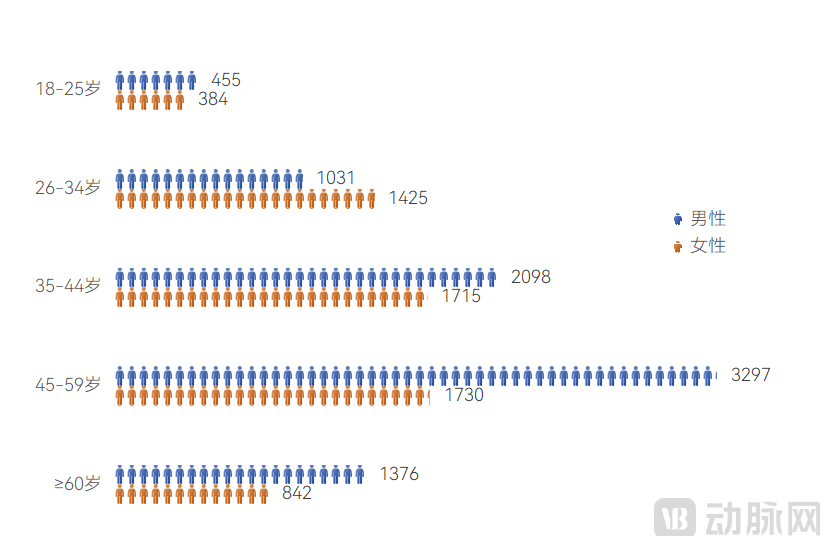
Distribution of Male and Female Non-Diabetic CGM Users in China by Age Group