

EndoQuest Robotics Secures $42 Million in Series C-1 Funding to Advance Flexible Endoluminal Surgical Robot

ENDOQUEST Robotics
Surgical Robot Developer
On December 4, 2023, EndoQuest Robotics, a pioneer in flexible endoluminal surgical robots, announced the successful completion of its $42 million (RMB 300 million) Series C-1 financing round. The round was led by existing investors CE Ventures Limited and McNair Interests, with participation from new investor Puma Venture Capital. The proceeds will be used to advance the research and development of its flexible endoluminal surgical robot.
ENDOQUEST Robotics, formerly known as ColubrisMX, was renamed in June 2022. During its time as ColubrisMX, the company secured $10.7 million in Series A financing and $76.1 million in Series B financing.
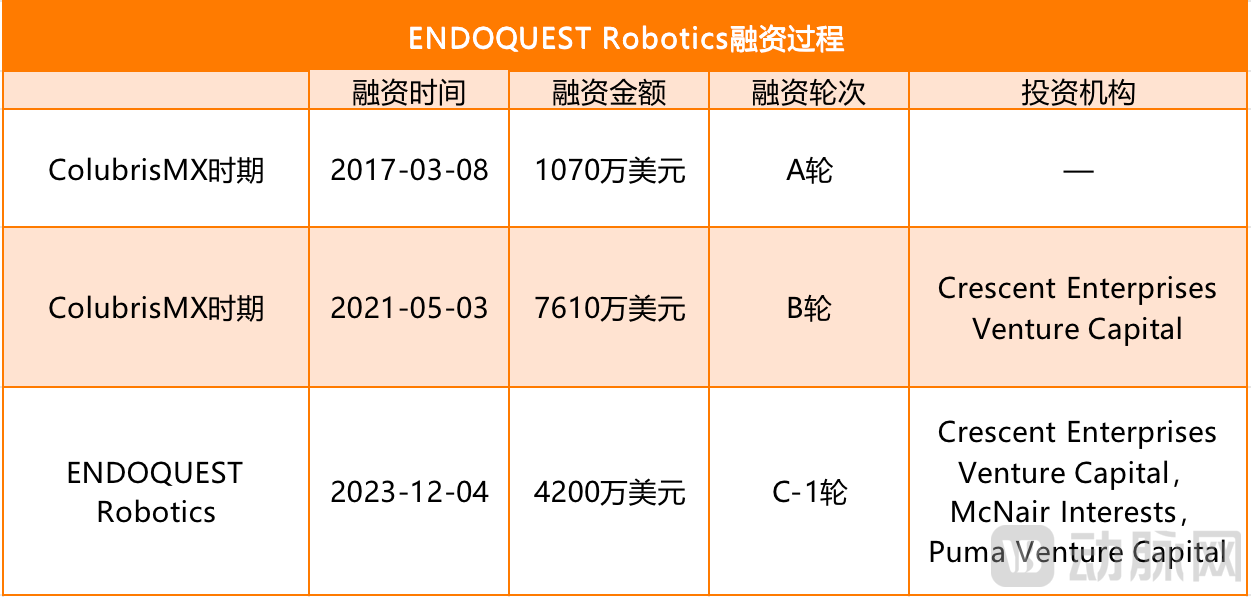
ENDOQUEST Robotics Financing Process | Produced by VCBeat
EndoQuest Robotics is dedicated to addressing unmet needs in gastrointestinal (“GI”) and other endoluminal surgical fields. By developing flexible robotic systems that enable GI procedures via the oral or anal route, it facilitates minimally invasive interventions.
Generally speaking, the team is a key factor determining a company's R&D capabilities.
Kurt Azarbarzin, CEO of EndoQuest Robotics, has extensive experience in the surgical, robotics, cardiovascular, interventional, orthopedic, and urology markets, with a 39-year career in the healthcare industry. In 2005, Kurt Azarbarzin founded SurgiQuest and later sold it to CONMED; its AirSeal technology has since become the standard of care for advanced laparoscopic and robotic surgeries. He subsequently served as CEO of Verb Surgical, a joint venture between Google and Johnson & Johnson.
Kurt Azarbarzin has led the development of more than 90 new products at companies including U.S. Surgical, Tyco Healthcare (now Medtronic), Spine Wave, Respimetrix, SurgiQuest, Verb Surgical, and Johnson & Johnson, generating annual sales exceeding $910 million.
Another notable team member is Todd Wilson, M.D., a minimally invasive surgeon at the University of Texas Health Science Center at Houston, whose research focuses on the development of endoluminal surgical systems. To date, Dr. Wilson has published more than 70 related articles.

Some Members of the Team Image Source: EndoQuest Robotics
The team members’ extensive experience and professional expertise have not only enabled EndoQuest Robotics to establish a competitive barrier in the field of flexible endoluminal surgical robots, but also accelerated the company’s R&D progress in this area.
Endoscopic Mucosal Resection (EMR) is currently the standard treatment for non-malignant colorectal polyps in the United States. When using EMR to manage large colorectal polyps, piecemeal resection is a common surgical approach. However, as the extent of the lesion increases, the difficulty of performing en bloc resection also gradually rises.
The primary disadvantage of EMR is its low en bloc resection rate. The fragmented nature of the resection impedes margin assessment, resulting in a low R0 resection rate (defined as the absence of cancer cells at the resection margins on pathological examination) and hindering the determination of future treatment plans for patients. This further necessitates frequent colonoscopies to monitor for recurrence, thereby imposing a burden on the healthcare system.
Endoscopic Submucosal Dissection (ESD) offers advantages such as being non-invasive, preserving the anatomical structure of the gastrointestinal tract, causing minimal trauma, enabling rapid recovery, reducing medical costs, and shortening hospital stays, thereby effectively improving this situation. It allows for en bloc resection, significantly increasing the R0 resection rate compared to Endoscopic Mucosal Resection (EMR). However, its widespread adoption is limited by the technical difficulty, steep learning curve, and relatively higher risks of intraoperative bleeding and perforation.
Flexible surgical robots are uniquely positioned to address these challenges, serving as a powerful tool to assist physicians in performing highly complex procedures under endoscopic guidance, thereby enhancing the efficiency and safety of minimally invasive internal surgeries. It is precisely for this reason that flexible endoluminal surgical robots have emerged.
The application of surgical robots has demonstrated significant efficacy in enhancing the precision of laparoscopic surgery. However, their rigid mechanical arms impose certain limitations on practical utility. To address this challenge, EndoQuest Robotics has developed a flexible endoluminal surgical robot, known as the EndoLuminal Surgical System (ELS). This surgical robot also represents an innovation in the field of minimally invasive surgery.
"In contrast, this robotic system enables scarless and minimally invasive surgery, minimizing external incisions and associated complications."
At its inception, the ELS consisted of two components: the Patient Cart and the Surgeon Console.
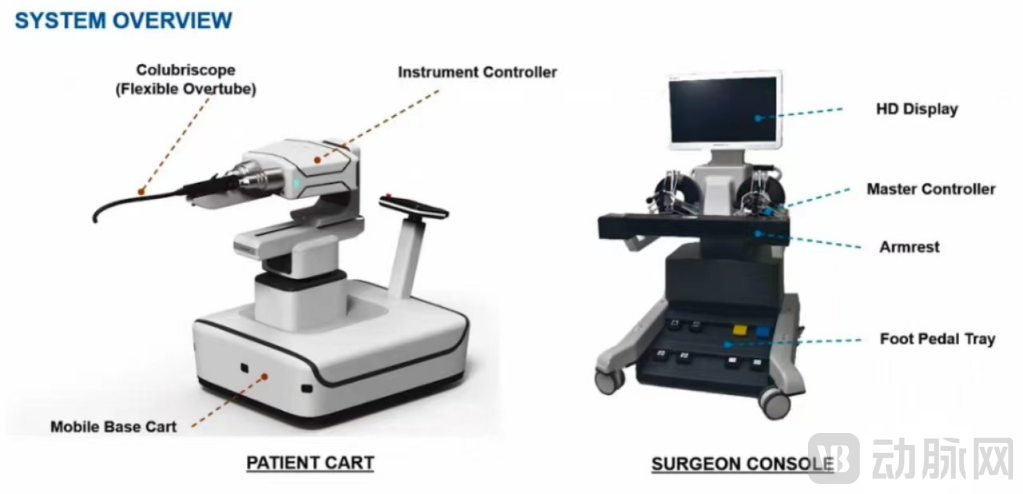
First-Generation ELS Image Source: EndoQuest Robotics
The ELS is introduced into the body via a scope (Colubriscope), which can be manually inserted orally into the esophagus or transanally into the colon. The digital interface on the cart mimics the physician’s hand movements, enhancing procedural precision and control; the physician console allows visualization of two instruments and endoscopic views through the scope, and includes additional channels for insufflation, irrigation, and suction to facilitate compatibility with third-party endoscopic equipment.
Following further product iterations, the ELS system has expanded from its original two-component structure to a three-part configuration comprising the Patient Cart, Physician Console, and Flexible Instruments.
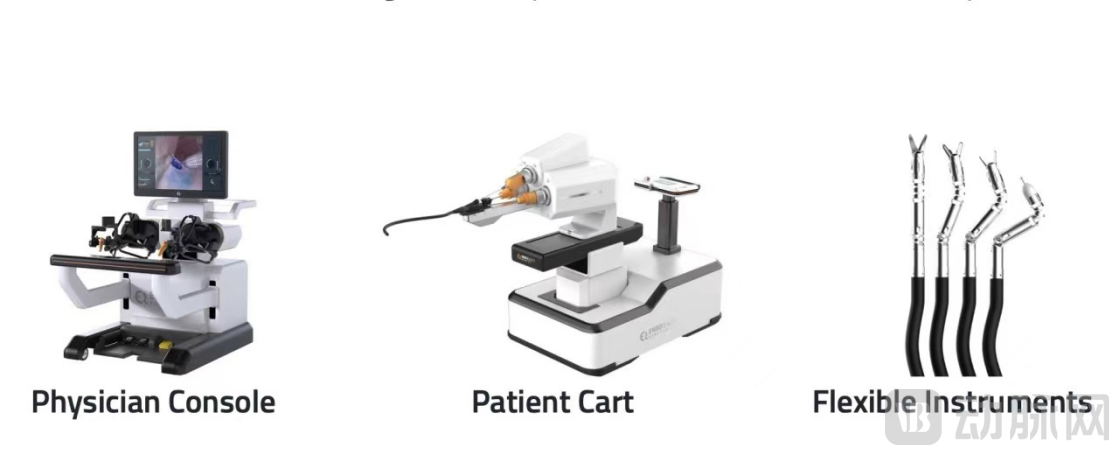
New Version of ELS Image Source: EndoQuest Robotics
Compared with the previous version, the new ELS system incorporates a robotic manipulator. Building upon the existing surgical robot platform, it achieves complete visualization of the surgical site and enables simultaneous operation of two 6-mm surgical instruments and a 3.7-mm third-party flexible endoscope (Olympus GIF-XP190). The surgical instruments form an operative triangle and feature jointed automation with up to seven degrees of freedom, enhancing flexibility for anatomical dissection within narrow cavities. Currently, in addition to gastrointestinal applications, ELS is suitable for various other natural orifice transluminal minimally invasive procedures.
Furthermore, ELS supports single-incision surgery to minimize postoperative scarring. This approach reduces trauma, accelerates wound healing, and improves post-operative patient care.
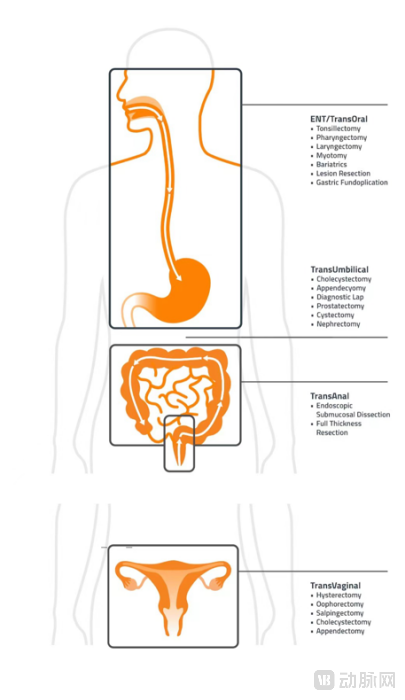
Minimally Invasive Surgeries Applicable to ELS. Image source: EndoQuest Robotics
Currently, ELS has completed its initial clinical evaluation. From October to December 2020, ELS was evaluated in a preclinical setting at the Florida Hospital for Children and Adults in Orlando, using porcine colon as the model, with a total of 20 patients participating in the study. During the study, the ELS system successfully performed 20 consecutive robotic transanal minimally invasive surgery (TAMIS) procedures with fragment-free operation. No adverse events occurred throughout the trial.。
In September 2022, EndoQuest Robotics announced that its ELS system had been installed at Brigham and Women’s Hospital (BWH), with both parties collaborating to advance the clinical application and procedural development of the ELS. Furthermore, the company plans to designate BWH as an Investigational Device Exemption (IDE) clinical research center, as well as its first Center of Excellence and training base in the United States, by the end of this year.
In March 2023, EndoQuest Robotics announced a partnership with Proximie, a global medical technology platform company, to accelerate the global deployment of its robotic ELS system.
In recent years, natural orifice surgical robots have developed rapidly worldwide. In addition to the ELS system developed by EndoQuest Robotics, overseas options include the Flex™ Robotic System developed by Medrobotics and the EaseSystem developed by Endomaster.
Nevertheless, obtaining approval for natural orifice surgical robots remains a significant challenge. To date, only four natural orifice surgical robots have received U.S. FDA approval or European CE marking: Intuitive Surgical’s Ion, Johnson & Johnson’s Monarch, Momentis Surgical’s Anovo (for vaginal surgery), and MedRobotics’ Flex (for the anus, rectum, and distal colon).
Surgical robots are innovative medical devices that integrate multiple disciplines, serving as a key technology for achieving intelligent surgery and representing the future direction of surgical procedures. Currently, various types of surgeries are progressively entering the robotic era, with surgical robots undoubtedly gradually transforming and disrupting traditional surgical practices. In the future, as more doctors become proficient in using surgical robots, the foundation for their research, development, and application will become increasingly solid. VCBeat will continue to closely monitor developments in this field.