

Former Pfizer Executives Lead Theratechnologies’ Strategic Shift Toward Peptide Drug Conjugates (PDCs) Amid HIV Legacy and New Oncology Pipeline
Theratechnologies
Biopharmaceutical Manufacturer
On December 13, 2023, Canadian pharmaceutical company Theratechnologies announced that the FDA had approved a 90-second intravenous (IV) push dose of Trogarzo®. This marks another update to the drug’s labeling, following the FDA’s approval of an IV push maintenance dose in October 2022. The administration time has been reduced from the original 30-minute infusion to just 90 seconds, while the biweekly maintenance dose now requires only 30 seconds.
Theratechnologies was founded in 1993 and listed on the NASDAQ in 2009. In October 2023, it announced the completion of a $25 million public offering of common stock alongside a concurrent private placement. To date, the company has successfully commercialized two drugs for HIV infection and continues to conduct research projects in the fields of AIDS, non-alcoholic steatohepatitis (NASH), and oncology.
Paul Lévesque, President and Chief Executive Officer, holds a Bachelor’s degree in Biochemistry from Laval University and a diploma in Management from McGill University. With over 35 years of experience in the research-based pharmaceutical industry, he joined Theratechnologies as President and Chief Executive Officer in March 2020.
Prior to joining Theratechnologies, Paul spent 28 years at Pfizer, holding marketing and general management roles in Canada, Europe, Asia, and the United States. He led the Global Rare Disease Business Unit in New York City, where he jointly oversaw the commercial translation of the unit’s product portfolio alongside Pfizer’s Global Head of Research and Development.

Paul Lévesque (Image source: Theratechnologies official website)
Christian Marsolais holds a Ph.D. in Biochemistry from the University of Montreal. He joined Theratechnologies in 2007 and has served as Senior Vice President and Chief Medical Officer since June 2016. Prior to joining Theratechnologies, he was a member of Pfizer’s Global Oncology team. He has over 30 years of experience in new drug research and development, as well as commercialization.
In the field of pharmaceutical research, he was responsible for the development of tesamorelin (an FDA-approved drug for treating visceral and abdominal fat accumulation in patients with HIV) for the treatment of NASH (non-alcoholic steatohepatitis). In commercial translation, he participated in the acquisition of Katana Biopharma, which discovered SORT1+ Technology™, and also played a significant role in the acquisition of Trogarzo®'s commercial rights in the United States and Europe, as well as its subsequent approval.

Christian Marsolais (Image source: Theratechnologies official website)
HIV is a retrovirus that stores genetic information in RNA. After entering host target cells, the virus releases its RNA and reverse transcriptase, which then synthesizes DNA using the viral RNA as a template. The resulting proviral DNA is integrated into the host cell’s DNA, serving as a template for the transcription of new RNA by the host cellular machinery.
Mutations readily occur during the action of reverse transcriptase (released by HIV), as this enzyme is error-prone when transcribing viral RNA into DNA. The viral DNA then enters the cell nucleus. Under the action of integrase (also released by HIV), the viral DNA is integrated into the host cell’s DNA. At this stage, the infected cell’s DNA directs the production of viral RNA and the proteins required for assembling new virions; the RNA and short protein fragments are then reassembled to form a new virus.
Viruses traverse the cell membrane via budding, enveloping themselves in a segment of the membrane to form the viral envelope. Budded viruses must undergo a maturation process before becoming infectious to other cells. Another viral enzyme, HIV protease, cleaves structural proteins within the viral bud and facilitates their reorganization into the mature viral form.
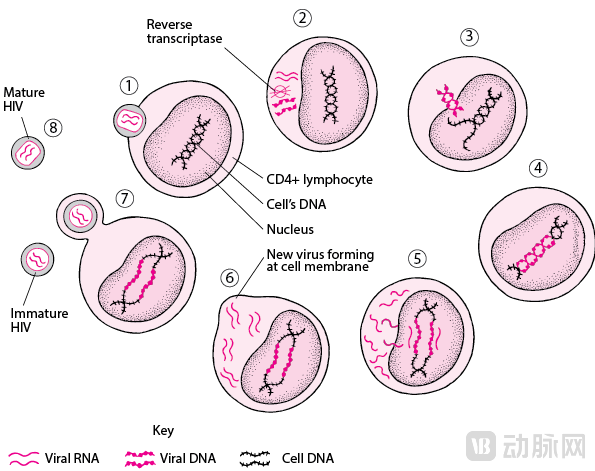
A Brief History of HIV Growth (Image source: Merck Manual)
If HIV patients do not receive antiretroviral therapy, it may lead to acquired immunodeficiency syndrome (AIDS), the most severe form of HIV infection. AIDS is diagnosed when an individual with HIV develops at least one serious complication or experiences a significant decline in CD4+ lymphocyte count.
December 1, 2023 marked the 36th World AIDS Day, with China’s campaign theme being “Mobilize Social Forces to Jointly Combat AIDS.” According to the “2023 Global AIDS Update – The Path That Ends AIDS” released by the Joint United Nations Programme on HIV/AIDS (UNAIDS), there are currently 39 million people living with HIV worldwide, of whom 29.8 million are receiving antiretroviral therapy. In 2022, there were 1.3 million new HIV infections, and 630,000 people died from AIDS-related illnesses.
Antiretroviral therapy is the primary treatment for AIDS. The report indicates that since 2010, the number of people receiving antiretroviral therapy (ART) worldwide has increased fourfold, rising from 7.7 million to 29.8 million in 2022.
Most antiretroviral drugs are designed to prevent HIV-1 from replicating within the T cells of the immune system, whereas Theratechnologies’ core pipeline drug, TROGARZO®, binds to the surface of T cells, blocking HIV-1 entry at its source. Another core pipeline drug, EGRIFTA SV®, effectively treats lipodystrophy, one of the complications in patients with HIV. The two core pipelines are detailed below:
·EGRIFTA SV®
Some people living with HIV also suffer from lipodystrophy, a condition that affects fat redistribution, including the accumulation and loss of fat in certain areas of the body. Excess fat accumulated in the abdomen due to lipodystrophy is known as visceral fat. Visceral fat exerts pressure on internal organs, leading to various severe and uncontrollable consequences.
In 1995, researchers at Theratechnologies developed EGRIFTA® (tesamorelin for injection) from growth hormone-releasing factor (GRF) to reduce excess abdominal fat in HIV-infected patients with lipodystrophy. Over the next 15 years, this innovative therapy underwent continuous development. In 2010, Theratechnologies obtained FDA marketing approval for EGRIFTA®. Initially marketed in the United States by third-party commercial partners, Theratechnologies adjusted its business model in 2014 to become a commercial-stage biopharmaceutical company and regained commercial rights to the product in the United States.

(Image source: Theratechnologies official website)
·Trogarzo®
Meanwhile, Theratechnologies is also advancing the development of a long-acting monoclonal antibody drug, Trogarzo®, an antibody that protects T cells from viral attack. Drugs for treating HIV infection are developed based on the HIV life cycle and are capable of inhibiting three key enzymes involved in viral replication, attachment, and cellular entry: reverse transcriptase, integrase, and protease.
Individuals with extensive treatment histories may develop resistance to multiple antiretroviral (ARV) drugs, becoming patients with multidrug-resistant (MDR) HIV-1 infection. Trogarzo® is a post-attachment HIV-1 inhibitor that binds to domain 2 of the CD4 T-cell receptor. It is indicated for the treatment of HIV-1 infection in heavily treatment-experienced adults with MDR HIV-1 infection (i.e., those who have previously received anti-HIV-1 therapy, are infected with HIV-1 strains resistant to antiretroviral drugs, and are experiencing failure of their current antiretroviral regimen).
Trogarzo® was initially developed by Tanox (acquired by Genentech in 2006), and TaiMed Biologics licensed the relevant patent assets from Genentech in 2007. In 2016, Theratechnologies Inc. entered into an agreement with its partner TaiMed to obtain commercial rights for Trogarzo® in the United States and other markets. In 2018, Trogarzo® received FDA approval as an intravenous medication for the treatment of HIV-1 infection in patients with persistently detectable viral loads.
TROGARZO® does not require daily administration. Once the initial loading dose is administered via intravenous injection, all subsequent doses can be delivered in 30 seconds every two weeks. TROGARZO® can also be administered via intravenous infusion every two weeks, with each infusion lasting 15 to 30 minutes. In October 2022, the FDA approved the intravenous bolus administration method for Trogarzo®, while Theratechnologies is advancing research on intramuscular injection delivery.
(Image source: Theratechnologies official website)
In addition to Trogarzo® and EGRIFTA SV®, two drugs developed in the field of HIV/AIDS, Theratechnologies has established multiple product pipelines in other therapeutic areas. In oncology, the company has initiated a Phase I clinical trial leveraging its proprietary SORT1+ Technology™. In the field of non-alcoholic steatohepatitis (NASH), it plans to launch a Phase III clinical trial to evaluate the efficacy of tesamorelin.
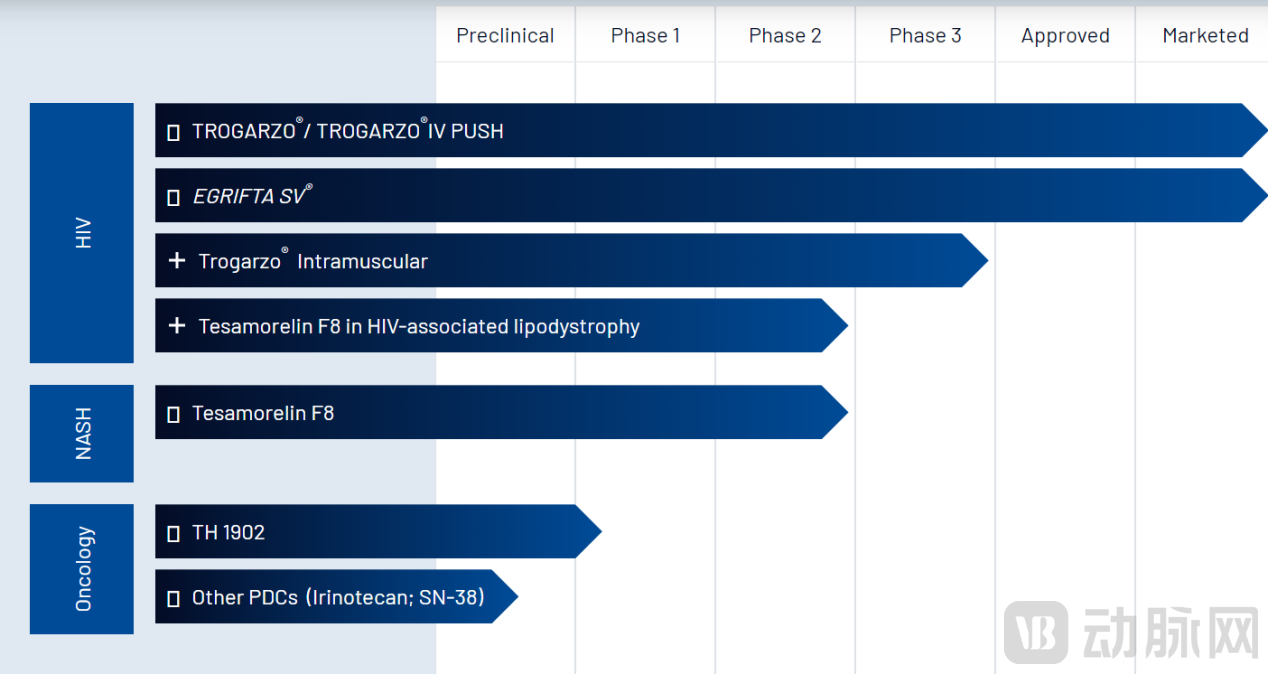
Product Pipeline (Source: Theratechnologies Official Website)
· Oncology
Theratechnologies is leveraging its SORT1+ Technology™ to develop a novel therapy targeting sortilin (SORT1)-positive cancers by linking the anticancer drug docetaxel—a well-established and well-characterized cytotoxic agent—to a proprietary peptide that specifically binds to the sortilin receptor. The drug, sudocetaxel zendusortide (TH1902), was granted Fast Track Designation by the FDA in 2021 for the treatment of patients with sortilin-positive, recurrent, advanced solid tumors who are refractory to standard therapies.
Compared with healthy tissues, cancer cells preferentially express the sortilin receptor. Expression of this receptor has been documented in various cancers, including ovarian cancer, endometrial cancer, triple-negative breast cancer, melanoma, lung cancer, colorectal cancer, and pancreatic cancer. Conventional chemotherapy damages both cancerous and healthy cells. In contrast, peptide-drug conjugates (PDCs) can selectively deliver cytotoxic payloads to sortilin receptors on cancer cells, followed by rapid internalization into the cancer cells and release of the cytotoxic agents, thereby facilitating more effective targeted therapy with improved sustainability.
SORT1+ Technology™ was acquired by Theratechnologies in February 2019 through its acquisition of Katana Biopharma, along with the latter’s peptide-drug conjugate (PDC) pipeline, including TH1902 (docetaxel-peptide conjugate) and TH1904 (doxorubicin-peptide conjugate). TH1902 is currently being evaluated in a Phase I clinical trial, with Funda Meric-Bernstam, M.D., Chair of the Department of Investigational Cancer Therapeutics at The University of Texas MD Anderson Cancer Center, serving as the principal investigator.
Non-alcoholic Steatohepatitis (NASH)
Theratechnologies is developing tesamorelin for the treatment of non-alcoholic steatohepatitis (NASH) in the general population and will continue discussions with potential partners to conduct Phase 2b/III studies.
Unlike novel cyclic peptide technology developers represented by Bicycle Therapeutics, Theratechnologies is a company that has long been dedicated to the research and development of traditional hormonal peptide analogs. The main components of molecules such as TH1902 are peptides and toxic payloads; the peptide moiety features a relatively traditional long-chain peptide structure, while the toxic payload is conventional paclitaxel, rather than a modified toxin molecule.
Theratechnologies has laid out its strategy in the PDC field, leveraging years of resource and technological accumulation, with the potential to achieve flexible transformation and iterative upgrades.
Peptide-drug conjugates (PDCs) leverage the advantages of peptides. Compared with antibody-drug conjugates (ADCs), PDCs have a lower molecular weight and are less likely to induce autoimmune responses. In contrast to the complex manufacturing processes associated with antibodies, PDCs are easier to synthesize and purify, effectively reducing the cost of large-scale production.
Currently, the majority of peptide-drug conjugate (PDC) drugs under development are being pursued by foreign companies. Notable companies with rapid and active R&D progress include Oncopeptides, Bicycle Therapeutics, and Cybrexa Therapeutics. Chinese companies active in this field include Shengnuoji Medicine, Tanyi Medicine, Tailikang Biopharma, Handing Medicine, Borui Biology, Zhitai Biologics, and Zhuliyuan Biologics.
Among them, SNG1005 (paclitaxel trevatide), co-developed by Shengnuoji Medicine and the Canadian company Angiochem, is currently undergoing Phase III clinical trials in China and is the most advanced peptide-drug conjugate (PDC) drug in the country.
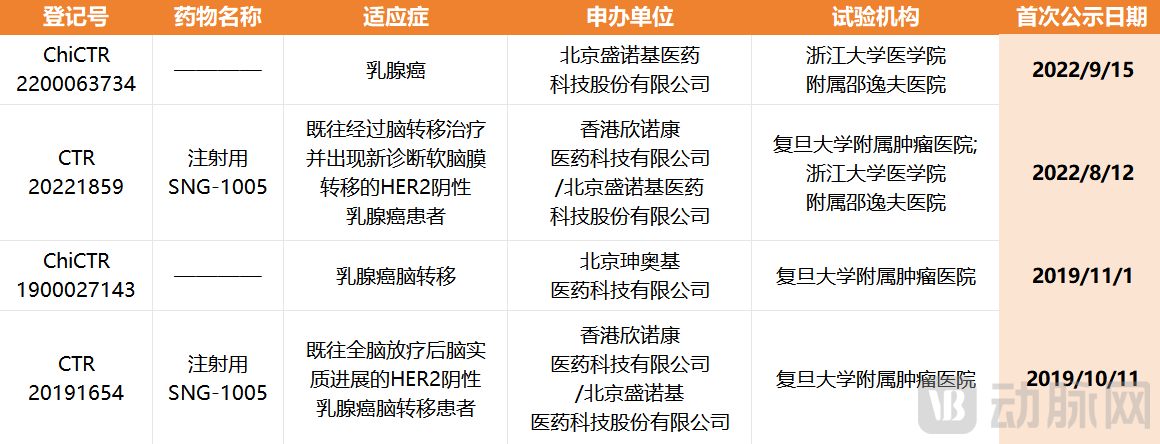
Progress in the Clinical Development of SNG1005 (Data Source: Compiled from Publicly Available Data)