

TeYi Data Files IPO Prospectus to Address Hospital Reimbursement Challenges in the Medical Food Market
With the reform of health insurance payment methods such as DRG/DIP, how to reduce patients' length of stay and help them achieve better disease treatment outcomes at lower medical costs has become a critical issue for hospitals to address.
Moreover, growing clinical evidence indicates that nutritional therapy can enhance the efficacy of clinical treatment and maximize therapeutic outcomes. For instance, a study in the United States found that patients receiving oral nutritional supplements had an average hospital stay reduced by 2.3 days and medical costs decreased by 21%.
This has also led to a growing emphasis on nutritional support for patients in an increasing number of hospitals.
However, the challenge facing hospitals is that medical institutions often lack an operational system for medical foods. This has also resulted in a large volume of medical foods (including foods for special medical purposes, functional foods, and traditional Chinese medicinal diets, among others) being unable to effectively enter hospital settings.
This also means that whoever can better help both hospitals and enterprises address this issue will be able to secure a place in the market.
A number of companies have emerged in this field. Among them is Teyi Data Technology Co., Ltd. (hereinafter referred to as “Teyi Data”), a company dedicated to providing hospitals with compliant operational solutions for medical foods.
The emphasis on nutritional support for patients is undoubtedly well-founded.
Taking foods for special medical purposes (hereinafter referred to as FSMPs) as an example, the emerging FSMP industry began to develop after the promulgation of the Administrative Measures for the Registration of Foods for Special Medical Purposes in 2016. In 2018, the draft for comments on the National Food Safety Standard: Code of Clinical Application of Foods for Special Medical Purposes was released. The code specifies that “physicians or clinical dietitians shall conduct nutritional screening and assessment, identify nutrition-related issues and etiologies based on the results, and make a nutritional diagnosis. For patients who meet the indications and do not have contraindications, a nutritional treatment plan and a prescription for foods for special medical purposes shall be formulated in accordance with their individual conditions.” This further clarifies that the prescribing entities are physicians or clinical dietitians.
This also implies, to a certain extent, that a significant proportion of nutritional prescriptions are issued in inpatient settings.
Perhaps more critical was the release of the 2021 “Expert Consensus on Clinical Management of Foods for Special Medical Purposes (FSMP).” This consensus covers various aspects, including the establishment of dedicated departments within clinical institutions for standardized management, physician prescribing, product traceability, and integration into hospital information systems. It provides particularly detailed guidance on how hospitals should handle prescribing practices.
However, the pain points for hospitals are evident. In the past, hospitals had already established standardized operational processes for the procurement and sales of pharmaceuticals, medical devices, and consumables. Today, however, they are required to build from scratch a standardized operational system covering the entire supply chain—from procurement to sales—for medical foods, including foods for special medical purposes (FSMP). On one hand, most hospitals lack the capability to independently develop such supporting systems; on the other hand, even if such systems are established, hospitals will still face significant operational challenges.
If an operational support system for medical foods cannot be effectively established, medical foods such as foods for special medical purposes (FSMPs) will be unable to enter hospitals, academic foundations will be difficult to build, physicians’ awareness will be hard to develop effectively, and patients will be unable to reap the benefits of nutritional therapy.
Demand does not come solely from hospitals. With the outbreak of the pandemic, the general public has placed greater emphasis on nutritional health. This undoubtedly represents a pain point awaiting resolution and a market with promising development prospects.
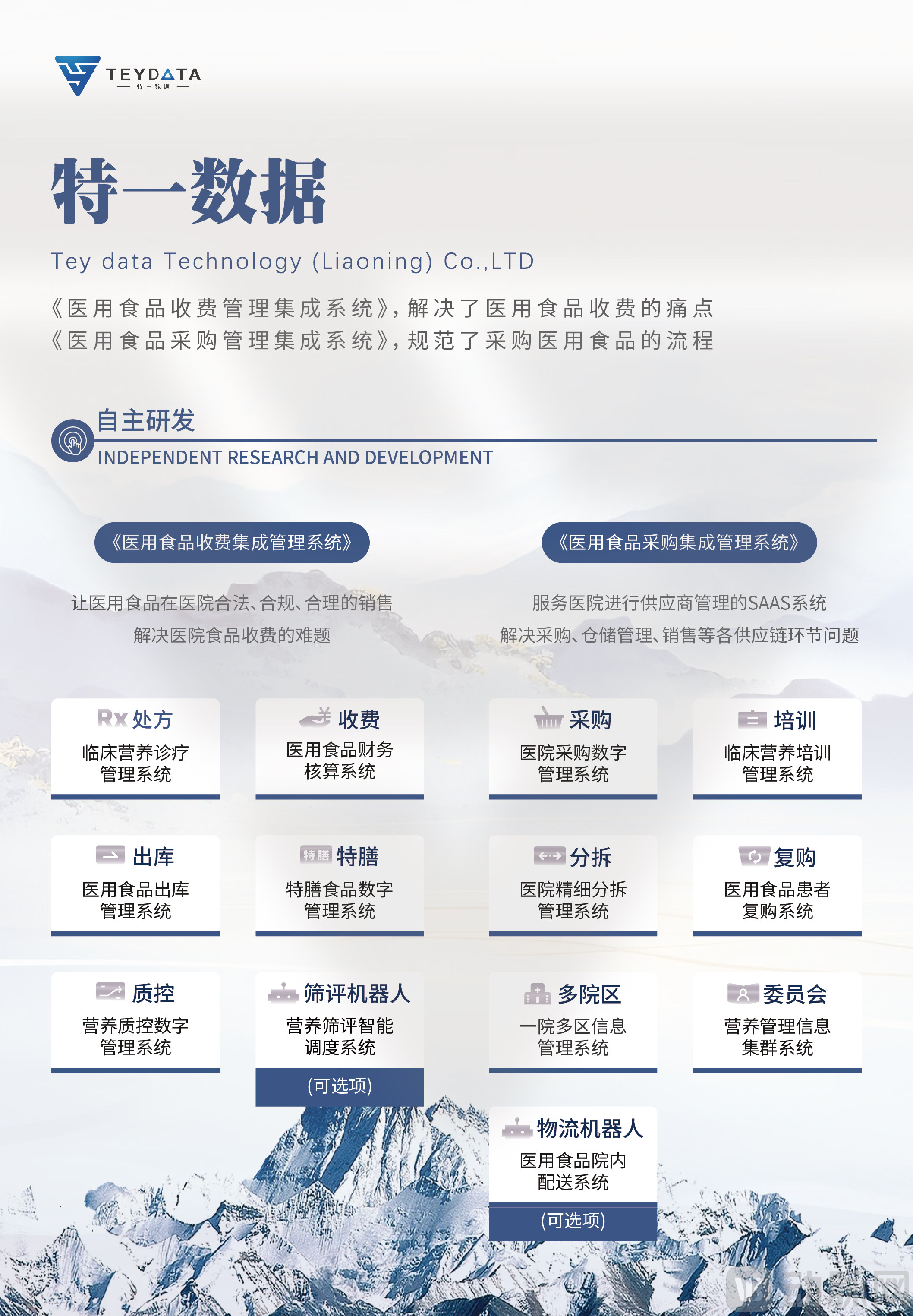
Teyi Data has undoubtedly targeted the pain points prevalent in hospitals. According to Zhe Liang, General Manager of Teyi Data, the company has built a suite of digital systems for hospitals, including a clinical nutrition prescription system, a billing and accounting system, a food for special medical purposes (FSMP) management system, and a cloud-based warehouse management platform, thereby helping hospitals achieve compliant operations in clinical nutrition support.
Currently, Teyi Data has provided compliant operational solutions for medical foods to more than 40 hospitals across China, including local hospitals in Liaoning Province such as the First Affiliated Hospital of Jinzhou Medical University, the Third Affiliated Hospital of Jinzhou Medical University, Shenyang Sixth People’s Hospital, and Shenyang First People’s Hospital, as well as Jilin Chemical Industry Hospital, the Second People’s Hospital of Jilin City, the First Affiliated Hospital of Tsinghua University, and the 304th Hospital of the Chinese People’s Liberation Army.
Once a compliant operational support system for medical foods has been established within the hospital, the obvious issue to address is the sourcing of these medical foods.
Among them, Teyi Data serves as a link between medical food suppliers and hospitals.
Currently, according to Zhe Liang, Teyi Data has established partnerships with over 100 B-side medical food suppliers. In addition to addressing hospital supply challenges, Teyi Data provides suppliers with a “mini ERP system” to help B-side enterprises streamline warehouse and customer management, thereby facilitating better access to the in-hospital market.
By connecting suppliers and helping hospitals address compliance issues in their operations, Teyi Data has truly delivered nutritional support to patients while achieving rapid growth in its own performance.
On one hand, this is related to the rapid growth of the entire medical food market. From a broader perspective, the implementation of DRG (Diagnosis-Related Groups) and DIP (Big Data Diagnosis-Intervention Packet) in China has transformed the previous healthcare payment model. Previously, hospitals generated higher revenues from longer patient hospital stays; whereas now, they must minimize patient length of stay and disease-related costs to maximize revenue. Furthermore, coupled with patients’ increasing emphasis on nutritional support, medical foods such as Foods for Special Medical Purposes (FSMP) thus possess significant potential for development.
On the other hand, this is also attributable to the inherent strengths of TeYi Data. As hospitals place increasing emphasis on nutritional support, the demand for compliant operational systems has continued to rise. While numerous software vendors have entered this sector to support the development of hospital nutritional prescription systems, they often lack complementary services such as operational support. TeYi Data, however, has recognized the comprehensive needs of hospitals, going beyond merely providing software systems to offering a complete suite of service solutions. This enables hospitals’ clinical nutrition operational systems to achieve refined management while ensuring compliance, thereby better benefiting both medical professionals and patients. The ability to deliver high-quality services is also closely linked to Zhe Liang and his team. With nearly 20 years of development experience himself, Zhe Liang leads a team of over 60 professionals who possess extensive expertise in both research and development and operations.
Furthermore, by leveraging TeYi’s data to establish a compliant operational system for medical foods within hospitals, it has also created a compliant channel for B2B enterprises to enter hospital settings. This has, to some extent, resolved the longstanding issue of B2B companies being unable to effectively connect with end users, thereby encouraging more B2B enterprises to collaborate with them.
As the strategic partnership between Teyi Data and General (Medical) Group takes shape, and with further expansion into the in-hospital market, the “flywheel effect” driving performance growth by linking B-side enterprises with hospitals will become more pronounced. Patients will also benefit to a greater extent.
To accelerate the development of clinical nutrition, TeYi Data is also making some attempts.
In 2023, Teyi Data entered into a strategic partnership with two hospitals affiliated with Shenyang Medical College—namely, the Central Hospital Affiliated to Shenyang Medical College and the Second Affiliated Hospital of Shenyang Medical College—to jointly establish a multi-center “Clinical Nutrition Big Data” industry-academia-research alliance. The plan aims to incorporate all hospitals in Liaoning Province into this alliance, enabling the province to build a multi-center clinical observation system for medical foods. According to Zhe Liang, Teyi Data will subsequently develop corresponding digital systems based on this framework to help more manufacturers facilitate product commercialization in the Liaoning region.
In addition, TeYi Data is also committed to building a big data platform to better assist government agencies in regulatory oversight and promote the healthy development of the industry.
For Te Yi Data, market expansion is undoubtedly the more critical priority at present. In addition to further penetrating the Northeast China market, Te Yi Data also plans to expand its nationwide presence, rapidly scaling from its existing hospital base to achieve coverage of 200 hospitals, thereby better serving both healthcare institutions and enterprise clients.
Currently, to accelerate its development, Teyi Data is also launching a new round of financing and is in discussions with institutional investors.
Zhe Liang pointed out that, to better promote the development of the entire industry, it is necessary to advance compliant hospital operations and provide academic and talent support for the production and R&D system of medical foods.
“With the establishment of a compliant operational system for in-hospital nutritional support, we are highly confident in the future development of the medical food market within hospitals,” stated Zhe Liang from TeYi Data.