

What Drove the 466% Surge in Chinese Healthcare Stocks in 2023?

Biokin
Pharmaceutical R&D Developer

Mabwell
Innovative Biopharmaceutical Company

Xingqi Pharmaceutical
Ophthalmic Drug Research, Development, Production, and Sales
SINOMED
High-end interventional medical device R&D, production, and sales provider

ChenGuang Medical
Developer, Manufacturer, and Supplier of Core Components in the MRI Industry Chain
Looking back on 2023, the healthcare industry endured a challenging period. Whether it was the post-pandemic decline in performance or the cooling sentiment toward contract research and manufacturing organizations (CXOs), many former star companies felt the chill of the market in 2023, facing significant sell-offs by investors and sharp drops in their stock prices. According to data from Choice, nearly 10% of healthcare companies listed on China’s A-share market saw their stock prices fall by more than 30% in 2023.
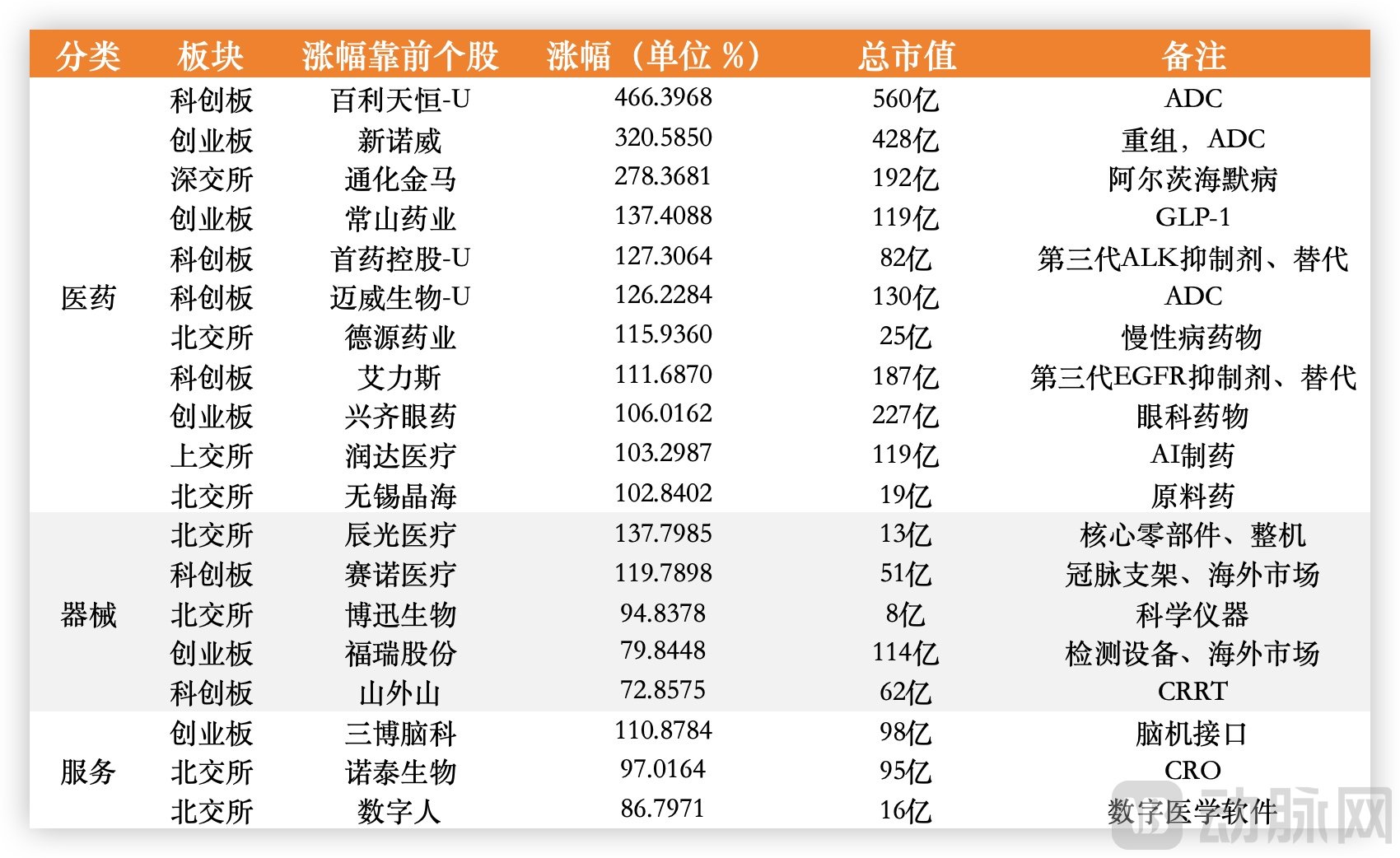
A-Share Listed Healthcare Companies with Top Gains in 2023, Data Sourced from Choice
Despite the continued sluggishness in the secondary market, 2023 was not without its hotspots. From traditional Chinese medicine at the beginning of the year to Alzheimer’s drugs and GLP-1 weight-loss medications, many companies rode these trends, sending their stock prices soaring. While it is undeniable that some firms merely capitalized on conceptual hype, others genuinely seized strategic opportunities for growth. Let us review the best-performing healthcare stocks in China’s A-share market in 2023: What did these companies do right?
A 466% Surge and a 50% Plunge: China’s Pharmaceutical Sector in 2023 Was a Veritable “Song of Ice and Fire,” with ADCs Undeniably Taking Center Stage.
According to statistics, the market capitalization of healthcare companies listed on the A-share and Hong Kong stock markets fell by approximately RMB 1 trillion in 2023. Amidst this sluggish market performance, some companies still achieved gains exceeding 400%.
In December 2023, Biokin announced that it had entered into a global strategic collaboration agreement with BMS, granting the latter the rights to develop and commercialize BL-B01D1, an EGFR×HER3 bispecific antibody-drug conjugate (ADC). The total transaction value amounts to up to $8.4 billion, including an upfront payment of $800 million.
The $800 million upfront payment surpassed the previous record of $600 million set by BeiGene, while the potential value of $8.4 billion also exceeded the prior record of a $5 billion total deal size established by Akeso. Leveraging the positive impact of this business development (BD) transaction, Biokin saw its stock price surge by 466% from its listing on the STAR Market in January 2023 to the end of the year.
License-out is becoming a benchmark for assessing the value of innovative drugs. Multinational corporations (MNCs) are undoubtedly better positioned than ordinary investors to evaluate the prospects of drug pipelines; therefore, pipelines selected and acquired by MNCs are inherently more competitive. Through license-out deals, pharmaceutical companies secure funding that ensures the smooth progress of drug development. In other words, license-out arrangements enhance corporate certainty over the near term for pharmaceutical firms, making those with such deals more likely to attract investor favor in 2023.
In terms of both transaction value and volume, antibody-drug conjugates (ADCs) were undoubtedly the standout highlight of 2023. Throughout the year, numerous ADC-related deals were struck, culminating in several major agreements between multinational corporations (MNCs) and Chinese pharmaceutical companies by year-end.
It is not only Biokin that has been propelled by ADCs, but also Mabwell.
Although Mabwell’s stock price fell by more than 50% in 2022, the rise of antibody-drug conjugates (ADCs) in 2023 ushered in its moment in the spotlight, with a full-year gain of 126%.
From the perspective of pipeline layout, Mabwell possesses key targets that emphasize differentiation, including Nectin-4, Trop-2, and B7-H3. In late 2023, Mabwell announced that its Phase III clinical trial protocol for 9MW2821, submitted to the Center for Drug Evaluation (CDE) of the National Medical Products Administration (NMPA), had been approved, officially launching the Phase III clinical study of 9MW2821 for the treatment of locally advanced or metastatic urothelial carcinoma in patients previously treated with platinum-based chemotherapy and PD-(L)1 inhibitors.
9MW2821 is an innovative Nectin-4-targeting antibody-drug conjugate (ADC) independently developed by Mabwell. It is also the first drug in China targeting this antigen to initiate Phase III clinical trials. The Nectin-4 ADC is poised to become the next blockbuster following DS8201, and it is precisely this expectation that has driven the rise in its stock price.
There is also Shinova Pharma, whose stock price surged by over 320% in 2023. As its parent company, CSPC Pharmaceutical Group, injected the innovative drug assets of Julstone Biologics into it, Shinova Pharma has also jumped on the ADC bandwagon. In the future, Shinova Pharma may become CSPC Pharmaceutical Group’s platform for innovative drugs.
If ADCs are the hottest topic in China, then GLP-1s were the global hotspot in 2023.
The stories of Eli Lilly and Novo Nordisk need not be repeated here. In China’s secondary market, Hebei Changshan Biochemical Pharmaceutical Co., Ltd. has been the primary beneficiary of this trend, with its stock price rising 137% over the year and peaking at a gain of over 400%.
As a blockbuster drug phenomenon, GLP-1 has swept across the globe. The prestigious academic journal *Science* named GLP-1 the 2023 Breakthrough of the Year in December. Major pharmaceutical companies have rapidly followed suit. In China, Huadong Medicine and He Ren Hui Biotech have successively received approval to market GLP-1-based weight-loss products. Multiple other pharmaceutical firms, including Hengrui Medicine, Livzon Group, Tonghua Dongbao, and CSPC Pharmaceutical Group, have also entered the field. Notably, Innovent Biologics initiated Phase III head-to-head clinical trials of its GLP-1R/GCGR dual agonist IBI362 against semaglutide in late December.
The Proliferation of GLP-1 Therapies Has Also Stimulated BD Deals: In November, AstraZeneca Announced an Exclusive License Agreement with Chinese Biopharmaceutical Company Chengyi Bio for the Small-Molecule GLP-1 Receptor Agonist ECC5004, Featuring an Upfront Payment and a Total Transaction Value of Up to $1.825 Billion.
From potent glucose-lowering agents to miracle weight-loss drugs, GLP-1’s relentless competitive journey shows no signs of stopping. GLP-1 therapies are making inroads across a broad spectrum of metabolic and related disorders, including cardiovascular disease, kidney disease, non-alcoholic steatohepatitis (NASH), heart failure, neurodegenerative diseases, addiction treatment, endocrine disorders, and immune-mediated inflammatory conditions.
It is foreseeable that the GLP-1 trend will continue to gain momentum in 2024.
Tonghua Jinma, with a year-to-date surge of nearly 300%, exemplifies the market’s anticipation for new drugs in certain therapeutic areas.
The core factor driving the rise in Tonghua Jinma’s stock price is the positive unblinding results of the Phase III clinical trial for its innovative drug, octahydroaminoacridine succinate tablets, which met statistical endpoints and holds promise as a key solution to Alzheimer’s disease. Octahydroaminoacridine succinate tablets are a Class 1.1 national-level new small-molecule chemical drug with fully independent intellectual property rights, representing a global first-in-class therapy for the treatment of mild-to-moderate Alzheimer’s disease.
According to data from the Pharmaceutical Research and Manufacturers of America (PhRMA), approximately 146 clinical trials for Alzheimer’s disease drugs failed between 1998 and 2017. Since 2000, multiple large pharmaceutical companies have invested a total of approximately $600 billion, yet no curative therapy has been developed. This is the current state of Alzheimer’s drug development, often referred to as a “black hole.”
For many years, hypotheses including the Aβ deposition hypothesis, the abnormal tau phosphorylation hypothesis, the neuroinflammation hypothesis, the mitochondrial hypothesis, and the lysosomal dysfunction hypothesis have failed to fully elucidate its pathogenesis. Succinate dihydroacridine tablets represent the cholinergic hypothesis, but their true efficacy in patients remains to be verified during subsequent commercialization.
Not only are intractable diseases such as Alzheimer’s disease lacking effective pharmacotherapies, but common conditions like myopia also suffer from a paucity of approved medications.
In September 2021, the Australian Therapeutic Goods Administration (TGA) approved Aspen Pharmacare’s 0.01% atropine sulfate eye drops for market release, making it the world’s first eye drop explicitly indicated for myopia control.
“Myopia” is a global public health issue. According to data from the National Health Commission, the number of people with myopia in China reached 750 million in 2022, representing an 8.18% year-on-year increase, with an overall prevalence rate of 59.6%. Among them, there is a large population of school-age children and adolescents who either already have myopia or are at potential risk, indicating substantial demand for myopia prevention and control as well as a vast market size.
Currently, low-concentration atropine eye drops are sold as in-house preparations in physical hospitals, and the true market for myopia drugs remains a blue ocean.
As early as 2016, Xingqi Pharmaceutical obtained five years of clinical study data on atropine eye drops through independent authorization from the Singapore National Eye Centre, to support the development of atropine sulfate eye drops. In April 2023, the website of the National Medical Products Administration indicated that Xingqi Pharmaceutical had submitted a new drug application for atropine sulfate eye drops, which was accepted; the indication sought in this submission was for slowing the progression of myopia in children.
Driven by both policy mandates and market demand for myopia prevention, the high likelihood of rapid penetration rate growth and a strong probability of regulatory approval contributed to Xingqi Pharmaceutical’s stock price surge of over 100% in 2023.
According to calculations by CICC, the market size for myopia prevention and control is expected to reach approximately RMB 210 billion by 2030. Faced with such a substantial market, domestic pharmaceutical companies are naturally poised to participate. More than twenty enterprises, including Hengrui Medicine, Ocumension Therapeutics, Lepu Pharmaceutical, Santen Pharmaceutical, Qilu Pharmaceutical, and Extreme Vision, have had their applications for related drugs accepted.
Whether it is myopia medications on the verge of an explosive growth phase or Alzheimer’s disease drugs that still require time to mature, market reactions have affirmed corporate efforts to address unmet clinical needs.
Domestic substitution was also a hot concept in the secondary market in 2023.
Taking AstraZeneca’s third-generation EGFR inhibitor, osimertinib, as an example, its annual revenue exceeds $5 billion. As a domestic competitor to osimertinib, Allist’s furmonertinib generated RMB 1.348 billion in revenue during the first three quarters of 2023, representing a year-on-year increase of 160%. This strong performance drove Allist’s stock price up by 111% for the full year.
The similar circumstances are reminiscent of Betta Pharmaceuticals, which once saw its market capitalization surge to RMB 60 billion by leveraging the domestic substitution of its first-generation EGFR inhibitor, icotinib. Unlike Betta, whose rise coincided with the broader pharmaceutical sector’s boom, Allist has carved out an independent trajectory amid a sluggish sector, driven by its robust financial performance.
However, with the approval and launch of Dizal Pharmaceutical’s third-generation EGFR inhibitor, sunvozertinib, in China in Q3 2023, competition in the domestic market has begun to intensify. Currently, Allist has initiated the development of fourth-generation EGFR inhibitors and is exploring the introduction of novel technologies to address resistance to EGFR inhibitors.
Similar to EGFR inhibitors, ALK inhibitors have also established their own paradigm of sequential replacement.
The ALK receptor tyrosine kinase is associated with three major types of tumors: hematologic, mesenchymal, and solid. Currently, only one third-generation ALK inhibitor has been approved for marketing worldwide, indicating a significant unmet clinical need.
Shouyao Holdings’ core pipeline assets, SY-707 and SY-3505, are its independently developed second-generation and third-generation ALK inhibitors, respectively. In December, Shouyao Holdings announced that SY-3505 had been approved to initiate a pivotal Phase III clinical trial. SY-3505 is currently the domestically developed third-generation ALK inhibitor with the most advanced development progress and is poised to become a domestic alternative.
Although distinct from furmonertinib, which has already achieved commercial scale-up, Frost & Sullivan analysis indicates that the compound annual growth rate (CAGR) of China’s ALK inhibitor market from 2024 to 2030 will be 11.4%, with the market size projected to reach RMB 13.88 billion by 2030. This market scale, exceeding RMB 10 billion, continues to attract strong investor interest.
With the rise of ChatGPT, artificial intelligence has become the undisputed hotspot of 2023, and AI-driven drug discovery has also gained significant traction.
Runda Medical has integrated its proprietary laboratory medicine knowledge graph with Huawei’s artificial intelligence technology to develop the “Liangyi Xiaohui” medical large language model, powered by Huawei’s foundational models. As one of the few healthcare scenario partners of Huawei in China, Runda Medical has garnered favor from secondary market investors through this strategic alliance, with its stock price surging by over 100% for the year.
The primary business models in AI-driven drug development are categorized into AI SaaS, AI-Biotech, and AI-CRO. Companies like Shanghai Runda Medical Technology Co., Ltd., which provide software platform services, fall under the AI SaaS category, whereas Insilico Medicine and XtalPi, which filed their prospectuses in June and November 2023 respectively, represent the latter two models. While different business models influence the revenue performance of AI drug discovery companies, financial reports from Runda Medical and prospectus data from the other two firms indicate that current revenue generated from AI-driven drug development remains limited, suggesting that widespread commercialization is still some distance away.
Both large language models and AI-driven drug discovery are industries with immense growth potential. Although the total number of collaborations between multinational corporations (MNCs) and AI drug discovery firms declined slightly in 2023, high-value deals worth hundreds of millions of dollars remained plentiful. This indicates that only AI projects that have demonstrated their value can attract investment from MNCs.
For medical device companies, failing to expand overseas is tantamount to cutting off a critical pathway for rapid growth.
SINOMED, which was excluded from the first volume-based procurement of coronary stents, has finally ushered in its moment in the spotlight after several years of struggle, with its full-year stock price surging by 119%.
In terms of performance, SINOMED’s two new coronary stent products were selected for the first time in the national centralized procurement renewal. As of Q3 2023, shipment volume reached 120,000 units, exceeding the contracted volume under centralized procurement by 48,000 units. Currently, SINOMED’s next-generation coronary drug-eluting stent, HT Supreme, has completed clinical trials in the United States, Europe, and Japan, and has successfully passed the FDA on-site inspection. It is expected to receive FDA approval by Q1 2024 at the latest. Meanwhile, the product has been included in the French national health insurance reimbursement list, with overseas performance poised to drive new growth.
Meanwhile, SINOMED is accelerating its commercialization efforts in Latin America, the Middle East, Africa, and Asia. Multiple coronary intervention products have obtained regulatory approval in more than 10 countries, including those in Europe, the United States, South Korea, and Singapore, and the company has established commercial partnerships with local distributors.
Furui Shares (79%), another medical device company with significant growth, also benefited from contributions by overseas markets.
Furui Shares’ primary products are liver disease medications and liver disease diagnostic equipment, with equipment revenue accounting for over 60% of the total, making it the core source of profit.
Whether it is alcoholic liver disease (ALD) or non-alcoholic steatohepatitis (NASH), the disease progression follows a trajectory from hepatitis to hepatic fibrosis, and ultimately to cirrhosis or hepatocellular carcinoma. While cirrhosis is irreversible, hepatic fibrosis is reversible. Therefore, early diagnosis at the fibrosis stage can effectively control the progression of liver disease.
Furui’s subsidiary, Echosens, has launched the world’s first non-invasive device for detecting liver fibrosis. Leveraging two core technologies—Vibration-Controlled Transient Elastography (VCTE) and Controlled Attenuation Parameter (CAP)—the device accurately quantifies hepatic steatosis by measuring attenuation levels within the liver. The device has been listed as essential equipment for liver disease management by authoritative organizations such as the World Health Organization (WHO) and the American Association for the Study of Liver Diseases (AASLD), and it has received FDA approval for long-term clinical use.
Meanwhile, Echosens is collaborating with Novo Nordisk to promote screening for fatty liver disease among patients with diabetes. Furthermore, if any NASH drugs are approved for market launch within the next two years, this will further drive demand for diagnostic equipment.
Once a company accurately identifies genuine, unmet clinical needs overseas and provides reliable solutions, the vast international market will deliver substantial financial returns.
Beyond companies with rising stock prices, we are seeing the Beijing Stock Exchange emerge as a financing avenue worth exploring.
During a recent period of broad market downturn, the Beijing Stock Exchange (BSE) bucked the trend, with its index rising from 706 points to 1,114 points, marking a peak gain of 58%. Among BSE-listed companies, ChenGuang Medical, SINOMED, and Deyuan Pharmaceutical ranked among the top ten in the A-share healthcare sector for price appreciation in 2023. Meanwhile, Bioxun Biotech, Nuotai Biological, Digital Human, and Datang Pharmaceutical each saw gains approaching 100%.
From a policy perspective, the positioning of “Specialized, Refined, Differential, and Innovative” (SRDI) enterprises, along with the philosophy of serving small and medium-sized innovative companies, makes the Beijing Stock Exchange highly favorable for pharmaceutical innovators dedicated to driving industrial upgrading.
Taking ChenGuang Medical as an example, the company specializes in core components and complete systems for superconducting MRI. It initially entered the industry with RF coils and gradually expanded its product portfolio to include superconducting magnets. Its collaborative clients include Wandong Medical, Philips, and Langrun Medical. Starting in 2022, ChenGuang Medical ventured into the complete system business, focusing on the R&D of 3.0T superconducting MRI systems and the development and upgrade of cost-effective 3.0T superconducting magnets, with prototypes expected to be completed between late 2023 and early 2024. In 2023, ChenGuang Medical’s stock price rose by 137%.
As an upstream player in the industrial chain, ChenGuang Medical’s superconducting technology for superconducting magnetic resonance systems is not only applicable in the medical field but also has extensive applications in the photovoltaic sector. To this end, ChenGuang Medical is actively developing related technologies and has completed the preliminary design of a new type of magnetically controlled Czochralski single-crystal superconducting magnet with superior cost efficiency.
Core component manufacturers for imaging equipment listed on China’s A-share market, such as iRay Technology, have market capitalizations exceeding RMB 20 billion, whereas ChenGuang Medical currently has a market cap of just over RMB 1 billion. To achieve growth, whether through expanding into complete system manufacturing or diversifying across industries, sustained investment is essential.
Bioxun Biotech, also listed on the Beijing Stock Exchange, saw its stock price surge by 94% in 2023.
This company specializes in durable scientific research instruments, including microbial incubators, pharmaceutical stability testing chambers, sample drying ovens, plant/cell culture incubators, autoclaves, and biological safety cabinets. In the scientific instrument sector, pricing power is held only by exclusive products within niche segments; therefore, expanding revenue necessitates mergers and acquisitions to enter new niche markets.
Listing on the Beijing Stock Exchange (BSE) has provided smaller-scale enterprises with opportunities for growth. In June 2023, the BSE and the Hong Kong Stock Exchange (HKEX) signed a Memorandum of Understanding on Cooperation, supporting eligible listed companies from each market in applying for listing on the other’s market.
In other words, the “Beijing + H” model is about to be implemented.
In the current capital winter, listing on the Beijing Stock Exchange (BSE) to raise funds for development, and initiating a listing process on the Hong Kong Stock Exchange (HKEX) at an appropriate time to diversify financing channels, represents a viable growth model.