

Cell Signaling Technology Files IPO Prospectus Following Seven Consecutive Years as Global Leader in Highly Cited Antibodies, Highlighting Its Leading-Edge Senescence Detection Portfolio

Cell Signaling Technology
Innovative Research and Diagnostic Product Provider

CiteAb
Life Science Data Provider
In July 2023, life sciences data provider CiteAb released its list of the Top 100 Most Cited Antibodies Globally in 2022. Cell Signaling Technology (CST), a developer of antibody-based diagnostic products, secured 36 spots on the list and swept the top three positions. This marks the seventh time since 2016 that CST has ranked first.
CST, founded in 1999 and headquartered in Massachusetts, USA, is a privately held, family-owned biotechnology company established by scientists. It is dedicated to providing high-quality research tools and diagnostic products to the biomedical research community, with the aim of accelerating researchers’ understanding of biology and advancing personalized medicine.
Currently, CST leverages its proprietary monoclonal antibody technology platform, NG-XMT™, and proteomics technology, PTMScan®.®and PhosphoSitePlus®PTM (Post-Translational Modification) Database offers nine major product categories to research institutions and biotechnology enterprises. Its flagship products in the aging sector include a range of cell-based assay kits and antibody sampling kits targeting aging biomarkers.
In CiteAb’s 2022 Global Top 10 Most-Cited Antibodies list, Cell Signaling Technology (CST) accounted for six entries. Among these, two products are specifically used to detect aging biomarkers: the loading control antibody GAPDH (D16H11) (#5174) and Cleaved Caspase-3 (#9661). These are key reagents for detecting age-related diseases such as Alzheimer’s disease (AD), Parkinson’s disease (PD), and senile dementia.
CST is an antibody company serving the scientific research community, boasting a roster of industry leaders.
After receiving his Ph.D. in Chemistry from the University of Oregon in the United States in 1984, Dr. Michael J. Comb, President and Chief Executive Officer, served as Director of the Laboratory for Molecular Neurobiology and Associate Professor of Neuroscience at Harvard Medical School, and was awarded the Lifetime Achievement Award by CiteAb.
During his academic research, Dr. Comb recognized that the tools available at the time for studying signaling pathways were inadequate to meet research demands, and he aspired to see the emergence of higher-quality antibody reagents for both basic and clinical research.
Therefore, Dr. Comb founded CST and established a diverse global management team for the company.
Among them, Dr. Roberto Polakiewicz, Chief Scientific Officer at CST, earned his Bachelor’s degree in Chemistry and Ph.D. in Molecular Biology from the Hebrew University of Jerusalem in Israel, and completed his postdoctoral research at the Whitehead Institute for Biomedical Research at MIT. With 25 years of experience in research and technology development spanning molecular and cellular biology, signal transduction, and cancer, he has authored approximately 65 peer-reviewed publications and holds multiple patents. During his tenure as Chief Scientific Officer at CST, Dr. Polakiewicz drove the establishment and application of the company’s fourth-generation novel antibody technology platform.
Sean Beausoleil, Executive Director of Research, holds a B.A. in Biochemistry from Saint Anselm College and a Ph.D. in Cellular and Molecular Biology from Harvard University, and has authored more than 35 peer-reviewed scientific publications. Sean joined Cell Signaling Technology (CST) in 2010 to lead the research team in advancing the identification and early development of new products, as well as driving improvements in R&D technologies and fostering continuous innovation.
Maggie Xie, Global Vice President and General Manager of Greater China at CST, has previously held positions in business management, marketing and sales, and product development at companies such as Thermo Fisher Scientific and the life sciences company Eppendorf. In her current role at CST, her primary responsibilities include expanding CST’s organizational capabilities in China, establishing strategic partnerships with key customers, and broadening the company’s market channels.
In 2008, CST partnered with Bristol-Myers Squibb (BMS) through PhosphoScan®and PhosphoSignature™Provide tumor phosphorylation analysis for BMS small-molecule kinase inhibitors.
PhosphoScan®The proteomics technology platform developed by CST enables rapid determination of cellular phosphorylation profiles and direct identification of kinase drivers implicated in transformation and cancer, helping researchers elucidate cancer mechanisms in cell lines and human tumors. In practical applications, PhosphoScan®Mutant Janus Kinase 3 (JAK3) Tyrosine Kinase Identified as a Novel Driver in Acute Myeloid Leukemia (AML).
Moreover, based on PhosphoScan®, Cell Signaling Technology (CST) conducted extensive analyses of cancer cell lines and primary tumor tissues, uncovering numerous critical disease mechanisms involving activated tyrosine kinases and identifying more than 15,000 phosphorylation sites. Building on this foundation, CST established PhosphoSignature, a resource encompassing data from hundreds of cancer cell lines and human tumors.™Database.
Furthermore, in 2017, CST independently discovered the EML4-ALK fusion protein mutation in patients with non-small cell lung cancer (NSCLC) for the first time. In 2011, CST licensed the relevant patents to Pfizer, which subsequently developed crizotinib for the treatment of ALK-positive advanced NSCLC based on this technology.
Meanwhile, CST collaborated with Roche to jointly develop an IHC companion diagnostic kit for the clinical diagnosis of ALK fusion proteins, with its core component, the ALK antibody, being the ALK (D5F3) provided by CST.®) Rabbit monoclonal antibody.
Subsequently, through technological improvements and innovations, CST ultimately launched NG-XMT.™Antibody Discovery Technologies and PTMScan®Proteomics technologies for the discovery and validation of biomarkers across multiple classes of enzyme targets and lead small-molecule inhibitors.
Furthermore, CST established PhosphoSitePlus.®Bioinformatics Resource Database: This database comprises 599,017 post-translational modification (PTM) sites across 57,664 proteins, providing relevant information and tools for PTM research packages to accelerate the discovery of key disease biomarkers and drug targets.
Currently, Cell Signaling Technology (CST) offers more than 10,000 product SKUs. Among these, products in the aging research field mainly include two major categories: assays for detecting neurodegenerative diseases and cellular senescence levels, with over 50 products currently available.
Detection of Neurodegenerative Diseases
Neurodegeneration is characterized by the gradual loss of neuronal function and structure, leading to cognitive impairments such as dementia. This process is partly driven by neuronal death and disrupted glial homeostasis, is associated with aging, and may result in the onset of Alzheimer’s disease (AD) and Parkinson’s disease (PD) with advancing age. However, many biological processes underlying neurodegeneration remain poorly understood; therefore, biomarkers have become important indicative tools for diagnosis and clinical treatment.
Taking Alzheimer’s disease (AD) and Parkinson’s disease (PD) as examples, the pathological hallmark of AD is progressive neuronal and synaptic loss caused by the deposition of amyloid-β (Aβ) plaques and phosphorylated tau neurofibrillary tangles, making Aβ and tau the most critical core pathological biomarkers for AD currently. In patients with PD, Lewy bodies, which exhibit high expression of misfolded α-synuclein, serve as an important pathological hallmark of the disease.
Based on the distinct hallmark events and pathological biomarkers associated with the progression of neurodegenerative diseases, Cell Signaling Technology (CST) has developed nine categories of assay products. Among these, in the field of aging research, multiple aging biomarkers have been linked to neurodegenerative diseases. For instance, under tau pathology conditions, Cdkn2a (p16), which is involved in regulating cell cycle arrest, accumulates in senescent astrocytes and microglia. In the context of amyloid plaque pathology, p16 and p27 accumulate in senescent oligodendrocyte progenitor cells (OPCs).
Based on aging biomarkers such as p16, p21, and β-galactosidase, Cell Signaling Technology (CST) offers corresponding antibody products and detection kits. For example, the Senescence β-Galactosidase Staining Kit #9860 contains the reagents required to detect β-galactosidase activity at pH 6.0, a known characteristic of senescent cells.
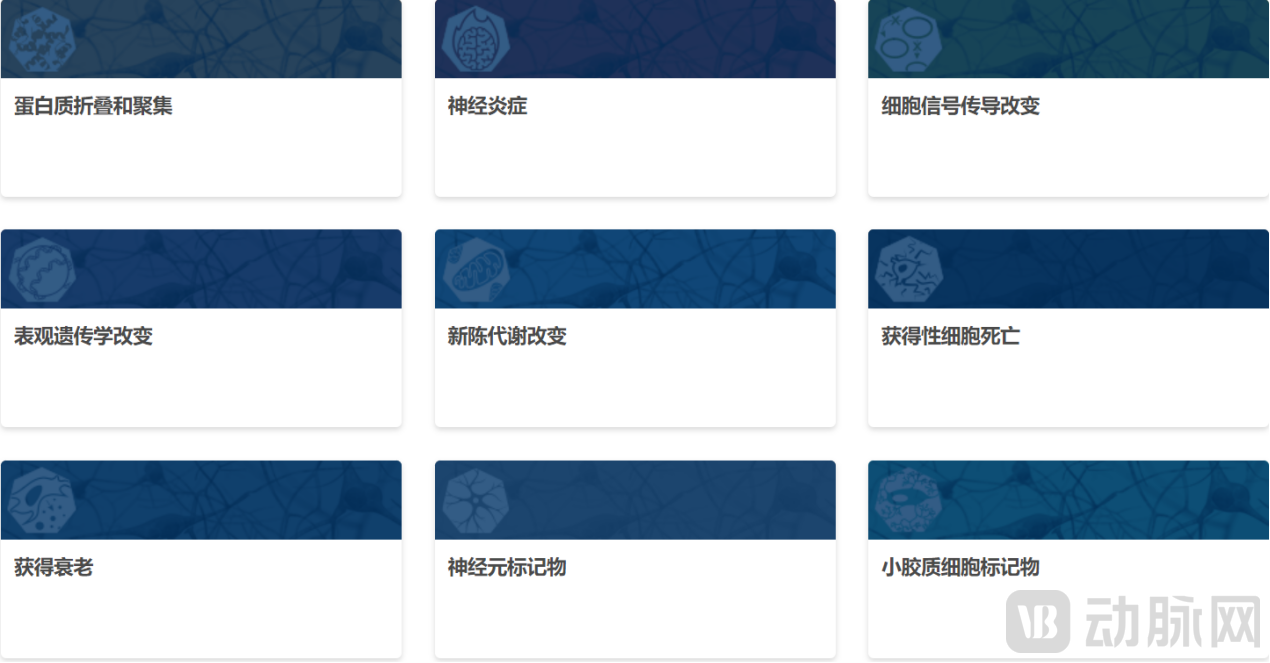 Biomarker Products for the Detection of Neurodegenerative Diseases
Image source: CST official website
Detection of Cellular Senescence Levels
Biomarkers of aging have become a critical basis for understanding the aging process and developing targeted anti-aging interventions. However, not all senescent cells exhibit the expected aging biomarkers. Furthermore, although senescent cells possess certain identified characteristics, there is currently no universal biomarker for aging, and such biomarkers are not necessarily specific to senescent cells. Therefore, researchers must comprehensively evaluate multiple aging-associated biomarkers to holistically assess the aging status of cells, organs, or the human body.
Based on morphological and metabolic changes associated with aging, Cell Signaling Technology (CST) has developed a range of tools for detecting cellular senescence. For instance, due to the reduced expression of Lamin B1, senescent cells exhibit compromised nuclear envelope integrity and distinct morphological differences from normal cells; therefore, assessing Lamin B1 expression levels provides insight into the degree of cellular senescence. Leveraging this mechanism, CST has developed 58 specialized antibody products targeting Lamin B1.
Furthermore, secreted proteins associated with the senescence-associated secretory phenotype (SASP), such as pro-inflammatory cytokines (e.g., IL-6/IL-1β), proteases (e.g., MMP3), and growth factors (e.g., EGF/VEGF), can be used to confirm the presence of senescent cells under various conditions.
Based on different secreted protein components associated with the senescence-associated secretory phenotype (SASP), Cell Signaling Technology (CST) has developed the SASP Antibody Sampler Kit (#38461). This kit contains multiple aging biomarkers and provides a simple and rapid method for detecting cellular senescence.
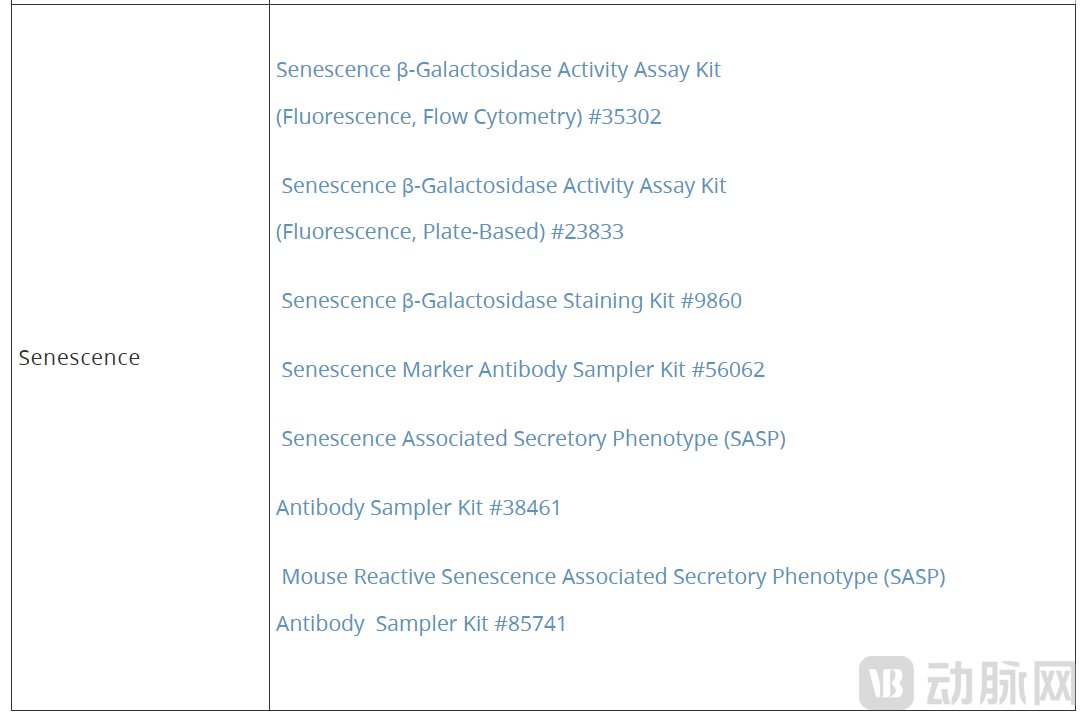 Products for Detecting Cellular Senescence Levels
Image source: CST official website
Currently, anti-aging is a hot topic of interest for capital and the market. Many tech giants and companies have entered this field, with the news that anti-aging company Altos Labs secured $3 billion in angel funding at the beginning of 2022 further igniting this sector. As life expectancy continues to rise, people are expecting moreExtending HealthspanThe Emergence of Innovative Technologies or Products to Enable Healthy Aging.
A crucial prerequisite for achieving healthy aging is a thorough understanding of the aging process. Consequently, aging biomarkers have garnered significant attention, becoming a key component in elucidating the mechanisms of aging and developing targeted anti-aging interventions. This explains why Cell Signaling Technology (CST) had two aging detection products featured in CiteAb’s 2022 Global Top 10 Most-Cited Antibodies list.More CompaniesSurging InAnti-Aging Sector, during the research process, more raw material products provided by CST are needed to further study and understand aging.
Furthermore, CST is continuously increasing its investment in the development of products related to aging detection, thereby helping researchers further elucidate the mechanisms of cellular senescence and their role in human diseases, and promoting the industrialization and commercialization of anti-aging research.