

Calyxo Submits IPO Prospectus Highlighting CVAC System with 96.1% Stone Clearance Rate Following $350 Million in Total Funding

Calyxo
Medical Device R&D and Manufacturer
The kidneys are two bean-shaped organs that filter waste and excess water from the blood to produce urine. Kidney stones form when minerals and salts in the urine crystallize into hard deposits. These stones develop in the kidneys and can cause severe pain as they pass through the urinary tract.
Epidemiological data indicate that the prevalence of kidney stones in China ranges from 1.61% to 20.45%, and this figure continues to rise. In the United States, more than 5 million adults (2%) are affected by kidney stones each year, with over 28 million people expected to develop the condition. By 2030, the total direct costs of kidney stone treatment in the U.S. are projected to exceed $4.1 billion (data from the American Urological Association).
Calyxo, based in California, targets this pain point in kidney stone surgery.
Calyxo, a medical device company, announced on December 12, 2023, the successful completion of a $50 million Series D financing round. The round was led by Avidity Partners, with participation from existing investors CRG and Questa Capital. The funds will be used for product development and clinical research. Having completed four rounds of financing, Calyxo has now raised a total of $97.2 million.
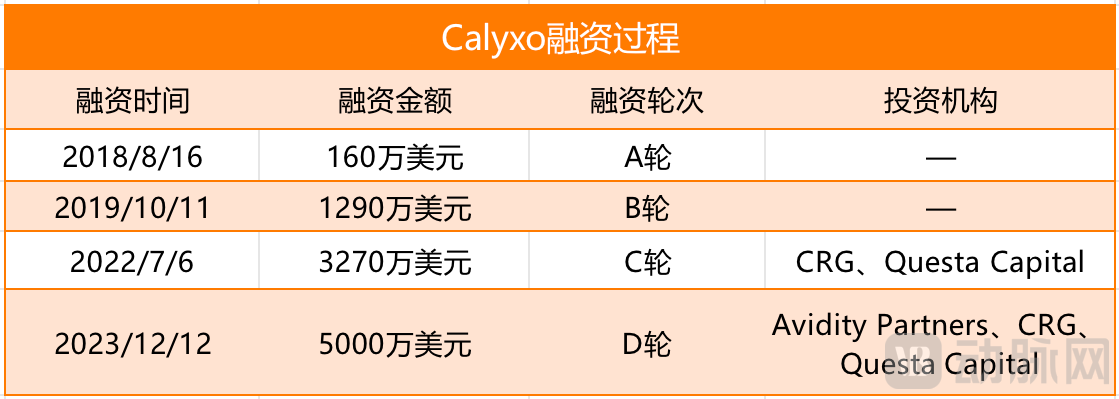
Calyxo’s Financing Process | Produced by VCBeat
Stone clearance rate is only 55%-60%
Urgent Need to Upgrade Traditional Technologies
In recent years, surgical procedures have shown a trend toward minimally invasive techniques. Among these, minimally invasive surgeries such as ureteroscopic lithotripsy and percutaneous nephrolithotomy have become the preferred methods for treating stones.
Flexible ureteroscopic lithotripsy, also known as RIRS, is a minimally invasive procedure with rapid recovery. The physician simply inserts a flexible scope approximately 3 mm in diameter through the urethra into the bladder, advances it into the ureter, and navigates up to the kidney to locate the stones, which are then fragmented using laser energy. However, the stone-free rate (SFR: percentage of stone volume removed) for this procedure is typically 55%–60%, and the clearance rate decreases as the size of the renal calculi increases.
Therefore, for large kidney stones, particularly those larger than 20 mm, the clinically recommended treatment is Percutaneous Nephrolithotomy (PCNL). PCNL is a minimally invasive surgical procedure that utilizes B-mode ultrasound guidance to direct a puncture needle through the lumbar skin into the kidney. By establishing an operative tract from the skin to the kidney, surgical instruments and lithotripsy devices are inserted to fragment the renal calculi. PCNL has minimal impact on the kidney and surrounding structures, and does not compromise future renal surgeries.
It is worth noting that while the two aforementioned lithotripsy techniques are effective in treating kidney stones, they fail to completely remove stone fragments. Due to gravity during the procedure, fragmented particles tend to settle in the dependent posterior calyces. Residual stone fragments can cause pain, infection, stone recurrence, and emergency department visits; in severe cases, they may necessitate repeat surgery, where retrieval is challenging and requires the use of auxiliary stone baskets or high-pressure irrigation for extraction or flushing.
Furthermore,Not all patients are suitable for PCNL.. If ureteroscopy is to be performed, many patients require more than one procedure. The complex anatomy of patients also poses technical challenges for percutaneous nephrolithotomy (PCNL), increasing the likelihood of poor postoperative outcomes. Although ureteroscopy is already a common and well-established surgical technique, more advanced technologies are still needed to improve patient prognosis.
FDA 510(k) Cleared
The CVAC system can aspirate stone fragments as small as 2.5 mm.
Steerable Ureteroscopic Renal Evacuation (SURE) is a novel minimally invasive technique for the treatment of urinary stones.During the SURE procedure, the CVAC aspiration system developed by Calyxo is required to perform controlled ureteroscopic renal evacuation.
CVAC is a novel steerable catheter system featuring dedicated irrigation and vacuum lumens, designed for the removal of kidney stone fragments. Intraoperatively, the application of this device enables physicians to extract multiple stone fragments within just a few seconds. This system not only ensures that stone removal procedures are performed efficiently and easily, but also achieves a stone clearance rate as high as 96.1%.
Specifically, after laser lithotripsy, the physician simply removes the ureteroscope and allows the CVAC system to advance over a guidewire into the kidney through a 12/14F ureteral access sheath under fluoroscopic guidance. By applying suction to the renal collecting system under fluoroscopic guidance, small stone fragments measuring 2.5 mm can be aspirated through the 7.5F inner vacuum lumen.
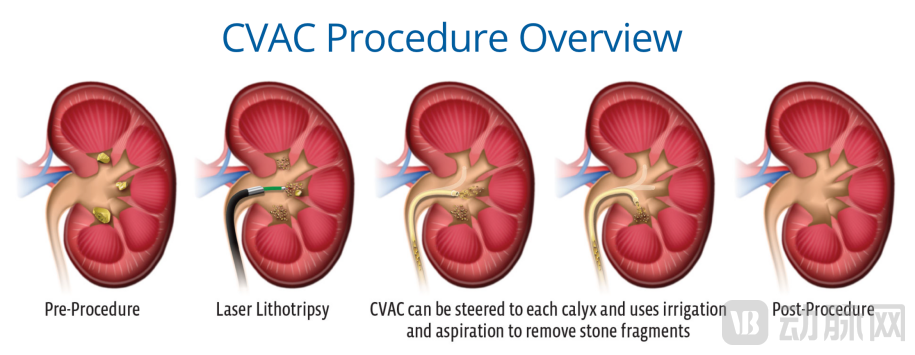
Schematic Diagram of the CVAC System Operation. Image Source: Calyxo
CVAC has previously been demonstrated to be safe and feasible in patients with a stone burden of <15 mm.
In 2022, a study published by Calyxo in *The Journal of Endourology* confirmed the safety and feasibility of the CVAC aspiration system. Compared with traditional stone removal surgery, the CVAC aspiration system clears more kidney stones.
Based on this study, Calyxo published “Steerable Ureteroscopic Renal Evacuation (SURE) for Large Renal Stones: A Multi-Institutional Center Study” on November 14, 2023. The article has been published in the Journal of Endourology.
This study enrolled 43 patients with large renal calculi. The results demonstrated that the SURE system, utilizing the CVAC aspiration technology, cleared nearly all renal stones in a single procedure; in terms of average patient surgical outcomes,SFRs reached as high as 96.1%, 90% of patients who would have originally required two or more surgeries were successfully treated with a single SURE procedure.
For patients with a large stone burden, particularly those at high risk for percutaneous nephrolithotomy (PCNL) or who prefer minimally invasive procedures, the SURE procedure combined with the CVAC system is an excellent option.
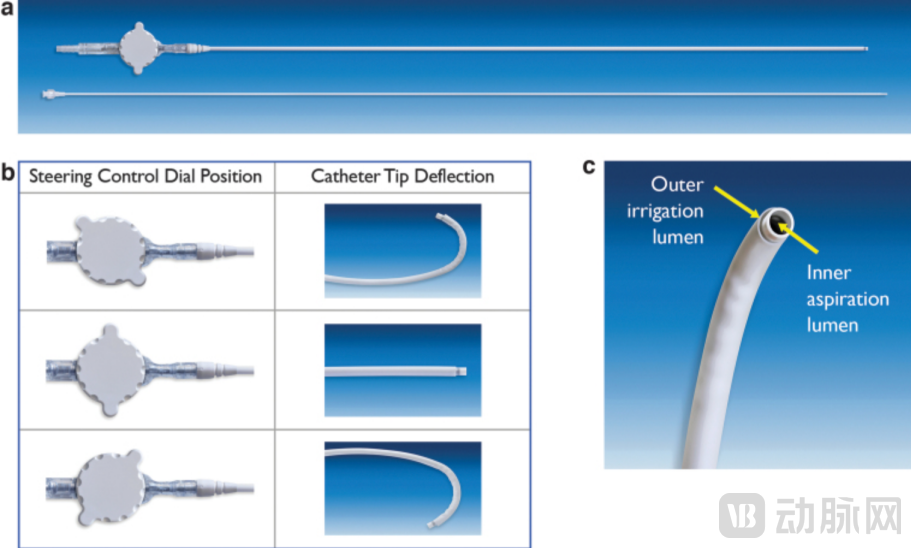
(a) CVAC aspiration catheter and introducer; (b) The CVAC aspiration catheter steering control knob enables tip deflection; (c) The distal tip of the CVAC catheter features a dual-lumen design. Image source: Calyxo
Furthermore, this technology has been successfully applied in the United States to treat more than 1,300 patients.FDA 510(k) Cleared. Currently, Calyxo is accelerating the commercialization of the CVAC aspiration system.
Leveraging its team’s profound medical expertise, Calyxo has achieved significant milestones in the development of kidney stone treatment products.
Joe Catanese is the current CEO of Calyxo and holds a Ph.D. in Bioengineering from the University of California, Berkeley, and the University of California, San Francisco. Mr. Catanese has previously conducted research in urology and holds multiple patents related to urological treatments, including those for benign prostatic hyperplasia (BPH).
Joe Catanese, co-founder of NeoTract, developed the UroLift System at the company to treat lower urinary tract symptoms (LUTS) caused by benign prostatic hyperplasia (BPH). The system has received FDA clearance and has helped more than 200,000 patients to date. NeoTract was successfully acquired by Teleflex in 2017 for over $1 billion.
Calyxo founder Jee Shin also boasts an impressive track record. Currently serving as Calyxo’s Chief Business Officer, Jee Shin graduated from the University of Washington and Stanford Graduate School of Business. He began his career in 1998 and now has over 25 years of experience in the healthcare sector. Prior to founding Calyxo, he worked in the healthcare corporate arena for more than 12 years and invested in multiple innovative medical device and biopharmaceutical companies.
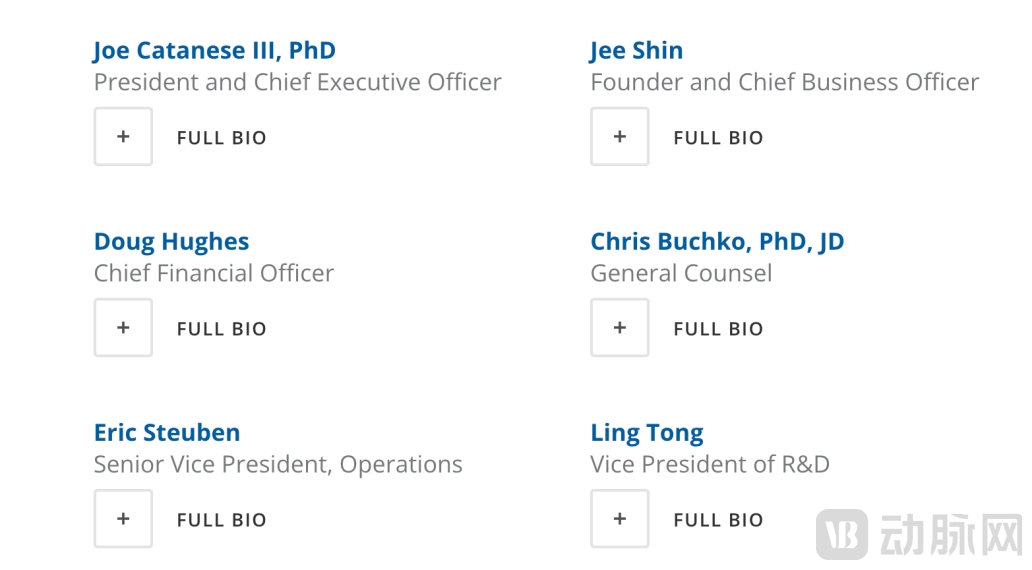
Key Team Members. Image source: Calyxo
Regionally, the United States holds the largest share of the lithotripsy devices market, driven by high adoption rates and strong demand for advanced technologies among healthcare professionals. Europe ranks as the second-largest market in terms of share. Meanwhile, the Asia-Pacific (APAC) region is the fastest-growing market and is projected to dominate the market by 2023.
As one of the three countries with the highest prevalence of urinary stones globally, China still primarily relies on surgical interventions for the treatment of kidney stones. In the niche segment focused on the clearance of stone fragments, although few domestic companies have made significant strategic investments, some have achieved breakthroughs.
Taking Yiweite, a company specializing in minimally invasive treatment of urinary stones, as an example, it has launched an intelligent pressure-controlled stone clearance system. By integrating precise computer algorithms, the system is used in conjunction with ureteroscopes and lithotripsy equipment during holmium laser lithotripsy and stone extraction procedures. Currently, the company’s sales have reached the tens of millions of yuan, providing innovative solutions for the domestic market.
It is believed that with the advancement of China’s medical standards and the enhancement of R&D capabilities among domestic manufacturers, the lithotripsy device market in China will experience rapid growth. This will lead to the emergence of more innovative products and services that meet the needs of diverse patient populations, ultimately improving both the prevalence and cure rates of urinary stones.