

Chinese Biotechs Step onto the Global Stage at J.P. Morgan Healthcare Conference
The JPM Conference has once again concluded in San Francisco. As a widely recognized flagship event for the biopharmaceutical and healthcare industry, and the world’s largest gathering for medical investment and industrial collaboration, it draws an immense volume of information within just a few days. These developments are analyzed and debated as stakeholders seek out valuable signals. Beyond the tightly scheduled conference sessions, peripheral social events serve as crucial venues for networking, dialogue, and forging potential partnerships.
“This year, the contingent attending the JPM Conference from China has become significantly more diversified. In previous years, attendees were mostly familiar faces—established pharmaceutical companies and a fixed group of biotech firms. However, this year, perhaps spurred by the surge in large-scale deals, there was a noticeable increase in the number of biotech companies on site, particularly those with strong innovative capabilities,” said Jiang Xiaoyang, Partner at Yafa Capital. Each year, this firm, which specializes in business development (BD) transactions, mergers and acquisitions, and investments in the pharmaceutical sector, hosts the “ACCESS CHINA” roadshow and reception dinner during the JPM Conference, providing pharmaceutical companies seeking licensing opportunities with face-to-face engagement with overseas partners.
“Another trend is the growing number of investors from various funds. In the past, domestic investment firms often considered the JPM Conference to have little relevance to their investment activities; however, this year many investors are willing to attend to help their portfolio companies explore opportunities for international collaboration.”
Rather than seeking fundraising leads and investment opportunities during the JPM conference, funds are more primarily focused on identifying exit opportunities for their portfolio companies. In the current climate of narrowing IPO exit pathways, the strategies and preferences of multinational corporation (MNC) buyers warrant careful study. Well-timed, significant business development (BD) collaborations, or even potential acquisition interests, will continue to bring prestige to biotech firms and China’s innovative pharmaceutical industry. Some investors began seeking “connections” one to two weeks before the conference, hoping to quickly join core discussions upon arriving in San Francisco, much like they would seamlessly navigate the Consumer Electronics Show (CES).
MNCs, of course, will not miss this opportunity, using it to outline their future key investment areas and showcase differentiated expansion strategies. For example, Eli Lilly’s CEO David Ricks stated that Eli Lilly does not merely acquire assets; rather, it brings innovative talent and creative R&D thinking into the company. Notably, including Point Pharma, the nuclear medicine company announced for acquisition last year, Eli Lilly has retained the original management teams for many of the biotech firms it has acquired.
As the glory of Biotech meets the expansion dreams of MNCs, a new game in the 2024 biopharmaceutical market has begun.

JPM 2024 Venue. Image source: DeepInsight MedTech, one of the active participating companies at the JPM Conference, invited annually. DeepInsight MedTech has collaborated with Avid (a subsidiary of Eli Lilly), Telix, and numerous domestic and international radiopharmaceutical manufacturers on multiple projects involving clinical enhancement and AI processing of radiopharmaceuticals.
Chinese Biotech Has Taken Its Seat at the Table
Deal announcements made during the JPM Conference can be regarded as key bellwethers and barometers for the industry. Last year’s JPM Conference kicked off with AstraZeneca’s $1.8 billion acquisition of Cincor and Ipsen Pharma’s $950 million acquisition of Albireo, which were seen as signals of a resurgence in cross-border M&A. Throughout 2023, biopharmaceutical M&A activity remained robust, with the number of large-scale deals exceeding $5 billion reaching a new high.
M&A and business development (BD) activities were more frequent and their trends clearer during this year’s conference. Key therapeutic areas focused on antibody–drug conjugates (ADCs) and immunotherapy, while enabling technologies included small nucleic acids, cell and gene therapy (CGT), as well as artificial intelligence and machine learning, all pointing the way for future industry development.
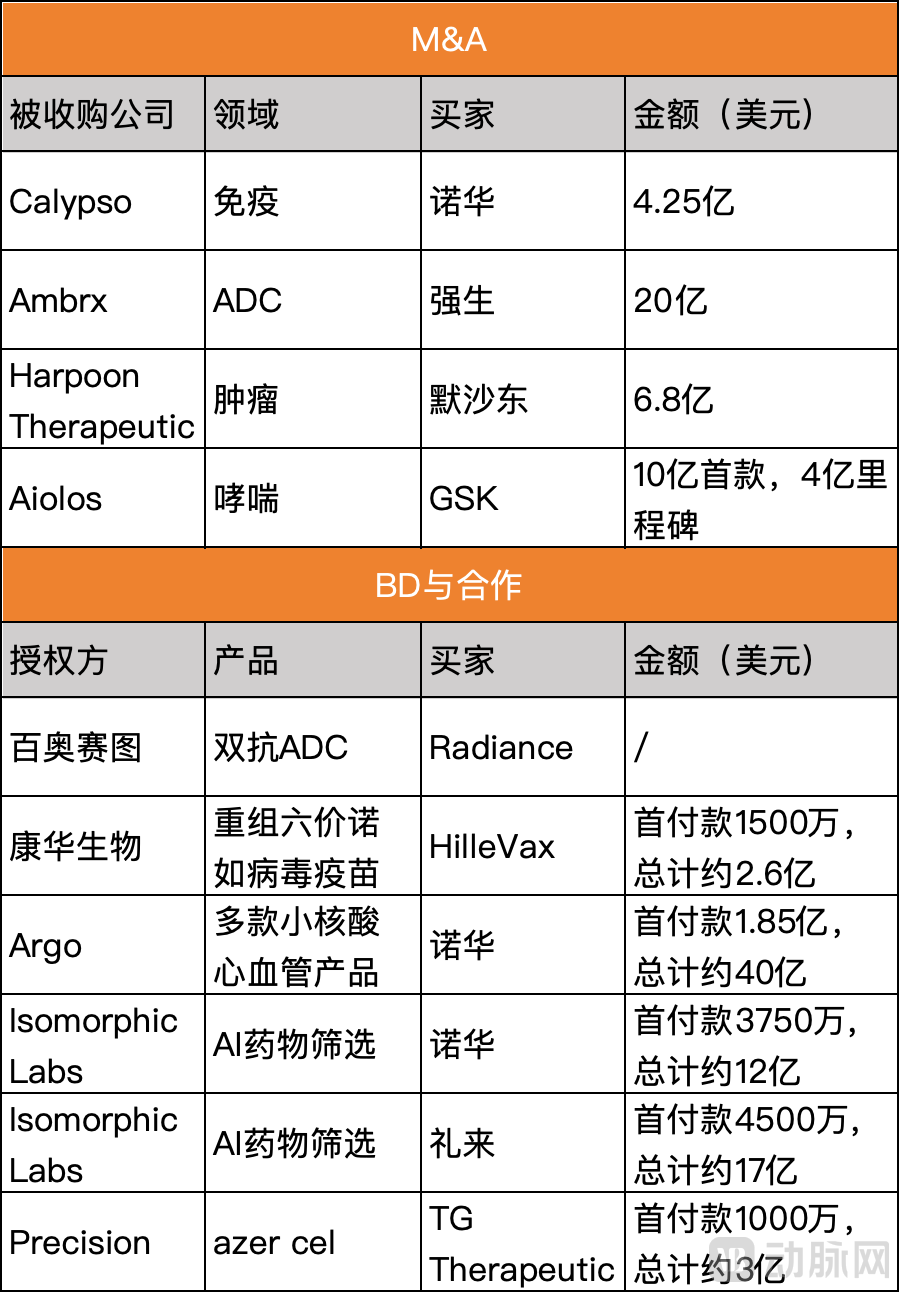
Transactions and Partnerships Announced During JPM 2024
Unlike their role as sideline observers in previous years, Chinese biotech companies gradually stepped into the spotlight at JPM 2024.Just one day before the conference, Bowang Pharma announced that it would license multiple cardiovascular products to Novartis, with an estimated total value exceeding $4 billion. The company, founded less than three years ago, has completed the first overseas licensing deal in the field of small nucleic acid therapeutics by a Chinese biotech firm.
In M&A transactions, the presence of Chinese companies is also evident; Aiolos, whose core product originates from Hengrui, was acquired by GSK for an upfront payment of $1 billion and milestone payments of $400 million.
“MNCs are placing increasing importance on Chinese pharmaceutical companies. In 2021, only about 20% of licensing-out deals by Chinese companies were with MNCs; this figure rose to approximately 40% in 2022. In 2023, the proportion exceeded 50%, with nine of the top ten largest deals being struck with MNCs.”Jiang Xiaoyang believes that MNCs are becoming the main players in the international trading market for Chinese pharmaceutical companies.
Amid the capital winter, China’s biopharmaceutical industry has undergone profound structural adjustments. Pharmaceutical companies are actively or passively pursuing original, differentiated innovative drugs with global intellectual property rights and competitive potential, making these products key targets for multinational corporations (MNCs) seeking high-quality assets. This is why many Chinese pharmaceutical companies’ business development (BD) teams travel to the JPM Conference, spending their days networking on-site and returning online late at night to coordinate with domestic teams, exploring new possibilities for the coming year’s business.
However, for Chinese biotech companies attending the JPM conference for the first time, lack of experience may affect the effectiveness of their participation.
“The greatest advantage of JPM is that it brings companies from around the world together in the same place at the same time. While the large crowd may seem to offer abundant opportunities, adopting a casual, hit-or-miss approach is unlikely to yield significant results. By setting clear targets and communicating in advance to schedule meetings ahead of time, you can maximize efficiency; on a tightly packed day, it is possible to meet with five or six companies.”
Dr. Zhang Fabao, founder of MedSci, summarized from the JPM Conference that the core competitiveness of biotech companies has shifted from technology itself to strategic vision and fundraising capabilities. The preparatory work involved in scheduling meetings with potential partners is clearly part of this equation. As Chinese innovative drugs transition from late-stage fast-follow assets to earlier-stage, differentiated innovations, and from a sole focus on products to equal emphasis on both products and technology platforms, it signifies that Chinese biotech firms must fully engage in this high-stakes game, leveraging their resources to secure greater returns and deepen their integration into the global landscape of innovative medicines.
Seeing Through the MNCs’ “Open Cards”
“In presentations and communications between biotech firms and multinational corporations (MNCs), the most critical factor is understanding the counterparty’s needs, identifying which types of companies are a good fit for your assets, and then accordingly demonstrating your technological capabilities and the superiority of your data,” said Jiang Xiaoyang. He believes that clearly recognizing the strengths of one’s own transactional assets, as well as determining what types and regions of partners can be attracted, is key to participating in the globalization of innovative drugs.
The annual JPMorgan Healthcare Conference is an ideal opportunity to gain insight into the strategic plans of various multinational corporations (MNCs). Some companies present strategies that are even clearer than those disclosed in their financial reports or investor days. This year, MNCs have provided more detailed introductions to their business development directions. Actions or plans announced by some MNCs include:
AstraZeneca:To rank among the top three in five key therapeutic areas: oncology, rare diseases, vaccines and immunology, respiratory and immunology, and cardiovascular and metabolic diseases; to maintain an open business development (BD) strategy, continuously enriching the pipeline through joint ventures, licensing, and acquisitions; and to achieve “industry-leading growth” by 2030.
Eli Lilly:Lilly has vigorously strengthened external innovation through mergers and acquisitions (M&A) and collaborations, which focus not only on assets but also on the comprehensive value of talent, expertise, and strategy. Its venture capital arm, Lilly Ventures, invests in start-ups, with a particular emphasis on innovative companies in the nucleic acid therapy sector. In potential M&A transactions, Lilly will also prioritize assets in this high-potential area.
Novartis:Aggressively develop three major innovative technology platforms: in the field of radiopharmaceuticals, leverage acquired RDC technology to further expand competitive advantages; in the oligonucleotide sector, invest in and collaborate on emerging technologies such as RNAi and ASO; in the CAR-T domain, optimize existing products and seek new breakthroughs. Continue to consolidate strengths in oncology, cardiovascular diseases, the immune system, and nephrology. Temporarily refrain from entering the ADC field.
Novo Nordisk:Continue to expand business in the GLP-1 sector and increase production capacity to meet market demand; explore emerging therapeutic areas such as cardiovascular diseases and rare diseases; advance the research and development of next-generation innovative drugs, such as the Phase III trials of CagriSema; achieve business expansion through mergers and acquisitions to identify long-term growth drivers
Merck & Co.:In the near term, we will closely monitor and strategically prioritize the ADC field; consolidate our strengths in oncology and vaccines, while emphasizing expansion beyond oncology and Keytruda, with a particular focus on cardiometabolic drugs and immunology; and seek out disruptive, first-in-class novel therapeutics to maintain our leadership position in the global pharmaceutical industry.
GSK:Continuing strategic acquisitions, with further target identification following the Aiolos Bio deal; reinforcing core strengths in oncology, respiratory diseases, and vaccines; given that several recent transactions have involved Chinese companies, we will continue to monitor and strategically deploy capital around China’s innovative resources.
Pfizer:Following the acquisition of Seagen, large-scale M&A has been paused in favor of flexible business development (BD) to drive innovation; non-core assets have been divested to focus on high-growth areas, with increased investment in the weight-loss sector; close monitoring of the ADC pipeline continues, alongside sustained emphasis on advancing oncology.
MNCs Lay Their Cards on the Table at JPM: In the New Round of Competitive Reshuffling Among MNCs, There Is Strong Demand for Biotech Firms to Infuse Innovative Pipelines; While Specific Preferences Vary Across Companies, Focus Areas Are Primarily Oncology, Immunology, and Metabolism; Early- to Mid-Stage Asset Transactions Offer Greater Flexibility and Convenience Compared with Commercialized Products, Provided They Possess Sufficient First-in-Class Competitiveness.
However, it remains clear that the driving force behind MNCs’ mergers and acquisitions and external collaborations is still the current market’s low valuations.
In this regard, an investor told VCBeat, “M&A peaks tend to occur simultaneously during both the upswing and downturn phases of an industry. During the upswing, market conditions are relatively loose, financing costs in the capital markets are low, and participants in M&A activities are diverse, with companies of all sizes engaging in consolidation. In contrast, during downturns, the primary participants are large-scale companies with strong financial resources, which pursue acquisitions to build project pipelines and achieve economies of scale. Therefore, the current M&A landscape aligns more closely with the characteristics of downturn-driven M&A, suggesting that the biopharmaceutical market may still be in a bottoming-out and recovery phase.”
“The recovery of the biopharmaceutical market will take time. While biotech companies have more options this year, only a few can enjoy the M&A and BD frenzy.”
Although a clear turning point has yet to emerge, expectations for an improvement in the U.S. biopharmaceutical market have risen amid potential interest rate cuts in 2024, with the enthusiastic atmosphere at the JPM Conference spilling over into the secondary market. On the first day of JPM 2024, the XBI Biotechnology Index closed up 5%, posting a gain of over 2% for the entire conference period; by contrast, the XBI’s average return during the JPM Conference over the past decade was only 0.76%.
On the final day of JPM 2024, the skies cleared in San Francisco, suggesting that the gloom hanging over the biopharmaceutical market may also be poised to dissipate.