

Chinese Pharma Companies Flock to Singapore: Less Competition, But Profitability Remains Elusive
CMS
Professional Drug Developer
The “double involution” of pricing and products, compounded by specific economic cycles, has gradually eroded the logic of achieving scalable profitability through a single product in a single region. By the end of 2023, going global had become an imperative for many domestic innovative pharmaceutical companies.
Mature markets, led by Europe and the United States, have always been the primary destination for Chinese innovative drugs seeking overseas expansion. According to statistics from PharmaCube, both the number and total value of license-out deals for Chinese innovative drugs reached record highs in 2023, with nearly 70 transactions and a disclosed total value exceeding $35 billion, the vast majority of which were directed at these two major markets.
Overseas destinations may shift in the new year. Bulk market access in mature markets indicates that many domestic innovative pharmaceutical companies now possess the capabilities and experience to navigate international markets, expand into non-tier-one markets, avoid intense competition, and identify new growth opportunities.
On the road to the finish line, Singapore has become a convergence point for numerous biotech and biopharma companies.
Having set up shop in Singapore, the natural focus is on the Southeast Asian market.
According to relevant United Nations statistics, Southeast Asia had a population of approximately 680 million in 2022, nearly half that of China, with an aging rate of 6.7%, approaching the WHO’s critical threshold of 7%. Many institutions compare the level of pharmaceutical and medical development in Southeast Asia to that of China in the early 21st century. If estimated based on China’s per capita healthcare expenditure in major urban areas in 2000, the market size there would be at least $200 billion.
Although the market scale falls far short of that in Europe and the United States, it has the advantage of avoiding hypercompetition. Furthermore, with Indian generic drugs prevalent in Southeast Asia, Chinese pharmaceutical companies hold a quality edge, positioning them to deliver a disruptive competitive strike.
As the only developed country in Southeast Asia, Singapore is the optimal choice for both domestic and international pharmaceutical companies seeking to enter this market. Its advantages lie not only in its strategic location within a three-hour flight radius of Southeast Asia, but also in the presence of more than 20 global pharmaceutical giants, including GlaxoSmithKline, Merck & Co., AbbVie, Novartis, Pfizer, and Roche, solidifying its position as the undisputed hub for innovative medicine in Southeast Asia.
For the many domestic biotech companies seeking to rapidly generate cash flow through license-out deals, Singapore’s geographic location, high density of multinational corporations (MNCs), and language advantages enable management to easily oversee R&D and transactions for both domestic and overseas subsidiaries, while also facilitating communication with multiple global pharmaceutical companies at a controllable cost.
If pharmaceutical companies wish to actively enter the sales market, Singapore is also an excellent transit hub.
Li Keying, CEO of Rxilient and Vice Chairman of PharmaGend, stated in an interview that innovative drugs and biosimilars from China can capture a share of the high-end pharmaceutical market from multinational corporations (MNCs) by building brands through academic promotion, enhancing physician awareness, and leveraging pricing advantages.
However, the 11 countries of Southeast Asia are scattered across the Pacific and Indian Oceans, each with its own language, national culture, and religious beliefs, as well as differing NDA regulations and processes. Under these circumstances, establishing a firm foothold in Southeast Asia inevitably requires frequent visits to target markets for on-site assessments. Therefore, setting up a regional hub in Singapore is significantly more cost-effective than operating from China.
Witnessing the surge in life sciences, Singapore is actively embracing overseas demand and aggressively attracting investment in biotechnology.
It is reported that Singapore invests approximately S$1.5 billion (equivalent to about RMB 8 billion) annually in biomedical research and development, directing funds toward core research in frontier technology areas. An additional S$3.7 billion (equivalent to about RMB 20 billion) has been allocated for the construction of R&D infrastructure. Biopharmaceutical companies establishing international or regional headquarters in Singapore can enjoy a preferential corporate tax rate as low as 15%. Furthermore, qualifying capital expenditures incurred for the construction, renovation, or expansion of eligible buildings or structures are eligible for an initial 25% tax allowance, followed by an annual 5% tax allowance thereafter.
In terms of the ecosystem, Singapore has also established multiple diversified collaboration platforms. These platforms aim to facilitate efficient communication among key stakeholders in the innovation ecosystem—including multinational corporations, local enterprises, research institutions, and government agencies—by addressing their targeted needs in core areas such as technology R&D, research team formation, financial support, and business cooperation.
When attracting biomedical enterprises, Singapore shows a stronger preference for innovative biotech firms over biological manufacturing. This is because Singapore’s limited national scale and land area make it economically unviable to replicate large-scale biotechnology hubs with complete pharmaceutical supply chains, such as Geneva or Boston. Consequently, Singapore prioritizes securing the sources of innovation to create greater value per unit of land. This strategy has become an advantage for Chinese biomedical companies establishing their presence in Singapore.
In terms of talent, Singapore launched the “Life Sciences Manpower Development Plan” at the turn of the century, focusing primarily on three horizontal dimensions: first, continuing its “foreign talent policy” to recruit top-tier global experts in the life sciences; second, leveraging local premier universities such as the National University of Singapore and Nanyang Technological University to specially cultivate R&D professionals in the medical field; and third, collaborating with pharmaceutical companies to directionally train a cohort of emerging R&D talents based on corporate research and development needs.
To date, Singapore has established more than 30 large-scale innovation research hubs conducting cutting-edge research in fields such as clinical science, genomics, bioengineering, cell biology, pharmaceutical biology, bioimaging, and immunology, with annual commercialization revenues exceeding USD 30 billion.
Overall, the expansion of Chinese biopharmaceutical companies into Singapore represents a mutually beneficial partnership. Rather than engaging in relentless domestic competition over drug targets, these companies can leverage Singapore as a gateway to tap into the Southeast Asian market and seek new growth opportunities.
Looking back at the ten-year journey of Chinese healthcare companies expanding into Southeast Asia, Yitu Technology and its underlying artificial intelligence established an office in Singapore as early as 2018, leveraging the city-state’s regional advantages to enter markets such as Malaysia, Thailand, and Indonesia. In the same year, WeDoctor signed an agreement with Fullerton Healthcare, a comprehensive health solutions provider in the Asia-Pacific region, spearheading the overseas expansion of internet-based healthcare services.
Compared to medical technology, the pace of innovative drug development is slightly slower, primarily due to bottlenecks in product registration regulations. The Southeast Asian market is large yet fragmented, with each country having its own registration regulations; the only commonality lies in their alignment with the content and format requirements of European and American regulatory approvals.
Therefore, for Chinese pharmaceutical companies to capture the Southeast Asian market, they must either establish local entities in each country and collaborate with local Marketing Authorization (MA) holders to secure regulatory approval, or first penetrate the European and American markets and then leverage existing FDA and EMA approvals to directly file for a New Drug Application (NDA).
Neither of these two paths has proven viable in the past. The former entails high costs, long timelines, and inherent risks in collaboration; the latter demands robust R&D capabilities, with few biotech companies able to secure overseas market access approvals.
However, license-out deals have become the norm for Chinese pharmaceutical companies. They can leverage existing regulatory review opinions to achieve registration with relative ease, bypassing the need for new clinical trials. Furthermore, after obtaining approval for a single marketing authorization, they can file for new indications by conducting bridge studies involving only a few dozen cases. This is particularly true for generic drugs: companies that have succeeded in centralized volume-based procurement have already established significant cost and scale advantages, enabling them to outperform many Indian pharmaceutical firms in Southeast Asian markets through superior quality and supply chain capabilities.
Furthermore, the deepening economic cooperation within ASEAN in recent years, coupled with the determination of member states to upgrade their pharmaceutical industries, has further lowered the barriers for Chinese companies expanding overseas. For instance, Innovent Biologics’ Byvasda® received ASEAN certification in 2022, signaling a shift in ASEAN’s attitude toward China’s innovative drug industry.
With favorable timing, geographic advantages, and strong human resources all in place, a large number of enterprises have assessed the situation and already implemented bold, strategic layouts.
To sell pharmaceutical products in Southeast Asia, the most direct approach is to establish manufacturing facilities, specifically locating production operations in Singapore. This is particularly feasible for large biopharmaceutical companies that already have a global presence and mature operational systems, as they can readily replicate their existing production models.
Since 2020, leading Chinese biopharmaceutical companies, including Sinopharm, Sinovac Biotech, GenScript, and WuXi Biologics, have successively established manufacturing facilities in Singapore.
GenScript’s regional headquarters for life sciences in Singapore, established in 2020, primarily serves customers in the Asia-Pacific region outside of China. In February 2022, GenScript Biotech’s production and R&D facility in Singapore officially commenced operations. Less than a year after starting production, GenScript announced an expansion of its Singapore plant’s capacity to support cell and gene therapy research as well as vaccine development programs. According to the company’s fiscal year 2022 annual report, GenScript’s revenue in the Asia-Pacific region rose to USD 146 million.
Leading Chinese CXOs are somewhat reliant on overseas revenue and place significant emphasis on emerging markets in Southeast Asia. In June last year, WuXi Biologics increased its investment in Singapore by entering into a global strategic partnership with Morimatsu Pharmaduct, a wholly owned subsidiary of Japan’s Morimatsu Group, for the Singapore CRDMO service center project. Under this strategic collaboration, the two parties will focus on the modular construction of two key production facilities at WuXi Biologics’ Singapore CRDMO center, covering critical stages across the project lifecycle, including design, manufacturing, Factory Acceptance Testing (FAT), installation, commissioning, and validation.
Midstream biopharmaceutical companies are devoting greater effort to their global expansion strategies. In March 2023, Junshi Biosciences subscribed to newly issued shares of Excellmab, a wholly-owned subsidiary of Kanglianda Biotech, thereby acquiring a 40% equity stake. The company also plans to grant Excellmab exclusive licenses and other related rights for the development and commercialization of intravenous toripalimab in Thailand, Brunei, Cambodia, Indonesia, Laos, Malaysia, Myanmar, the Philippines, and Vietnam.
CMS Pharma, the parent company of Kanglianda Biotech, has its own strategic vision. In December 2023, CMS announced that it had completed the acquisition of a Singapore-based manufacturing facility through its wholly-owned subsidiary CMS MEDICAL VENTURE PTE. LTD. and its non-wholly-owned subsidiary Rxilient Health (Kanglianda Health), jointly with PharmaGend Global Medical Services Pte. Ltd. (“PharmaGend”), in which Pharmaron Holdings Co., Ltd. and Legend Capital are also shareholders. This acquisition aims to launch contract development and manufacturing organization (CDMO) services for formulated pharmaceutical products in Southeast Asia. The facility is located in the Tuas Biomedical Park in Singapore, covering an area of approximately 60,000 square meters, with nearly 30,000 square meters of developed production space.
From Kanglianda Health to PharmaGend, the “new globalization” overseas closed-loop of a Chinese pharmaceutical company is gradually taking shape: new drugs developed in China are formulated and manufactured in Singapore, then sold to global markets.
If establishing manufacturing facilities and making direct investments prove too costly, rapid international expansion through license-out models has become a third option for Chinese biopharmaceutical companies. Following the precedent set by Innovent Biologics, CTTQ Akeso has also made significant efforts, signing a collaboration and licensing agreement with Singapore-based Specialised Therapeutics. This agreement grants exclusive commercialization rights for its independently developed drug, Anike (PD-1 monoclonal antibody, penpulimab injection), in Australia, New Zealand, Papua New Guinea, and 11 Southeast Asian countries including Singapore and Malaysia. Reportedly, the total consideration for this partnership is approximately USD 73 million, and CTTQ Akeso will also receive a 15% royalty on net sales of Anike in the licensed territories.
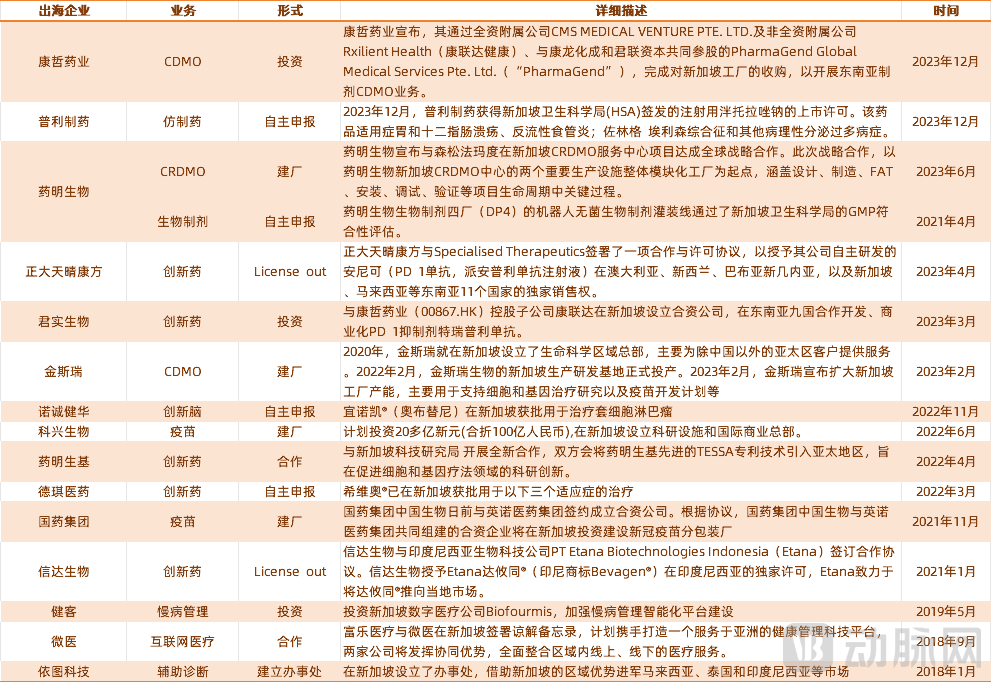
Export Models of Chinese Medical Enterprises
These three models constitute the mainstream of Chinese pharmaceutical companies’ global expansion, but they do not represent the entirety.
InnoCare Pharma’s core product, orelabrutinib, obtained Health Sciences Authority (HSA) approval in 2022; however, the company has not disclosed specific sales strategies. Poly Pharma secured HSA marketing authorization for pantoprazole sodium for injection in 2023, making 2024 a pivotal year for determining its approach to capturing overseas markets. Furthermore, numerous other enterprises are accelerating their international expansion efforts. Their emergence may introduce more diverse models, reshaping the global landscape of Chinese biopharmaceuticals.
Although the stance of Singapore and the situation of domestic biopharmaceutical companies continue to demonstrate the necessity of going global, in reality, Southeast Asia is not a perfect or easily accessible market.
First, Singapore is a place with high costs of living and land prices. The entire process of site selection, design, construction, and certification for building a new factory takes at least five years. Even large biopharmaceutical companies must carefully calculate the payback period to avoid the high costs associated with an extended construction cycle.
Second, although Southeast Asia has a large population, it is not wealthy. Similar to the situation in China, governments in various countries are attempting to strengthen control over healthcare expenditures; consequently, they prefer procuring low-cost generic drugs and disdain expensive innovative medicines.
In this context, the formulation of business development (BD) strategies is even more critical than during domestic market expansion. Given the differing economic trajectories and market positioning of Thailand and Malaysia, differentiating between the two markets in terms of demand, preferences, and purchasing power has become a key determinant in assessing the capabilities of Chinese biopharmaceutical companies and their partners.
Finally, many biotech firms suffer from low reputational standing and lack the brand prestige of companies like Novartis, Merck & Co., and GSK. With uncertain prospects, they struggle to attract high-caliber talent during recruitment. Even if a passable team is assembled, it remains challenging to integrate employees from diverse cultural backgrounds around the world into a cohesive unit with strong organizational alignment.
The solution to this challenge is to build localized teams by hiring local talent to handle local operations. When establishing such teams, some companies expanding overseas prioritize two types of candidates: first, employees from leading Southeast Asian enterprises such as Unilab, which possess strong regional DNA and whose staff have an in-depth understanding of the Southeast Asian market; second, professionals from multinational corporations operating in Southeast Asia, such as Novartis and Merck & Co., predominantly expatriates from countries like Singapore, who bring advantages in cross-cultural communication.
Compared to R&D, the myriad complexities arising from management and sales may pose even greater challenges for biotech companies. Consequently, Southeast Asia cannot yet be considered a profitable market.
However, as industries such as manufacturing and healthcare gradually take root, the industrial and consumer landscapes in Southeast Asia are becoming increasingly vibrant. These early movers expanding overseas may well secure a foothold first in this emerging market.