

Microsoft's Strategic Blueprint in Digital Health: Comprehensive Overview and Product Portfolio
With the booming development of internet healthcare, major tech giants have been actively moving to carve out their own territories, engaging in an intense “arms race.” In China, the tripartite standoff among Baidu, Alibaba, and Tencent (BAT) has led to ongoing battles in areas such as glucose meters, physician-facing apps, and medical payment systems. Abroad, Apple and Google have long been strategically positioning themselves: they have not only launched their respective health management platforms, HealthKit and Google Fit, but also developed proprietary hardware and applications while increasing investments in the healthcare sector to define their spheres of influence in internet healthcare. As the battlefield of internet healthcare becomes increasingly contentious, how could Microsoft, a longstanding industry giant, remain on the sidelines? VCBeat has compiled Microsoft’s key moves in the internet healthcare space in recent years to examine how the company is building its own foothold in this domain.
Microsoft Ventures Accelerator
In June 2013, Microsoft announced the consolidation of its venture capital support programs into a unified “Microsoft Ventures” initiative, aimed at providing startups with more in-depth and comprehensive entrepreneurial services. VCBeat has previously reported on companies participating in the Microsoft Accelerator program. (Click here for details)
Microsoft Ventures comprises three components: the Startup Community, the Incubator, and Customer Support. The Startup Community incorporates Microsoft’s BizSpark program, launched in 2008, providing startup teams with free or low-cost Microsoft software and other services. It also facilitates networking among entrepreneurs, helps them find partners, and offers a technical support platform. Microsoft’s Incubator maintains offices in multiple countries worldwide, including the United States, China, and Israel, offering 3–6 months of incubation support for entrepreneurs. The Customer Support service leverages Microsoft’s extensive global customer base to provide startups with essential customer channels, helping them build their own customer bases and promote and expand their brands.
In June last year, Microsoft announced a partnership with medical technology company Becton Dickinson (BD) to establish a new incubator focused on health and medical technology startups at its Microsoft Venture branch in Tel Aviv, Israel. This will be Microsoft’s only incubation hub dedicated exclusively to the medical technology sector.
Currently, Microsoft Ventures’ offices around the world have incubated many successful enterprises, including several startups in the healthcare sector. According to statistics from VCBeat, Microsoft Ventures’ global incubators have cumulatively incubated more than 200 startups, with over a dozen related to healthcare. The Microsoft Ventures Accelerator in China has held six cohorts to date, with more than 100 startups joining the accelerator. Among them, six companies are focused on healthcare and medical services, covering areas such as chronic disease management, health management, and maternal and child health.

Investment and M&A
Microsoft had already invested $250 million in the health information website WebMD as early as May 1999, marking its initial entry into the healthcare sector through mergers and acquisitions.
In 2006, Microsoft announced that, as part of a new strategic partnership with MedStar Health, a non-service healthcare institution, it would acquire Azyxxi, a medical database software developed by MedStar’s Washington Hospital Center. Following the acquisition, Microsoft planned to introduce Azyxxi to the global healthcare market. This marked Microsoft’s first entry into the health information technology sector.
In 2007, Steve Ballmer, then CEO of Microsoft, announced at a healthcare information conference held in New Orleans that Microsoft would acquire Medstory, a health information search engine company.
In 2009, Microsoft announced its acquisition of Sentillion, a software vendor specializing in the healthcare industry. The company planned to integrate Sentillion’s products with its Amalga UIS system, enabling healthcare professionals to more easily access various IT applications and patient data, thereby delivering improved medical care to patients.
Intelligent Wearable Devices
Microsoft is certainly not going to miss out on the fertile ground of smart wearable devices. As previously reported by VCBeat, Microsoft has developed bone-conduction headphones employing 3D soundscape technology for blind users, as well as a wristband called Alice Band designed for the blind and visually impaired community (Click here for the original text.). As for the hottest wearables on the market—fitness bands and smart glasses—Microsoft has successively launched its two most representative products, the Microsoft Band smart fitness tracker and the HoloLens holographic glasses, over the past two years.
Microsoft Band
As the market for smart bands and smart watches heats up, Microsoft has also jumped into the fray. In late October last year, Microsoft launched its own smart band product, the Microsoft Band. Equipped with 10 smart sensors, this band allows users to wear it 24/7, providing real-time monitoring of sleep, heart rate during exercise, calorie burn, and other metrics. By partnering with well-known gyms, it offers users personalized fitness plans to help them achieve their health goals. Additionally, the band provides at-a-glance insights into your health index through calendar notifications and email previews, and supports note-taking and schedule reminders via the Cortana voice assistant. Microsoft has priced the Microsoft Band at $199.
HoloLens
Google has suspended its Google Glass project, but Microsoft recently launched its own smart glasses product, HoloLens. In many respects, this cutting-edge device appears to be an upgraded version of Google Glass. In fact, HoloLens is a pair of holographic glasses with augmented reality capabilities. Unlike virtual reality smart glasses that create an entirely virtual world for users, HoloLens enhances the interaction between users and the real world.
Unlike Samsung’s previously released virtual reality glasses, which required pairing with a smartphone, the HoloLens is a fully standalone computer equipped with a CPU, a GPU, and a dedicated holographic processing unit. This head-mounted smart glass features a transparent display integrated into its dark visor and incorporates a spatial sound system, enabling users to both see and hear sounds from the surrounding holographic environment. The HoloLens can also track eye and hand movements, responding intelligently to these interactions.
Software and Data Platform
Microsoft Health
Apple has HealthKit, and Google has Google Fit. As one of the tech giants, how could Microsoft be content to lag behind? Thus, alongside the release of the Microsoft Band, Microsoft also launched its own health management platform, Microsoft Health.
Similar to Apple and Google, the Microsoft Health cloud service platform also focuses on storing and integrating health and fitness data for consumers and the industry. Consumers can access Microsoft Health through the Microsoft Health app, which is available for download on Android, iOS, and Windows Phone platforms.
Microsoft Health can integrate data collected from various health and fitness devices and store it securely in the cloud. Users can also compare and analyze data already stored on the Microsoft Health cloud platform with new data acquired from different devices. Metrics such as step count, calories burned, and heart rate are processed through Microsoft’s “Intelligence Engine” to derive valuable insights, such as which exercises burn the most calories, recommending appropriate recovery times based on exercise intensity, and suggesting optimal sleep durations. Furthermore, users can correlate workout information with time and location data. Based on the physical and health data uploaded by users, the “Intelligence Engine” within the Microsoft Health platform can formulate personalized exercise plans and provide daily lifestyle recommendations—for example, whether eating breakfast can improve running performance, or how the number of daytime meetings may affect sleep quality.
For developers of Microsoft Health, Microsoft has announced that it will provide a comprehensive suite of resources, including apps and open APIs, enabling them to upload data to the cloud and leverage Microsoft’s advanced algorithms and powerful “Intelligence Engine” to deliver commercialized recommendations.
Microsoft has already reached agreements with device and service providers including Jawbone UP, MapMyFitness, MyFitnessPal, and RunKeeper. In the future, it plans to offer options for users to share their data with healthcare providers through the connection between Microsoft Health and HealthVault.
HealthVault
In fact, as early as 2007, Microsoft launched HealthVault, a personal health management platform. On the HealthVault platform, users can maintain their health records online simply by registering for a personal health account. In addition to storing and exchanging personal health information, the platform enables health information searches, making “accessing medical assistance as convenient as withdrawing cash from an ATM.”
Unlike Microsoft Health, Microsoft places significant emphasis on the privacy and security of this platform. HealthVault is essentially a Personal Health Record (PHR) platform designed for individuals, functioning more like a secure vault for personal health information. Although HealthVault provides open interfaces that enable data exchange with third-party device manufacturers and insurance companies, users retain full control over what information they upload and to whom they grant access, thereby ensuring the security of their personal data.
Amalga UIS
Microsoft Amalga UIS is an information system specifically developed for healthcare professionals. Featuring data warehouse and web portal capabilities, it serves as a complement to business intelligence solutions in the healthcare industry, facilitating in-depth data mining and analysis. It addresses challenges that were previously difficult or prohibitively expensive to resolve, and presents data in diverse formats, thereby overcoming the limitations of many earlier business intelligence solutions.
Xbox Fitness
In September 2013, Microsoft launched the Xbox Fitness motion-sensing fitness service alongside the release of its next-generation gaming and entertainment console, the Xbox One.
Xbox Fitness focuses on gamified fitness. Leveraging Kinect’s motion-sensing technology, the Xbox Fitness service tracks workout quality by monitoring data such as heart rate and muscle strength, and dynamically adjusts training plans based on users’ past exercise history and results. To ensure workout quality and professionalism, Xbox Fitness incorporates instructional videos from renowned fitness brands, including P90X® (Tony Horton), INSANITY® (Shaun T), Jillian Michaels, and Tracy Anderson. Additionally, Xbox Fitness is integrated with Xbox Live, enabling users to boost their motivation through competition with friends. Currently, Xbox Fitness has surpassed 1.6 million users, and reports indicate that Microsoft plans to launch a mobile version.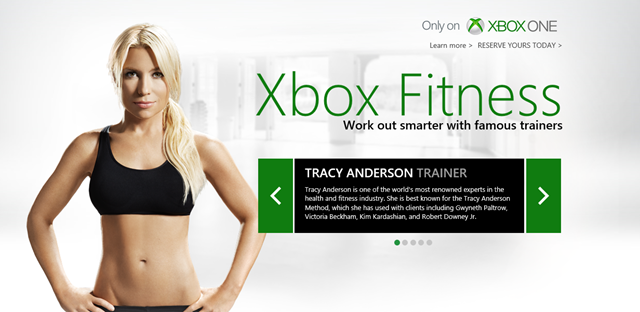
Microsoft has also launched an innovation accelerator specifically leveraging Kinect technology, encouraging startups to utilize this technology for entrepreneurial innovation. Healthcare startups such as GestSure and Jintronix from Canada, and Zebcare from the United States, have all adopted Kinect technology.
(For the latest updates on digital health entrepreneurship, please follow VCBeat’s WeChat official account: vcbeat. We also welcome you to engage with us on topics of interest, contact us via WeChat, and share your startup projects or research insights.)