

Most Health Insurers Lack Robust Companion Apps, New Report Reveals
Research2Guidance has recently released a report analyzing the mobile app offerings of 79 health insurance companies worldwide. According to the report, 70% of these insurers have launched only one or two companion apps, and among them, 67% have fewer than 100,000 downloads. VCBeat has compiled the key findings of this report to shed light on the shortcomings and underlying reasons in health insurers’ app development strategies.
Prior to this report, the company had already conducted research and investigation into the landscape of companion apps in the pharmaceutical industry (Click here for details), it was found that many pharmaceutical companies began developing apps at an early stage and have already launched numerous ones in the market; however, compared with apps released by other industries, those from the pharmaceutical sector lag far behind in both download volume and user engagement. For more information on pharmaceutical companies’ strategic deployments in the internet healthcare sector, please refer to “Analysis of the Internet Healthcare Layout by Pharmaceutical Giants from 2010 to 2014》
Similar to the aforementioned report on pharmaceutical apps, the analytics firm also categorized health insurance companies’ apps into four groups: those with above-average app downloads and app counts (“Active”), those with above-average app downloads but below-average app counts (“Initial Success”), those with below-average app downloads but above-average app counts (“Still Striving”), and those with below-average metrics in both aspects (“Hesitant”).
Seventy percent of health insurance companies have been categorized as “hesitant,” including Blue Shield of California in the United States and many other companies outside the U.S. Only 9% of companies fall into the “active” category, including Aetna and Humana.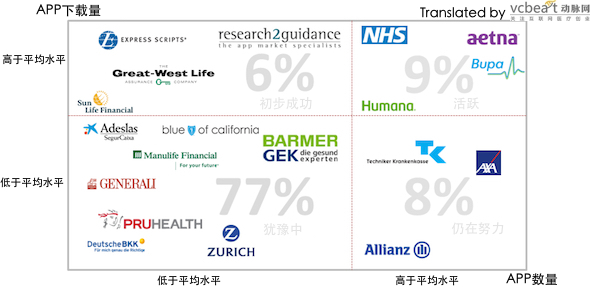
“Aetna stands out among numerous health insurance companies,” wrote Samuel Aylett, an analyst at Research2Guidance, in a blog post. “It has released 28 apps spanning both iOS and Android platforms, achieving over 140,000 downloads—significantly higher than all other health insurers. Although Aetna’s performance is impressive, 85% of its downloads come from just one of its many apps: iTriage. This pattern is not uncommon among health insurers that have achieved substantial download volumes. For instance, seven of the top ten health insurers derive more than 50% of their total app downloads from their flagship app.”
It is worth noting that iTriage was not developed by Aetna; it was created by a startup named Healthagen, which was later acquired by Aetna. Why do insurance companies relatively lack the capability to develop impactful apps? In response to this question, Research2Guidance proposed the following theory.
Analyst Aylett wrote: First, the app lacks six elements that the company considers best practices—“tracking and coaching, automatic data entry, remote consultations, secure use of internet medical data, integration of solutions into existing healthcare IT infrastructure, and aesthetically pleasing and user-friendly design.” He further concluded that few insurers leverage apps to link healthy behaviors with financial incentives, thereby missing a significant opportunity for cross-promoting their apps.
“Best practitioners of internet healthcare apps have achieved the mutual prosperity of their app portfolios through cross-promotion, such as ‘More Apps’ pages, pop-up ads, and push notifications,” Aylett wrote. “But health insurance companies have not yet managed to do this at all.”