

Top 15 Internist-Recommended Medical Apps File for IPO
After reviewing apps on both the iPhone and Android platforms, Douglas Maurer and Satish Misra from Johns Hopkins Hospital have curated a selection of internal medicine medical apps. The selection criteria were based not only on the practical experience of internists and family physicians but also on the comprehensive screening results by the iMedicalApps team. VCBeat has specially translated the recommended app list as follows. We believe that the apps on this list are unparalleled and of the greatest value to internists, physician assistants, nurse practitioners, and other clinicians.
The Best Medical Calculator: QxMD Calculate(Cost: Free)
How essential it is to install a reliable medical calculator on your smartphone! QxMD stands out as exceptionally professional and thorough, decisively outperforming its peers. For instance, when calculating the Wells score for patients with pleuritic chest pain or the PORT score for those with suspected bacterial pneumonia, QxMD makes the task effortless. The app offers comprehensive categorization of calculation tools, allowing users to browse by theme or alphabetical order, along with a familiar search engine interface. Most calculation methods include brief explanations and relevant references, many of which are further elaborated in another app, QxMD Read, accessible directly within the platform. For users with institutional credentials, full-text articles can be automatically downloaded. In summary, QxMD Calculator is an indispensable tool for internists and primary care physicians alike.
The Best Medical Literature App: QxMD Read(Cost: Free) andJournal Club(Cost: $4.99)
Clinicians read literature daily to acquire new knowledge. This is especially true for internists, who must continuously refine their skills through practice, underscoring the substantial breadth of knowledge required. We recommend two apps, QxMD Read and Journal Club, which differ significantly yet complement each other, making them excellent assistants for internists!
QxMD Read helps you organize and curate your favorite journals, making it convenient to browse each issue of medical publications such as JAMA, NEJM, and AAFP in one place. Users can access abstracts or PubMed links for every article, and those with institutional credentials can directly download full-text PDFs. Editors at iMedicalApps compared QxMD Read with other similar apps and found that Read holds a clear advantage in terms of operating speed, regulatory compliance, annotation features, and local storage, rightly earning it the top ranking, with Docphin App coming in a close second.
Journal Club is another essential tool that provides critical appraisal of all landmark medical research findings. Going beyond mere article abstracts or full texts, Journal Club explores the context and background of studies, examines key methodological factors, and discusses the evaluation of research outcomes. For instance, if you wish to search for novel oral anticoagulants for patients with deep vein thrombosis (DVT), you can select “DVT” in the software’s “Disease Zone,” which then allows you to browse relevant content, including information on drugs such as apixaban, low-molecular-weight heparin, and direct thrombin inhibitors.

Atlas Challenge App: JAMA Network Challenge(Cost: Free) andNEJM Image Challenge(Cost: $2.99)
The NEJM Image Challenge, which has been in operation for several years, offers an engaging and efficient way to learn about diseases. It presents any disease of interest through thumbnail images, accompanied by responses from physicians or NEJM editors as well as relevant pathological descriptions. However, its drawback is that it is only compatible with iPhones.
Recently, JAMA has been involved in the development of the JAMA Network Challenge app, which is compatible with both iOS and Android platforms. Its distinguishing feature is the timed, continuous rotation of images rather than a menu-based selection approach. The app also provides relevant pathological explanations that are more in-depth than those offered by the NEJM Image Challenge, along with a cleaner and more user-friendly interface. Furthermore, its software structure is more rigorous than that of the NEJM app, presenting five images at a time in a random yet sequential order. Indeed, JN Challenges stands out as the leading app in this field, fully deserving its reputation.

Encouragement Award: Figure 1(Cost: Free)
Another app worth noting, often referred to as “image sharing for physicians,” provides a large volume of user-submitted images and allows users to respond to and comment on each image, fostering an open-discussion atmosphere for disease diagnosis. A drawback is that submitters often post the answers in the comments, which may compromise the precision and quality of the information.
Cardiologist App: ACC Anticoag Evaluator(Cost: Free)and ASCVD Risk Estimator(Cost: Free)
Since most patients registered with internal medicine departments have cardiac issues, introducing two apps strongly recommended by the American College of Cardiology and the American Heart Association is an excellent resource for internists.
Atrial fibrillation is a common condition that frequently challenges internists. To address this, we recommend the ACC Anticoag Evaluator, which enables rapid and straightforward risk assessment for patients with atrial fibrillation by calculating their CHA₂DS₂-VASc and HAS-BLED scores. Its key advantage lies not only in estimating stroke risk but also in predicting bleeding probabilities under various medication regimens. Furthermore, it provides appropriate dosing recommendations for warfarin, aspirin, and several novel oral anticoagulants. This app is highly valuable for the initial evaluation of patients suspected of having atrial fibrillation, facilitating the discussion and formulation of anticoagulation treatment plans.
Unfortunately, it does not compare or comment on different treatment methods, but it remains a valuable medical tool for patients with occasional palpitations.
In 2013, the American College of Cardiology (ACC) and the American Heart Association (AHA) introduced a new treatment protocol for heart disease prevention, replacing the Framingham Risk Score with the Pooled Cohort Equations. This app rapidly calculates the 10-year risk index for atherosclerotic cardiovascular disease (ASCVD) and provides clinical guidance. Furthermore, it offers tailored background information for both physicians and patients, facilitating better physician explanation of the entire care process. It also includes evidence-based recommendations for lifestyle modifications. While many calculator apps can perform risk assessments, this app goes beyond mere calculation by conveniently helping internists quickly access and understand treatment guidelines.

Medical News App: MedPage Today(Cost: Free)
Nowadays, merely browsing the latest issues of authoritative journals such as NEJM and JAMA is insufficient for maintaining scientific leadership and staying current. Physicians must broaden their horizons and absorb a wider range of professional information. Major events that have impacted the medical community in recent years include the controversy surrounding the 2013 lipid management guidelines, the evolution of U.S. health insurance exchanges, and the re-certification process for physicians. This app effectively addresses this gap. With its clean and concise interface, it provides medical news written by senior medical journalists and rigorously reviewed by physicians. Users of this app also have the opportunity to earn national-level continuing medical education (CME) credits through a collaborative program with the Perelman School of Medicine at the University of Pennsylvania.
Encouragement Award: Medscape’s MedPulse(Cost: Free)
Recently, this field has welcomed a new addition—Medscape’s MedPulse. It covers a wide range of specialized medical news and related reports, as well as various medical news items curated from Medscape and other sources. In particular, the Clinical Commentary section provides valuable insights into clinical trials and new guideline recommendations. Additionally, its sleek design and seamless integration with Twitter for content sharing are quite impressive. The expert column section is also noteworthy, featuring contributions from renowned specialists such as Dr. Bob Harrington, Chief Medical Officer at Stanford Medicine, and Dr. Paul, an infectious disease expert at Johns Hopkins University. Overall, this app is well worth having.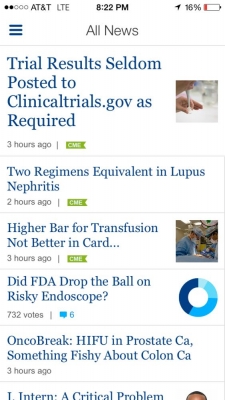

Comprehensive Medical References: UpToDate, Dynamed, and Medscape
For most of us, UpToDate is a medical application designed to help answer a wide range of clinical questions. It proves invaluable in various settings, including outpatient clinics, hospital wards, intensive care units (ICUs), ward rounds, and morning reports. Suitable for both individual practitioners and healthcare institutions, it is an exceptional comprehensive app.
To date, UpToDate is not the only tool for rapid information retrieval; three alternative options also provide medical references. Dynamed is particularly recommended. Although it does not offer as extensive information as UpToDate, it is the most evidence-based application. Learning from past experience, Dynamed has improved its previously poor user interface and launched its second version. Therefore, objectively speaking, Dynamed shows strong potential to surpass its competitors.
Notably, Medscape is a highly engaging app that integrates clinical references, drug guidance, news aggregation, and nationally accredited continuing medical education (CME), making it a comprehensive
A Loose Generalist. It is worth noting that many apps have offline collaborations with pharmaceutical manufacturers, so the entire app ecosystem can also be utilized in offline settings. Unfortunately, Medscape’s disease reference library is too limited, containing only 4,400 entries, which still lags significantly behind UpToDate’s 10,000 entries!

Medication Guide App: Epocrates(Premium Plan Fee: $159.99 per year), Lexi-Comp(Cost: $175 or $595 per year, depending on the version),Micromedex(Price: $2.99)
Epocrates has undergone significant improvements since its inception, while consistently maintaining its reputation as the most user-friendly and efficient platform. Subscribers to Epocrates Essentials Premium gain access to a suite of companion apps, including medical calculators, nursing care highlights, alternative drug information, infectious disease guidelines, and disease guidance resources developed in collaboration with The BMJ (British Medical Journal). Furthermore, although a free version is available, Epocrates maintains partnerships with pharmaceutical companies; thus, so-called “free” medical apps are not truly free.
To obtain the most comprehensive medication information, you must not miss Lexi-Comp. This application is not inexpensive, but many institutions provide free access, so it is advisable to consult with medical librarians or hospital pharmacists. The full version includes multiple integrated modules, such as Toxicology, Infectious Diseases, Natural Medicines, and 5-Minute Clinical Consult, among others.
Compared to the two aforementioned high-cost software options, Micromedex is more affordable and cost-effective. The app can be accessed through institutional subscriptions, subject to a modest annual fee. In terms of content quality, it rivals Lexicomp (formerly known as exi-Comp), particularly in its in-depth coverage of pharmacokinetics—a knowledge domain that Epocrates notably lacks.

Infectious Disease App: Johns Hopkins ABX Guide(Cost: $29.95)
Although the disease treatment content in this app is virtually identical to that in another app, Sanford Guide, as both draw from the Infectious Diseases Society of America (IDSA) guidelines, the former boasts a more aesthetically pleasing and well-organized user interface. Another advantage of Hopkins is its more comprehensive descriptions of diseases themselves, even covering topics such as antibodies and antiviral agents—specialized knowledge typically found only in pharmacy textbooks. These highly useful and frequently accessed pieces of information spare users the hassle of consulting specialized references.
Geriatrics App: Geriatrics at Your Fingertips(Cost: $19.99 per year)
The American Geriatrics Society has recently released several useful geriatric apps in recent years, but *Geriatrics at Your Fingertips* remains the most comprehensive and high-quality option. For elderly patients in China, it provides standardized data for various clinical indicators. Since the popular guidebook was first published in 1998, mobile apps have continuously emerged and evolved. Recently, Atmosphere Apps has taken the lead, with its newly released version being the most visually appealing and user-friendly. The app serves as a miniature textbook of geriatrics, featuring chapters on physical and mental health assessment in older adults, appropriate prescribing, dementia, and delirium. The appendix also includes convenient assessment tools. However, these assessment tools are merely literal translations and lack the utility of dedicated calculators. Although the app is updated annually, some of its recommendations are not synchronized with the latest literature or rely solely on expert opinion.
Dermatology Reference App: VisualDx(Cost: $199.99 or $299.99, depending on the version)
Although we can accept common skin conditions, such as sudden-onset rashes, they often serve as important clues to systemic diseases. This app allows users to search by keywords, browse images, review descriptions of symptoms or signs, and access treatment plans. Its most prominent feature is the ability to perform differential diagnoses; upon inputting common dermatological manifestations, physical examination findings, organ involvement, or medical history details, it rapidly generates diagnostic results. This is highly convenient and particularly valuable when a personal dermatology consultant is unavailable. While no other similar apps are as comprehensive, some serve as viable alternatives, such as DoctorDerm and The Color Atlas of Family Medicine.