Can 3D Printing Revolutionize Traditional Healthcare? Market Trends and Strategic Insights
A forecast report released by Gartner in October 2014 stated that the compound annual growth rate (CAGR) of 3D printer shipments from 2012 to 2018 would be 106.6%, while the revenue growth rate would reach 87.7%. By 2018, 3D printer shipments are projected to reach 2.3 million units, representing a market size of $13.4 billion. Can 3D printing truly disrupt the powerful traditional manufacturing industry? The answer is yes. VCBeat’s Internet Healthcare Research Institute has synthesized data from multiple sources to compile this trend analysis, providing a quick overview of the development status and key trends of 3D printing technology in the healthcare sector.
Although 3D printing cannot yet compete with large-scale traditional manufacturing in the short term, it is being applied to prototyping, assembling traditionally manufactured components, and directly producing highly customized or intricately crafted items with low production volumes.
As bottlenecks related to object volume and printing speed in 3D printing are gradually overcome, coupled with the declining cost of printing materials, 3D printing is gaining increasing popularity from an economic perspective. This trend is further driven by the continuous optimization of costs and processes across end-to-end product design, manufacturing, assembly, transportation, distribution, and operation. Consequently, consumers will increasingly choose products that incorporate 3D-printed components—or are entirely 3D-printed—spanning sectors from automobiles and aircraft to consumer electronics and kitchen appliances.
The application of 3D printing in the medical industry has begun with bone implants, teeth, and prosthetics.
The most exciting applications of 3D printing are in the healthcare industry, where it is used to save lives or alleviate patient suffering. According to forecasts by SmarTech Markets, shipments of 3D printers in the healthcare sector are projected to grow from 2,135 units in 2020 to 3,055 units in 2024. Although it will take several more years for medical 3D printing to achieve large-scale adoption, early-stage products and devices—such as tissues, organs, bones, and prosthetics—already offer a glimpse into the role this technology plays in improving patients’ quality of life.
Not long ago, SmarTech Markets issued forecasts on the growth trends of the 3D printing market across several major application sectors. As shown in the figure below, if the medical and separately listed dental segments are combined, the healthcare sector accounts for a substantial share of the overall 3D printing market. In 2015, this share was approximately 37.8%, and it is projected to reach 41% by 2023, corresponding to a market size of nearly $8 billion.

Opportunities and Challenges of 3D Printing Technology in Medicine and Dentistry
Opportunities in the medical field are primarily found in the following areas:
Modeling
Cutting Guide
Plastic Surgery Transplantation
Specialized Medical Equipment
Major Challenges in the Medical Field: Can 3D Printing Be Applied in the Operating Room? Issues include quality perception, load-bearing applications of implants, biocompatibility between implants and human tissues, biomechanics of biological tissues, and kinematics.
Opportunities in the Field of Dentistry Are Mainly in the Following Aspects
Paraffin Model
Artificial Stone Model
Temporary Materials
Customized Dental Implants
Key Challenges in Dentistry: The application of 3D printing in dentistry is an industry trend. Will the previously widely adopted CNC technology facilitate or hinder the adoption of 3D printing? What will the landscape look like after the implementation of 3D printing?
3D Printing in Medical Applications Has Truly Begun
The Wake Forest Institute for Regenerative Medicine has developed a 3D printing technology capable of fabricating tissues and organs using patients’ own cultured cells or stem cells. The institute’s ultimate goal is to address the shortage of donor organs available for transplantation. Scientists are tackling various challenges, including the biofabrication of ears, muscles, and kidneys (see figure below). The 3D printer utilizes data derived from medical imaging scans, such as CT or MRI, to print human tissues and organs. This process is based on the layer-by-layer deposition of living cells together with biomaterials that serve as scaffolds to connect the cells. The resulting 3D-printed organs or tissue structures are intended for transplantation, thereby resolving issues related to biocompatibility and immune rejection, while continuing to mature and function within the body. The precursor to the 3D-printed kidney project was the “mini-kidney,” constructed from cells and biomaterials, which demonstrated the ability to produce a urine-like substance when connected to a diversion device. This advancement promises to spur significant progress in cytology, genomics, translational medicine, and related fields.

3D-Printed Human Structures: Top left, kidney; top right, ear; bottom, finger. They hold the potential to address the shortage of donor organs and facilitate repair of damaged body parts in the near future. Source: Wake Forest Institute for Regenerative Medicine
Furthermore, the application of 3D printing technology in surgery is becoming increasingly prevalent. For instance, Walter Reed Army Medical Center has manufactured and successfully implanted over 60 titanium cranial plates. In June 2011, the world’s first 3D-printed jawbone (also made of titanium) was successfully transplanted into an 83-year-old female patient by lead surgeon Jules Poukens from Hasselt University. These 3D-printed implants fit patients’ anatomy precisely, offer high stability, reduce surgical time, and lower the risk of cross-infection. Axcelon, a member of the VCBeat Entrepreneur Circle, is one of the few companies in China to introduce 3D printing technology into clinical applications. Axcelon provides technical support to orthopedic clinicians at numerous hospitals across China and helps develop new treatment methods (for project details, please seeVCBeat Startup Circle WeChat Group Roadshow: Aikesailong)。
A proper fit with the patient’s body is also a key aspect of prosthetic devices. 3D printing is an ideal solution for products that require high customization, low-volume production (only one unit per design), and the use of strong yet lightweight materials. It enables amputees to obtain prosthetic devices that meet their specific requirements for appearance, tactile feel, size, and weight. Crucially, it helps eliminate the likelihood of further amputation and significantly restores the original function of the surgical site, all at a fraction of the cost of traditionally manufactured prosthetics.
Bespoke Innovations, now acquired by 3D Systems, uses 3D printing technology to create custom prosthetic covers and is committed to producing entire prosthetic limbs via 3D printing in the future. A related example involves Emma, a two-year-old girl born with a rare form of arthrogryposis. Doctors fitted her with a pair of 3D-printed “magic arms” that enable her to lift her own arms, giving her a new lease on life. These “magic arms” can be reprinted as Emma grows, and their lightweight material places no burden on her body, which weighs only 25 pounds. Additionally, although still relatively expensive, 3D-printed hearing aids offer superior sound quality due to their customized fit.
3D Printing: More Than a Technology, It Is a Digital Solution
3D printing is not merely a manufacturing technology; it is a digital technology. Currently, 3D printing is open-source in nature, providing a practical platform for various innovations. It lowers the barriers to manufacturing and ignites the spark of mass creativity. 3D printing is creating new products and services, while also cultivating a wave of disruptive newcomers in the market. Manufacturers must be fully prepared for such disruption. For traditional large-scale design and manufacturing companies, 3D printing serves as a bridge connecting IT with the manufacturing sector, as well as IT with experts—scientists and engineers often need to visualize their designs. For example, part of the strategic blueprint of James Rinaldi, CIO of NASA’s Jet Propulsion Laboratory (JPL), is to “shift the meaning of IT from ‘Information Technology’ to ‘Innovate Together.’”
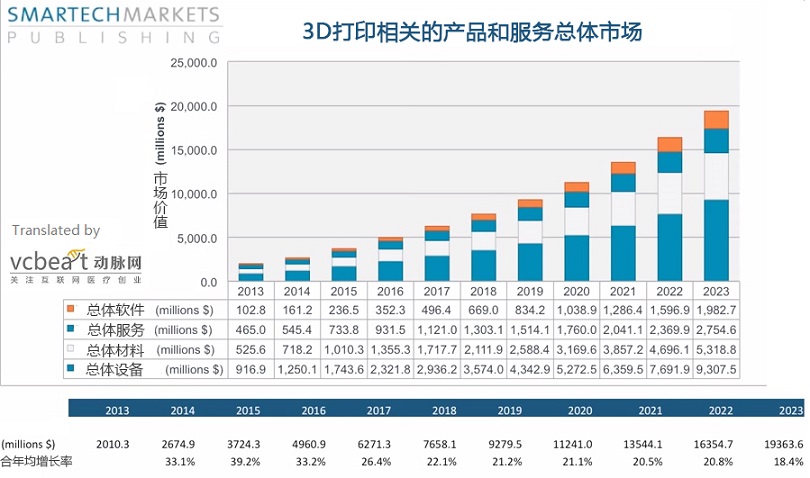
In specific application areas, particularly in the medical sector, services that provide a comprehensive suite of solutions deliver greater value. As illustrated by the two SmarTech Markets forecast charts below, although the market size for devices alone remains the largest, software, services, and materials collectively account for approximately half of the market. In terms of growth trends in market share, the proportions of both software and devices are expected to continue experiencing modest increases overall.