

iBaby Files IPO Prospectus: Revolutionizing Prenatal Care Experience Through Digital Health Platform
As the world’s second-largest consumer market for maternal and infant products, China is currently home to more than 70 million infants and toddlers aged 0–3 years, while the number of children aged 0–13 has reached 200 million. Furthermore, driven by the relaxation of the two-child policy, the country continues to see 16 to 20 million newborns annually, with the market size expected to surpass RMB 2 trillion.
The immense pressure from the large population has led to widespread criticism of difficulties in accessing medical care. This is particularly true for expectant mothers, who face not only time-consuming and labor-intensive processes such as queuing for registration and waiting for doctors during prenatal check-ups, but also certain safety risks. Many complain about spending hours in line for registration, only to have a few minutes with the doctor, while paying hundreds or even thousands in examination fees. Not only do they often encounter unfriendly attitudes from medical staff, but they sometimes fail to obtain even the basic information they seek. Long wait times, high costs, and safety risks are currently common phenomena in the medical experience of pregnant women.
iBabyDedicated to Creating a Better Healthcare Experience for Expectant Mothers
Lu Guotao, the founder of iBaby, encountered similar challenges. An experience accompanying his wife to a prenatal checkup inspired him to create an online platform connecting expectant mothers with obstetricians. During one visit, his wife was required to have a full bladder for an ultrasound examination. However, due to excessively long waiting times, she could no longer hold her urine and had to use the restroom, only to need to refill her bladder again when her turn finally came. Additionally, they had to wait for the test results and then consult the doctor for interpretation. This pattern—lengthy registration and payment queues coupled with brief consultation times—is a common patient experience across major hospitals in China.
In September 2014, Lü Guotao and his founding team officially established Chengdu Hulian Fenxiang Technology Co., Ltd., driven by their shared vision for internet healthcare. They began developing the iBaby project, aiming to create a high-quality mobile internet interaction platform tailored for expectant mothers and physicians. In October of the same year, iBaby secured RMB 2 million in angel investment.
The iBaby mobile client was officially launched on April 20 this year and has already registered more than 250,000 expectant mothers. Currently, the platform has attracted renowned chief-level obstetrics experts from West China Second University Hospital and department director-level experts from Chengdu Women's and Children's Central Hospital. It has signed contracts with over 1,000 obstetricians and gynecologists from public hospitals at the county level and above, with the number growing rapidly every day.
No queuing for registration, on-demand doctor consultations, and prenatal education content delivery
24/7 free consultation with responses from doctors in as little as one minute. After the consultation, you can rate the doctor’s service. This seamless healthcare experience is all accessible through the iBaby mobile app, eliminating the need for time-consuming and effort-intensive hospital visits for in-person inquiries.
For prenatal checkups, expectant mothers can also schedule appointments via the iBaby app, sparing them the hassle of waiting in line. In the near future, users will be able to access services such as medical consultation accompaniment, home visits, postpartum home follow-ups, and postpartum recovery on iBaby, truly enabling convenient medical consultations from the comfort of their homes.
In the iBaby Knowledge Base section, expectant mothers can access free expert interpretations covering a comprehensive range of topics—from preconception care, pregnancy, and childbirth to parenting. They can also tune in to irregular lectures on maternal and child health delivered by obstetrics specialists. The content spans various categories, including dietary guidelines during pregnancy, prenatal lifestyle, prenatal check-ups, exercise, fetal education, and disease management and medication use.
Additionally, users can search for doctors by geographic region on iBaby and choose to follow those they are satisfied with, thereby selecting their own private physicians and consulting doctors. Private physician services are fee-based. Currently, the “My Doctors” feature is not yet available on the user side. According to the iBaby team, more user features will be gradually improved and rolled out in the next version update.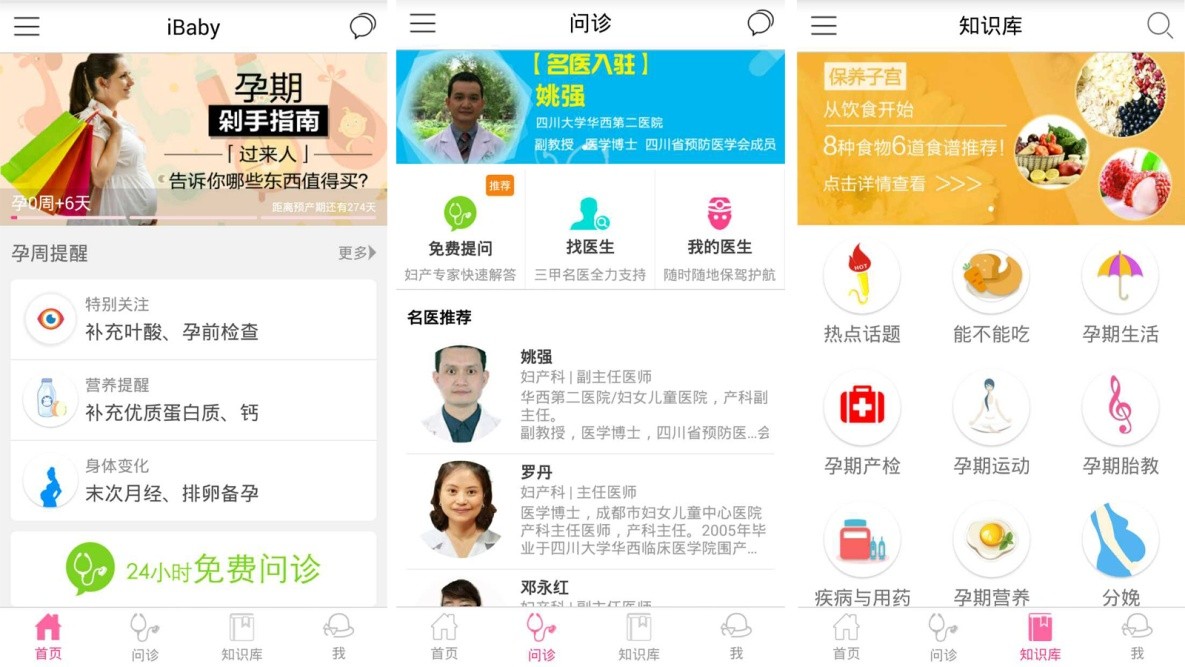
Enhancing Reputation, Striving for a Win-Win for Doctors and Hospitals: Patient Referral May Be the Key to the Model
According to VCBeat, from a profitability perspective, hospitals focus most on the delivery stage throughout the entire journey from preconception to childbirth, as this represents the largest single expense that most expectant mothers are required to pay.
The launch of mobile online consultation platforms like iBaby, particularly the feature that allows users to select their own private physicians, not only generates additional income for doctors but, more importantly, aggregates a community of expectant mothers. Hospitals are more willing to channel this demographic to offline facilities, ultimately deriving revenue from maternity and obstetric medical services. This may well be the core of the business model for such online consultation apps.
While iBaby builds a user-friendly, convenient, and efficient healthcare platform for patients, it also provides obstetricians with an exclusive tool to ease doctor-patient relationships, expand career development opportunities, improve work efficiency, and enrich clinical experience.
In addition, it enables physicians to leverage fragmented time to enhance doctor-patient interactions, thereby improving their income while fostering positive doctor-patient relationships. This allows patients to genuinely experience the qualitative improvement in medical services within the internet-enabled healthcare landscape, ultimately reducing the likelihood of doctor-patient disputes.
As a platform tool designed exclusively for obstetricians, iBaby enables physicians to manage their patients in groups and stay updated on patient status in real time, thereby significantly improving work efficiency. Furthermore, by joining the online consultation platform under the affiliation of their hospital department’s experts, physicians can not only enhance their own professional influence and visibility but also promote the brand reputation of their affiliated hospitals. This undoubtedly provides hospitals with an important channel for attracting expectant mothers.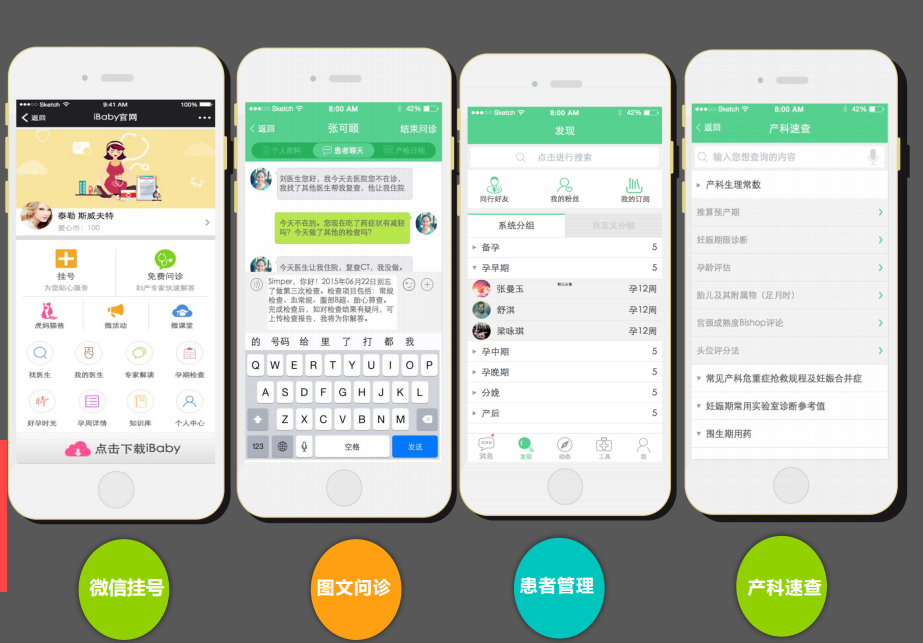
Rooted in the Local Market, Specializing in Maternal and Infant Care, with Nationwide Coverage Expected by Year-End
Initially, iBaby focused on intensive cultivation of the western region, emphasizing localization. Adopting a strategy of “encircling cities from the countryside,” the product was piloted in Chengdu and Mianyang during the first two months following its launch in April 2015. Starting in July, promotion expanded across the entire Sichuan province, with pregnant women from Sichuan accounting for 40% of all registered users. At the “Western Obstetrics Summit” recently concluded in Xi’an in August, iBaby garnered attention and acclaim from the Chairman of the Western Obstetrics Alliance, demonstrating significant advantages in localization.
According to VCBeat, iBaby will launch its promotional campaign in Shanghai and other East China regions in mid-August, followed by Shandong in September and Chongqing in October, with plans to expand its reach across China by the end of this year.
In the niche market segment for expectant mothers, there are also a number of maternal and infant community and medical consultation applications, such as Lamma Bang, Mama Circle, and Baby Knows. In terms of functionality, Lamma Bang and Mama Circle resemble maternal communities, focusing more on experience sharing and communication among expectant mothers. Taking Mama Circle as an example, users can follow each other and share their experiences in pregnancy preparation and child-rearing. Its features are similar to those of Weibo, functioning as a mobile community for maternal and infant care.
Founding Team and Business Model
As Founder and CEO, Lv Guotao previously served as the Western Region Director at Founder Lenovo. With over a decade of entrepreneurial experience, he is a serial entrepreneur whose prior ventures achieved annual profits exceeding RMB 10 million.
iBaby’s founding team is equally experienced. Chen Yuxia, the Director of Product Operations, has many years of experience in media and app operations, having managed platforms such as Mala Community and Yun Ci, each with over 10 million users. CTO Hou Xu previously served as CTO at companies including Founder Group and China Telecom, bringing extensive expertise in technology and management. Jiang Lin and Luo Wei are the founders of Angel Maternity Hospital and Yawei International Health Hospital, respectively. The founding team spans three major sectors—internet, media, and healthcare—offering clear complementary advantages. (Internet + Media Talent + Medical Team)
Currently, iBaby is a completely free application platform for expectant mothers in terms of online medical consultations and information access. In the future, iBaby will gradually introduce paid consultation services for private care. Users will be required to pay fees based on the consultation rates set by chief physicians of different seniority levels. (The prevailing fee models in China currently charge consultation fees either per session or per minute for telephone consultations. For example, text-and-image consultations are priced at RMB 30 per session, while telephone consultations are charged at RMB 5 per minute.)
According to the iBaby team’s disclosure to VCBeat, in addition to commissions from online and offline medical services, which constitute their primary revenue stream, the expanded profit focus will extend into areas such as maternal and infant products, smart hardware, and insurance once the iBaby model matures—for example, collaborating with insurance companies to sell online insurance policies.
iBaby’s core strategic plan is to establish a strong foothold in Western China while targeting the national market. Currently, iBaby has officially entered its Pre-A financing round, with investment firms having committed RMB 5 million.
(The photo shows Lv Guotao, founder of iBaby, delivering a speech at the "Western Obstetrics Summit Forum")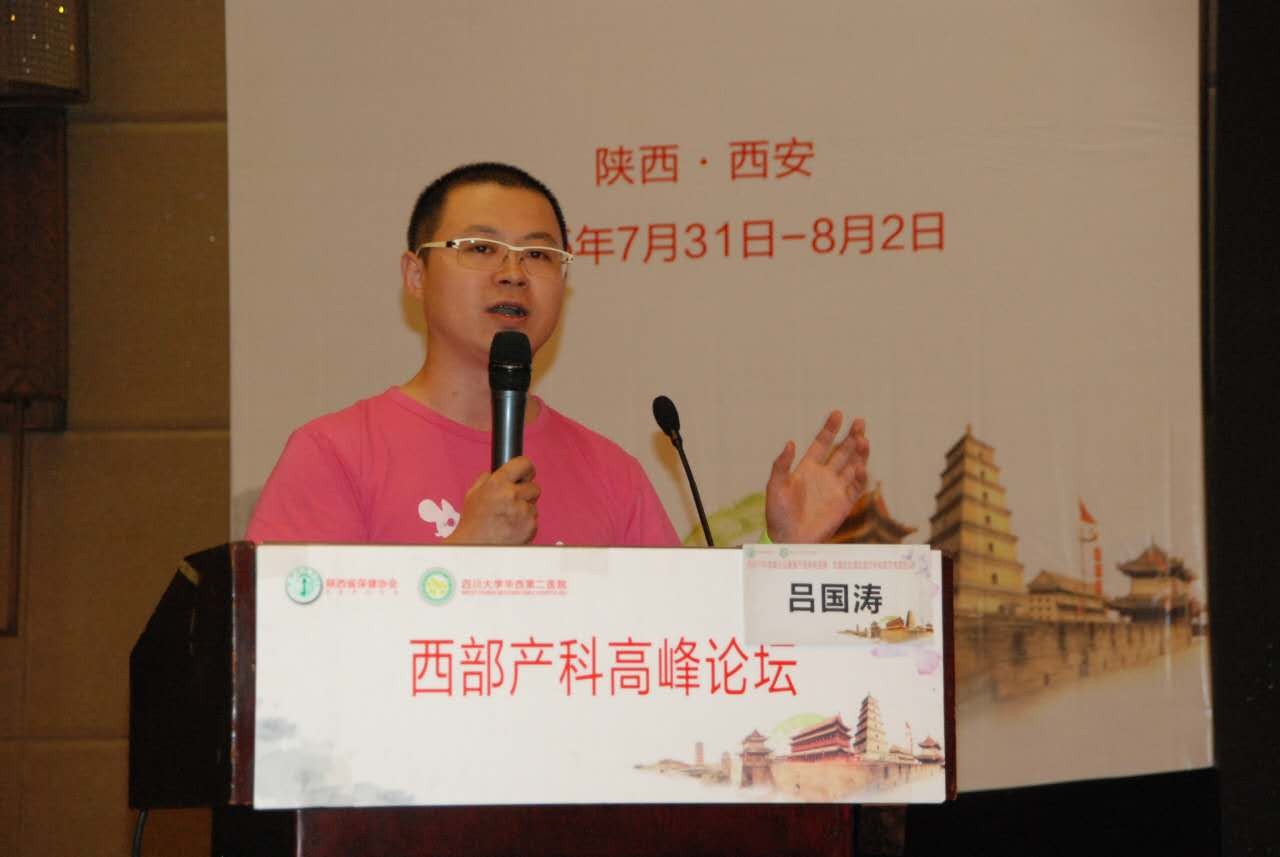
By John Wang