

Roche Advances First-in-Class FcRH5/CD3 Bispecific Antibody Cevostamab into Phase III Trial for Relapsed/Refractory Multiple Myeloma

Roche
Oncology Drug Research, Development, and Manufacturing



On September 23, 2025, Roche held its "Pharma Day" event for this year, during which Roche announced the upcoming launch of its FcRH5/CD3 bispecific antibody.Cevostamab'sPhase III Clinical Study and Named asCevolution。
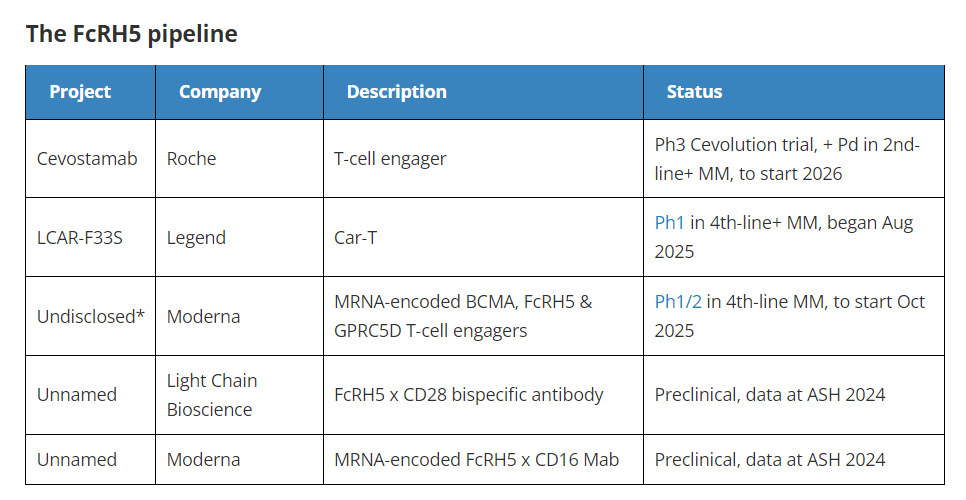
The phase III trial, named "Cevolution" and planned to launch in 2026, will test the efficacy of cevostamab combined with pomalidomide and dexamethasone in second-line and above treatment for multiple myeloma. At the event, Roche also highlighted data from the phase I Camma 1 trial using the same combination in second-line and above treatment: among 54 patients, the overall response rates for cevostamab at doses of 70mg and 105mg reached 86% and 88%, respectively. According to Roche, the incidence of grade 3 infections was less than 30%.
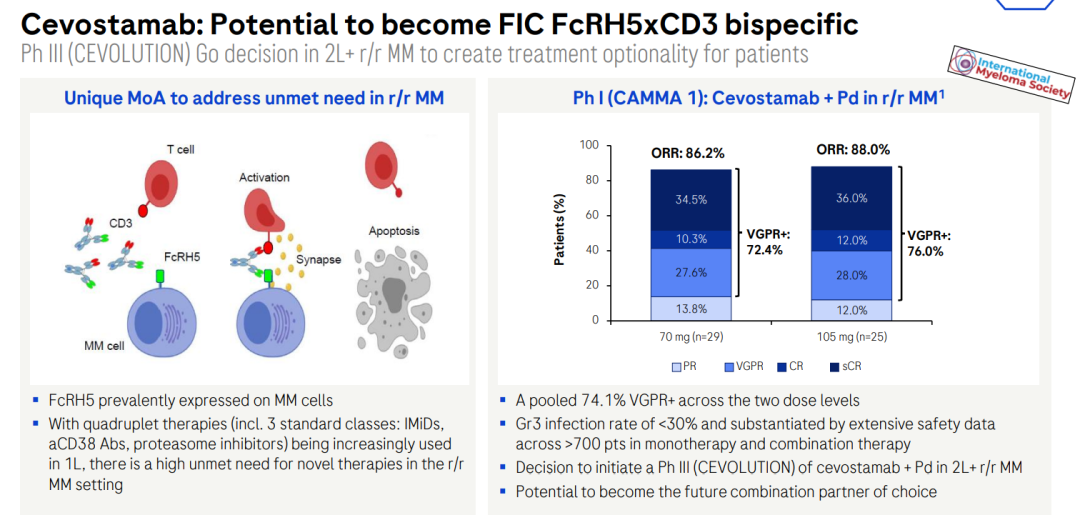
Roche Skips Phase II, DecidesCevostamab Pushed to Phase III to a Certain ExtentTaking a risk, as the efficacy of this target has yet to be validated; moreover, there are hardly any players in this field developing similar molecules, with only a few assets from Legend Biotech and Moderna currently in the early stages of testing. Roche hopes it can compete with the numerous other products vying for market share in multiple myeloma, but at the same time, there are high expectations for cevostamab as a component of combination therapy.
The company believes that with the increasing popularity of quadruple therapies containing anti-CD38 antibodies such as Darzalex in first-line treatment, there is a significant unmet medical need in the relapsed/refractory treatment space. Charles Fuchs, Head of Global Oncology and Hematology Development at Roche, pointed out that FcRH5 is expressed on "nearly 100%" of myeloma cells; however, drug development targeting it has faced challenges due to its similarity to other members of the FcRH family.
Competitive Landscape
Other companies still hoping to succeed in this field include Legend Biotech (whose CAR-T project LCAR-F33S has recently entered clinical trials) and Moderna. The latter is developing an mRNA-based asset that can encode three TCE bispecific antibodies targeting BCMA, FcRH5, and GPRC5D in a single product.
Despite the scarcity of projects targeting FcRH5, cevostamab may still face competition from products with different mechanisms of action in the rapidly evolving treatment landscape for multiple myeloma. Legend Biotech and Johnson & Johnson's BCMA-targeting CAR-T therapy Carvykti has already been approved for second-line treatment, while Johnson & Johnson, Pfizer, and Regeneron aim to expand their respective BCMA-targeting T-cell engagers Tecvayli, Elrexfio, and Lynozyfic from current later-line treatments to earlier lines.
In addition, several companies are developing trispecific T-cell engagers, including Johnson & Johnson's BCMA x GPRC5D program JNJ-79635322, and AbbVie's recently licensed Xencor Inc.'s BCMA x CD38 program ISB 2001.
However, Fuchs emphasized that cevostamab's novel target and its efficacy and safety profile are expected to make it an "ideal partner for cross-industry multiple myeloma therapies." He added that the company is "actively discussing these combination options with several potential enterprises."


Warm Tips
