

3D Printing Market Pivots Toward Medical Device Industry Amid Regulatory and Ethical Challenges
Not long ago, Gartner released a report forecasting the Hype Cycle for 3D printing. In the medical application sector, the 3D printing market is gradually transitioning toward the medical device industry, which has the potential to unlock the biotechnology industry’s latent capabilities. We believe this will slowly transform the traditional procurement model for artificial organs—a prospect that is truly exciting. However, Stephenson, speaking at the Stanford Medicine X conference, may serve as a reality check. She will analyze the current state and future prospects of 3D printing in the healthcare industry.
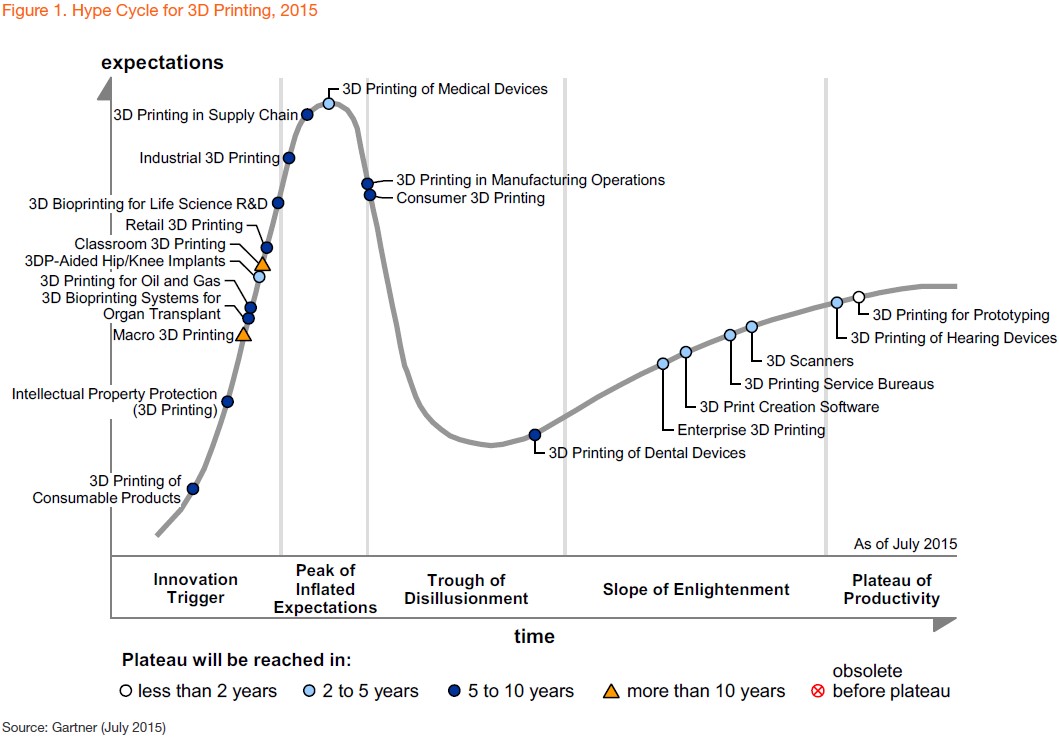
She pointed out that the value of 3D printing as a research and development tool is often overlooked, yet in reality, the benefits derived from its use in prototyping and medical device modeling account for the majority of industry revenues. This approach offers a more cost-effective strategy for designing medical device models, enabling manufacturers to conduct rigorous testing and make necessary modifications based on their design concepts without assuming significant financial risk.
Stephenson stated that the FDA has currently approved 82 medical device products utilizing 3D printing technology, most of which fall into the low-risk category of simple mechanical devices and are primarily used for facial and cranial applications, such as support arms, hearing aids, and skull implants. The military is leveraging this technology to develop customized tools to assist humans, particularly items like mandibular implants.

A significant portion of the current challenges stems from regulatory and ethical hurdles. Although the FDA has stated that it will continue to treat 3D printing as a standard manufacturing process for medical devices, it has yet to address 3D printing from the perspective of customization. However, by incorporating 3D printing technology into their operations, hospitals effectively assume the role of an additional medical device manufacturer.
If a 3D printing device malfunctions and causes actual harm, who should be held liable? The hospital, the surgeon, or the developer of the 3D printing software? The individual who participated in testing and ultimately installed the software on the computer? Or the fool who pressed the print button? These are all potential liabilities for hospital administrators, who will not adopt any recommendations until these issues are clarified.
Then comes reimbursement under insurance policies. “We must figure out how to submit our bills to insurance companies,” said Stephenson. She pointed out that obtaining FDA approval typically takes about three to four years, while gaining inclusion on insurance reimbursement lists could take five to ten years.
In the field of biotechnology, the complexity of developing tissues and cells makes 3D-printed organs more challenging. Most work is being done on scaffolds, and it needs to meet 100% cell density. Companies like Biobots and Organovo (which had a rough ride in the stock market this summer) are supporting drug development. Stephenson pointed out that Organovo’s development of 3D-printed kidney cells provides a useful method for their simulations.

“Much like the heavily promoted cycle by Gartner,” Stephenson said, “the reality is that we have avoided using 3D printing for customizable hearts for over a decade. In addition to the challenges of developing suitable tissues, hospitals also need to correctly differentiate patients in their workflows to avoid patient identity confusion.”
Compiled from:http://medcitynews.com/2015/09/3d-printing-outlook/