

Alibaba Cloud, BGI, and Intel Launch Asia-Pacific's First Precision Medicine Cloud Platform Amid Over £2 Billion UK-China Healthcare Deals
1, Alibaba Cloud Partners with BGI and Intel to Launch Asia-Pacific’s First Open Cloud Platform for Precision Medicine
On October 22, at the 10th International Conference on Genomics held in Shenzhen, it was announced that Alibaba Cloud, Intel, and BGI Group had jointly signed a strategic cooperation memorandum to launch the first cloud platform dedicated to precision medicine applications in China and even the Asia-Pacific region.
Analysts believe this will be China’s first precision medicine cloud platform that transcends industry boundaries, jointly built by IT companies, genomics and life sciences research institutions, and public cloud service providers.
It was revealed that the three parties have formulated a detailed plan, outlining the necessary steps required to successfully establish this platform. According to the Memorandum of Strategic Cooperation, BGI Genomics, as the world’s largest genomics research center, will integrate and consolidate resources from all parties to build a genomics data center and analytics platform. This initiative, building upon the BGI Online genomic data analysis platform released in April this year, aims to promote the development of the precision medicine industry.
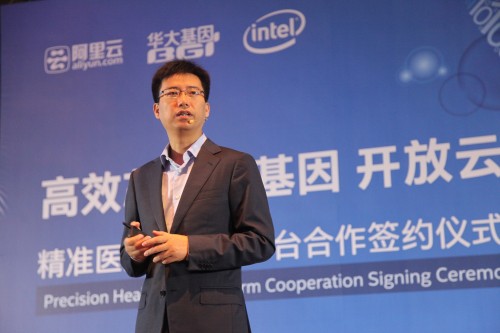
Hu Xiaoming, President of Alibaba Cloud
2, President Xi's Visit to the UKSignature exceeds20Billion-Pound Healthcare Agreement
According to The 21st Century Business Herald, Chinese and British enterprises, universities, and institutions signed economic and trade cooperation agreements worth over £2 billion in the healthcare sector on October 21 (UK local time).
In the healthcare sector, scientific research, hospital development, education and training, diagnostics, and drug R&D will be the focal points of bilateral cooperation. The signing of the agreement fully demonstrates the immense potential for collaboration between China and the UK in the life sciences field.
During this period, the University of Warwick will collaborate with the Sun Yat-sen University Cancer Center on education, training, and scientific research to jointly develop anti-cancer treatments. Meanwhile, patients in the UK will also benefit from China’s advanced medical technologies; for instance, the partnership between United Imaging Healthcare and the UK-based company Cerno will introduce the latest tumor imaging technologies to the UK.
3、23andMeGenetic Testing Finally Receives FDA Approval“Let Go”
According to foreign media reports, 23andMe announced that the FDA has approved its service offering genetic testing directly to consumers. Since the FDA halted 23andMe’s personal genetic testing services in 2013, the two parties have engaged in countless communications. During this period, 23andMe secured $79.08 million and $115 million in separate financing rounds.
Returning to the market, 23andMe is now offering its revised personalized genomic service, which includes reports on ancestry, health, non-medical traits (such as freckles, hair curliness, and lactose intolerance), and carrier status. Priced at $199, this new service helps consumers determine whether they carry genetic mutations associated with hereditary diseases, including cystic fibrosis, Tay-Sachs disease, and sickle cell anemia.
4, Hospital Market Sales 20Top 20 Pharmaceutical CompaniesStrongPfizer Tops the List
According to reports, a statistical analysis was conducted on continuous samples based on hospital drug procurement data from 2012 to 2014, sourced from sample hospitals monitored by the National Pharmaceutical Economic Information Network (with tertiary hospitals accounting for 66.3% and secondary and lower-tier hospitals comprising the remainder). The analysis revealed that the top 20 pharmaceutical companies by hospital procurement volume held nearly 34% of the hospital pharmaceutical market share, with a growth rate of 18.2%, exceeding the national average for hospital drug usage in 2014. Among these top 20 companies, 11 were domestic enterprises and 9 were foreign-funded enterprises.
By John Wang