

Ultra-Thin, Low-Cost Wearable Sensor Patch Enables Dynamic Blood Flow Monitoring
Recently, good news emerged from the wearable technology sector. According to a report by MIT Technology Review, Professor Rogers from the Department of Materials Science and Engineering at the University of Illinois Urbana-Champaign has developed an ultra-thin, low-cost wearable device that canDynamic Real-TimeMonitoring human blood flow is most important, very lightweight, and inexpensive.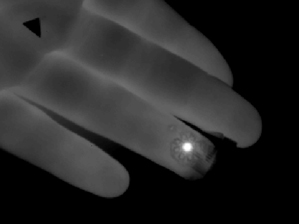
The infrared thermogram above displays a novel wearable sensor, with the bright central region representing mildly heated skin; the sensor monitors blood flow in real time following thermal stimulation.
We know that to determine blood flow in veins, arteries, and capillaries, we typically need to remain still. But this is no longer necessary; this new wearable device can provide the information you desire, whether you are moving or stationary.
The core of the device consists of a heating pad andThermal SensorComposed in a small sandwich-like shapePatch, all components "applied" to the skin are made ofSiliconcomposed of. The majority of the sensor’s thickness consists of a 40-micrometer-thick silicon layer, while each of the other layers is only tens to hundreds of nanometers thick.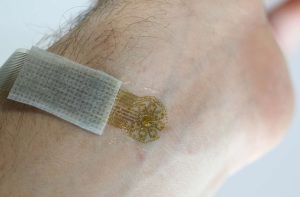
It first quietlyHeating the Epidermis(Rest assured, the temperature here will not exceed normal human body temperature.) Once the device has finished heating, blood flow in the skin will dissipate the heat from the area placed within the circle of the heating element.Temperature SensorIt records the direction of blood flow and its thermal changes, as blood is in constant motion. By integrating the monitored data with models, applyingHemodynamics, we can quantitatively determine the status of blood flow. Isn't that amazing?
This sensor is thin and lightweight, adhering tightly to an inconspicuous area of the skin surface, thusSuper Wear-Resistant, it accurately maps blood flow beneath the skin, thereby helping physicians obtain critical information, while physical activity does not affect its measurement results.
We recognize that blood flow monitoring is critically important in healthcare. Inflammation and infection can lead to increased local blood flow, whereas conditions such as atherosclerosis, heart failure, and diabetes can result in decreased local blood flow. Therefore, this technology is particularly vital for patients who have limited opportunities for frequent blood flow assessments, as it provides favorable conditions for physicians to deliver personalized medical care.
New “Epidermal Electronics“Rogers, the inventor of the sensor system, stated that he is ready to”Clinical Applications...particularly for monitoring skin health. They stated that if research continues in this direction, it may eventually be applied within the human body.
A recent public demonstration study has shown that the device can indeed accurately record data on blood flow beneath the surface of human skin, particularly in the forearm veins and the microvascular network on the skin surface.
“Compared with the most advanced non-invasive methods for measuring blood flow currently available, this new sensor, which relies on optical systems and ultrasound technology, is remarkably simple and inexpensive,” said Rogers. “More importantly, it is so thin and lightweight that you sometimes forget it’s even there.”
Things are not always perfect, and this miraculous patch is no exception; it can only monitor blood flow within two millimeters of the surface. However, researchers are experimenting with different combinations of heating elements and sensors to monitor deeper blood flow.
Notably, the primary supporter of this new technology is the cosmetics giant L'Oréal. The company has already begun manufacturing the device and is simultaneously developing corresponding software for data analysis to further uncover secrets related to skin health.
Prior to this, MC10, selected as one of MIT Technology Review’s 50 Smartest Companies in 2014, possessed stretchable sensor-based electronic tattoo technology. One of its functions allows it to serve directly as an electronic token for unlocking smartphones, computers, and other devices, while also enabling the monitoring of skin surface temperature and health status.