

Key Policy-Driven Trends in China's Healthcare Industry: Insights from Junliang Capital's Wang Jianfei at 'Xingdong Xiangyi' Public Lecture Series

Legend Capital
Early-stage venture capital and growth-stage private equity investment institutions

Event Name:Xingdong Xiangyi HuiIssue 1Open Course
Event Dates: November 7–8, 2015
Organizers: Legend Star, VCBeat, BlueRun Ventures
Guest Speaker:
Wang Jianfei, Investment Director at Legend Capital. He joined Legend Capital (formerly Lenovo Investments) in 2006 as an Investment Director. Currently, he is a member of the healthcare investment team, focusing on medical IT and healthcare services. With over 12 years of experience in the investment industry, he has led and participated in the management of numerous projects in the healthcare sector.
Below are the highlights from Professor Wang Jianfei’s inspiring speech. For the full presentation, please follow VCBeat on WeChat (vcbeat) to watch.
1. I am just an ordinary investor in the healthcare investment circle. Much of my understanding and thinking comes from entrepreneurs, many of whom I have had in-depth discussions with today. Among the attendees, 90% are from the internet healthcare sector, but only two or three have found clear business models.
2. The Timmons Model of Entrepreneurial Opportunities: Business opportunities are the primary driving force. To identify where these opportunities lie, one must look for change. Examining this from three perspectives—technology (where breakthroughs are difficult), market (where many opportunities stem from deregulation), and society (where changes in lifestyle take time)—the most significant changes are likely to arise from deregulation. No opportunities exist in a static market.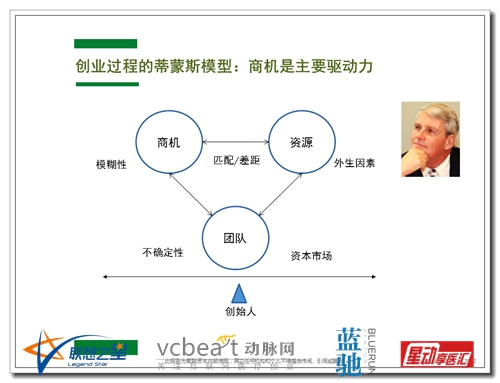
3. The window of opportunity is opening and closing in a shorter timeframe. Mark Twain: “I seldom see opportunities; by the time I do, they are no longer opportunities.”
4. Wherever there are people, there is a demand for medical services. In China, the territorial and regional management model has led to a healthcare system that is relatively fragmented overall yet concentrated within specific regions, resulting in a paradoxical situation of extreme fragmentation coexisting with extreme monopoly.
5. The Past Decade: Improvements in the social security system have driven a 26% increase in healthcare expenditures, objectively leading to an imbalance in the structure of healthcare service supply. This supply-side imbalance has resulted in low efficiency within public medical services. Today, all pressures stem from the fact that the medical insurance fund pool is depleted.
6. Multiple policies are promoting the reform of the medical service system, with strengthened efforts to reduce administrative intervention. The objectives of healthcare reform are clear, and the measures are diverse. Future reforms are expected to lower the threshold for administrative approval and advance market-oriented reforms of medical service pricing.
7. Driven by policy, the fundamental trends will include strong entry of social capital, a significant increase in the proportion of private medical services, expanded market space, and intensified competition. Pricing mechanisms will become more market-oriented at the regional level, leading to higher service prices and innovation in service models. A growing awareness among physicians will spur a surge in independent practice.
8. Basic Trend Assessment:
1) Strong influx of social capital, with a significant increase in the share of private-sector services
2) Market-oriented pricing mechanism, increased service prices, and innovative service models
3) The Awakening of the Physician Community and the Rise of Freelance Practice
9. Core Logic of Business Opportunities:
Consumption Upgrading: Specialty Chain Clinics / Shifts in Disease Spectrum / Middle-Class Demand
Optimizing Payment: Medical Insurance Cost Control / Commercial Insurance
Operational Efficiency Improvement
To be a doctor who keeps pace with the times, you must follow the “Daifu” official subscription account.
Please scan the QR code below
