

Future High-Potential Healthcare Startup Opportunities According to Junlin Capital's Wang Jianfei – Xingdong EnjoyMed Webinar Series Episode 5

Legend Capital
Early-stage venture capital and growth-stage private equity investment institutions

Event Name:StarMed ConnectIssue 1Open Course
Event Dates: November 7-8, 2015
Organizers: Legend Star, VCBeat, BlueRun Ventures
Guest Speaker:
Wang Jianfei, Investment Director at Legend Capital. He joined Legend Capital (formerly Lenovo Investment) in 2006 as an Investment Director. Currently, he focuses on healthcare IT and healthcare services within the firm’s healthcare investment team. With over 12 years of experience in the investment industry, he has led and participated in the management of numerous projects in the healthcare sector.
Below are the highlights from Professor Wang Jianfei’s inspiring speech. For the full presentation, please follow VCBeat on WeChat (vcbeat) to watch.

10. There are two critical factors in internet healthcare. First, the core resource in medical services is physicians’ time. A product that fails to retain physicians on its platform and leverage their time forfeits a vital resource. Second, the data generated within the served population is highly valuable. Currently, vast amounts of data are scattered across various locations; attracting a large customer base to consolidate this data would yield substantial value.
Internet healthcare possesses the attributes of the service industry, and this service sector is driven by three factors: assets, human-based services, and data technology.
11. Transformation is the keyword for internet healthcare. Shifting from a disease-centered to a people-centered approach, internet healthcare is transitioning toward a patient-centric model with multi-party participation. The demands of the middle class have evolved to include convenient physical examinations, health management knowledge and services, a trusted family doctor system, reasonable insurance premiums, and attention to the needs of the elderly and children. Currently, the core elements of the industry are gradually shifting, leaning more toward asset-driven models, human-centric services, and data technology, while the value of purely tool-based solutions is very limited.
Therefore, for new family-based health services, establishing extensive connectivity to foster communication and interaction is key to building trust. Connectivity, data, and experience constitute the core values of internet healthcare.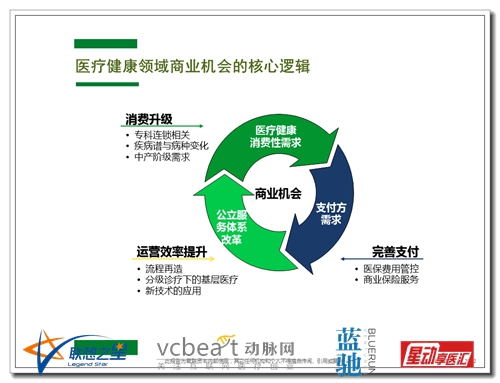

12. I believe that the most promising entrepreneurial opportunities in the near future will primarily emerge in three areas: first, process reengineering, such as in clinical operations, clinical support departments, and logistical support; second, medical support services, which offer certain platform-based opportunities, exemplified by KingMed Diagnostics; and third, non-clinical medical services, where numerous fragmented opportunities exist, such as medical equipment maintenance and repair, as well as caregiving services, including hospital patient care assistants.
13. I am more inclined to enter the healthcare sector by focusing on single-disease platforms. This is because markets segmented by specific diseases constitute nearly entirely independent industries; for instance, two different disease areas operate as distinct sectors. Therefore, I believe greater opportunities arise from a deep understanding of a specific disease, entering the market through pharmaceutical provision, service support, and post-treatment rehabilitation management, thereby thoroughly analyzing and penetrating the industry’s entire value chain. In each niche segment, one should identify entry points within the core value chains based on its unique characteristics.
14. In fact, the most significant restructuring of the entire public healthcare system is the implementation of tiered diagnosis and treatment. I personally feel that the current medical supply system has reached the end of its pendulum swing. In the future, a portion of the 7.6 billion outpatient visits will be gradually diverted to primary care facilities. Various subsidy methods will be employed to support community health service centers, improve compensation packages, and attract high-quality physicians. Community health service centers are not limited to state-run institutions; indeed, due to fiscal constraints in central and western regions of China, a large number of these centers have already come under private management. Additionally, providing family-based services helps earn the trust of the general public.
Community health service centers, including clinics, are likely to become a critical battleground in the future. Indeed, many pharmaceutical sales representatives now place significant emphasis on channels within community health centers following extensive discussions. Once community physicians are granted certain prescribing privileges, competition will center around these rights. From the perspective of payers, including large hospitals, as well as medical device companies, such channels will garner substantial attention. We have also observed that several companies securing the largest financing rounds in the internet healthcare sector have made this strategic choice. Whether their decisions prove correct remains to be seen.
I remain quite optimistic about this model, though the specific path forward will likely depend on their own capabilities. Chunyu Doctor opened 25 clinics back in the day, while DXY opened only two. My reasoning is that if the public healthcare system cannot deliver this service effectively, it might be better left to private capital. Therefore, while it is hard to assess investment efficiency at this stage, I believe that once the basic infrastructure is established and physicians are attracted through various approaches, the general public will make their own choices.
15. Innovation-driven service applications based on new technologies represent an enduring opportunity. Regardless of whether they are propelled by policy, this sector abounds with fresh opportunities. Within diagnostic and therapeutic technologies, examples include gene sequencing, robotic surgery, and cell therapy. Some patients may access these innovations through such avenues. Our focus is not merely on how cutting-edge a technology is, but rather on its effective market application. Certain investments involve equipment with technology imported from abroad; this is acceptable as long as there is demand in the Chinese market. For instance, we have invested in a company offering non-invasive prenatal testing (NIPT) for Down syndrome, with each test priced at several thousand RMB, which still presents a strong opportunity.
16. As the entire public healthcare system improves its efficiency under cost pressures, it inevitably displaces or diverts a substantial volume of non-essential medical demand, which is primarily addressed by private-sector supply. For instance, specialized disease-focused chains, as well as aesthetic surgery, dentistry, and ophthalmology services—areas often deprioritized by top-tier (Grade 3A) hospitals—are increasingly provided by private medical institutions. For these so-called conditions, patients generally already understand the treatment options; therefore, the key differentiator becomes a high-quality service environment. While there were previously significant reservations about dental care, growing trust in these private institutions has gradually made dentistry an important component of society’s non-essential healthcare offerings.
17. Patients’ voice is growing increasingly influential. Ultimately, your actions should be guided by patient-centric value considerations. We can leverage the B2B2C model to reach patients by serving hospitals, physicians, or other institutions, with the end goal of directly engaging consumers (2C), as patients today place their trust in internet healthcare platforms and institutions.
18. Summary:
First, the founder’s background and learning ability determine the future ceiling of a startup; when evaluating companies, the most critical factor we consider is the founder, who must strike a balance among business opportunities, resources, and team.
Second, the addition of key resources and teams can change a company's destiny.
Finally, I believe that healthcare is an industry that requires patience. This is the first principle I adhere to in my investment journey within the healthcare sector. Perseverance is crucial; staying true to one’s original aspiration is key. Given the imminent reform of the national health insurance system and the necessary restructuring of public hospitals, which will stimulate economic vitality, I am convinced that the next 5–10 years will be a golden period for investment in the healthcare industry.
Most importantly, heed the final point: it is often the information you think you know, but which is in fact inaccurate, that leads you astray. Although we have covered a great deal today, including Professor Zhu’s remarks, our discussions merely reflect observations from the broader social landscape. When it comes to making actual decisions, I strongly encourage you to engage directly with the market and communicate with your clients.
To be a doctor who keeps pace with the times, you must follow the “Daifu” public subscription account.
Please scan the QR code below.
