

Beyond Models to Implementation: The Real Challenge of Tiered Medical Care in China
Since my last article on internet-based tiered diagnosis and treatment, I have discussed the current state of tiered care with numerous healthcare professionals and attended several mobile health forums. However, I have observed that while there are many models for implementing tiered diagnosis and treatment, and various players in the mobile health sector have proposed different approaches, merely discussing these models amounts to empty promises. The true realization of tiered diagnosis and treatment depends on how—and indeed whether—it can be effectively implemented on the ground.
Of course, let us first examine the four tiered diagnosis and treatment models that have garnered significant attention, exploring their commonalities and differences.
Let us begin with the “American model,” which has been widely discussed by many experts in China.Obama’s healthcare reform plan has repeatedly become a focal point of global attention, highlighting that even the United States, with its highly developed medical system, still faces certain healthcare challenges. The tiered diagnosis and treatment model in the U.S. healthcare system relies on the family physician system, where family physicians provide initial diagnosis and treatment before referring patients to appropriate hospitals. There, nurses or doctors conduct further triage based on the Emergency Severity Index (ESI). In other words, patients first consult their family physicians; conditions that cannot be managed at this level are then referred to hospital specialists for treatment, thereby significantly alleviating the burden on hospitals. As mentioned in the previous article, China’s number of physicians per 1,000 people is comparable to that of the United States. This may well be one of the reasons why many Chinese physicians trained in the U.S. advocate for the American tiered diagnosis and treatment model.
Next, we will discuss the “UK Model”As the earliest and most stringent Western country to implement a tiered diagnosis and treatment system, the United Kingdom has long made this system a hallmark of its welfare framework. The UK healthcare system operates under a strict three-tier structure: first, community-based general practitioner (GP) clinics; second, general hospitals providing comprehensive care; and finally, teaching hospitals specializing in emergency care and complex, refractory diseases. Clearly, the UK’s tiered diagnosis and treatment model holds significant institutional advantages. It can be regarded as an integral component of the broader healthcare system, which also encompasses the separation of prescribing and dispensing, prescription-only medication sales, and appointment-based consultations. The World Health Organization and the UK are often cited alongside China’s own efforts as the “three pillars” guiding the development of tiered diagnosis and treatment in China, underscoring their considerable importance.
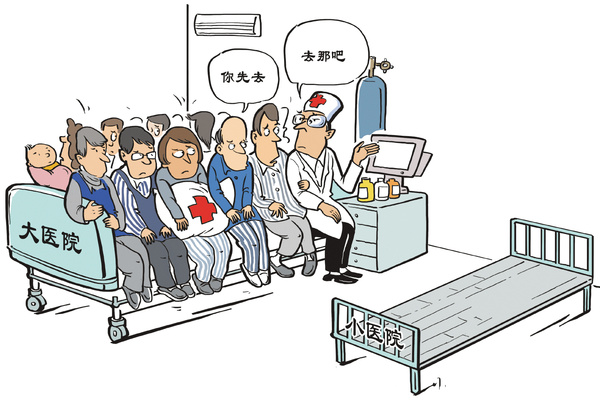
Then there is the government-led tiered diagnosis and treatment model in China.The “Guiding Opinions on Advancing the Construction of a Tiered Diagnosis and Treatment System,” released not long ago, outlines a timeline for China’s tiered diagnosis and treatment system and proposes building an orderly framework along four dimensions: initial consultation at primary care institutions, two-way referrals, separate management of acute and chronic conditions, and coordination between different levels of healthcare providers. However, given the complexity of China’s healthcare system and the public’s established healthcare-seeking habits, it is unlikely that the tiered diagnosis and treatment models of the United Kingdom or the United States can be directly replicated domestically. Currently, 16 provinces and municipalities across China are exploring the feasibility of tiered diagnosis and treatment and are gradually improving the related institutional mechanisms.
Finally, we discuss internet-based tiered diagnosis and treatment. Against the backdrop of the “Internet Plus” initiative, leveraging the internet to reform the healthcare system has become a prevailing trend. Regarding tiered diagnosis and treatment, mobile health companies have generally proposed the following approaches. First is WeDoctor Group’s “WeDoctor Model,” which essentially implements China’s established tiered diagnosis and treatment framework via the internet. This model facilitates collaboration among physicians, matches patients with appropriate medical teams based on their conditions (i.e., triage), and establishes electronic health records through internet platforms. Second is the online consultation model adopted by companies such as Baidu, which provides intelligent triage services through big data analytics and recommends suitable clinical experts to patients based on expert profiles. Third, mobile health entrepreneurs are focusing on physician resources, aiming to enable “free practice” via the internet. They seek to establish an internet-based healthcare system outside the conventional medical framework and explore various models of tiered diagnosis and treatment.
It is evident that the tiered diagnosis and treatment systems in developed countries such as those in Europe and America provide corresponding models, while China has officially advocated for the implementation of a tiered diagnosis and treatment system. However, as previously mentioned, 16 provinces and municipalities in China have already been exploring tiered diagnosis and treatment. What is the current status, and what opportunities does the internet present? We will begin by examining three typical implementation cases.
The first is the Minhang Model in Shanghai. In mid-2015, Shanghai established a tiered diagnosis and treatment system as a key component of the comprehensive reform of community health services. The Shanghai Municipal Health and Family Planning Commission partnered with WeDoctor Group to build an information-sharing platform that enables data exchange among municipal, district, and community-level medical institutions. Under this model, community residents first sign contracts with family doctors at community health centers. These community physicians provide initial consultations and, based on the findings, handle prescribing, referrals, and health management. After referral and specialized care, patients return to community hospitals for follow-up and continuous treatment.
The second is the Xi’an ModelSince 2005, with Shaanxi Province as the hub, the network has expanded to cover 126 affiliated hospitals, serving as a practical implementation of vertical medical consortia. In terms of tiered diagnosis and treatment, the core of the “Xi’an Model” is team-based care, which facilitates precise matching between patients’ healthcare-seeking information and medical service provision. For example, after a patient consults an initial physician, that physician makes a preliminary assessment of the condition and then identifies the most appropriate department and specialist for the patient within the care team.
The third is a general practitioner.. In 1994, Zhongshan Hospital in Shanghai established the Zhongshan Department of General Practice, focusing on the training of general practitioners. It is reported that over the past decade, the department has held 32 training courses for general practitioners, training nearly 4,000 individuals. The model for general practitioners is well-defined, with its core remaining community-based first-contact care, two-way referral, and health management; however, the prerequisite is to improve the medical proficiency of primary-care general practitioners. Currently, Shanghai has already comprehensively implemented standardized residency training, which is also being continuously promoted nationwide.
In fact, although the three cases exhibit certain differences, they share three core commonalities. First, they align closely with the national strategy for tiered diagnosis and treatment, which emphasizes initial consultations at primary care facilities, two-way referrals, separate management of acute and chronic conditions, and coordinated care between different levels of the healthcare system. Second, they all place significant emphasis on the role of primary care physicians; whether through team-based care or general practitioners, the focus is on enhancing the capabilities of primary care providers. Third, given the numerous issues plaguing the current healthcare system, the most critical one is likely the lack of trust between patients and physicians. The goal is to build patient trust in community doctors, rather than having patients flock to tertiary Grade A hospitals for both minor and major illnesses. However, as domestic medical policies have not yet been fully liberalized, relying solely on the traditional healthcare system to comprehensively implement tiered diagnosis and treatment is akin to climbing a tree to catch fish—an futile effort. Nevertheless, based on these three implemented cases, if the internet sector aims to promote tiered diagnosis and treatment, it must address the following challenges.
1. How Can the Professional Competence of Primary Care Physicians Be Enhanced?
Shanghai has trained nearly 4,000 general practitioners (GPs) through GP training programs over the past decade. In other regions outside Shanghai, the situation is even more dire, particularly in western China, where many primary care physicians were formerly “barefoot doctors” or converted military medics. Currently, there are three approaches to addressing these challenges through mobile health solutions. First, providing training opportunities for registered physicians to attract more doctors to join platforms; however, in practice, this has proven to be more of a marketing gimmick than a substantive solution. Second, facilitating collaboration and communication among physicians through apps such as WeDoctor (Wei Yi). This approach aims to improve internal communication and learning mechanisms within medical teams—for instance, WeDoctor assigns a team assistant to each medical team—while also strengthening collaboration between different medical teams, particularly by accurately matching patients’ conditions with appropriate medical teams during triage. Third, telemedicine, which enables physicians to access more consultation support via mobile health apps, thereby enhancing the triage capabilities of primary care providers. Many mobile health companies are enthusiastic about this model, and evidence has shown it to be an effective strategy. For the mobile health sector, physician resources will become the key determinant in the future competitive landscape.
2. How to Establish Triage Criteria for Internet-Based Healthcare?
Even WeDoctor Group, which has made the most progress in internet-based tiered diagnosis and treatment, still relies on the experience of initial consultation physicians for triage standards before making corresponding matches. Although WeDoctor’s online triage team has grown to over 8,500 assistants and achieved notable success in precise triage, it still faces the shortcoming of lacking standardized triage protocols. In mature tiered diagnosis and treatment systems abroad, Australia has established the Australasian Triage Scale (ATS), Canada uses the Canadian Triage and Acuity Scale (CTAS), and the United States employs the Emergency Severity Index (ESI). While China has its own emergency triage standards, they appear unsuitable for internet-based tiered diagnosis and treatment. Whether it is WeDoctor or other mobile healthcare enterprises, it is imperative to establish more standardized triage protocols at an early stage, rather than relying solely on clinical experience.
3. How to Enhance Trust Between Patients and Primary Care Physicians?
Many people choose tertiary hospitals as their first option for medical care, primarily due to a lack of trust in primary care physicians, especially given the persistently high misdiagnosis rates at the grassroots level. In addition to improving the clinical competence of primary care physicians and leveraging the internet to reduce misdiagnosis rates, it is imperative to enhance trust between doctors and patients without delay. The approach adopted by mobile health platforms is to implement a designated physician system, similar to the contracted community doctor model seen in the Minhang District model. Indeed, providing designated physicians with support from expert teams via mobile health apps, along with access to medical resources and green channels for referrals and consultations, facilitates the implementation of this system to some extent. However, mobile health platforms should promptly integrate health management and medical insurance services to bridge the gap between the public and designated physician teams, thereby addressing income issues for these physicians and mitigating mutual distrust.
4. How to Enhance the Capabilities of Community Hospitals?
Although some radical mobile health companies have advocated for the "de-hospitalization" of healthcare, major players such as WeDoctor, Baidu, and Alibaba have not adopted a confrontational stance toward community hospitals. Instead, they regard community hospitals as a crucial component of internet-based tiered diagnosis and treatment systems. The key challenge they face is how to enhance the capabilities of these community facilities. Observation suggests two viable approaches: first, establishing remote diagnostic systems to address the shortage of medical equipment in community hospitals; remote electrocardiogram (ECG) services, for instance, have already begun to enter the market and are becoming an indispensable part of the mobile health ecosystem. Second, leveraging county-level medical resources. Given that the national goal for tiered diagnosis and treatment is for county-level hospitals to manage 90% of medical cases, and considering the ongoing reforms in which higher-tier hospitals oversee lower-tier ones, strengthening collaboration with county-level hospitals is a strategic and pragmatic move rather than an unnecessary concern.
In any case, community hospitals and primary care physicians remain the bottleneck in the tiered diagnosis and treatment system. For all mobile health companies and relevant departments promoting this system, focusing solely on business models while neglecting the development of grassroots medical resources will render the implementation of tiered diagnosis and treatment nothing more than an empty promise.
The views expressed in this article are those of the author and do not represent the position of VCBeat.
This article is published on VCBeat with authorization from the author, Alter. Reproduction without permission is prohibited. Alter is an internet observer who has long been dedicated to observing and researching industries such as smart hardware, O2O, and mobile phones. WeChat Official Account: spnews