

Mayo Clinic Partners with Viewics to Enhance Cost Control and Data-Driven Healthcare Decisions
Recently, Mayo Clinic signed an agreement with Viewics, a healthcare solutions provider, under which Mayo Clinic will leverage the Viewics data analytics platform to drive key initiatives in safety, service, cost, and quality. Who is Viewics? Why has it managed to partner with Mayo Clinic? Stay tuned as we provide detailed answers below.
In Collaboration with Mayo Clinic
As part of the agreement, Viewics will deploy its data platform, Viewics Health Insighter, across various departments within Mayo Clinic’s Department of Laboratory Medicine and Pathology, including its reference laboratory, Mayo Medical Laboratories. The Viewics analytics platform will aggregate data from diverse sources to provide Mayo Clinic with real-time information and insights in clinical, operational, and financial domains, thereby supporting strategic decision-making and standardizing daily laboratory operations. Viewics Health Insighter will help Mayo Medical Laboratories and its clients understand the significant impact that data analytics can have on laboratory products and value propositions.
“Clinical laboratories can create greater value by analyzing data, a value that extends far beyond a single test result,” said William Morice, Chair of the Department of Laboratory Medicine and Pathology at Mayo Clinic. “By collaborating with Viewics, we can develop algorithms to extract data and unlock an ‘information goldmine.’ This information will help us deliver high-value laboratory services and high-quality, low-cost care to patients around the world.”
Viewics' Three Major Products
Viewics, headquartered in the heart of Silicon Valley, provides business intelligence and analytics solutions that help healthcare organizations perform data extraction, data curation, and data transformation, enabling data-driven decision-making to optimize operational, clinical, and financial outcomes.Here are a few data points regarding Viewics:More than 100 hospitals and laboratories use Viewics' solutions.Viewics processed 20 million patient records across multiple departments and diverse channels.The Viewics data platform provides healthcare institutions with clinical, financial, and operational analytics, leveraging a database of 650 million test records.
Data Platform
Viewics’ ETL (Extract-Transform-Load) technology automatically extracts, transforms, and loads data from source systems to destination systems, reducing costs for IT teams. Viewics Data PlatformIt can directly connect to various enterprise systems and accept data, with output in popular file formats such as CSV and XML.
How does Viewics automatically extract data from user systems? Viewics’ official website addresses this question: “We employ a non-intrusive infrastructure that leverages your laboratory’s computers or low-end servers. Our automated extraction software communicates with your systems to retrieve the required data. Many IT teams favor our architecture because we do not create any openings in your firewall, allowing you to maintain full visibility and control.” Data can be extracted from enterprise systems at customer-specified intervals or in real time via HL7 technology. Many laboratories choose Viewics precisely because this data extraction strategy offers flexibility and minimal impact.
Once the data extraction process is complete, the raw data is transformed, cleaned, and structured according to customer requirements. Viewics’ technology enables automated, intelligent data cleaning—a process that is typically time-consuming for most analytics projects—allowing Viewics to rapidly clean and structure data. Furthermore, the Viewics data model can detect data anomalies.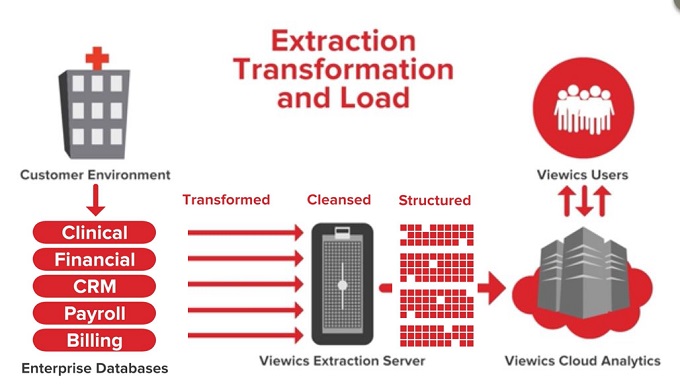
After cleansing and structuring, the data is encrypted and transferred to Viewics’ cloud computing environment. Viewics’ analytics servers process the data, encrypt protected health information (PHI), and finally store it in the corresponding data structures.
Data Analysis
Viewics Health Insighter (VHI)It is a tool designed to provide organizations with actionable clinical, financial, and operational analytics. VHI authorized users benefit from interactive dashboards that are intuitive, customizable, and shareable. With Viewics’ visualization and analytics solutions, clinical, operational, sales, and marketing teams gain access to critical information for daily decision-making. This enables staff to focus on other priorities, while managers have a platform tailored specifically to their systems and budgets. Viewics’ robust support empowers organizations to drive value immediately.
Key Functions and Features of VHI: Immediate connection to data for query execution; recognition of data as common terminology; drag-and-drop user interface for ad-hoc analysis; proactive alerts and predictive analytics; rapid creation of interactive dashboards; provision of pre-built dashboards tailored to specific organization types. Below are several dashboard data visualizations from Viewics.

Data Sharing
Viewics PulseIt is a highly scalable, data-based, secure, and transparent sharing platform designed to deliver the right information to the right people at the right time. Viewics Pulse provides comprehensive services to stakeholders—including customers, patients, payers, and suppliers—to meet their data needs, ensuring that each participant receives the information they require.
Viewics Pulse prioritizes data security above all else. Viewics Pulse employs Secure Sockets Layer (SSL) to secure all communications between user browsers and servers. Additionally, Viewics Pulse utilizes industry-standard encryption algorithms, such as SHA256, MD5, and DES. Viewics Pulse enables seamless, automated sharing of reports and dashboards, with all user-generated content encrypted both in transit and at rest.
In the United States, many healthcare organizations are subject to the HIPAA Privacy Rule; therefore, Viewics Pulse places significant emphasis on privacy protection. Administrators of Viewics Pulse can configure data source access for each user, including whether they can access Protected Health Information (PHI). Data access is managed separately, enabling administrators to perform reporting functions without concern for compromising user privacy.
Introduction to the Core Team
Dhiren Bhatia – CEO
Viewics was founded in 2009, and Dhiren is the co-founder and CEO of Viewics. Prior to joining Viewics, he spent one year in the IT Strategy Department of Sutter Health Group.
Prior to joining Sutter Health, Dhiren worked at HP, where he was responsible for launching key software offerings as part of its solutions-as-a-service portfolio. Dhiren is an active participant in the Silicon Valley analytics and technology communities, and he is also an avid golf enthusiast.
Dhiren holds a Master of Engineering from Texas A&M University and an MBA from the University of California, Berkeley.
Eleanor Herriman – Chief Medical Officer
Dr. Eleanor is the Chief Medical Officer at Viewics. She has over 20 years of experience in the healthcare industry.
Prior to joining Viewics, Eleanor was a faculty member at the Institute for Strategy and Competitiveness at Harvard Business School. Her other professional experiences include leading market research and strategic services for the pathology and laboratory industry, providing healthcare strategy consulting for Bain & Company, and founding multiple medical technology enterprises.
Eleanor holds an M.D. from Baylor College of Medicine in the United States, where she was awarded the “Presidential Scholarship” for her excellence in neurology, psychiatry, and neuropathology. She also earned an MBA from Harvard Business School, where she was designated a “Baker Scholar,” a prestigious academic honor conferred upon only the top 5% of graduating students.
Tim Kuruvilla – Chief Business Officer
Tim is the Co-founder and Chief Business Officer of Viewics. With extensive experience in management consulting, private equity, and entrepreneurship, he has focused on exploring how healthcare enterprises leverage data and information technology to drive value.
Tim was the founder of Opus Capital, a $280 million private equity fund. He played a pivotal role in defining investment strategies, evaluating investment opportunities, and cultivating an ecosystem of partners. Prior to joining Opus Capital, Tim worked in healthcare investment and provided management consulting services to large hospitals and health systems.
Tim holds a Bachelor’s degree in Management from the University of California and an MBA from the Haas School of Business at the University of California, Berkeley.
Financing Information
In May 2013, Viewics secured seed funding from five investors, including Farzad (Zod) Nazem, Plug & Play Ventures, and AME Cloud Ventures; the specific amount was not disclosed.
In October 2014, Viewics secured $8 million in Series A financing, led by Canvas Venture Fund, with participation from Farzad (Zod) Nazem and AME Cloud Ventures. Canvas provided strategic guidance to Viewics and facilitated its entry into an extensive partner network to support its growing customer base. Viewics allocated these funds toward business growth and product innovation.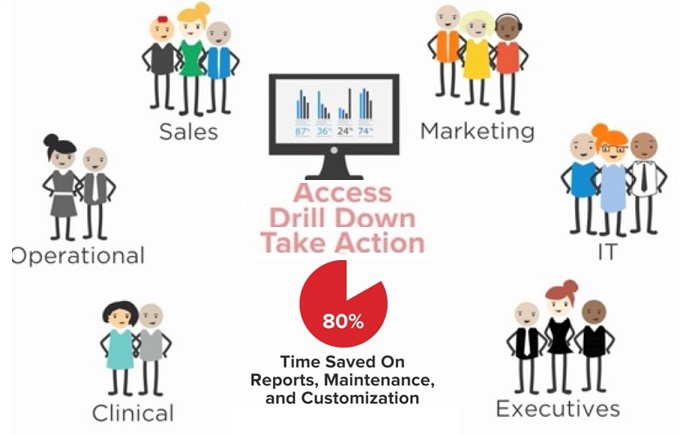
“Viewics is transforming how hospitals use data, helping them increase revenue and reduce expenses,” said Rebecca Lynn, General Partner at Canvas. “I spent four years tracking Viewics, and I was deeply impressed by its ability to attract many prominent clients. Viewics employs a unique approach by integrating data from various aspects of healthcare organizations—finance, laboratory, sales, and marketing—without burdening hospitals’ internal IT departments. Viewics indeed offers a robust SaaS analytics platform, which has earned the trust of its customers.”