On November 14, the NMPA website showed that Roche's PD-L1 monoclonal antibodyAtezolizumab Subcutaneous Injection Approved for Marketing in China。
Insight database shows that this isThe First Imported PD-(L)1 Subcutaneous Injection Approved in ChinaNot only that, but when it was previously approved in the UK, the drug was also the first PD-(L)1 subcutaneous injection to be approved overseas.Screenshot source: NMPA official websiteAtezolizumab is a monoclonal antibody targeting PD-L1, which has been approved in the United States since 2016,The drug has been approved for more than 10 indications, covering non-small cell lung cancer, small cell lung cancer, liver cancer, breast cancer, urothelial carcinoma, melanoma and other types of cancer.As one of the star drugs in the PD-(L)1 immunotherapy era, its fullGlobal SalesAs of 2023, it has already reached$4.198 billionSo High.RocheCombining atezolizumab with Halozyme Therapeutics' Enhanze drug delivery technology, throughDevelopment of Subcutaneous Formulations with Recombinant Human Hyaluronidase PH20 (rHuPH20)Subcutaneous formulations have a significant advantage in terms of compliance, reducing injection time from 30-60 minutes for intravenous injections to 7 minutes, improving the medication experience and increasing patient satisfaction with medication while maintaining similar efficacy.According to the Insight database, Atezolizumab Subcutaneous Injection(Atezolizumab SC)As early asTo be realized in the UK in September 2024World's First Batch, currently also alreadyApproved for marketing in the EU, Canada, and the United States.The domestic listing application was accepted on July 27, 2024, and successfully approved for listing today.The approval of Atezolizumab SC is based on the IMscin001 study.(Registration Number: NCT03735121/CTR20211387)Positive results.Part 2 of the study is a global, multicenter, Phase III, open-label, randomized controlled trial exploring Atezolizumab SC vs intravenous injection.(IV)Exposure, efficacy, and safety.
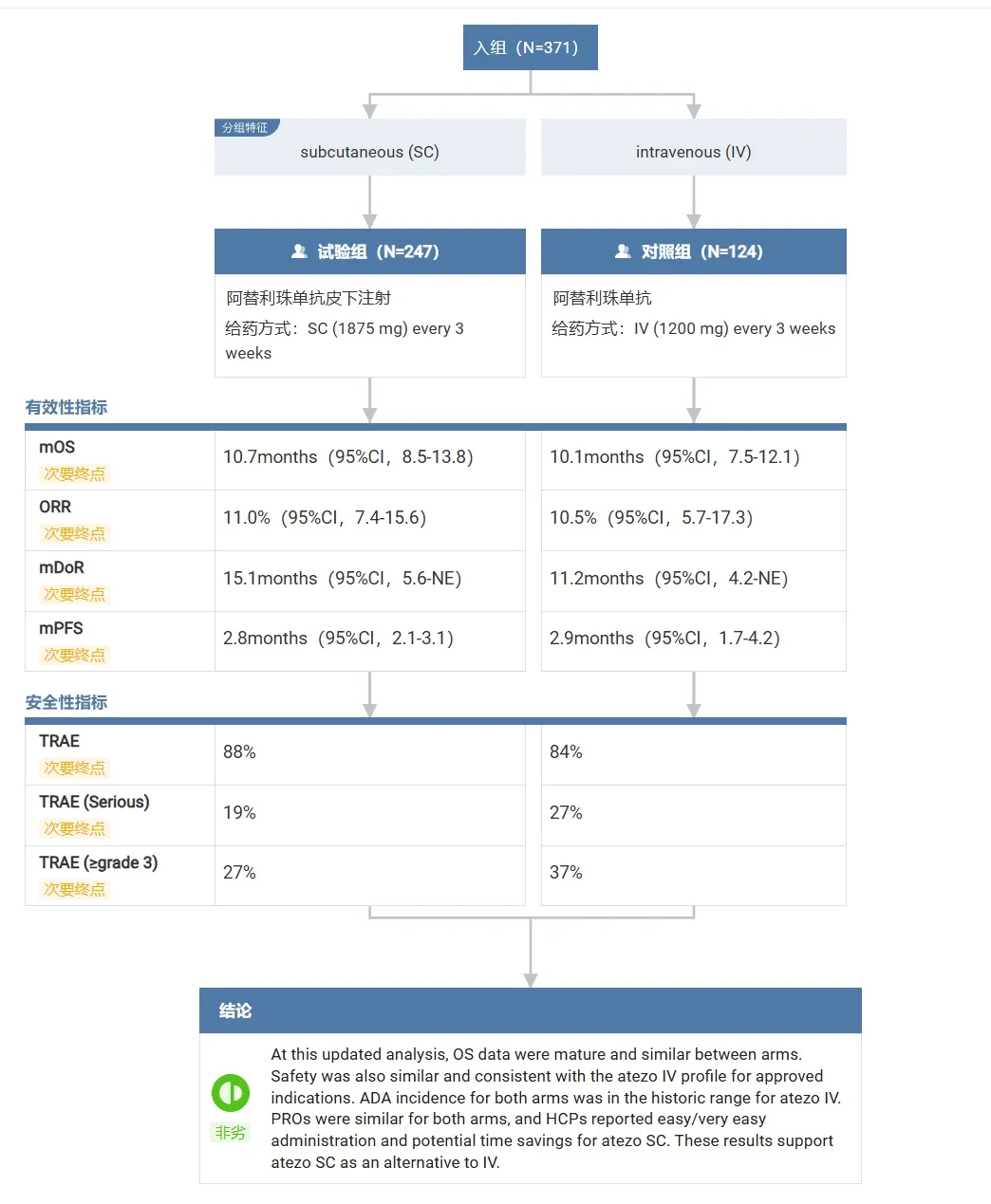
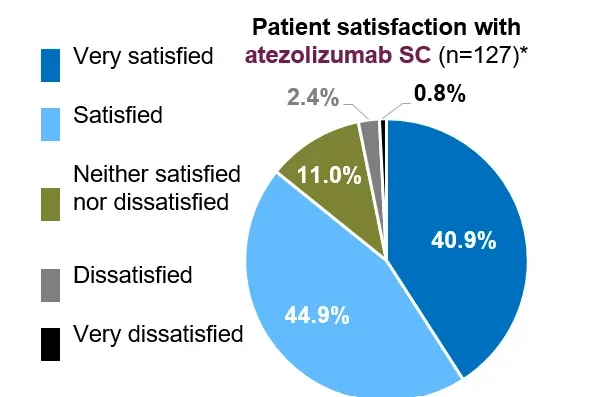
Results Show Consistent Efficacy and Safety of Atezolizumab SC vs IV. The median progression-free survival of the two(mPFS)2.8 months and 2.9 months, respectively, median overall survival(mOS)10.7 months and 10.1 months, adverse events(AE)Similar incidence rates, no new safety signals detected。Screenshot source: Insight Database Web VersionNot only that, but Roche has also conducted research to explore patient preferences for SC formulations versus IV formulations.IMscin002 study enrolled 179 patients, and the results showed that over 70% of the patients preferred atezolizumab SC; in terms of satisfaction, 85.8% of the patients were satisfied with SC.Screenshot from:2024 ELCCIn the post PD-(L)1 era, the development of subcutaneous injections is becoming a key direction for major pharmaceutical companies to counter patent cliffs and extend product life cycles. It also offers patients greater convenience and more diverse medication options. Not only are companies with existing blockbuster PD-(L)1 products actively reformulating their drugs into subcutaneous forms, but latecomers in bispecific antibody projects are also increasingly adopting a dual-track approach from the outset, simultaneously advancing both intravenous and subcutaneous formulations.
According to the Insight database, there are currently more than ten PD(L)-1 subcutaneous formulation projects in clinical development. From the perspective of multinational corporations (MNCs), Merck's Keytruda and BMS's Opdivo have already been developed into subcutaneous formulations, with approvals for overseas markets expected by the end of 2024 to 2025; Pfizer has also developed a PD-1 subcutaneous injection, Sasanlimab, with positive Phase III clinical results for non-muscle invasive bladder cancer already announced.In China, participants in the PD-(L)1 field are actively entering the market. BeiGene, Junshi Biosciences, and Hengrui Medicine have all developed their PD-1 monoclonal antibodies into subcutaneous injections; Hengrui has also developed a subcutaneous injection for its PD-L1 antibody, adebrelimab.However, Roche's layout in subcutaneous injectables could be said to be quite early and also quite mature.In the field of oncology, Roche collaborates with Halozyme, and currently, there are up to 9 subcutaneous injection antibody drug projects under development, with 7 of them already approved for marketing.Especially in HER2 Pertuzumab and Trastuzumab Injection(Phesgo, Herceptin®)has already achieved success, with an increasing number of patients switching from intravenous to subcutaneous injections, effectively combating the former "three-horse carriage" patent cliff. Phesgo has already achieved$19.72 billionSales revenue increased by 58% year-on-year.
Scan the QR code to add「"Little Sound", reply with the commandNew Drug Approval, you can obtain Insight's 2025 Global New Drug Approval and Market Resource Package?(Updated once at the beginning of each month, currently updated to October)。
Cover image source: ZCool HaiLuoDisclaimer:This article is for information sharing only,不代表 Insight 立场和观点, and does not recommend or introduce any treatment options. If you have any needs, please consult and contact正规医疗机构.PR Article Coordination: WeChat insightxbSubmissionWeChat: insightxb; Email: insight@dxy.cn
Diversified functions, traceable data……Insight Database Web Version Awaits Your Experience
Click to read the original text,ImmediatelyUnlock!