

In-Depth Analysis of Light-Asset Elder Care Startup Models: Opportunities at the Intersection of Internet, IoT, and Home-Based Services
Authors: VCBeat, Zheng Qi, Duan Mingjie
In 2014, China’s population aged 60 and above reached 212 million, accounting for 15.5% of the total population. By the end of 2015, this elderly population was projected to reach 222 million. Currently, the elderly population is growing at a rate of 10 million per year, with more than 40 million seniors suffering from disabilities or partial disabilities. Such rapid and large-scale aging has drawn widespread attention from the government, society, and the market. Based on VCBeat’s extensive prior research into market dynamics and policy landscapes, we believe that the emergence of a new generation of silver-haired consumers will create numerous entrepreneurial opportunities in the “Internet + Elderly Care” sector, sparking a new wave of venture capital investment in this field.
“Internet+” Empowers Asset-Light Entrepreneurship in Elderly Care
The elderly care industry serves a specialized demographic. VCBeat has engaged in multiple rounds of discussions with investors and professionals in the elderly care sector. Many participants identified significant challenges in integrating the internet with the elderly care industry, suggesting that entrepreneurial opportunities in “Internet Plus Elderly Care” are limited or, at best, immature. The primary obstacles include: 1. The vast majority of older adults do not use smartphones and remain largely disconnected from the internet; 2. Due to prevailing mindsets and income constraints, older adults have limited purchasing power; 3. Adult children devote considerably less attention to their elderly parents than they do to their own children. VCBeat acknowledges that these issues are objectively present. However, we also observe that, under current conditions, the elderly care industry still offers substantial entrepreneurial opportunities when targeting niche sectors and specific subpopulations. We have identified three areas with the greatest potential for opportunity: elderly care services and operations, Internet Plus solutions, and smart technologies. VCBeat believes that by integrating the Internet, the Internet of Things (IoT), and service networks, there are numerous Internet-related entrepreneurial opportunities centered around the elderly. Significant potential for Internet-based startups exists in the interactions between the elderly and their relatives, between relatives and healthcare/service providers, between the elderly and offline institutions, between relatives and offline institutions, and among various institutions. The Internet holds substantial promise in these areas, and indeed, many emerging startups have already appeared in these fields.
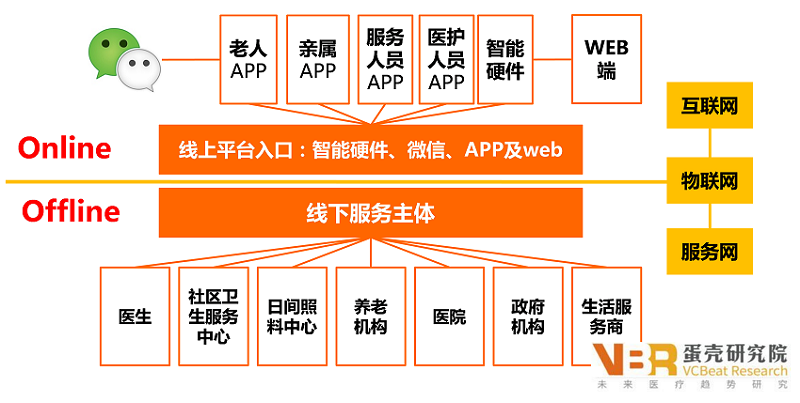
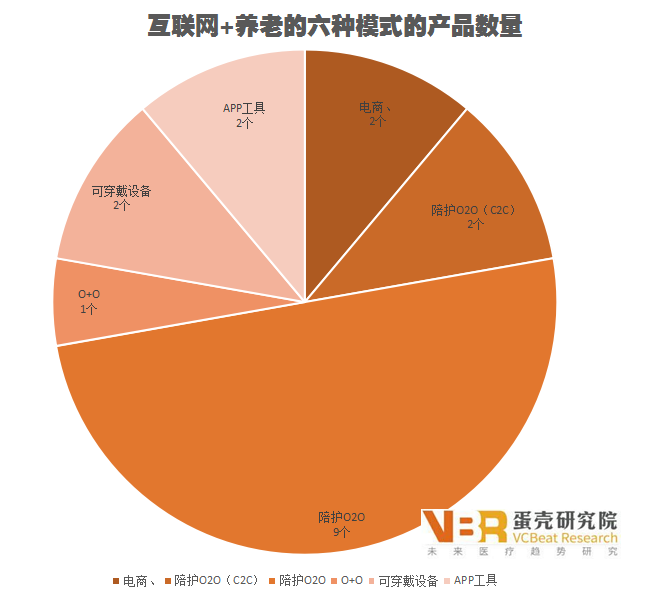
VCBeat has compiled a list of “Internet Plus Elderly Care” projects launched this year, excluding asset-heavy ventures such as senior living real estate. The details of these projects are presented below.

These initiatives take diverse forms, including O2O (Online-to-Offline), C2C (Consumer-to-Consumer), e-commerce platforms, wearable devices, and mobile applications. However, among the current entrepreneurial models in the “Internet Plus Elderly Care” sector, the O2O model is the most prevalent. In this model, entrepreneurs deliver various services required by elderly users directly to their homes, such as in-home nursing care and housekeeping. Furthermore, wearable devices play a significant role in the “Internet Plus Elderly Care” domain. These hardware products can be integrated with software solutions to collect seniors’ physiological data, which is then stored and analyzed in the cloud. This enables children and healthcare professionals to monitor seniors’ health information remotely and in real time, thereby helping to prevent risks when seniors are alone at home or out on their own.
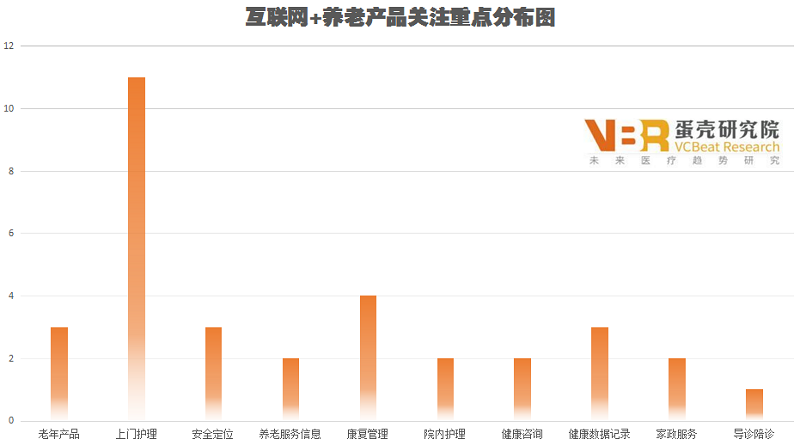
These products primarily focus on providing in-home nursing services for elderly users. Additionally, depending on their developmental priorities, they engage in other business activities, such as selling elderly care products (e.g., health supplements and personal hygiene items for seniors), offering rehabilitation management, providing health consultations, collecting and analyzing health data, and delivering medical guidance and accompaniment services.
However, at present, most “Internet+ elderly care” projects in the market are still in their early stages; even those experiencing relatively rapid growth have only reached Series A financing, and their future development remains uncertain.
Below, VCBeat will provide a detailed overview of typical projects within the aforementioned models.
Model 1: Caregiver O2O Model
Typical Project: Hulingjia, creating an O2O model for home-based rehabilitation and nursing care for the elderly.
Hulingjia is a home-based rehabilitation and nursing product for the elderly under Yikang Meichen Health Technology (Beijing) Co., Ltd. Given the rather grim current state of home-based elderly care in China, Hulingjia aims to introduce advanced foreign systems for home-based geriatric rehabilitation and nursing. Currently, Hulingjia also seeks to leverage mobile internet and big data processing to make professional elderly care services and specialized personnel training more efficient, scientific, and humanistic.

Hulingjia staff providing services to visitors
“We categorize elderly individuals into three groups: Group A consists of healthy seniors, Group B includes those who are partially dependent in activities of daily living, and Group C comprises those with physical disabilities and/or cognitive impairments. Each group has distinct needs, and we provide personalized solutions tailored to each category,” introduced Xu Lishan. He further explained that for Groups B and C, professional assessment services are offered, along with the development of specialized care and rehabilitation plans.
Hulingjia’s product consists of three components. The first is the app used by adult children, the second is the tablet placed at the elderly person’s bedside, and the third is the app used by care providers. “Our platform differs from other internet platforms in that we do not focus on community or social features. Instead, we facilitate natural connections essential to the nursing and rehabilitation processes,” said Feng Yixuan, co-founder of Hulingjia, noting that the three components of the Hulingjia product are designed to work in concert.
First, adult children use the mobile app to schedule an online appointment, during which they complete a brief online assessment and provide their home address and contact information. This allows caregivers to obtain essential details before providing in-home services. Subsequently, assessors notify the elderly person’s adult children via the app and conduct an in-person home visit. During the assessment, the assessor collects required data using a professional scale (the team’s assessment instrument integrates 13 validated scales gathered from around the world, incorporates traditional Chinese diagnostic methods—inspection, listening/smelling, inquiry, and pulse-taking—and features a standardized assessment process developed in collaboration with research institutes). Based on these data and discussions with the elderly individual, the assessor formulates a personalized care and rehabilitation plan. The finalized plan is then pushed to the adult children through the app; upon their approval, they can proceed with payment to implement the plan.
Upon successful payment, the elderly individual will receive a tablet. Subsequently, caregivers will provide ongoing in-home services. Prior to each visit, the caregiver will notify both the children and the elderly person of the scheduled service time via the app and communicate relevant details.
Upon arriving at the elderly client’s residence, the caregiver will check in using the client’s tablet to initiate the service. After completing the service, the caregiver will also use the tablet to schedule the next phase of care and rehabilitation tasks for the elderly client, which will be carried out by the client’s children or home caregivers. Furthermore, the elderly client or their accompanying hired aide will provide an evaluation of the service. The children will be able to view their parents’ ratings of the caregiver, while the caregiver will also submit feedback on their own performance, detailing the level of task completion and overall service conditions.
High-quality nursing professionals are the core of Hulingjia’s services. All caregivers on the Hulingjia platform are professionally trained nurses; some are students cultivated through collaborations between Hulingjia and nursing colleges, while others are practicing clinical nurses from major hospitals. Gong Lihua, co-founder of Hulingjia, stated, “We need standardized services and a unified service standard for our caregivers to ensure that their care is professional and trustworthy.”
Typical Project: Shanghai Youkang Technology, a comprehensive provider of uninterrupted O2O services.
Shanghai Youkang Information Technology Co., Ltd. is a private high-tech enterprise that provides professional service products for the elderly and individuals with intellectual disabilities, and it is one of the projects that has secured Series A financing.
The company holds an ICP (Value-Added Telecommunications Business License) and an SP (Mobile Internet Application Services) license, and possesses independently developed intellectual property rights for its BOSS (Business Operation Support System), call center system, communication gateway, and GIS (Geographic Information System).
It is understood that Shanghai Youkang Technology applies the concepts of the Internet of Things (IoT) and cloud computing technology, with customer service and a robust data processing center at its core. By interconnecting with public platforms such as 110 and 120, and integrating established enterprises serving the elderly, the company adheres to the theme of “Emergency Rescue, Assistance, and Recreation.” It implements strict and standardized computerized service processes to provide seniors with 24/7, year-round proactive care, emergency assistance, location services, electronic geofencing, purchasing and agency services, information dissemination, and club services. More than 500 organizations have joined its backend service network, covering ten major categories and 53 specific services, including daily living services, maintenance, cultural and entertainment activities, medical care, legal services, institutional elderly care, education, dining, and special-needs services.

Yiyangbao Operational Model
The company was established in 2010 with a registered capital of RMB 50 million. Operating on a market-oriented basis, it provides various paid services to the elderly across the city, with a service capacity of 10 million people. It also undertakes government-commissioned elderly care services. Currently, the company has over 280,000 online members.
Furthermore, Youkang Technology employs market-oriented operational strategies and collaborates with the three major telecommunications carriers in China—China Telecom, China Mobile, and China Unicom—enabling children to customize thoughtful services for their elderly parents simply by sending text messages. Meanwhile, Youkang Technology undertakes various government-commissioned elderly care services. It has successfully developed tailored service packages for the districts of Xuhui, Minhang, Huangpu, and Songjiang, aligning with each district government’s requirements for elderly care work and addressing the personalized aging-in-place needs of seniors, thereby comprehensively meeting diverse home-based elderly care demands.
Yiyangbao, its flagship platform dedicated to serving the elderly, acts as a hub connecting family units centered on senior citizens with various stakeholders. On the benefit side, it liaises with government organizations at all levels (such as sub-district offices and neighborhood committees), public social resources (including emergency services like 110 and 120), and service providers. By continuously integrating supplier resources and constructing and optimizing the service chain, Yiyangbao transforms the experience for seniors from actively seeking out services to passively enjoying proactive care delivered directly to their homes.
Model 2: O+O Model in Collaboration with Offline Nursing Homes
Typical Project: Yi Yang APP, which integrates service information in the elderly care industry and partners with offline nursing homes.
The Yi Yang APP is a free application launched by the mobile internet elderly care service platform developed by Beijing Yi Yang Network Technology Co., Ltd. (hereinafter referred to as “Yi Yang Tech”), providing an elderly care service consumption platform for smart terminals. Yi Yang covers comprehensive information on the elderly care industry, including travel-based elderly care, community-based elderly care, elderly care products, elderly care information, and hospitals. With diverse projects, it offers an integrated, exclusive, and customized APP tailored for seniors’ later life. The query function enables real-time access to seniors’ information; the online store allows easy purchasing of various elderly care products with simple order placement; and the reminder function provides alerts for medication, medical check-ups, orders, and travel-based care, helping address forgetfulness among the elderly.
Through the Yi Yang app, users can view detailed information about nursing homes across China. Beyond contact details, Yi Yang provides access to other standardized data, including accommodation conditions, levels of care, environmental quality, hardware facilities, bed availability, and accurate pricing.

Qiao Liang, COO of Yi Yang Technology, once stated that the data provided by the Yi Yang app is absolutely authentic. For every nursing home partnering with Yi Yang Technology, the team dispatches staff to conduct on-site verification of information. Furthermore, the team has established its own rating standards for nursing homes. Nursing homes can no longer self-promote their status; instead, their ratings must be determined in accordance with our standards.
The YiYang APP not only provides nursing home information to facilitate searches, but also enables online self-service booking. Users can choose nearby nursing homes or reserve accommodations at distant travel destinations, selecting check-in dates and stay durations according to their needs, with one-click payment functionality. Furthermore, families can have peace of mind when seniors travel independently, as the YiYang APP offers third-party station drop-off and pick-up services. During seniors’ stays, their children can monitor vital signs—including body temperature, blood pressure, and weight—in real time via the YiYang APP. This achieves true remote monitoring, allowing caregivers to look after up to four elderly individuals simultaneously.
Meanwhile, in its early startup phase, Yi Yang Technology adopted a collaboration model with nursing homes, purchasing bed capacity in bulk on a long-term basis. This approach reduced bed costs and passed on maximum savings to users. For nursing homes, Yi Yang Technology also helped activate their underutilized resources.
Furthermore, the Yi Yang app provides comprehensive medical services. Through the hospital appointment module, users can select specialized hospitals appropriate for specific conditions and further choose specialist physicians. By scheduling appointments via the Yi Yang app, dedicated companions will accompany elderly patients to the hospital at the designated time. Since consultation slots are pre-booked with physicians, patients can experience a more relaxed and efficient visit. After the consultation, companions will record the details of the visit in the Yi Yang app, thereby establishing and refining the elderly patient’s medical records. The Yi Yang app’s support does not end there; it offers continuous assistance throughout the entire healthcare journey—from registration and outpatient visits to inpatient treatment, follow-up consultations, or readmissions. Additionally, the app automatically generates schedule reminders for various aspects of care, including upcoming medical appointments and medication adherence.
Model 3: C2C Model, Building an Uber for Caregiving
Typical Project: Tiantian Peihu launches a C2C Uber-style model, bringing caregivers directly to users' homes.
Yu Le, CEO of Tiantian Peihu (Daily Care), graduated from the French Institute of Electronics and Information Engineering with a major in IT Finance. He previously worked at Huarong Asset Management Co., Ltd. and the Belgian company DJALOG, accumulating extensive experience in both finance and IT. “Tiantian Peihu” is an internet-based caregiving platform dedicated to establishing service excellence within the healthcare industry.
Tiantian Caregiving is an Uber-style care solution that operates on a dispatch model. Users place orders online, and Tiantian Caregiving promptly assigns them to available caregivers, who then respond by providing in-home nursing services. The team fosters mutual professionalism and dedication, gradually earning public recognition for the caregiving profession and thereby attracting more individuals to enter the industry.
Tiantian Peihu’s business model leverages technology to help caregivers manage service workflows, while utilizing user health big data to provide value-added services in the process.
According to research conducted by the Tiantian Caregiving Team, the current caregiving industry faces three prevalent issues. The first is the lack of standardized regulations. Historically, no statutory national standards have been established for caregiving services, leading to unresolved matters regarding risk management and insurance liability. Currently, professional competency assessments are typically administered by health bureaus; however, this approach has proven ineffective, as many assessments remain purely documentary and lack practical operational value.
Another reason is that this group, being an external labor force, often exhibits several weaknesses: first, their overall quality is relatively low, and their educational attainment is generally modest; additionally, many caregivers are older, making them more difficult to manage. As a result, many intended regulations cannot be effectively implemented, which makes it challenging to ensure the quality of the patient care industry.
From another perspective, users lack the ability to independently evaluate and select caregivers who suit their needs. Due to the scarcity of professional caregiving staff and the erosion of home-care agencies’ profits by hospitals, these agencies are unable to disclose detailed information about their employees for client selection. As a result, clients often have no choice but to passively accept the assigned caregivers.
The third reason is the lack of safeguards for caregivers. Significant issues arise in the aftermath of nursing risks and incidents, as insurance companies do not offer specialized long-term care insurance products. Consequently, there is a lack of mechanisms to protect the rights and interests of both parties. In response to the aforementioned issues, Tiantian Caregiving has proposed several solutions.
The first aspect the team needs to address is the issue of caregivers. First, Tiantian Peihu has established a platform to aggregate caregiver resources, with the majority of these personnel coming from the elderly care market, as the talent pool from other industries is quite limited. Subsequently, service qualifications are confirmed through a rigorous screening process, which includes: first, a health examination; second, a psychological assessment; and third, a professional competency exam. This approach ensures that the retained caregiving team is more compassionate, passionate, and professionally knowledgeable.
Subsequently, the team will provide training to enhance the professional skills of caregivers. More importantly, it aims to instill in employees a service philosophy centered on empathy—thinking from the perspective of others—thereby enabling them to fully dedicate themselves to their work and careers.
The second aspect involves introducing international systems to establish operational models; in the healthcare sector, this entails leveraging the robust systems of Japan and the United States to enhance the service quality of our teams.
The third aspect is risk management. The Tiantian Caregiving team primarily focuses on pre- and post-incident control. Initially, detailed customer health data are assessed to determine whether they meet the criteria for receiving care. Subsequently, refined management is implemented through internet-based and IT-enabled intelligent solutions to mitigate caregiving risks. Finally, should an incident occur, the team strengthens post-incident remedial measures, leveraging insurance or funds to ensure caregiving coverage and provide compensation to affected users.
Mode 4: Wearable Mobile Phone Data Mode
Maimai Elderly Care: Assisting home-based elderly care by collecting health data from seniors through smart hardware.
One of the pain points in the elderly care industry is the digitalization of health management for seniors. However, the current reality is that the penetration rate of home medical devices capable of monitoring the health status of the elderly remains low, with no real-time data being uploaded and aggregated. Consequently, health management models still rely primarily on health data obtained through community outpatient clinics or hospital physical examinations.
“Internet Plus” Initiative: Emerging internet technologies such as mobile internet, cloud computing, the Internet of Things (IoT), and big data will support telemedicine services and cloud-based smart processing centers within the elderly care industry. Meanwhile, the advent of the mobile internet era and the growing popularity of smart wearable devices tailored for the elderly will serve as powerful means of data acquisition.
MaiMai Elderly Care is a team that collects health data from the elderly through smart hardware and manages their health based on this data.
In June 2015, MaiMai Elderly Care secured tens of millions of RMB in angel-round funding from Beijing Tongdu Venture Capital. The funds will be allocated to team recruitment, product development, and the establishment of subsidiaries in Beijing and Shanghai.

Mai Mai Elderly Care primarily adopts a two-pronged product strategy, targeting both the B2B and B2C segments.
In its B2B product strategy, the core of MaiMai Elderly Care is the Health Cloud. The elderly user terminal consists of smart wristbands, smart gateways, and smart mattresses; the nurse terminal comprises smart wristbands, smart gateways, nurse tablets (Pads), smart blood pressure monitors, smart glucose meters, and smart scales; the family member terminal is a WeChat mobile application; and the management platform is a web-based application.
Among these, all hardware devices (including smart wearable devices, electronic blood drug concentration monitors, glucometers, etc.) serve as channels and sources for Health Cloud to collect data. The collected data is currently applied in fall alerts, wandering alerts, nighttime bed-exit-without-return alerts, and electronic health records. Through data collection, organization, and analysis, it can be more accurately utilized for early warning of elderly physiological indicators, routine health management, and even future applications in chronic disease management.
In terms of its B2C strategy, MaiMai Elderly Care has launched the “User-Friendly Parental Phone Desktop,” known as the Xiaomai Desktop. Addressing the pain points of elderly mobile phone users, it integrates certain B2B services to build a parental health management assistant and serve as a medical aide for parents. By combining hardware and software, MaiMai Elderly Care ensures that its two strategies complement each other, ultimately providing comprehensive smart elderly care solutions for older adults.
It is understood that Maimai Elderly Care has previously entered into strategic cooperation agreements with major domestic and international elderly care institutions, including Vanke and the German insurance group Allianz. The two parties have carried out in-depth collaboration on projects such as Vanke’s Happiness Home and Oak Club. In addition, Maimai Elderly Care’s solutions have attracted significant attention from Fosun Property, an industry giant, and both sides are accelerating their exploration of models for deeper cooperation.