

Gender Diversity in Digital Health: Rock Health Report Urges Shift Beyond Male-Dominated Leadership
According to a report released by Rock Health, a renowned U.S. healthcare incubator, gender diversity among leadership can enhance a company’s performance, yet such diversity remains insufficiently pronounced in the digital health industry.
Although 2014 and 2015 were record-breaking years for women in Fortune 500 companies, only 11% of the 45 healthcare enterprises on the 2015 Fortune 500 list had women serving as CTO or CIO. Furthermore, among these 45 companies, only 35% had female executives comprising more than one-quarter of their management teams.
“We have tried to understand why diversity seen in other industries is not as evident in the healthcare sector, even though women make 80% of healthcare decisions and are thus regarded as the ‘Chief Medical Officers’ of their households,” said Teresa Wang, Strategy Manager at Rock Health. “As participants in the healthcare industry, we are striving to determine what actions we can take to promote gender diversity in leadership roles within healthcare. At the most fundamental level, this will enable your company to operate more smoothly.”
Among the top ten healthcare companies on the Fortune 500 list, the proportion of women in middle management is significantly higher than that in other healthcare companies on the Fortune 500. Furthermore, nine of these ten companies have at least one female executive. Among the top 100 hospitals, only eight have appointed female CEOs; however, four of these eight hospitals have received the “Everest Award.” In the digital health startup sector, male CEOs lead 85% of “zombie companies” (those requiring financial support) and all companies in the “death pool.” This sufficiently demonstrates that gender diversity in leadership enables companies to operate more effectively.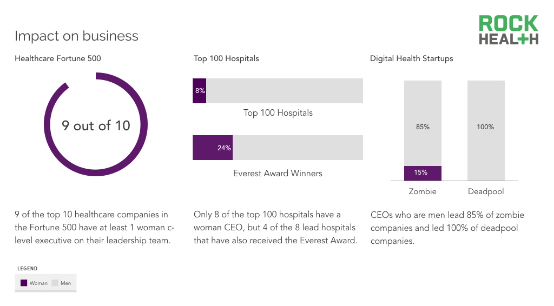
Wang explained that other industries may lead the healthcare sector in gender diversity because companies in those sectors have begun to value different types of expertise, thereby drawing greater attention to roles long dominated by women, such as human resources and marketing.
According to Rock Health’s report, none of the healthcare companies in the Fortune 500 have female CEOs; among the top 100 hospitals, eight have female CEOs; in digital health startups, 13% have female CEOs; and in venture capital firms focused on healthcare, only 6% have female CEOs. To address this disparity, Rock Health offers three recommendations:
Board Diversity: Increasing the percentage of women on the board is conducive to increasing the number of female executives.
Hiring: Employment criteria should be based on talent, not gender.
• Culture: Introduce talent identification and promotion mechanisms, launch mentorship programs, and implement women’s leadership initiatives.
Compiled by: Lü Siyang