

China's Innovative Drug Pipeline Advances: World’s First Bispecific ADC Nears Approval, Pioneering NK Cell Therapy Enters Phase II

Biokin
Pharmaceutical R&D Developer
iMBioRay
CAR-NK Cell Therapy Drug Developer

June 16, 2026
eMedClub News
According to incomplete statistics from the CDE website and public information, from June 8 to 14, 2026, more than 10 Class 1 innovative drugs were proposed for priority review, had their marketing applications accepted, or received implicit clinical trial approval. These drugs cover various fields including novel NK cell therapies, gene therapies, ADCs (Antibody-Drug Conjugates), bispecific antibodies, PROTACs (Proteolysis Targeting Chimeras), and other areas.
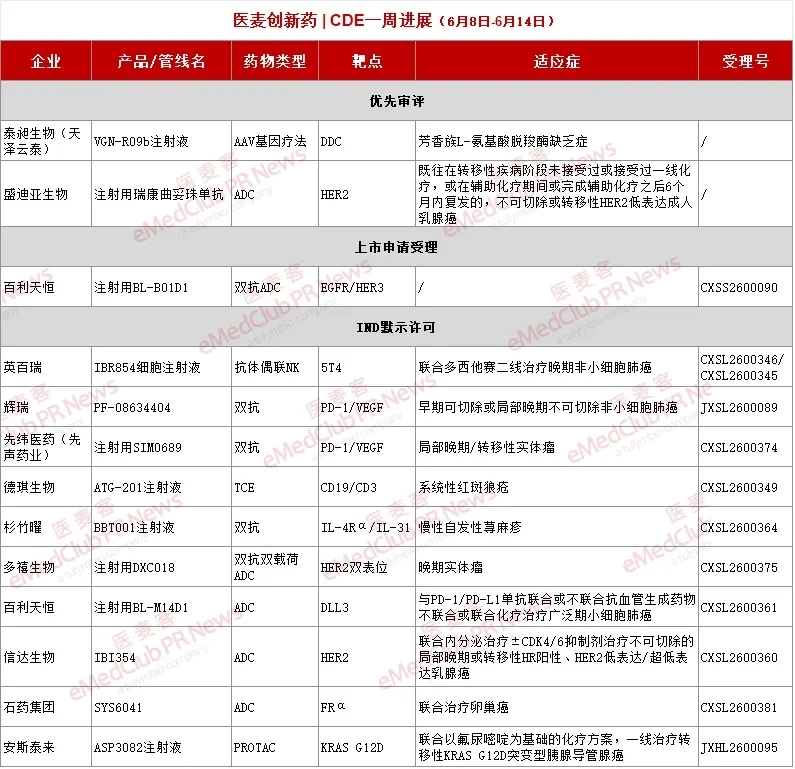
The following is an introduction to the representative pipeline:
Biokin:
BL-B01D1 for Injection
Biokin’s Third Marketing Application for Its Self-Developed EGFR/HER3 Bispecific Antibody–Drug Conjugate BL-B01D1 for Injection Accepted, Intended for the Treatment of Patients with Unresectable Locally Advanced or Metastatic Triple-Negative Breast Cancer Who Have Previously Failed Taxane Therapy
This new indication marketing application is based on the positive results of the pivotal Phase III registration clinical study PANKU-Breast02. The study met its progression-free survival endpoint in the prespecified interim analysis.(PFS). Overall Survival(OS)Both primary endpoints yielded positive results. PANKU-Breast02 is the first global study in the field of second-line or later treatment for triple-negative breast cancer,Phase III Clinical Study Achieving Positive Results for Both PFS and OS Dual Endpoints。

Previously, BL-B01D1 was evaluated in patients who had previously been treated with PD-1/PD-L1 monoclonal antibodies and had received at least two lines of chemotherapy(at least first-line platinum-containing)The marketing applications for two indications—patients with recurrent or metastatic nasopharyngeal carcinoma who have experienced treatment failure, and patients with recurrent or metastatic esophageal squamous cell carcinoma who have experienced treatment failure following prior therapy with PD-1/PD-L1 monoclonal antibodies in combination with platinum-based chemotherapy—have been accepted by the CDE.and all have been included in the priority review, if successful, it is expected to become the world’s first approved bispecific antibody-drug conjugate (ADC).
Imbioray:
IBR854 Cell Injection
imbioray's Core Candidate Product ACC-NK, Independently Developed(IBR854)Cell Injection Approved by CDE for Clinical TrialsPhase II Clinical Trial, it is intended to be combined with docetaxel for the second-line treatment of patients with advanced non-small cell lung cancer (NSCLC) who have failed first-line standard therapy. Previously, IBR854 had been approved for two Phase II clinical indications: advanced renal cell carcinoma, and in combination with pemetrexed and cisplatin for the first-line treatment of locally advanced or metastatic non-squamous NSCLC.
IBR854 is the world’s first NK cell therapy targeting 5T4 for the treatment of solid tumors to enter the registrational clinical stage, leveraging non-gene-editing and non-viral vector technologies, and built upon Imbioray’s proprietary ACC-NK core technology.(Antibody-Cell Conjugation Technology)It achieves “precise targeting” of solid tumor cells while completely avoiding the mutation risks associated with genetic modification. 5T4 is detectable on the surface of various solid tumors, including gastric cancer, colorectal cancer, ovarian cancer, renal cancer, and lung cancer, covering more than 90% of solid tumors.
Antengene:
ATG-201 Injection
Antengene's ATG-201 Injection Approved for Clinical Trials, Planned for the Treatment of Systemic Lupus Erythematosus(SLE). Public information indicates that this is a CD19/CD3 bispecific T-cell engager antibody, a bispecific TCE targeting CD19 with steric shielding technology, designed to eliminate CD19-expressing B cells. By simultaneously binding to CD3 on T cells and CD19 on B cells, the molecule achieves dual-specificity linkage between T cells and B cells, thereby mobilizing the body’s own immune system to deliver potent intervention in B cell-driven diseases.
Astellas:
ASP3082 Injection
Astellas’ ASP3082 Injection Approved for Clinical Trials in China, Intended as First-Line Treatment in Combination with Fluorouracil-Based Chemotherapy Regimens for Patients with Metastatic Pancreatic Ductal Adenocarcinoma Harboring KRAS G12D Mutations
ASP3082 is a novel small-molecule targeted protein degradation chimera that binds to and selectively targets the KRAS G12D mutant protein, leading to its degradation by recruiting E3 ubiquitin ligase. KRAS G12D is among the KRAS mutationsMajor Mutant Subtypes, detectable in approximately 34% of pancreatic ductal adenocarcinomas, 12% of colorectal cancers, and 4% of non-small cell lung cancers, as well as in various other types of cancer.
Recommended Reading:First HER2 Bispecific Antibody Dual-Payload ADC Approved for Clinical Trials in China
Recommended Reading:Innovative Gene Therapy Proposed for Inclusion in Priority Review

Exciting Events
Scan the QR code with long press to participate now↓


Tap "Share”、“Like" and "Watching”
Charge me up~