

CallDoctor: The Path to Monetization in Internet Healthcare
As a large number of internet healthcare companies have secured financing beyond Series C, their business models have undergone extensive experimentation, and major industry players are now focusing on monetization.
Among internet healthcare companies that have recently secured financing, the proportion of pure-play internet projects has declined significantly. Companies with deep integration into medical services are more favored, such as physician groups. The underlying rationale is their monetization capability, where each service generates tangible transactions.
"Doctor On Call" is a platform designed to connect hospital departments with attending physicians and above at tertiary (Grade 3A) hospitals. Since its launch a few months ago, its most notable feature has been the steady growth in both order placement and acceptance rates, all representing genuine transactions. Its core customer base focuses on the under-served market of hospitals below the tertiary level, which has not yet received significant attention in the current market. The platform fully empowers physicians, encouraging greater participation from internists and specialists, thereby ensuring that multi-site practice is no longer dominated solely by surgeons.
Ultra-Short Path
Business models that successfully facilitate transactions are often simple and straightforward. According to our understanding, Lin Peixin initially chose the name “Call a Doctor” to help users gain a more intuitive understanding of the product. The core functionality involves one party posting a request and another accepting it, with the transaction process initiated upon successful matching.
Currently, Call a Doctor has first developed WeChat-based products, which are divided into the hospital side and the doctor side.
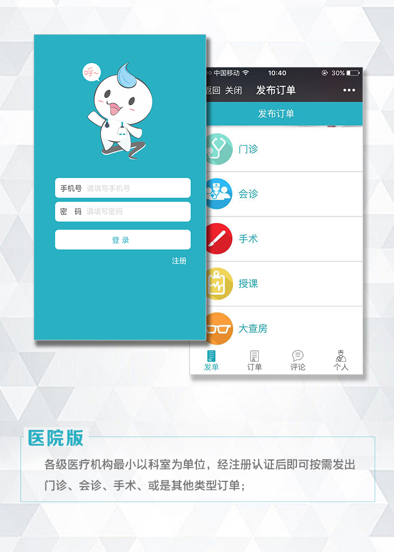
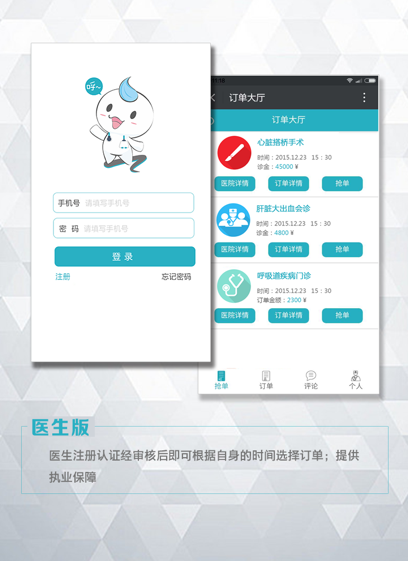
Lin Peixin, founder of Call a Doctor, told VCBeat, “There is a common misconception that multi-site practice for physicians refers exclusively to surgeons performing ‘fly-in’ surgeries, while outpatient and internal medicine physicians are overlooked. This is a significant error.”
Annual outpatient visits in China exceed surgical procedures by more than a hundredfold. Deploying physicians from tertiary hospitals to primary care institutions for outpatient services can better meet patient demand, as outpatient consultations require less stringent facility conditions and thus offer broader coverage. Furthermore, with the gradual liberalization of multi-site practice, the “on-call physician” model provides internal medicine specialists with practice environments comparable to those available to surgeons. Currently, physicians on the on-call physician platform span all clinical specialties. Lin Peixin stated, “We have liberated internal medicine and specialty physicians, ensuring that multi-site practice is no longer an exclusive privilege of surgeons, and enabling internal medicine and specialty physicians to extend their services beyond hospital walls.” We anticipate that outpatient orders on the platform will surpass surgical orders by the end of this year.
Transaction Process Completed
For many internet healthcare companies, monetization is a major challenge. However, for Call a Doctor, Lin Peixin simply migrated offline transactions to the online platform, so monetization was never an issue from the outset.
Before founding Call a Doctor, Lin Peixin had already provided physician-on-call services to many hospitals, though at that time, the service was delivered via telephone.
Exclusive data obtained by VCBeat shows that as of April 30, the Call-a-Doctor platform had completed nearly 1,000 orders. Among these, surgeries accounted for 61.91%, outpatient consultations for 20.53%, case conferences for 11.83%, grand rounds for 4.6%, and lectures for 1.13%. The average transaction value was RMB 3,822 for surgeries, RMB 1,105 for case conferences, RMB 3,351 for outpatient consultations, RMB 4,915 for grand rounds, and RMB 2,500 for lectures.
Among these, the hospitals initiating orders are predominantly secondary public hospitals and private hospitals. Lin Peixin told VCBeat that among the hospital departments currently served by the physician-on-call service, public hospital departments account for as high as 82.88%, while private hospitals account for 17.12%. However, most of the fulfilled service orders were initiated by hospitals below the tertiary Grade A level. Specifically, secondary Grade A hospitals accounted for 28.49%, secondary Grade B hospitals for 16.98%, and private hospitals for 45.85%. Orders initiated by tertiary hospitals accounted for 8.68%.
It is understood that since the product was launched, nearly 200 transactions for doctor consultations have been generated on the platform each month.
In Lin Peixin’s view, the reason why the “doctor-on-call” transaction model can succeed is that it has already achieved a win-win outcome for three parties.
On physician consultation platforms, hospitals can more easily engage specialists from Tier 3 Grade A hospitals. These physicians leverage their professional expertise to increase their income. This arrangement helps hospitals retain patients locally, thereby boosting institutional operational revenue, while patients benefit from the highest reimbursement rates under local medical insurance schemes. Additionally, it contributes to enhancing the hospital’s clinical capabilities, attracting a larger patient volume. Thus, all three parties—hospitals, physicians, and patients—benefit.
Pain Points for Physicians at Tertiary Hospitals: Facilitating More Convenient and Flexible Multi-Site Practice
Physicians at tertiary hospitals possess advanced clinical expertise, yet they are often frustrated by encountering patients whose conditions fall outside their specialties during outpatient consultations. If given the opportunity to provide care within their areas of greatest proficiency and receive commensurate compensation, physicians would naturally be willing to do so.
Call Doctor employs a ride-hailing-style order acceptance system to match physicians with the most suitable patients, enabling them to maximize their professional value. Additionally, Call Doctor prioritizes the privacy of its physician users; personal information for both parties remains concealed until a collaboration is confirmed.
Patient Pain Points: Medical treatments are covered by insurance, eliminating the need for travel.
In the closed-loop healthcare service model, patients are the ultimate beneficiaries. On platforms that facilitate physician consultations, the services provided to patients include access to specialist care at their doorstep—eliminating the need to travel extensively—while also enabling reimbursement through medical insurance.
Lin Peixin stated, “Patients lack the ability to accurately describe their medical conditions and evaluate physicians. The optimal approach is for patients to be admitted to the nearest hospital. If the facility is unable to provide adequate diagnosis or treatment, the hospital should coordinate with the most suitable specialists to provide on-site support, rather than requiring patients to transfer to other institutions and endure the difficulties of securing appointments and waiting for inpatient beds. This effectively facilitates tiered diagnosis and treatment.” This consideration primarily stems from the fact that the needs raised by hospitals are ultimately aimed at meeting patient needs. Peer-to-peer communication and collaboration between hospitals and physicians represent the most precise and efficient means of serving patients and addressing their pain points.
By adopting a tiered diagnosis and treatment model that enables on-demand consultation with physicians, the platform ensures that specialists follow the patient’s journey. This approach not only allows patients to access high-quality diagnostic and therapeutic services but also facilitates reimbursement through medical insurance.
This is primarily because, in China, the vast majority of people rely on the national health insurance system to cover medical expenses. The current health insurance schemes include Urban Resident Basic Medical Insurance, Employee Basic Medical Insurance, and the New Rural Cooperative Medical Scheme. A common practice for reimbursement is that contributions are made locally and reimbursements are processed locally. Since health insurance systems in many cities across China are not yet interconnected, patients can only receive reimbursed care at local hospitals, which prevents many from accessing specialist consultations at major tertiary hospitals. However, having specialists provide services in the patients’ local areas meets the conditions for health insurance reimbursement.
Furthermore, the costs associated with the Call-a-Doctor platform are relatively lower. Lin Peixin revealed that the average consultation fee for externally invited specialists performing surgeries on the platform currently does not exceed RMB 4,000, while the daily outpatient and consultation fees for these specialists are even lower. The fee structure on the platform consists of consultation fees plus insurance. Lin Peixin stated, “Compared to other platforms, our fees are only one-quarter of theirs. The specialist consultation fees are more reasonable, leading to higher acceptance among patients and hospitals, and thus a broader target audience.”
Future: Centered in Chongqing, with rapid expansion across China
The “Doctor-on-Call” model can effectively leverage the advantages of the internet to achieve rapid nationwide expansion. Lin Peixin stated, “By recruiting physicians from Grade III Class A hospitals who meet the platform’s requirements, establishing partnerships with Grade II and above hospitals as well as private hospitals, and leveraging internet-based advantages through an online-plus-offline approach, we can rapidly scale our model across China.”
Leveraging resources accumulated prior to his entrepreneurial venture, Lin Peixin initially focused on strategic deployment in Chongqing, where hospital departments now account for approximately 40% coverage. Physician resources are primarily concentrated in several major Grade A tertiary hospitals in the Chongqing area.
Currently, the new version of the doctor-on-call app is under development, featuring a patient query function that allows users to check whether nearby hospitals have attending physicians from Grade 3A hospitals.
It is understood that Call a Doctor’s current round of financing is nearing its conclusion, with plans to rapidly replicate the Chongqing model across China once the funds are in place.