

17-Year-Old Inventor Kenneth Shizuka's SensaRX Files IPO Prospectus for SafeWander Alzheimer’s Monitoring System
In January 2016, VCBeat Research Institute released its first in-depth review titled “A Comprehensive Analysis of Asset-Light Entrepreneurial Models in Elderly Care.” In March, it published “A New Entrepreneurial Frontier Has Emerged: The Rise of Asset-Light Opportunities in Elderly Care.” Moving forward, we will gradually roll out related reports focusing on startups in the niche segments of asset-light elderly care entrepreneurship. This article is the tenth in the series.
Nowadays, many countries are facing the problem of population aging. Therefore, the demand for medical services and products for elderly diseases will inevitably increase. To meet these needs, corresponding medical instruments are essential. This is why there have been many emerging companies focused on developing home medical devices in recent years worldwide. SensaRX LLC, which has won numerous awards, is one of them.
SensaRX was founded on July 22, 2014, by Kenneth Shinozuka, a 17-year-old American teenager. The company is headquartered in Manhattan, New York, just two or three blocks away from the renowned Lincoln Center for the Performing Arts. As an early-stage startup, SensaRX operates on a small scale, with fewer than ten long-term employees. Its flagship product, SafeWander, is designed to address a specific need in the care and monitoring of patients with Alzheimer’s disease.
Source of Inspiration
Alzheimer’s disease is a major form of dementia, accounting for approximately 60% to 80% of all dementia cases. Typical manifestations include memory loss, cognitive decline, and an inability to recognize familiar people. In addition to these nearly universal symptoms, another highly prevalent symptom significantly increases the caregiving burden for Alzheimer’s patients: wandering. According to data published by the Alzheimer’s Association, a leading authoritative organization in the United States, 65 out of every 100 patients exhibit wandering behavior.
Kenneth Shinozuka, the inventor of SafeWander, was long troubled by his grandfather Feng Deming’s (phonetic translation) wandering symptoms. Kenneth’s aunt voluntarily took on the task of monitoring the elderly man at night. However, due to this responsibility, she suffered from chronic sleep deprivation, and her health steadily deteriorated. Determined to find a solution to the challenge of monitoring his grandfather during sleep, Kenneth, then nearly 14 years old, resolved to devise an innovative approach.
When Kenneth saw his grandfather get out of bed, the moment his sock-clad feet touched the floor sparked an idea. If a pressure sensor were installed on his grandfather’s feet to detect such changes in pressure and transmit the detected signals to a receiver, the receiver would immediately trigger an alarm upon receiving the signal. This way, as soon as his grandfather got out of bed, his aunt would be instantly alerted. Since the signals can be transmitted wirelessly, it is only necessary to ensure that the sensor accurately detects the changes in foot pressure when his grandfather gets out of bed.
After months of effort, Kenneth finally turned his idea into reality, single-handedly developing the entire first-generation product line of SafeWander.
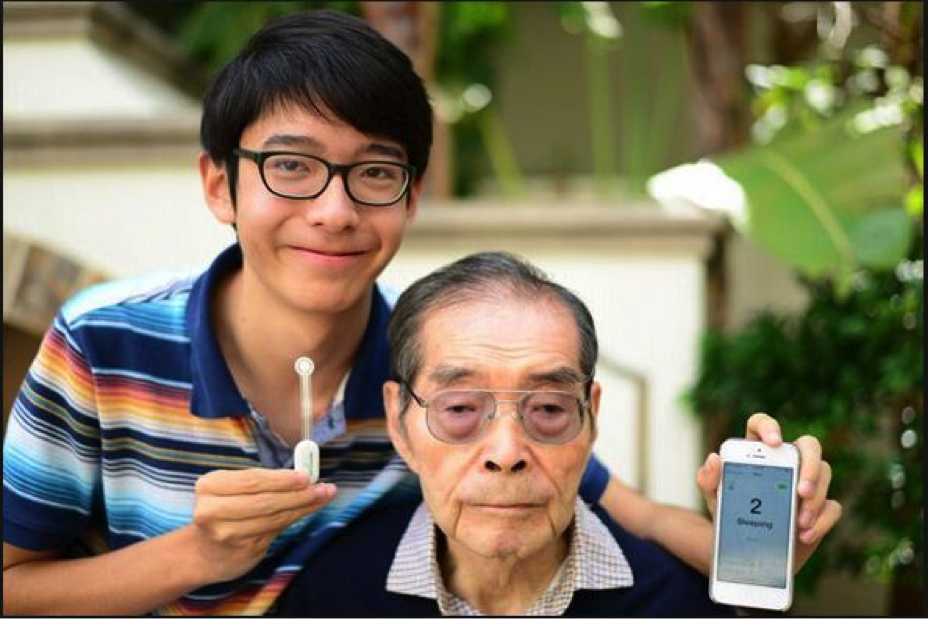
Kenneth Shinozuka (left) and his grandfather (right)
The product has undergone multiple improvements.
In 2014, 15-year-old Kenneth won the grand prize at the Google Science Fair for SafeWander, receiving a $50,000 award from the organizing committee (equivalent to approximately RMB 307,000 based on the exchange rate that year). To enable more Alzheimer’s patients to benefit from SafeWander, Kenneth decided to commercialize the product and founded SensaRX using the prize money along with financial support from family and friends.
Since its initial launch in 2014, SafeWander has undergone multiple improvements, resulting in three generations of mature products. The third-generation product includes: an angle sensor (center), a wireless signal transceiver named Getaway (right), and a companion iOS app (left).
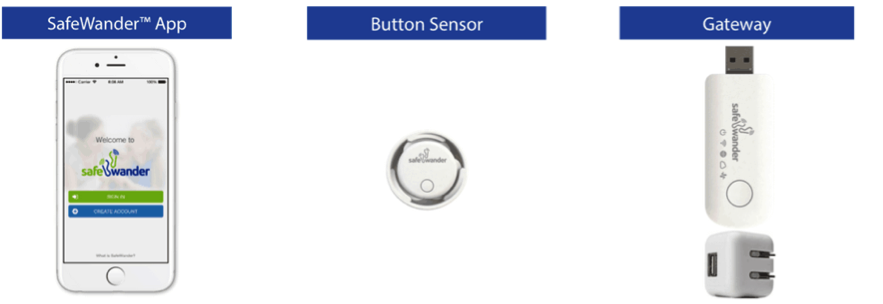
In the third-generation product, Kenneth introduced a new sensor—an angle sensor—and incorporated signal transmission and reception capabilities into the device. Furthermore, the accompanying application has been updated with numerous new features, integrating feedback from multiple stakeholders. The new sensor, no larger than an ordinary coin, can be attached to any close-fitting garment, including socks, underwear, and pajamas. Unlike the sensors in the first two generations, which detected a patient’s intention to get out of bed by monitoring changes in foot pressure upon contacting the floor, the new sensor determines whether a patient is rising by detecting the angular change as they transition from a supine to a sitting position. This shift in sensing principle enables caregivers to recognize a patient’s intent to rise more promptly—detecting the movement while the patient is still in bed rather than after they have stepped onto the floor. Consequently, caregivers can not only intervene in time to prevent wandering episodes but also provide earlier assistance during the act of rising, thereby reducing the risk of falls and other accidents caused by physical weakness or similar factors.
With Wi-Fi connectivity, Getaway can transmit sensor signals over the internet to caregivers’ mobile phones, enabling them to monitor patients’ activities in real time even when outdoors. The introduction of Getaway also allows the number of caregivers to increase from one to multiple, thereby enabling family members to share monitoring responsibilities. The third-generation companion iOS app supports the reception of signals from multiple sensors on a single mobile device, meeting the needs of rehabilitation institutions where one caregiver monitors multiple patients.
First: The sensor wearer stands up, the sensor detects a change in body angle, and transmits the detected signal to the Gateway;
Second: Getaway receives the signal, connects to Wi-Fi, and transmits the signal over the Internet;
Third: The caregiver’s mobile phone receives a signal and triggers an alarm; upon hearing the alarm, the caregiver comes to check on the sensor wearer.
Company Operational Status
Since the story of Kenneth’s development of SafeWander was reported, many readers have clearly expressed their willingness to purchase the product in the comments. After more than a year of product improvements and testing, the product finally hit the market last November. The first batch of customers included not only individuals but also multiple service institutions, such as rehabilitation centers and nursing homes. These customers have provided feedback indicating that the third-generation SafeWander offers excellent monitoring performance. This feedback suggests to some extent that SafeWander is a product favored by the market.
Currently, Kenneth and his team are focusing their efforts on the following three areas:
First: Develop a companion app for Android. Currently, SafeWander only offers an iOS app. To enhance customer convenience and expand the user base, SensaRX will launch an Android version earlier this year.
Second: Seeking a manufacturer. In an interview with CNBC this April, Kenneth stated that all SafeWander kits sold to date had been produced in his home. To accelerate product rollout, he is actively seeking a manufacturing partner;
Third: Promote the product and secure financing. Kenneth has already showcased SafeWander at multiple exhibitions and innovation technology competitions, leveraging these platforms to promote SafeWander and raise capital.
In an interview, Kenneth expressed his hope to promote SafeWander as soon as possible to safeguard the safety of more Alzheimer’s patients. More importantly, he aims to compile data collected from numerous patients into a large database to help scientists identify the reasons behind wandering behavior in Alzheimer’s patients.
Market Prospects
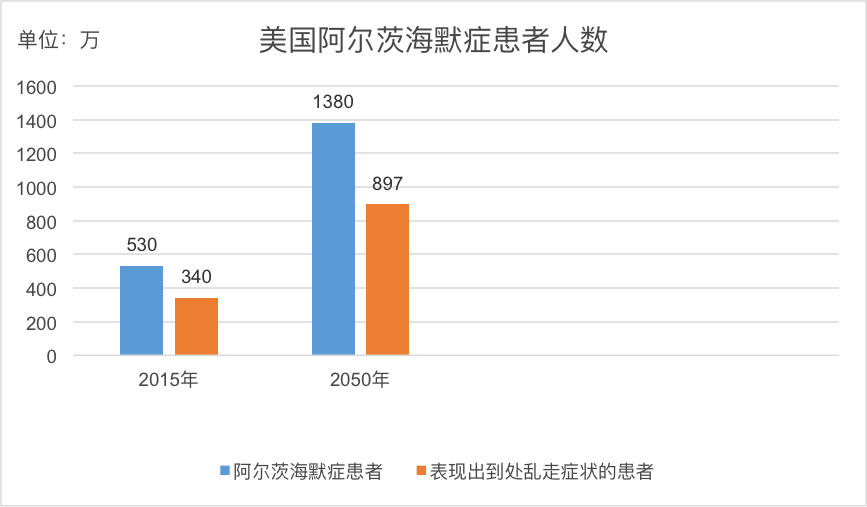
On March 24 last year, the Alzheimer’s Association in the United States released a report stating that the number of Alzheimer’s patients in the U.S. had reached 5.3 million, with projections indicating this figure will rise to 13.8 million by 2050. The association also conducted a survey on the prevalence of wandering behavior among Alzheimer’s patients, finding that 65% of the surveyed patients exhibited this symptom. Based on these two datasets, and excluding new cases, it is estimated that approximately 3.4 million Alzheimer’s patients in the U.S. currently require monitoring services similar to those provided by SafeWander. According to data released by the Pew Research Center at the end of last year, individuals from the middle class and above account for 70.4% of the total U.S. population. Given that SafeWander’s current full-set price of $249 (approximately RMB 1,611) is relatively affordable, a conservative estimate—assuming a 50% penetration rate—suggests that around 1.7 million people are willing to purchase SafeWander. Current market feedback indicates that at least 90% of these buyers will become long-term customers. Based on the lifespan of SafeWander’s batteries (approximately one year) and sensors (approximately two to three years), these long-term customers will need to replace their batteries twice and their sensors once over the next two to three years.
On a global scale, the market for SafeWander is even larger. On August 27 last year, Alzheimer’s Disease International released the “World Alzheimer Report 2015: The Global Impact of Dementia.” The report pointed out that in 2015, there were 9.9 million new cases of dementia worldwide, with one new case occurring every three seconds on average. It is estimated that by 2050, the number of people with dementia globally will rise from the current 46 million to 131.5 million. Moreover, more than half of these patients will be located in developed countries with strong purchasing power and rapidly developing economies such as China. (Alzheimer’s Disease International conservatively estimates that there are currently 9 million dementia patients in China, a figure projected to grow to 30 million by 2050, surpassing the total number in developed countries.) According to statistical data, 60% to 80% of dementia patients worldwide have Alzheimer’s disease.
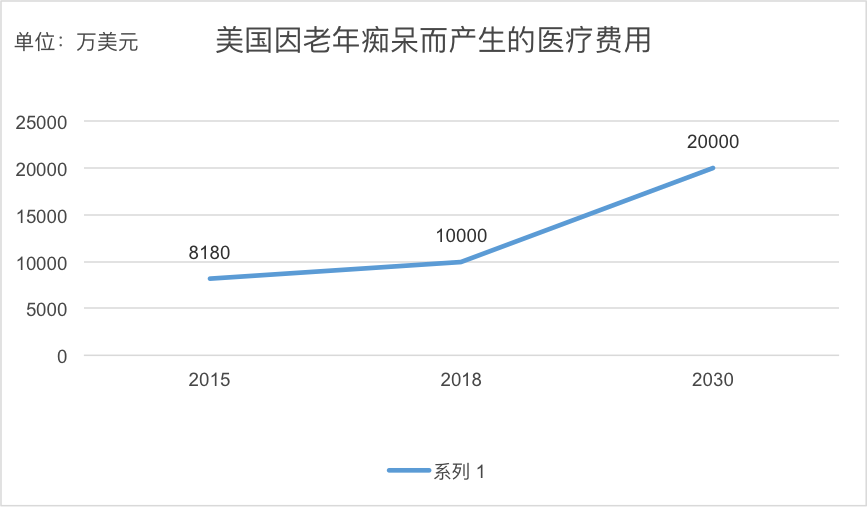
The report also analyzes the trends in medical costs associated with Alzheimer’s disease in the United States.
Currently, SensaRX is a small-scale company with mature products. Although the market potential for its products is substantial, the company lacks the capital required for large-scale production and marketing, and it remains uncertain whether the CEO’s academic commitments will impact business operations. However, these challenges can be addressed through fundraising and the establishment of a strong management team. Once these issues are resolved, SensaRX’s growth prospects are highly promising.